What Are the Most Common Lincoln Navigator Problems?
The most common Lincoln Navigator problems are air suspension faults, transmission issues, steering and front-end wear, and cooling-system leaks; if you find repeated warning lights, sagging ride height, or harsh shifting, plan to walk away or price in major repairs. Ignoring them can turn a “good deal” into a four-figure repair bill fast. This guide shows the warning signs, how to verify each fault on a test drive, and which symptoms are dealbreakers.
What problems show up most often?
Among the more commonly reported complaint areas are suspension, transmission, engine, electrical, and brake-related issues. On a used Navigator, the key is symptom behavior: one warning light can be minor, while repeat faults, limp-home behavior, or poor driveability point to a deeper system failure.
Which symptoms are warning signs versus normal wear?
Normal wear usually feels steady and predictable: some brake noise, slightly softer dampers, or a minor idle change after a cold start. Warning signs repeat, worsen, or spread across systems. Think sagging ride height after parking, gear changes that flare or hesitate, rough idle with a check-engine light, or electronics that reset without warning.
How to tell a minor nuisance from a no-buy fault
A nuisance affects comfort. A no-buy fault affects safety, drivability, or repair cost. A sticky door handle is annoying. A transmission that slips under light throttle is not. On a Navigator, that split matters because some repairs are trim-level fixes, while others involve suspension compressors, modules, or drivetrain work that can run high.
📊 The Navigator uses a twin-turbocharged 3.5-liter V-6. Source: Caranddriver.
Lincoln Navigator problem years and reliability
Used-shopping risk is uneven across the lineup. Early-model Navigators and some specific years draw more concern than later versions, especially when age, mileage, and missing service records stack up. Consumer Reports Predicted Reliability is useful here as a screening signal, not a final verdict.
Why 2003, 2006, and 2008 matter in used-shopping research
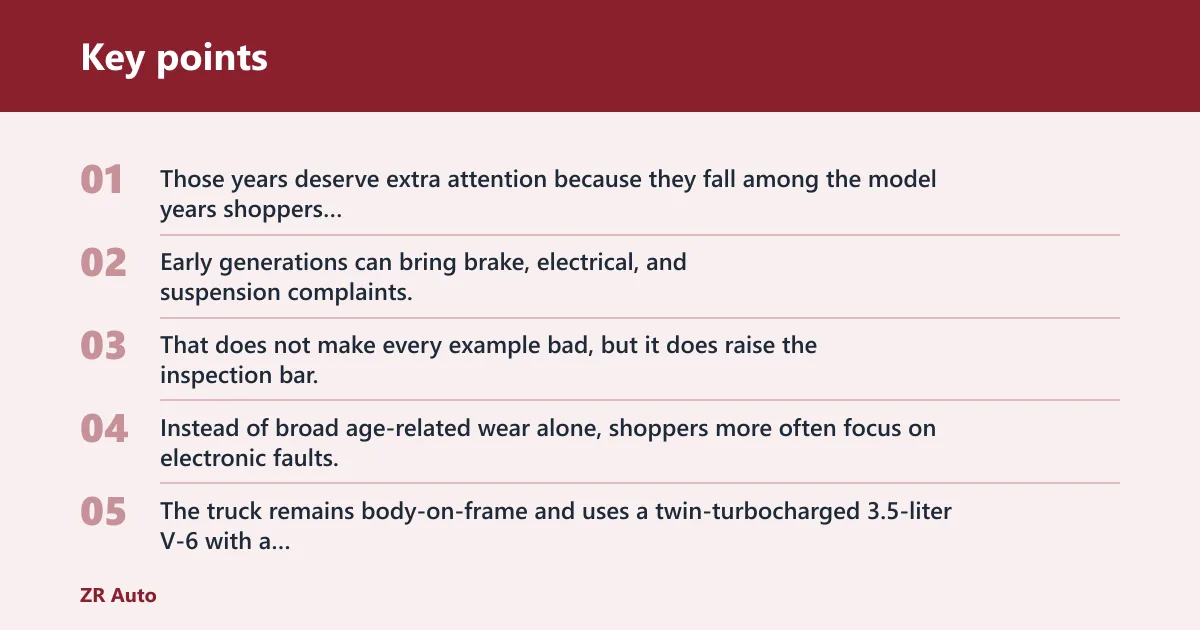
Those years deserve extra attention because they fall among the model years shoppers often flag for older Navigators. Early generations can bring brake, electrical, and suspension complaints; 2008 is also associated with brake-system concern. That does not make every example bad, but it does raise the inspection bar.
How later-generation trucks differ from early-model risks
Later Navigators shift the risk profile. Instead of broad age-related wear alone, shoppers more often focus on electronic faults, air suspension complaints, and powertrain behavior. The truck remains body-on-frame and uses a twin-turbocharged 3.5-liter V-6 with a 10-speed automatic, so drivetrain checks matter across model years.
How to use Consumer Reports Predicted Reliability as a screening tool
Use it to sort inventory before you spend time on a drive. A lower predicted-reliability year deserves stronger paperwork, a cleaner scan, and a lower tolerance for warning lights. A better-rated year still needs the same inspection, but it may be worth pursuing if the service history is complete and the test drive is clean.
Suppose two Navigators are the same price. One has a clean maintenance file and no stored codes; the other has a recent battery replacement, a history of air-suspension work, and intermittent climate-control resets. The second one deserves a much harder look, even if it starts and drives normally for five minutes.
Engine problems: what to listen
The Navigator uses a twin-turbocharged 3.5-liter V-6, so engine faults usually show up as misfires, rough idle, stalling, or complete shutdown rather than old-school carburetor-style drama. If the engine hesitates, shakes at idle, or dies after warm-up, that is a system-level warning, not simple age.
Misfires, rough idle, stalling, and shutdown patterns
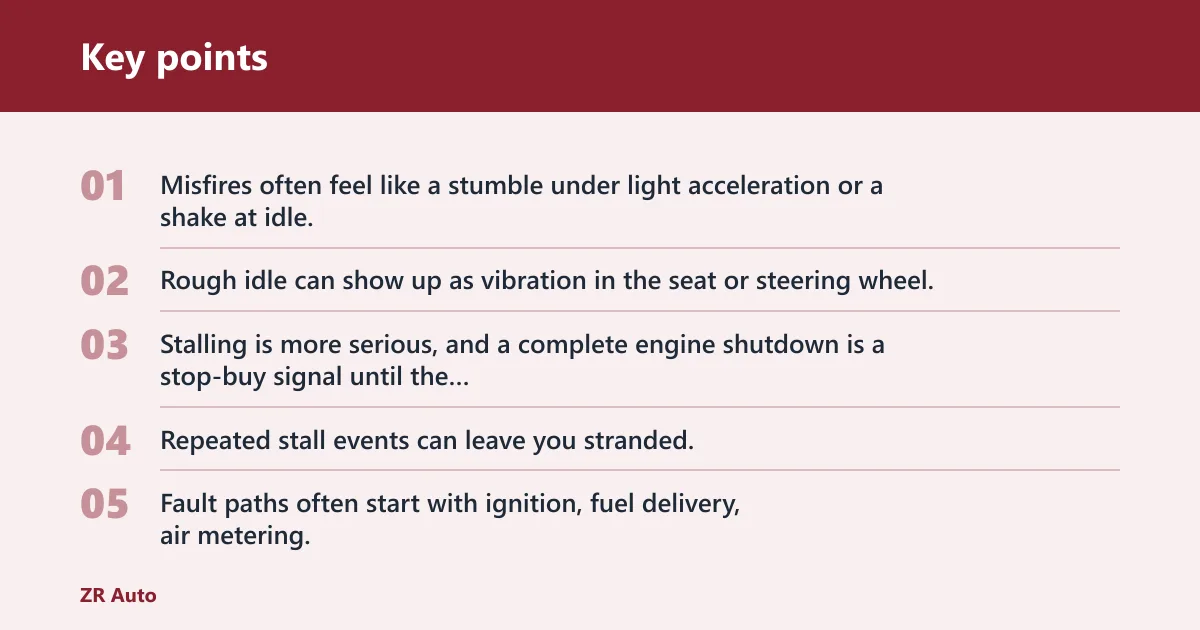
Misfires often feel like a stumble under light acceleration or a shake at idle. Rough idle can show up as vibration in the seat or steering wheel. Stalling is more serious, and a complete engine shutdown is a stop-buy signal until the cause is known. Repeated stall events can leave you stranded.
Likely fault paths in the twin-turbocharged 3.5-liter V-6
Fault paths often start with ignition, fuel delivery, air metering, or turbo-related plumbing, then move to sensors and control logic. A misfire code may point to a coil, plug, or injector issue. If the engine runs poorly and the scan tool shows multiple cylinder misfire counts, walk carefully.
Quick driveway checks and scan-code clues
Start the engine cold, then let it idle with the hood closed and the HVAC off. Listen for roughness, shake, or a hunting idle. During a short drive, pay attention to throttle tip-in and highway merging. OBD-II clues such as P0300 or a single-cylinder misfire code should not be ignored.
A common mistake is assuming a Lincoln Navigator is problem-free because the engine starts cleanly and idles smoothly on a short test drive. Suppose the SUV idles cleanly in the lot, then stumbles after a longer drive and a short stop at a gas station. That warm restart pattern is far more useful than a brief park-and-rev check.
Do Lincoln Navigator transmission problems happen often?
Yes, transmission complaints are a real used-shopping concern, especially when the 10-speed automatic shows slipping gears, delayed response, or harsh shifting. A healthy unit should engage cleanly and respond promptly. If it hesitates, flares, or bangs into gear, the repair risk can be high.
Shifting hesitation, slipping gears, and delayed engagement
Hesitation feels like a pause before the SUV moves. Slipping feels like engine speed rises without a matching push forward. Delayed engagement is obvious when you shift into Drive or Reverse and wait for motion. Any of those symptoms deserve a careful road test and scan check.
Road-test signs that point to the 10-speed automatic
Test the Navigator at low speed, mid-throttle, and steady cruise. Watch for flare between shifts, a shudder on gentle acceleration, or a clunk when selecting gears. Also test reverse engagement on level ground. A transmission that acts inconsistent in a short drive often gets worse, not better.
When transmission behavior is a walk-away problem
If the truck slips under light throttle, refuses to engage promptly, or throws transmission-related warning messages, treat it as a serious fault. That is especially true when the seller has no repair receipts or the behavior is repeatable on a warm test drive. Transmission work can be expensive and hard to predict.
Does the Lincoln Navigator have electrical problems?
Yes. Electrical complaints are common enough to matter, and they can range from nuisance faults to major module or wiring issues. Battery trouble, faulty wiring, navigation glitches, and climate control failures are the sort of problems that can make ownership frustrating and costly, even if the SUV still runs.
Battery drain, wiring faults, and module glitches
Look for dead-battery complaints, repeated jump-starts, random warning lights, or systems that wake up slowly after startup. Wiring faults can create intermittent problems that are hard to pin down. If the battery is weak and the vehicle has multiple electronic complaints, do not assume the battery is the only issue.
Navigation and climate control failures you can verify on site
Turn on the infotainment system, navigation, audio, and climate control before you start moving. Check fan speed changes, temperature response, touchscreen inputs, and camera views if equipped. If the screen freezes, the HVAC ignores commands, or settings reset on their own, assume the fault may be deeper than a simple software hiccup.
Scan data and warning lights that should change your buying plan
Scan for body, network, and climate-related codes if you can. U-codes, repeated low-voltage messages, or module communication faults are a red flag. A single stored code is not always fatal, but a cluster of electrical faults means the truck may need diagnostic time that exceeds a normal used-car budget.
Air suspension and brake issues
Air suspension complaints and brake concerns sit near the top of the Navigator risk list because they affect both comfort and safety. A sagging ride height can point to expensive suspension work. Reduced braking performance is more serious, and 2008 models have been tied to brake-system concern in used-shopping research.
Repeated air suspension complaints and repair-prone signs
Park the vehicle overnight, then look at stance from the side. One corner sitting low, uneven rise after startup, or a compressor that runs often are all bad signs. Repeated owner complaints around air suspension matter because the repair path can include compressors, lines, sensors, or air springs, none of which are cheap.
Brake performance loss and the 2008-model concern
On the road, brakes should feel firm and predictable. A soft pedal, long stopping distance, pull to one side, or pulsation under light braking needs attention. If you are considering a 2008 model, brake history deserves extra weight in the decision because that year carries more concern than a simple wear item.
Which symptoms are safety-critical and which are cost-only?
Brake fade, poor stopping, transmission slip, engine stalling, and complete electrical loss are safety-critical. A noisy compressor, slow infotainment response, or aging seat controls are cost-only until they start affecting core systems. Use that split to decide whether to negotiate or leave.
Heavy-Duty Trailer Tow package and towing checks
The Heavy-Duty Trailer Tow package unlocks an 8700-pound maximum tow rating on the Navigator. It also adds items such as a larger radiator, a trailer brake controller, trailer sway control, and a two-speed transfer case. That is useful equipment, but only if the cooling, brakes, and drivetrain are healthy. (Caranddriver)
What to inspect if the truck was used for towing
Look for hitch wear, wiring damage, trailer-brake use, and evidence of overheating. Ask for records that show coolant service, transmission service, and brake work. A tow-equipped Navigator without paperwork deserves skepticism because heavy use can stress the cooling system, transmission, and rear suspension.
Why towing history raises the inspection bar
Towing adds heat and load. That matters on a large body-on-frame SUV with a twin-turbo engine and 10-speed automatic transmission. If the seller admits regular trailer use but cannot explain maintenance intervals, expect more wear than a non-towing example with the same mileage.
Navigator inspection matrix
Use this table as a used-buy filter. It maps the symptom to the likely system, a quick driveway test, the scan clue to ask for, and the buying decision. A clean row does not guarantee perfection. A bad row usually means more time, more money, or both.
| Complaint | Observable symptom | Likely system | Quick driveway test | Scan or code clue | Buy severity |
|---|---|---|---|---|---|
| Air suspension fault | One corner sits low, or the SUV sags after parking | Air springs, compressor, height sensors | Park overnight, then check ride height before startup | Suspension or chassis codes; compressor run-time complaints | Proceed with caution if minor; stop buy if repeated or uneven |
| Transmission slip | RPM rises without matching acceleration | 10-speed automatic | Light-throttle acceleration and uphill roll-on test | Transmission codes, harsh shift adaptation behavior | Stop buy |
| Delayed engagement | Pause when shifting to Drive or Reverse | 10-speed automatic, hydraulic control | Shift from Park to Drive and Reverse on level ground | Stored transmission fault codes | Stop buy if repeatable |
| Misfire | Rough idle, stumble, flashing check-engine light | Twin-turbocharged 3.5-liter V-6 | Cold start, idle, then short road loop with gentle throttle | P0300 or cylinder-specific misfire codes | Stop buy until diagnosed |
| Electrical glitch | Navigation freezes, climate control resets, or random warnings appear | Battery, wiring, modules | Cycle infotainment, HVAC, and lighting systems | Low-voltage, network, or body module codes | Proceed with caution; stop buy if multiple faults appear |
| Brake performance loss | Soft pedal, pull, or long stopping distance | Brake hydraulics, pads, rotors, booster | Moderate-speed stop in a safe area | Brake system warning lamp or ABS-related codes | Stop buy if braking feels unsafe |
Frequently asked questions
What are the most common problems with a Lincoln Navigator?
The most common Lincoln Navigator problems are air suspension faults, transmission issues, electrical glitches, engine misfires, and brake concerns. The important part is symptom pattern. Sagging ride height, delayed gear engagement, rough idle, and warning lights are all more serious than age-related trim wear.
Are Lincoln Navigators reliable?
Reliability depends heavily on model year and maintenance history. Some examples hold up well, but others carry suspension, transmission, electrical, or brake concerns that raise ownership risk. Consumer Reports Predicted Reliability is a useful screening tool, especially when you are comparing two otherwise similar used SUVs.
Are Lincoln Navigators good cars?
They can be good cars for buyers who want a large, luxurious SUV and are ready for higher repair exposure. The Navigator’s body-on-frame design, twin-turbocharged 3.5-liter V-6, and 10-speed automatic give it strong capability, but used buyers should verify the drivetrain, suspension, and electronics before committing.
What Lincoln Navigator problems are most expensive to fix?
Transmission faults, air suspension repairs, engine shutdown issues, and complex electrical problems tend to be the costliest. Brake repairs can also get expensive if the issue goes beyond pads and rotors. If a seller cannot explain a repeat fault with records, the risk is usually too high.
Which Lincoln Navigator years have the most common problems?
Used-shopping research often puts extra attention on 2003, 2006, and 2008-era trucks. Those years are not automatically bad, but they deserve stronger proof of maintenance and a cleaner test drive. Later generations shift the focus more toward electronics, suspension, and drivetrain behavior.