Are Lincoln Navigators Expensive to Fix?
A Lincoln Navigator is only mildly expensive for routine repairs, but one major fault can drive costs up fast. If a quote is around a quarter to a third of the SUV’s value, the repair-or-sell question gets real. Push past that threshold and you may pour money into a truck that still needs more work. This guide explains the repairs that push costs higher, the upkeep you can expect, and how to judge a quote against value.
Are Lincoln Navigators expensive to fix?
Routine work usually stays manageable, but the Navigator can get expensive when a quote involves the engine, suspension, or electronics. Luxury labor times, premium parts, and complex systems push bills above non-luxury SUVs, so the answer depends on normal wear versus a major failure.
Where the bill stays normal
Oil services, spark plugs, brake work, tires, and scheduled fluid service belong in the normal-cost bucket for a full-size luxury SUV. Those items still cost more than the same work on a basic SUV, but they do not automatically make the vehicle a money pit.
Where the bill turns serious
The cost jumps when a quote includes cam phasers, turbo hardware, air suspension parts, or electrical diagnosis that keeps coming back. At that point, the repair is no longer routine upkeep. It is a value decision.
What it costs to own one
The Lincoln Navigator averages $1,089 a year in repair and maintenance costs. That is slightly below the typical luxury fullsize SUV average. Those averages help with budgeting, but they do not describe one specific vehicle or one specific quote.
What that average hides
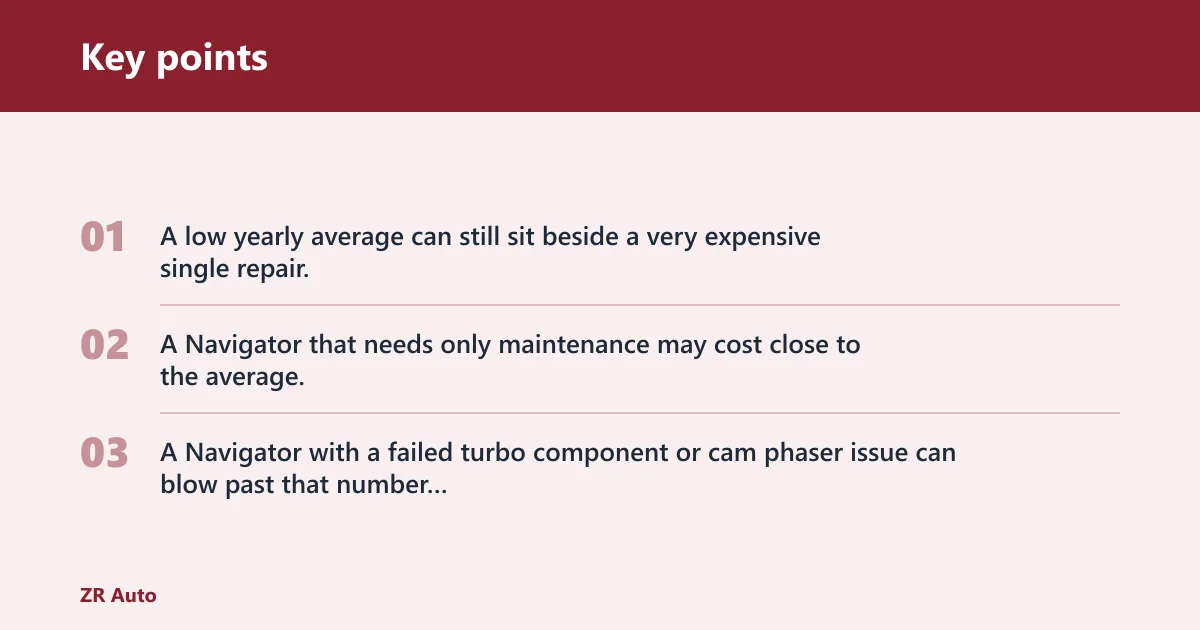
A low yearly average can still sit beside a very expensive single repair. A Navigator that needs only maintenance may cost close to the average. A Navigator with a failed turbo component or cam phaser issue can blow past that number in one visit.
| Problem area | Likely cost tier | Typical urgency | Repeat-risk flag | Fix-or-sell signal |
|---|---|---|---|---|
| Cam phasers | High; about $3,500 | High if noise is present | Yes, if noise returns or multiple valvetrain parts are involved | Fix if the truck is otherwise clean; sell if the quote is near a large share of value |
| Air suspension | High | Medium to high | Yes, because one failure can point to other aging components | Fix only if the rest of the SUV is in strong shape and the quote is contained |
| 3.5L EcoBoost turbo issues | High | High if boost loss, smoke, or drivability problems appear | Yes, especially on high-mileage trucks | Fix when the engine is otherwise healthy; sell if the diagnosis widens beyond one turbo-related fault |
| Infotainment and electrical faults | Low to medium | Low to medium unless safety systems are involved | Yes, if glitches recur after software or module repair | Fix if the problem is limited to convenience features; sell only if electronics are stacked with larger mechanical problems |
Which repairs drive costs up?
The biggest cost spikes usually come from the 3.5L EcoBoost engine, cam phasers, air suspension, and recurring electrical faults. Those systems are more expensive to diagnose and repair than basic wear items, and they can turn a decent-looking used SUV into a poor buy if the quote is large.
3.5L EcoBoost engine and turbo-related repairs
The Navigator’s 3.5L EcoBoost is a turbocharged V6, and turbo-related repairs can be expensive because they involve boost hardware, plumbing, and labor access. A turbo problem is not the same as a simple tune-up. If the quote includes smoke, power loss, or multiple engine-related fault codes, treat it as a major repair.
Cam phasers and valvetrain noise
AutoMoney Pit lists cam phasers as the top failure, and it shows the repair cost at about $3,500. That matters because cam phaser trouble often shows up as startup rattle or valvetrain noise. Noise alone does not prove the whole engine is failing, but it does mean the quote deserves a hard look.
Suppose a 2020 Navigator starts rattling for a few seconds after a cold start, and the quote points to cam phasers only. That is very different from a noisy truck with timing concerns, misfires, and turbo codes stacked together. The second case is where repair risk starts to multiply.
Air suspension parts and labor
Air suspension is a common trouble spot on a full-size luxury SUV, and it can create high repair bills when compressors, lines, struts, or ride-height parts fail. The cost is not only the part price. Diagnostic time and system-level repairs add up quickly.
Infotainment and electrical faults
Infotainment glitches are usually less dangerous than engine or suspension faults, but they still affect ownership cost. Screen resets, software bugs, module failures, and intermittent electrical complaints can become repeat visits if the root cause is not found the first time. That is why a “small” electronics quote can become annoying and expensive over time.
Are Lincoln Navigators reliable?
The Navigator’s reliability picture is mixed. VinExposed rates it medium, and it ranks #5 of 19 luxury full-size SUVs in the cited dataset. That puts it in the middle of the pack, which is useful, but it does not guarantee a specific used SUV will be trouble-free.
How mileage changes the picture
AutoMoney Pit uses 2022 as the representative year for the generation page and covers the 2018-2023 Navigator range. It also lists an expected lifespan of 200,000 miles. The important part is not the headline number. It is how close the vehicle is to the mileage band where major items start showing up.
At 100,000 miles, the page lists spark plugs and transmission service. At 120,000 miles, it lists a turbo inspection. Those checkpoints matter because a Navigator that has crossed them without records can be much riskier than a similar truck with documented service.
Can you fix it or should you sell?
Use the repair quote against private-party value, not against what you hope the SUV will be worth later. If a quote lands near 25% to 30% of the vehicle’s value, the fix-or-sell decision becomes practical instead of emotional. Replacement cost matters too, because a cheap repair on a weak truck is still a bad deal.
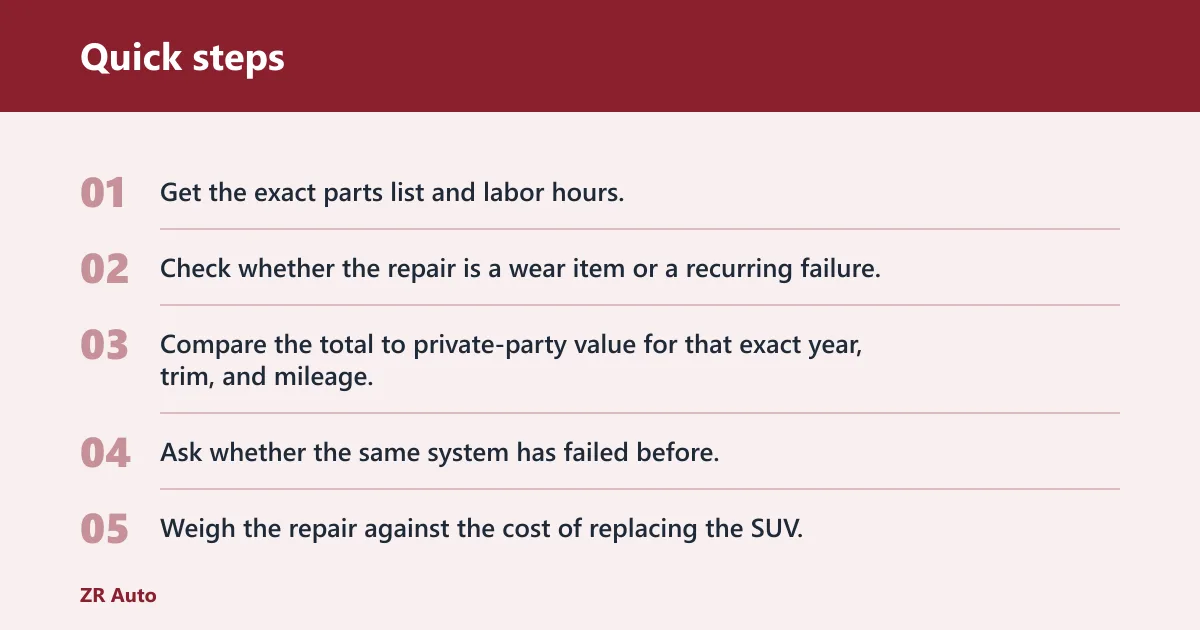
How to judge the quote
- Get the exact parts list and labor hours.
- Check whether the repair is a wear item or a recurring failure.
- Compare the total to private-party value for that exact year, trim, and mileage.
- Ask whether the same system has failed before.
- Weigh the repair against the cost of replacing the SUV.
When recurring faults point toward selling
If the same system keeps failing, the problem is no longer a one-off bill. Repeated air suspension faults, recurring electrical glitches, or a second round of engine-related work can turn a reasonable SUV into an expensive ownership trap. In that case, selling after the current repair may make more sense than chasing the next one.
Why model year matters
Model-year variation changes repair risk across the Navigator range. The same source suggests 2020, 2021, and 2022 as better years in its data, while it flags 2018 as a year to check more carefully. That does not mean every early truck is bad. It means year and mileage should shape your quote review.
Why service history matters more than averages
Averages do not tell you whether a specific Navigator had regular oil changes, timely spark plugs, or a past repair that still holds up. A clean service history can lower risk. Missing records raise it. That difference matters more than a broad average when you are staring at a real estimate.
Say your 2018 Navigator needs an air suspension repair, and the seller has no records for the last 30,000 miles. That repair quote means more than the same estimate on a 2021 truck with a documented service file and a recent inspection. The paper trail changes the decision.
VIN and service history checks
Use the VIN to confirm the exact vehicle before you buy or approve a repair. It helps verify recalls, coverage, trim details, and build specifics that can change parts pricing or repair assumptions. Model averages are useful only after you know which Navigator is in front of you.
What to confirm before you pay
Check recalls, warranty status, and prior repairs tied to that VIN. Match the quote to the exact trim and equipment. A repair estimate built on the wrong build sheet can hide the real cost or miss a coverage opportunity.
Frequently asked questions
Are Lincoln Navigators expensive to maintain?
Yes, more than a non-luxury SUV, but not automatically extreme for the class. The Navigator averages $1,089 a year in repair and maintenance costs, which sits 3% below the luxury fullsize SUV average shown. The real issue is whether one repair turns the bill much larger than the yearly average.
Are Lincoln Navigators worth the money?
They can be, if you want the size and features and you buy one with a clean history and a fair quote profile. The value case weakens when the SUV already needs major engine, suspension, or electrical work. Price the vehicle and the repair together, not separately.
Why are Lincoln Navigators so cheap?
Used prices often fall when shoppers expect higher repair exposure, especially on luxury full-size SUVs with expensive electronics and engine work. A lower asking price does not always mean a bargain. It can mean the market is pricing in cam phasers, suspension work, or a thin service record.
What repairs make a Lincoln Navigator expensive to own?
Cam phasers, turbo-related engine repairs, air suspension work, and repeated electrical or infotainment faults drive ownership cost up fastest. The cam phaser repair is shown at about $3,500, and the others can be just as disruptive when they repeat. One large bill can outweigh several years of routine service.
How much does it cost to maintain a Lincoln Navigator per year?
The cited average is $1,089 a year for repair and maintenance combined. That is only an average, not a promise. A truck with strong records may run below that number for a while, while a single major failure can push one year far above it.