Is the VW Jetta a Good First Car for a Teen Driver?
Yes, a VW Jetta can be a good first car for a teen if you choose a lower-power, well-maintained trim with strong safety features and budget for higher-than-average repair costs. Pick the wrong trim, and higher insurance, maintenance, and distracted driving risk can turn an affordable sedan into a stressful ownership decision. This guide breaks down safety, visibility, power delivery, operating costs, and which Jetta trims are easiest for parents to live with.
Which teen driver profiles match the Jetta?
For the right teen, yes. The Jetta is a compact sedan with calm road manners, an easy size to place in traffic, and power delivery that stays friendly around town. It fits a new driver who needs steady response and parent-friendly packaging, but it is a weaker choice if the family wants the lowest insurance bill or the simplest long-term maintenance profile.
Which teen profiles it fits best?
The Jetta fits a cautious new driver better than a speed-seeking one. A commuter teen who needs a highway-capable sedan will appreciate the fuel economy and trunk space. A nervous beginner benefits from the Jetta’s relaxed torque curve and light-enough size. A performance-seeking teen will want more than the base car can offer, and that is where costs and risk start rising.
Where it falls short versus rivals
Compared with a Honda Civic, Toyota Corolla, or Mazda3, the Jetta usually does not lead on one single parent priority. The Corolla often looks simpler on ownership cost, the Civic often has stronger resale demand, and the Mazda3 often feels more polished but can cost more to buy or insure. The Jetta lands in the middle, which is useful if you want balance rather than the cheapest possible answer.
📊 The Jetta’s wheelbase is 105.7 inches. Source: Caranddriver.
Jetta teen decision table
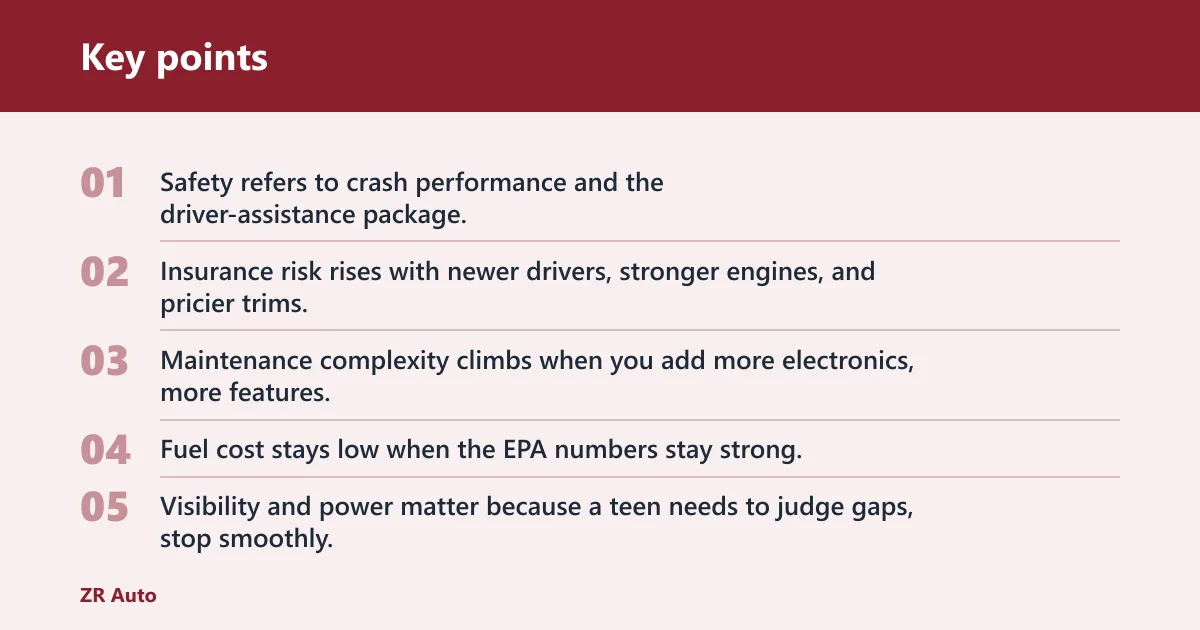
This table translates the Jetta into a teen-first-car choice. It focuses on the things that change ownership stress: safety equipment, insurance exposure, repair complexity, fuel cost, visibility, power, cargo room, and which year or trim makes the most sense for a new driver.
| Driver profile | Safety | Insurance risk | Maintenance complexity | Fuel cost | Visibility | Power | Cargo | Best-fit trim/year | Yes or no |
|---|---|---|---|---|---|---|---|---|---|
| New teen | Good, especially with driver assists | Moderate | Low to moderate on base trim | Low | Good outward visibility for a sedan | Manageable | Good for school bags and sports gear | 2019 Jetta S with automatic | Yes |
| Nervous teen | Good if equipped with safety tech | Moderate | Low if you stay away from extra equipment | Low | Good, with a normal sedan seating position | Gentle | Useful for daily errands | 2019-2021 base or mid trim, automatic | Yes |
| Commuter teen | Good on newer trims with more assists | Moderate | Moderate | Low | Good enough for commuting and parking lots | Enough for highway merging | Strong for a compact sedan | 2019+ mid trim with automatic | Yes |
| Performance-seeking teen | Good, but speed invites risk | High | Higher on loaded trims | Low to moderate | Still acceptable | More tempting than ideal | Same cargo space | Avoid loaded trims as a first car | No |
What each column means
Safety refers to crash performance and the driver-assistance package, not marketing language. Insurance risk rises with newer drivers, stronger engines, and pricier trims. Maintenance complexity climbs when you add more electronics, more features, and fewer simple parts. Fuel cost stays low when the EPA numbers stay strong. Visibility and power matter because a teen needs to judge gaps, stop smoothly, and park without strain.
Recommended trim and year by driver profile
For many families, the 2019 Jetta S with the automatic is a practical starting point. It starts at about $19,400, the automatic adds about $800, and the manual is commonly reported to be available only on the base trim. That keeps the car simple and limits the temptation to move into costlier equipment before the teen has enough seat time.
What changed on the 2019 Jetta?
The seventh-generation 2019 Jetta moved to Volkswagen’s MQB platform, which is the brand’s modular architecture. That matters because MQB is tied to cost savings and more standard features, even though the Jetta’s interior volume increased only nominally. For parents, the redesign matters less as a talking point and more as a sign that the car got more modern without becoming much bigger or harder to place in traffic.
Base trim pricing and trim ladder
The 2019 Jetta starts at $19,395 in S trim. Higher trims add equipment, but they can also add ownership complexity. The base car is the one that keeps the manual transmission available, while the automatic costs $800 on the base car. That split matters because once you climb the trim ladder, the car becomes less simple without giving a teen driver much extra useful ability.
What the redesign changed for everyday ownership
The redesign brought a more modern cabin and newer hardware, but it did not turn the Jetta into a large sedan. It remains a compact car with a normal footprint and easy parking manners. The rear suspension is commonly described as a torsion-beam setup, which is simpler than a more elaborate multi-link design and can help keep repair decisions less complicated for a parent who wants predictable ownership.
Is the VW Jetta safe for a teen driver?
The Jetta can be a reasonable safety choice for a teen, especially in newer model years with modern driver-assistance features. It is not automatically the safest pick in the segment, though, and you should compare equipment closely. The best version is the one with strong crash performance, automatic emergency braking, and enough visibility for a new driver to place the car accurately.
Crash safety context
Crash safety depends on year, trim, and equipment level. A newer Jetta is the safer direction than an older, stripped one, because safety technology usually improves over time. That said, the Jetta should be judged against the Honda Civic, Toyota Corolla, and Mazda3 rather than against a vague idea of “safe enough.”
Driver-assistance features to look
Look for forward collision warning, automatic emergency braking, blind-spot monitoring, and rear cross-traffic alerts when available. Those features help a teen in parking lots and stop-and-go traffic. Higher trims may add a Digital Cockpit, a 10.3-inch screen in the instrument cluster, which improves information display but is not a substitute for the basic assists parents should want first.
Visibility and outward sightlines
The Jetta’s sedan shape gives decent forward visibility and a normal driving position, which helps a beginner judge lane placement. Rear visibility is acceptable, but any modern car has thicker pillars and more blind spots than older sedans. Say your teen is backing out of a school parking space with SUVs on both sides; blind-spot monitoring helps, but only if the mirrors are adjusted correctly and the driver still turns to check.
How expensive is the Jetta to own?
The Jetta is not a bargain-bin car for a teen, but it is not automatically expensive either. Insurance, tires, brakes, and scheduled maintenance are the real ownership pressures. The cleanest way to keep cost down is to stay with a simpler trim, avoid unnecessary options, and choose an automatic if the teen is not already comfortable driving a manual.
Insurance risk for teens
Insurance for a teen driver is usually the biggest cost swing. A compact sedan with sensible power is often easier to insure than a sportier car, but any teen raises the bill. The Jetta’s insurance profile should be viewed as middle-of-the-road, not cheap. Trims with more equipment or more appeal to spirited driving can nudge premiums higher.
Maintenance and repair complexity
The base Jetta is easier to recommend than a loaded one because fewer features mean fewer systems that can fail. The MQB platform helps by tying the car to a more modern parts strategy, but Volkswagen ownership still tends to be more sensitive to service quality than the simplest mainstream sedans. For a beginner, that means regular service records matter more, not less.
Fuel costs and EPA numbers
Fuel cost is one of the Jetta’s better points. EPA fuel economy is 30 mpg city, 40 highway, and 34 combined. The automatic and manual versions share the same EPA estimates. That is useful for a teen commuter because the transmission choice does not punish you at the pump.
Engine, transmission, and driveability
The 2019 Jetta uses a 1.4-liter turbocharged inline-four with 147 horsepower and 184 lb-ft of torque at 1,400 rpm. That low-rpm torque is a good fit for beginners because the car pulls cleanly without needing high engine speed. It feels calmer than a higher-strung setup, which helps a teen focus on traffic instead of managing a busy powerband. (Caranddriver)
6-speed manual versus 8-speed automatic
The 6-speed manual is available only on the base trim, and the clutch takeup is described as progressive with a nicely weighted shifter. That can be ideal for a trained beginner, but it also increases workload during commuting and parking. The 8-speed automatic replaced the old 6-speed automatic and keeps the same EPA fuel economy as the manual, which makes it the easier recommendation for most teens.
Power delivery for a new driver
The Jetta’s power delivery is friendly rather than intimidating. It has enough torque to merge cleanly, but it does not need to be driven hard to feel responsive. That matters for parents because a teen who does not need to chase power is less likely to make fast, risky inputs just to get moving.
Space, cargo, and daily usability
The Jetta is sized well for school runs, errands, and one or two friends in the back seat. Its wheelbase is 105.7 inches and overall length is 185.1 inches, so it is still easy to park and maneuver in tight lots. The trunk shrank to 14 cubic feet, but that is still usable for backpacks, groceries, and sports gear.
Back-seat room for friends or family
Rear seat space is enough for average-size passengers on short trips, and that is usually all a teen needs. Interior volume increased only nominally with the redesign, so do not expect a midsize-car jump in room. For a parent, that means the Jetta is practical without being oversized for a beginner.
Trunk size for school and sports gear
The 14 cubic feet trunk works for daily life, though it is not class-leading. A common first-timer mistake is assuming a compact sedan cannot handle a sports bag, lunch cooler, and backpack at once. The Jetta can handle that kind of load, but large band equipment or bulky team gear may require folding the rear seat.
Parking and city maneuvering
The Jetta’s sub-3000-pound curb weights help it feel light enough for city driving. That does not make it tiny, but it does make it less tiring for a new driver to place in parking spaces and school lots. The standard torsion-beam rear suspension also tends to keep the car simple in daily use, which parents often prefer over more complicated setups.
Which Jetta year and trim should you buy?
For a teen first car, the best target is usually a 2019 or newer Jetta in a lower trim with an automatic transmission. That gives you the newer platform, a modern safety structure, and easier driving manners without the extra cost and distraction of a loaded model. The base S trim is the most logical starting point if the car has a clean history and complete maintenance records.
Best used years for a first car
Start with the 2019 redesign and newer if the budget allows. That model year moved the Jetta to the MQB platform and brought a more modern feature set. If you are shopping older cars, you need to be more selective about history and maintenance, because the earlier versions can vary more in equipment and condition.
Best trim for a new teen
The 2019 Jetta S is the trim to start with if the goal is a simple first car. It keeps pricing at $19,395 before the automatic add-on, and it avoids the creep of extra equipment that a new driver does not need. If you want the easiest ownership path, the automatic S is the one to compare first.
Trims and options to skip
Skip expensive trims if the driver is still learning habits. Higher-end versions with more electronics, more style equipment, and the Digital Cockpit may be appealing, but they raise the stakes without making the car safer in a meaningful way by themselves. For a teen, extra features should never outrank visibility, reliability history, and sensible power.
- Choose a clean 2019 or newer Jetta with service records.
- Prefer the S trim if cost control matters most.
- Pick the automatic unless the teen already drives a manual well.
- Verify safety equipment before shopping cosmetic options.
- Compare the insurance quote against a Civic, Corolla, and Mazda3 before buying.
Picture a teen who needs a school commute and a weekend shift at a part-time job. A base Jetta with an automatic can cover that routine without demanding much from the driver or the fuel budget. Add a loaded trim and the same car becomes harder to justify because the ownership cost rises faster than the teen’s actual needs.
Frequently asked questions
Is the VW Jetta expensive to insure for a teen?
Insurance for a teen is usually moderate to high no matter what you buy, and the Jetta is no exception. The car’s sensible size and power help, but the driver’s age matters more than the badge. A base trim will usually make more sense than a higher-powered or more heavily equipped version.
What year VW Jetta is best for a first car?
The 2019 redesign is the best starting point for most families because it brought the MQB platform, newer equipment, and a more modern ownership profile. A clean 2019 Jetta S is the simplest choice for a teen, especially if you want predictable controls and fewer features to manage.
Is a used VW Jetta reliable enough for a new driver?
A used Jetta can be reliable enough if it has a documented service history and you avoid neglected examples. The safest bet is a newer, lower-trim car with fewer options, because there is less to fail. A neglected turbo car is a poor first-car gamble for any beginner.
How much does it cost to maintain a VW Jetta?
Maintenance cost is usually moderate rather than cheap. Routine service, tires, brakes, and occasional repairs can be manageable, but the total rises with more equipment and poor maintenance history. For a teen, the simplest trim is the best way to keep the long-term bill under control.
Should I buy a manual or automatic VW Jetta for a teen?
The automatic is the better choice for most teens because it reduces workload in traffic, parking, and hill starts. The 6-speed manual is fine for a trained driver and is available only on the base trim, but it asks more from the person behind the wheel. The automatic also shares the same EPA fuel economy as the manual.
How big is the VW Jetta trunk and back seat?
The Jetta’s trunk is 14 cubic feet, which is enough for daily school and errands use. Rear seat room is suitable for friends or family on short trips, but it is still a compact sedan, not a midsize car. It is practical, not oversized.
Does the VW Jetta have enough safety tech for a first car?
It can, but only if you shop carefully. Look for modern driver-assistance features instead of relying on trim names. Higher trims may include the Digital Cockpit and additional equipment, but the most important items for a first car are collision mitigation, blind-spot help, and good outward visibility.