What Are the Most Common VW Tiguan Problems?
The most common VW Tiguan problems are timing-chain tensioner wear, water-pump leaks, oil consumption, and ignition-coil or PCV faults. On used cars, chain rattle or coolant loss should move the car to the top of your risk list. Ignored, they can turn a cheap Tiguan into a $1,000-$3,000 repair stack or a blown-engine risk. This guide ranks the faults by inspection priority, explains what to check, and shows how much repair budget to reserve.
VW Tiguan problems by risk
The first-generation Tiguan covered the 2009-2017 model years, and that span matters more than trim. Early 2.0 TSI cars use the CCTA and CBFA engine codes, which puts timing-chain tensioner risk, carbon buildup, PCV faults, and intake-manifold issues near the top of the list. Later cars still need a careful check, but the pattern changes with age and mileage.
The U.S. lineup included S, SE, and SEL trims, and Bluetooth became standard in all trims from 2011. Those details help with trim comparison, but they do not change the core inspection order: begin with engine health, then transmission behavior, then AWD, cooling, and roof drainage.
Tiguan problem triage table
| Symptom | Likely cause | Affected years/engines | Rough repair urgency | Used-buying leverage |
|---|---|---|---|---|
| Cold-start rattle, check engine light, rough start | Timing chain tensioner wear or chain stretch | Early 2009-2013 2.0 TSI, especially CCTA/CBFA | Deal-breaker if severe | Very high; walk or price in major repair |
| Coolant smell, puddle under the nose, low coolant warning | Water pump or coolant housing leak | 2009-2017, most often on turbo four-cylinder cars | High; avoid long drives until repaired | High; lowers offer because the repair is common and recurring |
| Misfire, rough idle, check engine light | Direct-injection carbon buildup or ignition-coil related misfire | 2009-2017 2.0 TSI | Moderate to high depending on misfire count | High; easy to budget, but it signals neglected maintenance |
| Idle surge, oily smell, whistling, lean codes | PCV / crankcase ventilation failure | 2009-2017 2.0 TSI | Moderate; fix soon | Moderate; useful for negotiation if multiple faults appear |
| Hesitation on shifts, flare, shudder at low speed | DSG service overdue, mechatronic wear, adaptation issues | DSG-equipped automatic cars | Moderate to high if shifting is erratic | High; missing fluid history matters |
| Vibration or binding in slippery conditions, AWD warning | Haldex pump or control-unit issue | 4Motion models | Moderate; AWD may be partly disabled | Moderate; good leverage if the car is not a front-drive model |
| Oil consumption between changes | Turbocharged direct-injection engine wear or ring/seal issues | 2009-2017 2.0 TSI | Moderate; monitor closely | Moderate; only a strong buy if the history is clean |
| Water on floor, damp headliner, musty smell | Panoramic sunroof drain blockage or leak | Sunroof-equipped cars, often with age and debris buildup | Moderate; can become electrical if ignored | Moderate; useful leverage because it can recur |
| Check engine light with intake-related codes, poor acceleration | Intake manifold or runner control valve fault | Certain 2008-2011 vehicles, engine-code dependent | Moderate | Moderate to high; check warranty history before buying |
Say your scan tool shows a stored misfire code and the idle hunts at a stoplight. That is not a “drive it and see” item. On a Tiguan, that combination often points to carbon buildup, a coil issue, or a PCV fault, and each one can turn into a stronger negotiation point than a cosmetic flaw.
Does the VW Tiguan have timing chain problems?
Yes. Early 2.0 TSI Tiguans can have timing-chain tensioner problems, and that is one of the first items to inspect on a 2009-2013 truck-shaped used example. A cold-start rattle, a check engine light, or rough starting can mean the chain has started to stretch or the tensioner is no longer holding proper pressure.
Early 2.0 TSI tensioner risk
The early 2.0 TSI engine codes listed for U.S. Tiguans are CCTA and CBFA. That turbocharged direct-injection layout is efficient, but the chain system on early cars is the fault that creates the biggest repair fear because it can move from noise to internal damage quickly. The article notes the chain can start stretching around 80,000 km, and oil changes no longer than 15,000 km matter here.
Cold-start rattle and warning lights
A rattle for a second or two after startup deserves attention. If the engine also logs a check engine light or runs unevenly, the inspection priority rises sharply. On a used Tiguan, that is one of the few faults that can justify walking away before a price discussion starts.
Why this is a top inspection item
- Start the engine cold and listen near the front cover.
- Watch for a brief metallic rattle before idle settles.
- Check service records for regular oil changes.
- Scan for cam/crank correlation or misfire codes.
- If the noise is present, budget for diagnosis before purchase.
What engine problems are most common?
PCV faults, carbon buildup, and intake-manifold problems are the most common engine-related Tiguan issues after timing hardware. They affect drivability, trigger warning lights, and often show up on cars that look fine at idle but stumble under load. They are less catastrophic than chain failure, but they still matter to a buyer.
PCV system failures
The PCV or crankcase ventilation system can fail and cause rough idle, whistling, oil leaks, or lean-running symptoms. On the road, the car may feel slightly off at part throttle before the check engine light arrives. It is a common maintenance item on the 2.0 TSI and worth checking for oil seepage around the valve cover area.
Carbon buildup and misfires
Direct-injection carbon buildup on intake valves can cause misfiring and a check engine light. Cleaning carbon buildup on intake valves could cost $350 to $800, which makes it a real budget item but not a disaster on its own. If the seller has no record of prior cleaning and the engine idles unevenly, assume the service may be due.
Intake manifold and runner control valve faults
The intake manifold or runner control valve can fail on certain vehicles, especially 2008-2011 examples. Volkswagen extended the intake manifold warranty for certain 2008-2011 vehicles, so engine code and coverage history matter. If the engine surges, lacks midrange pull, or stores intake-related codes, this repair can become a useful bargaining chip.
Picture a 2011 Tiguan with about 120,000 km, no service records for valve cleaning, and an intermittent misfire light. The smart move is not to guess. Ask for a scan report, inspect idle quality, and assume you may need both a carbon clean and ignition work before the car feels right.
Are DSG problems common on VW Tiguan?
DSG complaints are common enough to matter, especially if the service history is thin. The transmission is sensitive to oil and filter changes, and shift flare, shudder, or hesitation usually means the car needs attention rather than a software excuse. A healthy DSG should shift cleanly and predictably in normal driving.
Shift flare, shudder, and hesitation
If the transmission hesitates when pulling away, flares between gears, or shudders at low speed, treat it seriously. Some cases come from missed service, some from adaptation issues, and some from mechatronic wear. On a used Tiguan, a transmission that already feels confused has more weight than a cosmetic fault because the repair path can grow fast.
Service interval and fluid changes
DSG maintenance is not optional. The oil and filter interval is the key ownership checkpoint, and missing it weakens the case for any seller who says the gearbox is “just a little rough.” If the fluid history is missing, price the car as though the service is overdue.
When transmission behavior becomes a deal-breaker
Briefly imperfect shifting is one thing. Persistent shudder, harsh engagement, warning lights, or limp behavior is another. If the car cannot pull away smoothly from a stop or lurches during low-speed traffic, stop the inspection until the fault is diagnosed.
AWD, coolant, and sunroof faults
These faults matter because they can hide behind normal driving. They are not always the first complaint a seller mentions, but they become expensive if ignored. On 4Motion cars, cooling and roof-water issues can also show up after years of seals, pumps, and drains aging at the same time.
Haldex pump and 4Motion symptoms
Haldex all-wheel-drive coupling problems can cause vibration, inconsistent rear-drive engagement, or warning behavior on 4Motion models. Pump or control-unit issues are common enough that service history matters here too. If a 4Motion Tiguan feels like a front-drive SUV in slippery conditions, the AWD system needs a closer look.
Water pump and coolant leaks
Water pump and coolant system leaks are common on the Tiguan and deserve fast attention. The plastic housing vulnerability is part of the problem, and coolant loss can show up as a smell, a damp spot, or a low-level warning. Repair cost is often in the several-hundred-dollar range, and the car should not be ignored if the level keeps dropping.
Panoramic sunroof drainage
Panoramic sunroof drainage can leak when drains block with debris. That often shows up after years rather than months, and water intrusion may appear as a damp carpet or wet headliner before electrical problems start. Cars with a sunroof need a careful check around the drain paths and the spare tire well area.
What costs should you budget?
Budgeting works best when you group the Tiguan’s common faults by urgency. A car with only carbon buildup may be a smart buy if the price reflects the cleanup, but one with chain noise, coolant loss, and gearbox complaints can become a money trap. The goal is to reserve enough for the first repair wave.
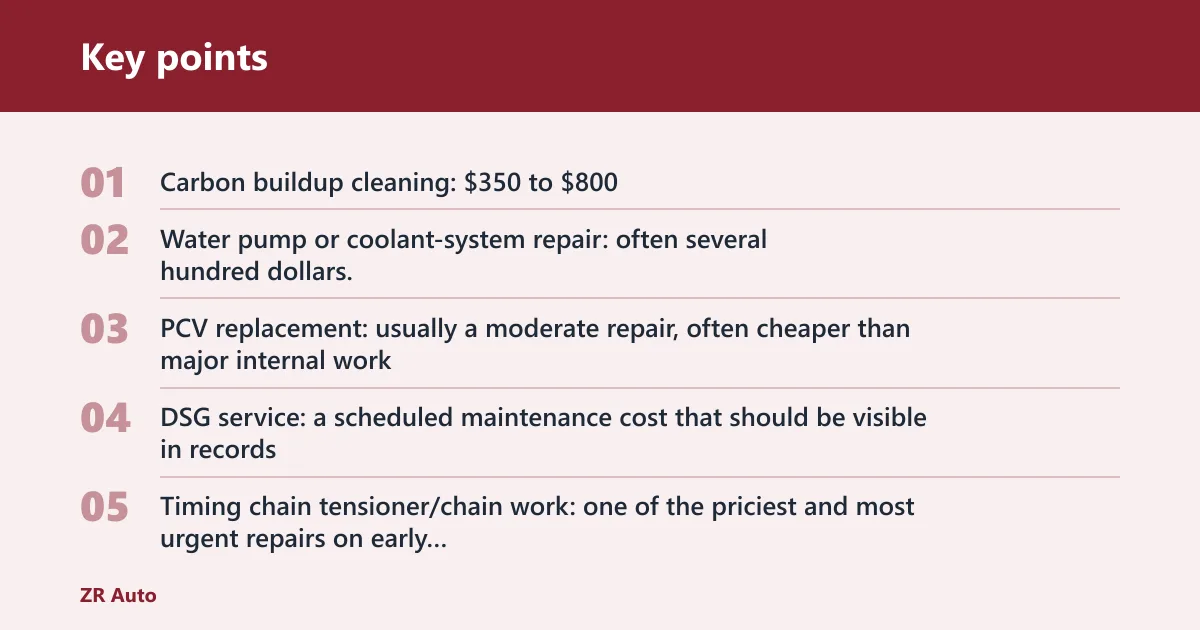
Repair cost ranges for common faults
- Carbon buildup cleaning: $350 to $800
- Water pump or coolant-system repair: often several hundred dollars, and more if related parts are needed
- PCV replacement: usually a moderate repair, often cheaper than major internal work
- DSG service: a scheduled maintenance cost that should be visible in records
- Timing chain tensioner/chain work: one of the priciest and most urgent repairs on early cars
Which repairs justify a lower offer?
Carbon buildup, a missing DSG service record, a worn PCV valve, and a leaking water pump all justify a lower offer if the car otherwise drives well. These are common enough that a buyer should not pay top market money for a Tiguan with no paperwork and obvious symptoms.
Which repairs should send you walking?
Walk if the chain rattles loudly, the engine misfires badly, the oil or coolant loss is active and unexplained, or the transmission shudders badly during a short test drive. Those issues can be repaired, but they are the sort of faults that make a “cheap” Tiguan expensive very quickly.
Suppose a 2010 Tiguan has 160,000 km, a wet carpet under the passenger side, and a cold-start rattle that lasts two seconds. Even if the paint is clean and the tires are new, that combination is enough to treat the car as high risk. The smartest move is to price the repair stack first, then decide whether the discount is real.
Frequently asked questions
What are the most common problems with VW Tiguan?
The most common problems with VW Tiguan are timing-chain tensioner wear on early cars, water-pump leaks, carbon buildup on direct-injection engines, PCV faults, DSG service sensitivity, and Haldex issues on 4Motion models. Used buyers should prioritize cold-start noise, coolant loss, rough running, and missing service records before anything cosmetic.
Does the VW Tiguan have oil consumption problems?
Yes, oil consumption can be an issue on some 2.0 TSI Tiguans. It is usually less dramatic than chain failure, but it still matters because low oil speeds wear and can worsen timing and turbo-related problems. Check the dipstick consistently, and treat unexplained oil use as a negotiation point.
What years of VW Tiguan have the most common problems?
Later cars can still have carbon buildup, coolant leaks, and DSG or AWD issues, but the earliest 2.0 TSI models are the biggest inspection priority.
How much does it cost to fix common Tiguan problems?
Carbon buildup cleaning could cost $350 to $800, while water-pump and coolant repairs often land in the several-hundred-dollar range. DSG service is a scheduled maintenance cost, and timing-chain repairs are much more expensive. On a used Tiguan, those figures should shape both your offer and your walk-away point.
Jaký je nejčastější problém s VW Tiguan?
Nejčastější problém u staršího VW Tiguan bývá rozvodový řetěz a jeho napínák, hlavně u prvních 2.0 TSI motorů. Pokud slyšíte studený start s chrastěním, je to varování. U ojetiny má takový projev vysoký dopad na cenu i na to, zda se auto vůbec vyplatí koupit.