Is the VW Jetta Reliable as a Used Car?
The VW Jetta is a mixed used-car buy: well-kept 2015–2021 examples are usually the safer pick, while neglected cars and some early Mk6 turbo/DSG combinations can turn into expensive repairs. Skip the wrong one and you can buy a car with hidden transmission, cooling, or electrical bills that erase the low purchase price. This guide breaks down reliability by generation, engine, and transmission, then lists the inspection clues that separate a good Jetta from a risky one.
What reliable means for Jetta shoppers
A used Jetta can be reliable, but only when maintenance history, prior ownership, and powertrain choice line up. A later car with a full file is usually the safer bet than an older one with gaps in service, missed fluid changes, or unknown repairs. The right car is the one with records, clean inspection results, and no warning signs on a test drive.
What reliability means for a Jetta buyer
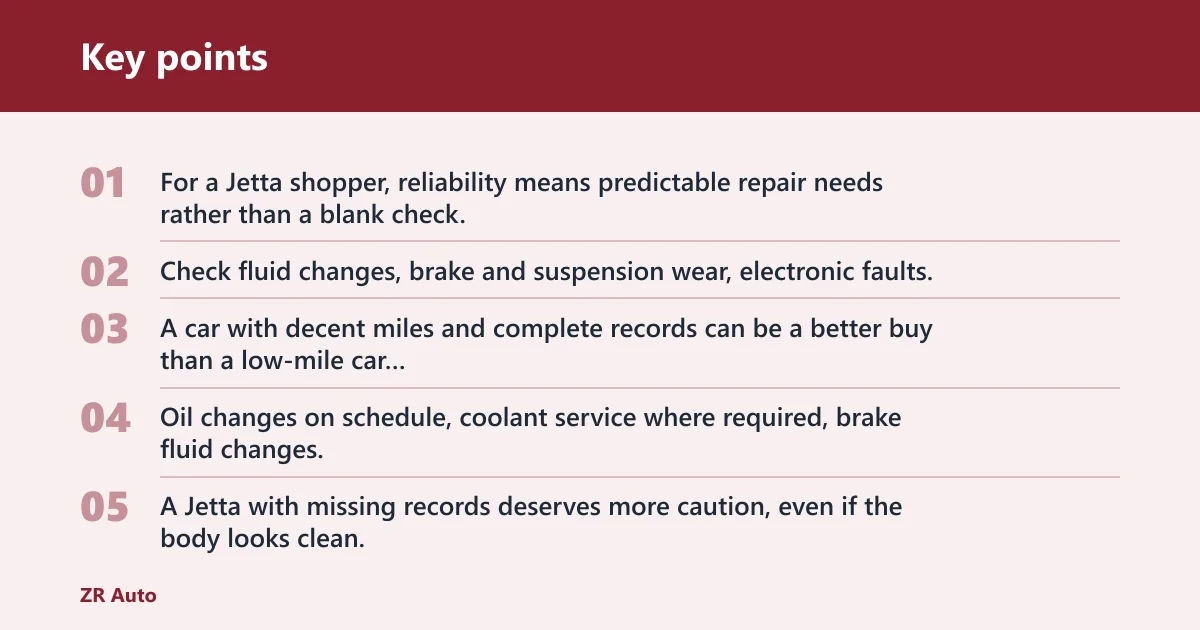
For a Jetta shopper, reliability means predictable repair needs rather than a blank check. Check fluid changes, brake and suspension wear, electronic faults, and transmission behavior. A car with decent miles and complete records can be a better buy than a low-mile car that sat, skipped service, or saw hard use.
Why maintenance history matters more than odometer miles
Mileage tells you how far the car went. Service records tell you how it got there. Oil changes on schedule, coolant service where required, brake fluid changes, and timely transmission service matter more than a single odometer number. A Jetta with missing records deserves more caution, even if the body looks clean. For maintenance planning, see Jetta service schedules.
How to read model-year risk at a glance
Use generation, engine, and transmission as your first filter. Older Jettas can be fine, but some combinations carry known ownership risk that is higher than average. If a car has a history of overheating, rough shifting, or electrical glitches, treat it as a repair project until proven otherwise. If you are comparing drivetrain concerns, it also helps to review VW DSG transmission problems.
Volkswagen used the MQB architecture on the 2019 Jetta. Caranddriver.
Jetta reliability decision table
| Generation / year range | Engine and transmission | Likely ownership-risk level | Inspection priorities | Buy or skip verdict |
|---|---|---|---|---|
| Mk5, 2005.5–2010 | 2.5L five-cylinder; 2.0T; automatic or manual | Medium to high | Service records, cooling system leaks, coil packs, timing chain or belt service, harsh shifts, misfire codes (P0300/P0301-P0305), coolant loss, and throttle-body or MAF sensor faults | Buy only with proof of care; skip neglected examples |
| Mk6, 2011–2014 | Turbocharged four-cylinder options; DSG or automatic in some trims | High | Transmission behavior, mechatronic faults, oil leaks, warning lights, start-up quality, DSG codes such as P17BF/P189C, crankshaft or camshaft sensor issues, and engine misfire counters | Skip unless records are excellent and inspection is clean |
| Mk6 facelift, 2015–2018 | 1.4T on many trims; manual or automatic depending on trim | Medium | Cooling system, turbo response, electronics, suspension wear, accident history, oxygen sensor readiness, EVAP leak codes (P0442/P0455), and battery-voltage stability at startup | Usually a better used buy than earlier Mk6 cars |
| Seventh generation, 2019–2021 | 1.4-liter turbocharged inline-four; six-speed manual or eight-speed automatic | Low to medium | Shift quality, infotainment faults, warning lights, underbody rust, service records, MAP/boost sensor plausibility, fuel trim stability, and transmission adaptation behavior | Buy if records and road test are clean |
| Recent older high-mileage examples | Any engine or transmission with incomplete history | Variable, often high | Compression of maintenance gaps, leaks, rust, and previous accident repairs | Skip if inspection or paperwork is weak |
Which Jetta years are safest used buys?
The safer used Jettas are usually the later, better-documented cars, especially 2015–2021 examples with clear service records. Long-term ownership gets easier when the car has fewer known weak points, a simpler maintenance trail, and no signs of skipped fluid changes. Older cars can still be worth buying, but only with stronger proof of care.
Safer generations for long-term ownership
Later Mk6 cars and the seventh generation are the better starting points for most buyers. The 2019 Jetta is a useful benchmark because it uses VW’s MQB architecture, which improved packaging and parts commonality. That does not make it bulletproof, but it does put it in a more manageable zone than many early turbo Jettas.
Years that need extra caution
Early Mk6 cars and any Jetta with incomplete paperwork deserve extra scrutiny. If the seller cannot show oil changes, transmission service where applicable, or repair history, assume there may be hidden work ahead. A cheap purchase price can hide expensive catch-up maintenance.
When a higher-mileage Jetta still makes sense
A higher-mileage Jetta can still be a sensible buy if the records are long, the test drive is clean, and the price leaves room for fresh maintenance. Say your shortlist includes a 2017 car with 110,000 miles and a stack of receipts, plus a 2014 car with 72,000 miles and no history. The higher-mileage car is often the safer pick.
Which engines and transmissions change the risk?
Engine and transmission choice change Jetta risk more than trim badges do. Turbocharged four-cylinder engines can be strong daily drivers, but they demand good oil service and clean cooling-system health. Automatic transmissions vary more than manuals, so a smooth test drive and documented service matter a lot.
Turbocharged four-cylinder choices
Turbo fours are common across newer Jettas, including the 2019 model’s turbocharged 1.4-liter inline-four. That engine makes 147 horsepower and 184 lb-ft of torque at 1400 rpm. Strong low-end torque helps around town, but you still want proof of regular oil changes and no boost-related hesitation, misfires, or coolant loss.
Automatic versus manual tradeoffs
The base 2019 Jetta offered a six-speed manual, while the available automatic is an eight-speed unit. The automatic is rated at 30 mpg city, 40 highway, 34 combined, and the manual can be a smart choice if you want fewer transmission concerns. The automatic can still be a good buy if shifts are smooth and service history is complete. (Caranddriver)
Shift quality, service needs, and warning signs
During a road test, watch for delayed engagement, flare on upshifts, hunting between gears, clunks when moving from park to drive, and shudder at low speed. Those symptoms point to transmission trouble or neglected service. A manual should engage cleanly and disengage without grinding, chatter, or slipping under load.
What should you inspect before buying?
Start with records, then move to a hands-on inspection and road test. A clean Jetta still needs proof of maintenance, accident history, rust inspection, and a scan for warning lights. If the seller hesitates on paperwork or the car behaves oddly on the drive, walk away.
Service records and maintenance gaps
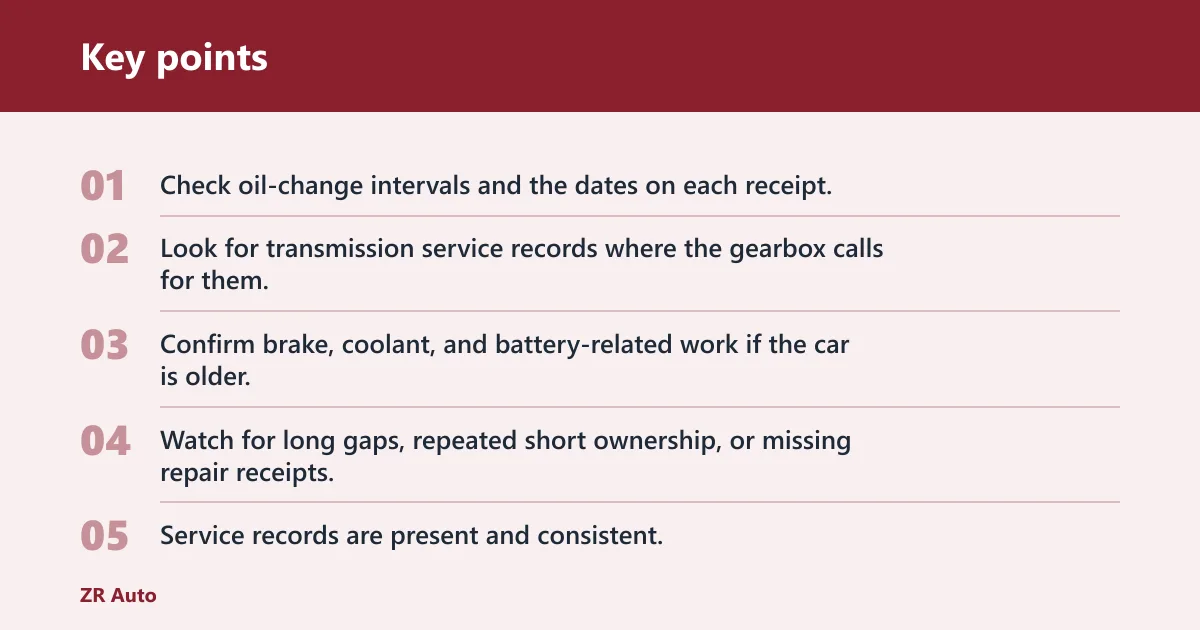
- Check oil-change intervals and the dates on each receipt.
- Look for transmission service records where the gearbox calls for them.
- Confirm brake, coolant, and battery-related work if the car is older.
- Watch for long gaps, repeated short ownership, or missing repair receipts.
Starting issues, warning lights, and electronics faults
Pay attention to cold starts, idle quality, and the first few minutes after ignition. A rough start, a check-engine light, or a flickering cluster can point to battery problems, sensor faults, or deeper engine issues. Test every switch, screen, camera, and climate function because small electrical faults often show up before a bigger repair.
Transmission behavior, noises, rust, and accident history
Listen for wheel-bearing hum, suspension clunks, exhaust leaks, and rattles over bumps. Check the underside, wheel arches, and lower doors for rust or corrosion. Then inspect panel gaps, paint tone, and fasteners for accident repairs. A Jetta with straight bodywork but poor shifting still needs caution.
Checklist before you buy
- Service records are present and consistent.
- No active warning lights are on.
- The engine starts cleanly cold and warm.
- The transmission shifts without flare, delay, or shudder.
- No unusual noises appear at idle or over bumps.
- No signs of rust, corrosion, or patchwork collision repair.
- A mechanic’s pre-purchase inspection comes back clean.
2019 Jetta reliability facts
The 2019 Jetta is the seventh-generation model and uses Volkswagen’s MQB architecture. It starts at $19,395 for the base S trim, with the optional automatic transmission on that trim costing $800. Those facts matter because they help you compare newer Jettas against older cars with more uncertain service histories.
MQB platform and why it matters
MQB is VW’s modular architecture, and it affects parts commonality and serviceability. For a used-car buyer, that can help with parts sourcing and routine repairs. It does not erase wear, but it can make a newer Jetta easier to live with than an older car built on a less standardized setup.
1.4-liter turbo engine and eight-speed automatic
Volkswagen pairs it with either a six-speed manual in base trim or an eight-speed automatic. The automatic is the better fit for buyers who want relaxed commuting and the EPA rating of 30 mpg city, 40 highway, 34 combined.
Torsion-beam suspension, Digital Cockpit, and packaging
The standard 2019 Jetta uses a torsion-beam rear suspension, a cost and packaging tradeoff that helps keep the car efficient and simple at the rear axle. Higher trims can add a 10.3-inch Digital Cockpit screen in the instrument cluster. The car also has a 14.2 cubic-foot trunk, down from 16 cubic feet, along with a 105.7-inch wheelbase, 185.1-inch overall length, and sub-3000-pound curb weights.
Is a used Jetta good for daily driving?
A used Jetta can be a solid daily driver if you buy the right year and keep repair risk under control. The better cars are comfortable enough for commuting, reasonably economical, and simple to size up in traffic. The wrong one can be an everyday headache because one small fault can become a recurring bill.
Fuel economy and commuter use
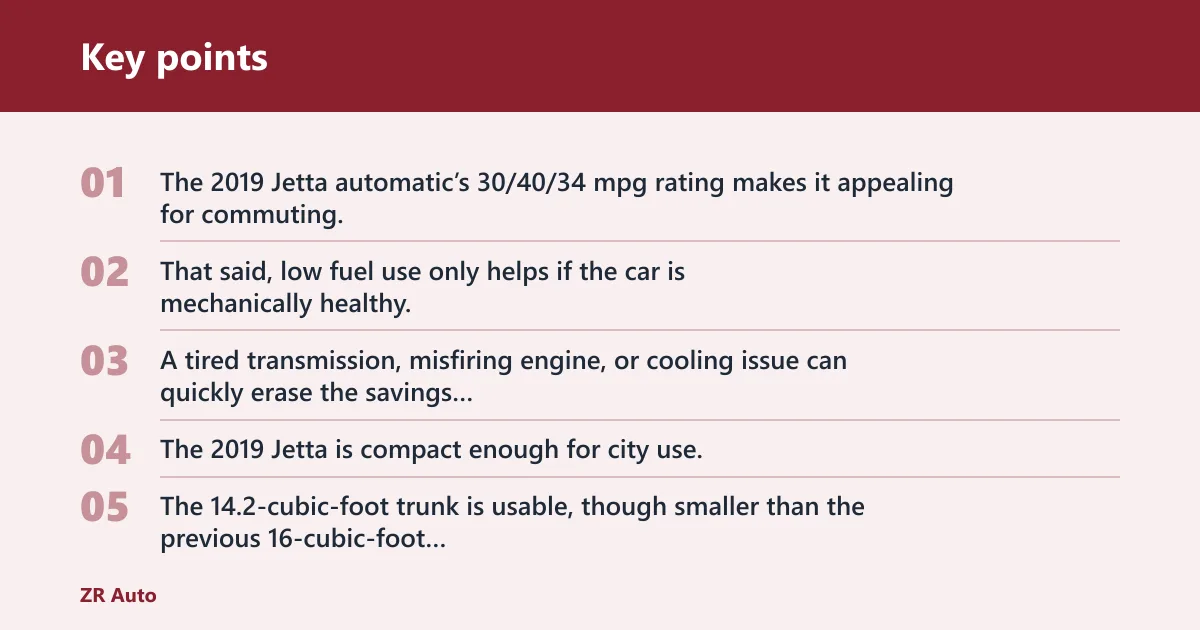
The 2019 Jetta automatic’s 30/40/34 mpg rating makes it appealing for commuting. That said, low fuel use only helps if the car is mechanically healthy. A tired transmission, misfiring engine, or cooling issue can quickly erase the savings from good mpg numbers.
Cabin space, trunk volume, and size
The 2019 Jetta is compact enough for city use, yet the 105.7-inch wheelbase and 185.1-inch length give it real passenger room. The 14.2-cubic-foot trunk is usable, though smaller than the previous 16-cubic-foot figure. For daily driving, that is usually enough for groceries, work bags, and a child seat without feeling oversized.
Low-running-cost expectations versus repair risk
If you want low running costs, buy a Jetta with a clear record and a clean inspection, then budget for maintenance anyway. Tire, brake, battery, fluid, and suspension wear still apply. A car that already shows shifting issues or warning lights is not a low-cost buy, even if the asking price looks friendly.
Picture a commuter who wants a 2019 Jetta with the automatic for a 40-mile round trip. That car makes sense only if the test drive is smooth, the electronics are quiet, and the service file is complete. If it surges, bucks, or throws a warning light, it is the wrong daily driver.
Frequently asked questions
How reliable is a Jetta as a used car?
A used Jetta ranges from fair to very good depending on year, engine, transmission, and maintenance history. Later cars with records are usually safer than neglected older ones. The best buy is the one that passes a pre-purchase inspection, shows clean shifting, and has no signs of accident damage or corrosion.
Are VW Jettas reliable cars?
They can be, but the answer is not the same for every model year. VW Jettas reward buyers who choose the right generation and verify service history. The risk rises fast when maintenance is missing, warning lights are present, or the transmission acts up on the road test.
Are Volkswagen Jettas reliable cars over the long term?
Yes, some are, especially later models with consistent maintenance and fewer known weak points. Long-term reliability depends more on previous ownership than on the badge alone. A newer Jetta with records is usually a safer long-term bet than an older one that missed services and repairs.
What year VW Jetta is most reliable used?
There is no single perfect year, but well-kept 2015–2021 Jettas are often considered a safer range for many shoppers. That range includes the 2019 seventh-generation car with MQB architecture and the 1.4-liter turbo engine. Condition and records still matter more than the year by itself.
Which Jetta generations are the safest used buy?
Late Mk6 cars and seventh-generation Jettas are the safest used buys for most people. They are generally easier to trust than earlier turbo cars with spotty history. Even then, you should still inspect for shifting issues, electronics faults, rust, and accident repairs before paying.
What should I check before buying a used VW Jetta?
Check service records first, then scan for warning lights, rough starts, odd noises, and shifting problems. Confirm the body is free of obvious crash repairs and rust. Finish with a mechanic’s pre-purchase inspection so you do not miss a cooling, suspension, or transmission problem.
Is a used Jetta a good car for daily driving?
Yes, if you pick a clean one with the right powertrain and a solid maintenance trail. The Jetta’s size works well in traffic, and newer models can return strong fuel economy. A bad example, though, will quickly become annoying if it has electrical faults or transmission hesitation.
Is the VW Jetta a good car if I want low running costs?
It can be, but only when the purchase price leaves room for maintenance and the car has no hidden issues. Low fuel use helps, but repair risk can wipe that out. For low running costs, favor later cars with records and avoid the ones with shifting or cooling concerns.
How reliable is a jetta
Reliability varies by generation and ownership history. A well-kept Jetta can be a sensible used car, while a neglected one can bring expensive repairs. The safest path is to focus on service records, road-test behavior, and a mechanic’s inspection rather than the badge alone.
Are vw jettas reliable?
Some are, some are not. Later Jettas with documented maintenance are the better bet, while early turbo and dual-clutch combinations can be riskier. If you want a dependable buy, prioritize clean records, smooth shifting, and no warning lights over a cheap asking price.
Is the vw jetta a good car?
It can be a good car if you choose the right year and inspect carefully. The Jetta suits daily use, and newer versions offer decent fuel economy and usable space. It is a poor choice only when maintenance is weak, repairs are hidden, or the test drive reveals trouble.