Why Does My Dodge Durango Have a Ticking Sound?
A Dodge Durango tick is often normal injector or valvetrain noise if it is light, rhythmic, and fades after startup, but a tick that speeds up with rpm, comes from one side, or gets louder under load should be diagnosed. Ignoring the wrong kind of tick can turn a low-cost repair into a damaged manifold, lifter, or engine. This guide maps common Durango tick sources, shows how to tell normal from urgent, and points you to the most likely fix.
Use this quick rule of thumb: if the tick is light, even, and mostly cold-start only, it is usually normal or monitor-only; if it is localized to one side, changes with temperature, or follows rpm, inspect soon; if it is deep, comes with oil-pressure warnings, misfire, or knock, stop driving now. A scan tool helps when codes, misfires, or cam/crank correlation issues are present, but a mechanical oil-pressure gauge matters most when the dashboard warning is ambiguous or the engine sounds like it is losing lubrication.
Decision tree: cold only + even + top-end clicking = normal/monitor; cold only + one side + wheel-well puffing = inspect soon; hot + louder with rpm + under-load tick = inspect soon; deep knock + oil light or flashing CEL = stop driving now.
What the tick can mean
A Durango tick can come from fuel injectors, exhaust leaks, lifters, belt-drive parts, timing components, or, in the worst case, internal engine wear. The sound matters most when you pair it with location and temperature: top end, wheel well, underbody, or accessory drive; cold start only or constant hot idle.
Some ticking is normal. Injector clicking is usually rapid, even, and easy to place near the engine cover. Heat-related noises can also fade as parts expand. A steady tick that gets louder, changes with load, or appears with a warning light deserves fast attention. On many Chrysler/Dodge applications, a brief rhythmic injector tick is considered characteristic rather than a fault, while a sharp cold-start exhaust tick is not.
What you’ll need
- Mechanic’s stethoscope
- OBD-II scanner
- Flashlight
- Gloves
- Oil dipstick
- Oil pressure gauge
Listen and localize the tick
Start with a cold engine, then listen again at warm idle. Move around the truck and compare the top end, wheel well, underbody, and belt side. A mechanic’s stethoscope helps separate a light injector click from a sharper mechanical tick.
- Start the engine cold and listen for the first 30 seconds.
- Stand by the driver-side and passenger-side wheel wells.
- Listen near the valve covers, intake, and accessory drive.
- Compare idle, light throttle, and warm idle.
- Use the stethoscope on the alternator, tensioner, and valve cover areas.
If a Durango ticks mainly near the passenger wheel well for about 10 to 20 seconds after startup, then quiets down, that pattern can point more toward an exhaust manifold leak than a bottom-end problem. A hot, deeper tick that stays with rpm needs a different path.
Durango tick diagnosis matrix
| Noise location | Cold or hot behavior | Likely cause | Urgency level | First check |
|---|---|---|---|---|
| Top end near engine cover | Cold or warm, rapid and even | Fuel injector clicking | Low | Listen for a steady rhythmic click on both banks |
| Wheel well near exhaust side | Loudest cold, may fade warm | Exhaust manifold leak | Medium | Look for soot, loose heat shields, or broken bolts |
| Top end, valve cover area | Cold start, may improve hot | Hydraulic lifter or valvetrain wear | Medium to high | Check oil level and service history |
| Top end after low-oil event | Hot tick that follows engine speed | Low oil level or wrong viscosity | High | Verify dipstick level and oil grade |
| Accessory drive side | Changes with rpm, may chirp or tick | Belt tensioner or idler pulley | Medium | Inspect belt, pulley play, and belt tracking |
| Accessory drive side | Cycles with A/C on or off | A/C compressor noise | Medium | Toggle A/C and listen for change |
| Front cover area | Cold-start rattle or tick | Timing chain wear or tensioner issue | High | Scan for codes and note any startup rattle |
| Low, deep, under load | Hot, gets louder with throttle | Rod-bearing warning | Immediate stop | Shut down and check oil pressure warning signs |
Is my Durango tick normal?
Yes, some ticking is normal, especially injector clicking and a few heat-related sounds. A normal tick is usually light, steady, and not tied to a sudden loss of power, oil pressure warning, or misfire. It should not sound like a knock, scrape, or heavy metallic tap.
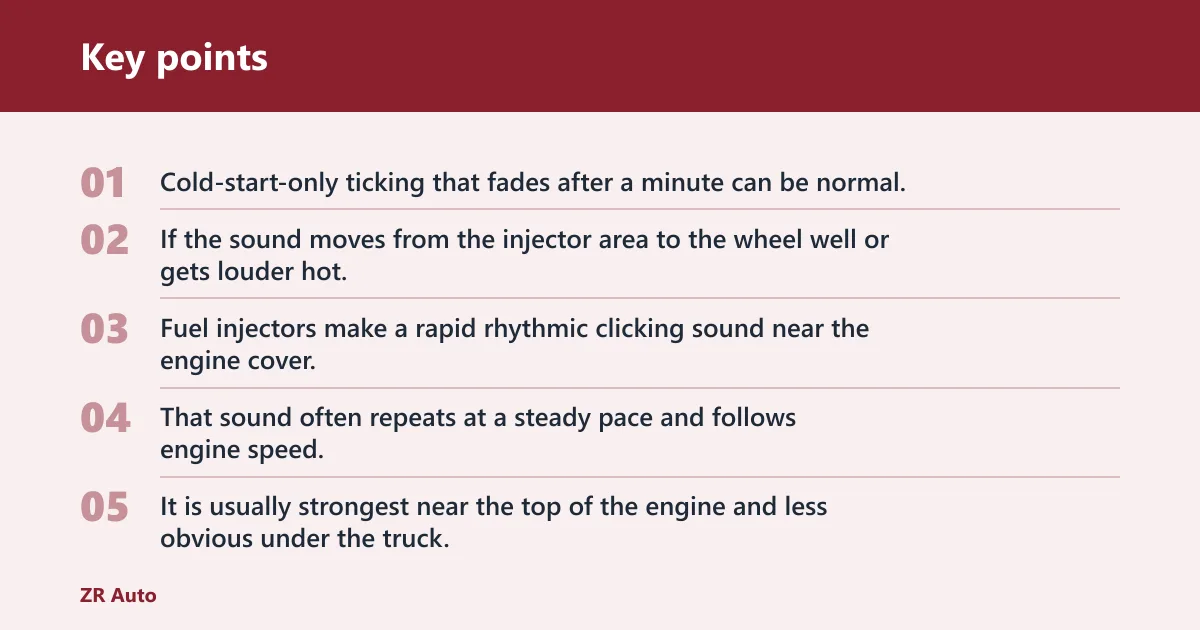
Cold-start-only ticking that fades after a minute can be normal, but it still helps to confirm the location. If the sound moves from the injector area to the wheel well or gets louder hot, treat it as a fault, not a feature.
Normal injector clicking
Fuel injectors make a rapid rhythmic clicking sound near the engine cover. That sound often repeats at a steady pace and follows engine speed. It is usually strongest near the top of the engine and less obvious under the truck.
Signs the noise is harmless
Harmless ticking stays even, does not worsen under load, and does not come with a warning light, misfire, or oil pressure issue. It may be more obvious on a cold start and then fade as the engine warms.
Signs the noise needs fast diagnosis
Fast diagnosis is warranted if the tick gets louder with rpm, comes from one side, appears with low oil pressure warning signs, or turns into a knock. A mechanical oil-pressure gauge can confirm pressure if the dashboard warning is questionable. For oil-pressure concerns, the question is not just whether the light is on, but whether actual pressure is dropping at hot idle or under throttle.
Diagnose the source step by step
Start with the cheapest checks. Check oil, inspect the exhaust, then move to the belt drive and scan for codes. That order catches the most common Durango tick causes before parts are replaced.
- Check the oil dipstick with the vehicle on level ground.
- Verify the oil level, oil change interval, and correct viscosity on the cap or service record.
- Inspect the exhaust manifold area near each wheel well for soot, loose bolts, or a sharp puffing tick.
- Inspect the serpentine belt, belt tensioner, idler pulley, alternator, and A/C compressor for play or noise.
- Scan with an OBD-II scanner for misfire, timing, or oil-pressure related codes.
If the oil level is low, add the specified oil in about 1/2-quart increments, then recheck the dipstick before adding more. If the oil is full but dark, thin, or past interval, schedule service before chasing deeper causes. Wrong viscosity can change valve train noise. A scan tool is most useful when there are misfire, cam/crank correlation, or timing-related codes; it is less useful for a plain mechanical exhaust leak or a loose bracket noise.
Could it be the engine or exhaust?

Yes. On a Durango, especially a 5.7L HEMI, exhaust manifold leaks and valvetrain noise are two of the most common engine-side tick sources. A HEMI-style exhaust leak often sounds sharp on cold start and may be easiest to hear near the wheel well. On HEMI V8 Durangos, the 5.7L is the classic manifold-bolt problem engine, while the 3.6L Pentastar can still have valvetrain, accessory-drive, or timing-related noises that need a different diagnosis.
5.7L HEMI exhaust leak clues
A broken or loose manifold bolt can let exhaust pulse through a gap and create a tick that sounds like a lifter problem. The sound is often strongest cold, may reduce as metal expands, and may be heard around the fender liner or lower engine bay.
Broken exhaust manifold bolts and gasket leaks are especially common on the 5.7L HEMI. Typical clues include a cold-start tick that quiets as the engine warms, soot around the flange, and a sharp puffing sound near the wheel well or lower rear edge of the manifold.
Lifter and valvetrain clues
Hydraulic lifters and other valvetrain parts usually make a top-end tick. Wear, sludge, or poor oil maintenance can keep a lifter from pumping up properly. If the tick stays hot, follows rpm, or appears with low oil pressure signs, inspection is needed.
Because lifter noise is often tied to oil supply and mechanical lash, a good next step is to confirm the oil level, verify the oil pressure with a gauge if the warning light or sound suggests low pressure, and then look for misfire or cam-following issues that a scan tool can capture.
Timing chain caution on high-mileage engines
Timing-related noise can start as a brief cold-start rattle and become more obvious with mileage. Do not confuse this with normal injector clicking. If startup noise comes from the front cover, scan for codes and listen again with a stethoscope before assuming the worst.
When timing-chain or lifter diagnosis is on the table, a scan tool can help identify correlation or misfire clues, but it does not replace a mechanical check for pressure, chain slack noise at the front cover, or repeatable top-end ticking that changes with oil quality and temperature.
Is it safe to drive a Durango with a ticking sound?
Sometimes, yes. A light injector tick or brief cold-start sound is commonly reported as safe to drive if oil pressure is normal and there is no misfire, loss of power, or knock. A deep tick, warning light, or sound that speeds up with load is a different case.
Stop driving now
Shut it down if the tick comes with low oil pressure, a knocking sound, flashing check engine light, misfire, or reduced power. Those signs can point to rod-bearing damage or a severe lubrication issue. Driving farther can raise repair cost fast.
If that didn’t work, try this next
If the oil level is correct and the noise is still present, move to a cold-start exhaust inspection and then a belt-drive check. If the sound remains after those checks, use an OBD-II scan and an oil pressure gauge before any major part replacement.
Common mistakes
A common mistake is replacing lifters before checking oil level and oil grade. Another is ignoring a tick that gets louder once the engine warms up. Cold-only clues matter, but hot behavior matters just as much.
Another miss is assuming every wheel-well tick is a brake issue. On a Durango, manifold leaks often echo into that area. Do not keep driving through an oil pressure warning, misfire, or fresh knocking sound.
Frequently asked questions
Why is my Dodge Durango making a ticking sound?
The most common causes are injector clicking, exhaust manifold leaks, lifter noise, belt-drive parts, or timing-related wear. Location helps narrow it down: top end for injectors or lifters, wheel well for manifold leaks, front accessory side for belt parts, and the lower engine for serious bearing noise.
Is a ticking noise from my Durango normal?
It can be. A light, even tick that stays steady and fades after startup is often normal injector noise or a heat-related sound. If the tick gets louder, changes with rpm, or appears with power loss or warning lights, it should be checked.
Can low oil cause a ticking sound in a Dodge Durango?
Yes. Low oil level, wrong viscosity, or a long oil change interval can make lifters and other valvetrain parts tick. Start with the dipstick, then confirm the correct oil grade and service interval. If pressure warning signs are present, do not keep driving.
Does a bad exhaust manifold make a ticking noise?
Yes. A loose or broken manifold bolt, or a leaking manifold gasket, can make a sharp tick that is often loudest on cold start and near the wheel well. Soot around the manifold, a puffing sound, or heat damage near the flange are useful clues.
Could the lifters or valvetrain be ticking in my Durango?
Yes. A top-end tick that changes with rpm, stays after warm-up, or follows poor oil service can point to lifters or other valvetrain parts. That kind of noise deserves inspection, especially if it is paired with sludge, a misfire, or low oil pressure signs.
How can I tell if the tick is from the engine, exhaust, or accessories?
Use a cold-start listening test and move by zone. Top end points to injectors or lifters, wheel well points to exhaust leaks, and the belt side points to tensioner, idler, alternator, or A/C compressor noise. A stethoscope and OBD-II scan help separate the source quickly.
How much does it cost to fix a ticking sound on a Dodge Durango?
Cost depends on the cause. An oil service or belt part can stay in the lower cost tier, while manifold bolt repair, lifter work, or timing repairs move higher. Do not assume the most expensive fix first; verify oil, location, and codes before pricing parts.
| Repair type | Typical cost range | What it usually covers |
|---|---|---|
| Oil service | $60-$150 | Oil and filter change, with correct viscosity |
| Belt components | $120-$450 | Serpentine belt, tensioner, or idler pulley |
| Manifold bolts/gasket | $250-$900 | Exhaust manifold hardware, gasket, and labor |
| Lifters | $1,200-$3,500+ | Top-end teardown, parts, and labor |
| Timing work | $1,000-$3,000+ | Timing chain, guides, tensioner, and related labor |
For a 5.7L HEMI Durango, manifold-bolt repair often lands in the middle of the budget range, while lifter or timing work can rise quickly because of labor time. If the tick is only injector noise, the right answer may be no repair at all beyond maintenance and monitoring.
Sources
- SAE International: HEMI exhaust manifold bolt issues and NVH discussion
- Mopar: vehicle information and oil viscosity guidance by model
- NHTSA: Dodge Durango recalls and complaint data
- AA1Car: oil pressure warning symptoms and diagnosis
- CarCareKiosk: engine ticking noise causes and diagnostics
- Motor: engine tick diagnosis overview