Is the Volvo S60 a Safe Car for a New Driver?
Yes, a used Volvo S60 can be a safe first car, especially 2011-and-newer models with stability control, multiple airbags, and available collision-avoidance tech. For a new driver, avoid the stronger turbo trims. Skip that advice, and you may trade safety margin for higher repair bills and harder handling. This guide weighs crash protection, driver-assist features, visibility, power delivery, and ownership costs for parents and first-time drivers.
Volvo S60 safety fit scorecard
| Category | Score | Why it lands there |
|---|---|---|
| Crash protection | 5/5 | Volvo puts safety at the center of the S60, and the car uses SPA architecture with a rigid passenger safety cell. |
| Active safety tech | 4/5 | Automatic emergency braking, lane-keeping support, blind-spot monitoring, and cross-traffic alert can catch beginner mistakes early. |
| Visibility and parking confidence | 3/5 | Comfortable seats help, but the low sedan stance and rearward sight lines demand more care in tight traffic and parking lots. |
| Power manageability | 3/5 | The 247-hp turbo four is reasonable for many drivers, while the 456-hp plug-in hybrid is too quick for a default first car. |
| Ownership cost | 3/5 | Used prices are attainable, but premium-brand insurance and repair costs can sting a new driver budget. |
Bottom line: cautious new drivers should prioritize lower-output trims and a clean safety history. Average first-time drivers can live with the S60 if the price, insurance, and visibility all check out. Confident drivers will appreciate the chassis and safety tech, but the plug-in hybrid is not the default answer.
Who should buy it?
The S60 fits a buyer who wants a premium compact sedan with strong crash protection and helpful driver aids, not a basic commuter. Car and Driver lists the 2025 S60 used price range at $23,999 to $49,991, which puts some examples in reach for first-car shoppers, but the top end can push well past sensible starter-car money.
The 2025 Volvo S60 is the model’s final production year. It seats five people and is available with both front-wheel drive and all-wheel drive, so used listings can vary in price, traction, and upkeep.
Is the Volvo S60 safe for a new driver?
Yes, the Volvo S60 can be a strong first-car option if you choose the right year and trim. Its safety reputation is real, but beginner drivers need more than a good crash rating; they need manageable power, clear sight lines, and driver aids that reduce common early mistakes.
What makes it a strong first-car option
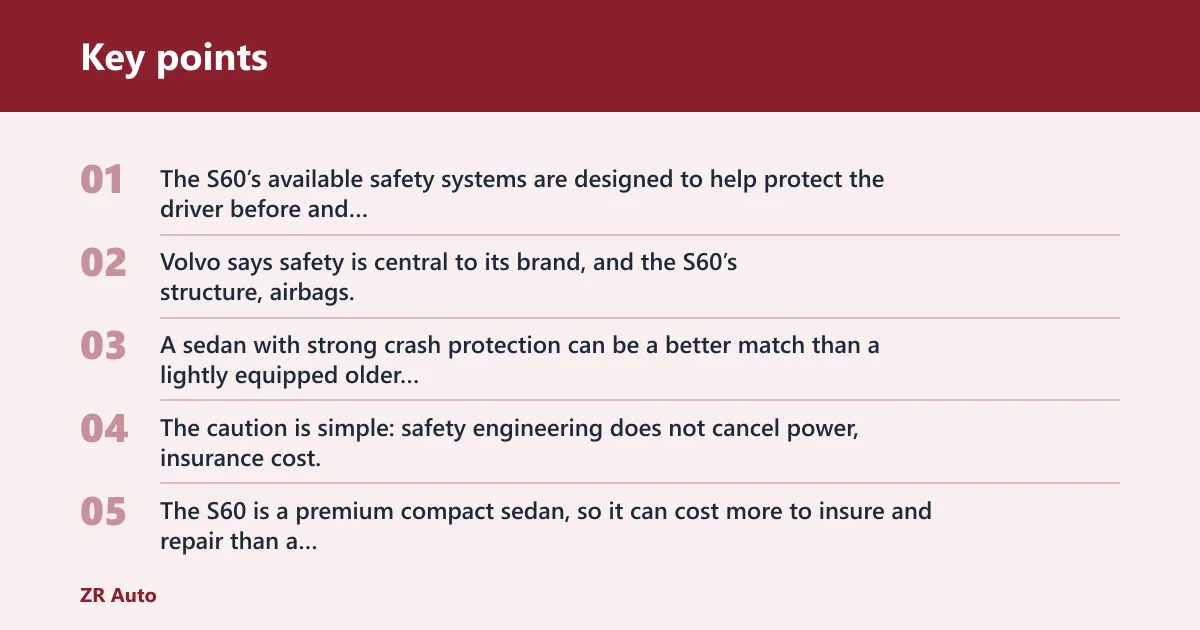
The S60’s available safety systems are designed to help protect the driver before and during a crash. Volvo says safety is central to its brand, and the S60’s structure, airbags, and available assistance systems are meant to help when judgment or timing is off.
That matters for a new driver. A sedan with strong crash protection can be a better match than a lightly equipped older car, especially when the buyer is still learning lane position, following distance, and parking judgment.
Where beginner drivers need caution
The caution is simple: safety engineering does not cancel power, insurance cost, or poor visibility. The S60 is a premium compact sedan, so it can cost more to insure and repair than a mainstream used sedan, and the tighter rear view can make backing out of crowded lots harder.
Say your new driver is backing out of a school parking space between two taller SUVs. The S60’s rearward sight lines and camera use become more important than its crash rating, because the problem is avoiding the mistake in the first place.
Best fit for cautious, average, and confident new drivers
Cautious new drivers: choose a lower-output S60 with front-wheel drive if possible, and keep the trim modest. The car is safest for this group when the goal is calm commuting, not quick acceleration.
Average new drivers: the S60 works if insurance is affordable and the car has the safety aids listed later in this article. It is a better fit when parents want a premium sedan with more protective hardware than the average used four-door.
Confident new drivers: the S60 can fit well, but the 456-horsepower plug-in hybrid should not be the starting point. Power can help on highways, yet it also raises the chance of abrupt acceleration in a driver still building habits.
How Volvo safety reputation carries over to the S60
Volvo’s safety image is a major reason buyers look at the S60 at all. The brand says safety is a core focus, and that matters because the company built its name around crash protection, restraint design, and driver-assistance systems rather than chasing the sportiest setup in the class.
Brand-level safety positioning
Volvo stresses a safety-first identity across its lineup, and the S60 follows that pattern. The car uses the Scalable Product Architecture, or SPA, and Auto-Mundo says the platform uses hot-formed boron steel for a rigid passenger safety cell.
That is not a guarantee against injury, but it is a meaningful reason parents often start their search with Volvo. A safety reputation only helps when it matches the exact car, trim, and model year on the used lot.
Standard and available safety equipment
The S60’s beginner-friendly appeal comes from features that can step in before the driver makes a bigger mistake. Automatic emergency braking helps with sudden stop-and-go traffic, lane-keeping support can keep the car centered, blind-spot monitoring helps during merges, and cross-traffic alert is useful when backing out of driveways or crowded lots.
These systems do not replace attention. They buy time. For a new driver, that extra margin can matter more than peak horsepower or a sport-tuned suspension.
Why safety is a real buying reason
Many shoppers say they want safety, but with the S60 it should be part of the buying math. A safer structure can reduce the damage from a crash, while the driver-assistance package can reduce the odds of a low-speed scrape or merge mistake that a beginner is more likely to make.
A common first-timer mistake is drifting right while checking mirrors in a busy two-lane street. Lane-keeping support can help, but it should be treated as backup, not a substitute for practice.
What crash-test results say
Crash-test results matter, but they should be read by model year, not by brand name alone. The safest way to shop a used S60 is to verify the exact year on the NHTSA site and then compare the overall safety rating for that version.
NHTSA overall safety rating
NHTSA is a standard crash-test source to check for a used S60. The overall rating can tell you a lot about crash protection, but the value only applies to the tested model year and drivetrain configuration, so a score on one year does not automatically cover every used example.
Why model-year-specific results matter
This matters because used S60s span a wide range of updates, equipment levels, and powertrains. A buyer should not assume that a 2025 result applies to an older car, even if the badge looks the same.
When a used listing looks good, verify the year first, then the crash-test result, then the safety equipment on that specific trim. That order keeps the decision tied to the actual car, not the brochure.
How to read crash ratings for a used S60
- Confirm the model year.
- Check the NHTSA overall safety rating for that year.
- Look for the specific driver-assistance equipment on the car in front of you.
- Compare the insurance estimate against your monthly budget.
- Use the result as one part of the decision, not the whole decision.
Which safety features matter most for beginners?
The most useful safety features for a new driver are the ones that reduce common mistakes at low and medium speeds. In the S60, automatic emergency braking, lane-keeping support, blind-spot monitoring, and cross-traffic alert are the main items to prioritize.
Automatic emergency braking
This is the feature that can help most in stop-and-go traffic. If a beginner follows too closely or a car ahead stops harder than expected, automatic emergency braking can help reduce impact speed or avoid the contact entirely in some situations.
Lane-keeping support
Lane-keeping support is useful for drivers who are still working on steady steering input. It can help with gentle corrections on marked roads, especially during longer commutes or when attention splits between mirrors, speed, and traffic flow.
Blind-spot monitoring
Blind-spot monitoring matters because inexperienced drivers often underjudge the space beside the car. It is especially helpful on multi-lane roads where a mirror glance is not always enough.
Cross-traffic alert
Cross-traffic alert is one of the best beginner aids for parking lots and driveways. It helps when backing out of a space with blocked sight lines, which is exactly where many low-speed bumps happen.
Power and drivability for a first car
The S60 is available with either a turbocharged four-cylinder of about 247 hp or a plug-in hybrid of about 456 horsepower. That spread is wide enough to change the whole character of the car, which is why powertrain choice matters so much for a new driver.
247-hp turbocharged four-cylinder
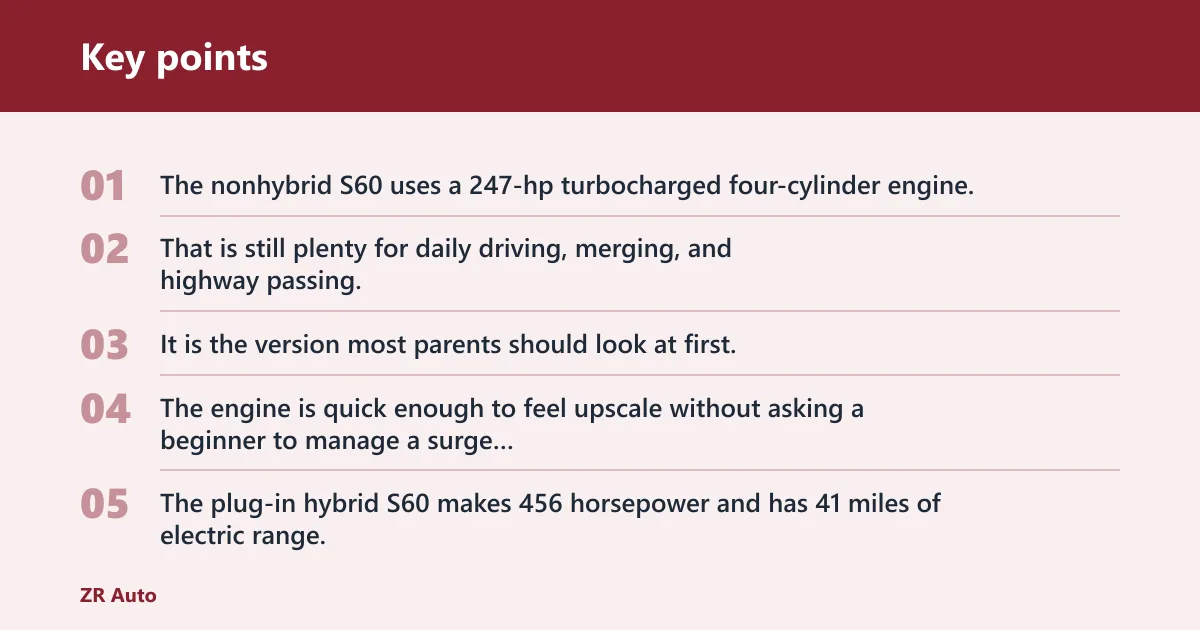
The nonhybrid S60 uses a 247-hp turbocharged four-cylinder engine. That is still plenty for daily driving, merging, and highway passing, but it is far easier to live with than the stronger plug-in hybrid for a first-time buyer.
It is the version most parents should look at first. The engine is quick enough to feel upscale without asking a beginner to manage a surge of acceleration that can catch them off guard.
456-hp plug-in hybrid
The plug-in hybrid S60 makes 456 horsepower and has 41 miles of electric range. That sounds appealing on paper, but it is not the best default choice for a new driver because the extra power can make throttle mistakes happen faster. (Caranddriver)
If the goal is a safe first car, choose restraint over speed. The plug-in hybrid makes more sense for a buyer who already knows how to manage a high-output sedan.
Front-wheel drive versus all-wheel drive
The S60 is available with both all-wheel drive and front-wheel drive. For a beginner, front-wheel drive is often easier and cheaper to live with, while all-wheel drive can help with wet or snowy traction if the buyer needs it.
All-wheel drive does not shorten braking distance by itself, and it does not make a driver more careful. It is a traction tool, not a substitute for judgment.
Too much power for a new driver?
For many first-time drivers, yes, the higher-output S60 can be too much. The 247-hp version is the better starting point, and the 456-hp plug-in hybrid should be treated as a later upgrade rather than a beginner default.
If the driver is still learning smooth brake release and proper mirror checks, extra horsepower adds risk without adding much real-world value.
Is the Volvo S60 easy to place in traffic and parking lots?
The S60 is comfortable, but easy placement depends on the driver’s skill and the car’s sight lines. Its seats are a plus, yet the sedan’s rear-seat position and premium styling can make parking confidence lower than in a small hatchback or crossover.
Seat comfort and driving position
The S60 is known for comfortable seats, and that helps a new driver stay relaxed on longer trips. A good driving position also reduces fatigue, which matters when a beginner is still building concentration habits.
The cabin feels upscale without needing to be flashy. That can help a new driver settle in, especially if the goal is daily commuting rather than aggressive driving.
Rear-seat visibility
The rear-seat and trunk area sit in a way that can narrow the view behind the car compared with some taller vehicles. That is why backing skills and camera use matter so much in this sedan.
Picture a tight grocery-store lot with rain on the rear glass. The driver’s confidence depends less on the badge and more on whether the camera, mirrors, and lane positioning are being used well.
Parking confidence and sight lines
Parking confidence is good enough for a trained beginner, but not effortless. Low-speed maneuvering is where the S60’s premium shape can feel less friendly than its crash rating suggests.
If a buyer wants a first car that is easy to park in every situation, a taller vehicle may be simpler. If the buyer wants a sedan with better safety focus and can accept a little extra attention, the S60 makes more sense.
What will it cost to insure and own?
The S60 can be a reasonable used purchase, but it is still a premium brand car, and premium-tier insurance often costs more than insurance on a typical mainstream sedan. For a new driver, that gap can be a deal breaker if the monthly budget is tight.
Why premium-tier insurance can be higher
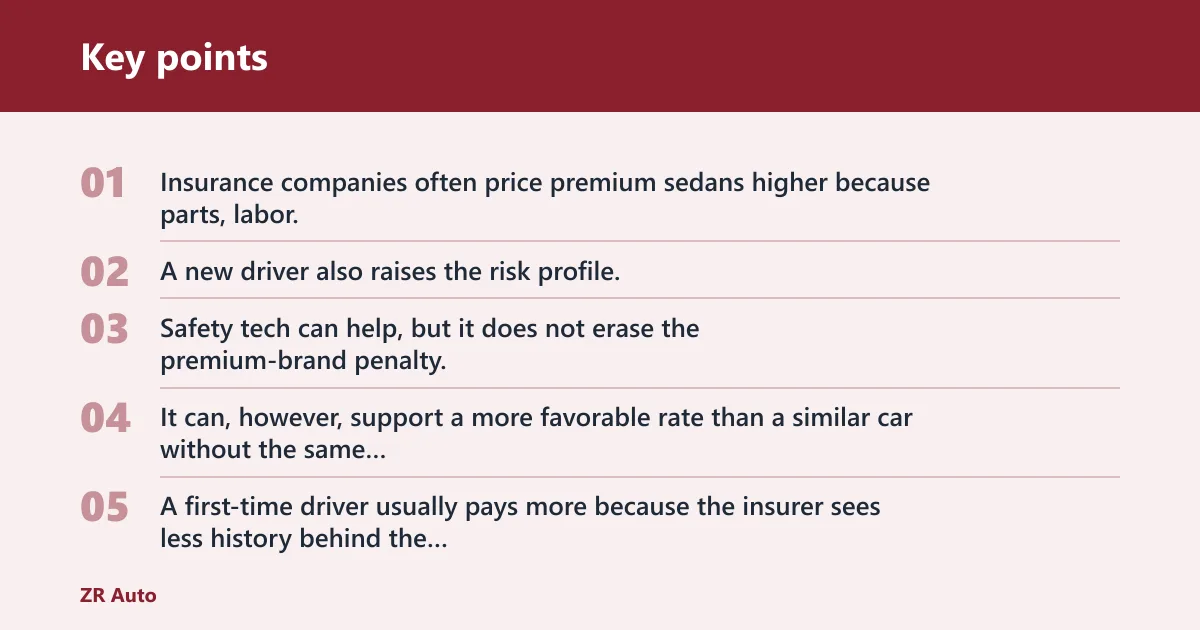
Insurance companies often price premium sedans higher because parts, labor, and repairs can cost more. A new driver also raises the risk profile, since insurers assume less experience means a higher chance of a claim.
Safety tech can help, but it does not erase the premium-brand penalty. It can, however, support a more favorable rate than a similar car without the same equipment.
How new-driver risk changes pricing
A first-time driver usually pays more because the insurer sees less history behind the wheel. That is why the S60’s purchase price is only part of the story; the insurance bill may be the bigger monthly hurdle.
When comparing cars, ask for quotes before buying. A used S60 that fits the purchase budget can still stretch the ownership budget after insurance and fuel are included.
How safety tech can affect rates
Automatic emergency braking and similar equipment can help lower risk in the eyes of some insurers. The effect is usually helpful, but it is not large enough to turn a premium sedan into a low-cost one.
Safety features should be viewed as support for the budget, not a fix for it.
Used price range and budget fit
That spread is wide because trim, mileage, and powertrain matter a lot, and the pricier examples may push a first-car budget beyond what is sensible once insurance is added.
For a cautious first-car shopper, the lower half of that range is the more realistic target. Higher trims and the plug-in hybrid can be attractive, but they make the purchase harder to justify if the buyer is still new to driving and ownership.
Used-buy checklist for a safety-first S60
Use this checklist before signing for a used S60. It keeps the decision focused on the details that matter most to a first-time driver.
- Verify the exact model year and check the NHTSA overall safety rating for that year.
- Prioritize a car with automatic emergency braking.
- Look for lane-keeping support, blind-spot monitoring, and cross-traffic alert.
- Prefer the 247-hp turbocharged four-cylinder over the 456-horsepower plug-in hybrid for a first car.
- Consider front-wheel drive first if the buyer does not need all-wheel drive for weather.
- Test the driving position, mirror adjustment, and rear visibility before deciding.
- Get an insurance quote before making an offer.
- Favor clean service records and avoid cars with unresolved warning lights or crash damage.
For safety-critical years, start with the newest model years you can afford, then verify the model-year-specific NHTSA result and the exact equipment list. The final production year, 2025, matters because it is the end of the line, but the year still needs its own rating and equipment check.
Frequently asked questions
Is the Volvo S60 a good car for a new driver?
Yes, if you choose the calmer version and the price works after insurance. The S60 gives a new driver strong crash protection, useful assistance systems, and a comfortable cabin, but its premium-brand running costs and stronger trims mean you should shop carefully, not casually.
Is Volvo a safe car brand?
Volvo has a long safety reputation, and that reputation is part of why shoppers look at the S60. The key is to remember that brand reputation is only the starting point; model year, crash-test results, and equipment on the exact car still matter more than the badge alone.
What safety features does the Volvo S60 have?
The S60 can include automatic emergency braking, lane-keeping support, blind-spot monitoring, and cross-traffic alert. Those systems are especially useful for beginners because they help with braking mistakes, drifting, merge checks, and backing out of parking spaces with limited visibility.
How does the Volvo S60 compare for insurance costs?
It is usually a premium-tier insurance vehicle, so costs can run higher than for a typical used sedan. A new driver can push the rate up further, though safety equipment may help somewhat. Get a quote before buying, because the monthly insurance bill can change the whole decision.
Which Volvo S60 years are safest to buy?
Use model-year-specific NHTSA results and equipment lists rather than assuming every S60 is the same. The safest used choice is usually the newest clean example you can afford with the right aids and a strong crash rating for that exact year, not just the best price.
Is the Volvo S60 too powerful for a new driver?
The 247-hp turbocharged four-cylinder is manageable for many beginners, but the 456-horsepower plug-in hybrid is more power than most new drivers need. For a first car, the safer choice is the lower-output model with easy throttle response and a calmer feel.