Is the Volvo XC90 Reliable for a Used SUV? Common Issues
A used Volvo XC90 makes sense only if you target 2019-2021 examples with full maintenance records and a clean pre-purchase inspection. Earlier neglected trucks can turn costly fast. Miss the warning signs, and repair bills can wipe out the SUV’s price edge. This guide covers the safest model years, the failures you should inspect, and whether XC90 repair costs still add up.
XC90 reliability decision matrix
The XC90 is a three-row luxury midsize SUV, and its reliability changes a lot by generation and model year. A clean late second-generation example can be a reasonable used buy. An early first-generation or launch-year second-generation truck can be a repair-risk purchase, especially if the service history is thin.
| Model-year range | Expected risk level | Buy or skip conditions |
|---|---|---|
| 2003-2005 XC90 T6 | High | Skip unless it has documented transmission service, clean shift behavior, and a price that leaves room for major repairs. The GM-sourced automatic transmission is the main concern. |
| 2003-2008 XC90 overall | High to above average risk | Buy only with complete records and a strong inspection. Automatic transmission issues are common enough to change the math for many shoppers. |
| 2016 XC90 | Above average risk | Buy only if software updates are current, oil consumption is not present, and the price reflects launch-year trouble. This is the redesign year to inspect carefully. |
| 2017-2018 XC90 | Moderate risk | Consider if records are strong and infotainment, electrical, and suspension systems check out. These are better than 2016, but still not the best choice in a vacuum. |
| 2019-2021 XC90 | Moderate to lower risk | Best buy zone for most shoppers. Look for full maintenance history, verified software updates, and no signs of oil use, camera faults, or suspension issues. |
| 2022, 2024, 2025 XC90 | Lower recent-year risk | Buy if the price premium still leaves enough savings versus a new SUV. Recent years score well in RepairPal-based rankings, but still need careful inspection. |
Is the Volvo XC90 reliable as a used SUV?
The XC90 is reliable enough to consider, but not reliable enough to buy on score alone. RepairPal rates it 3.5 out of 5.0, labels it above average, and places it 8th out of 14 luxury midsize SUVs. Consumer Reports gave the 2025 XC90 a predicted reliability score of 42/100, yet still marked it Recommended.
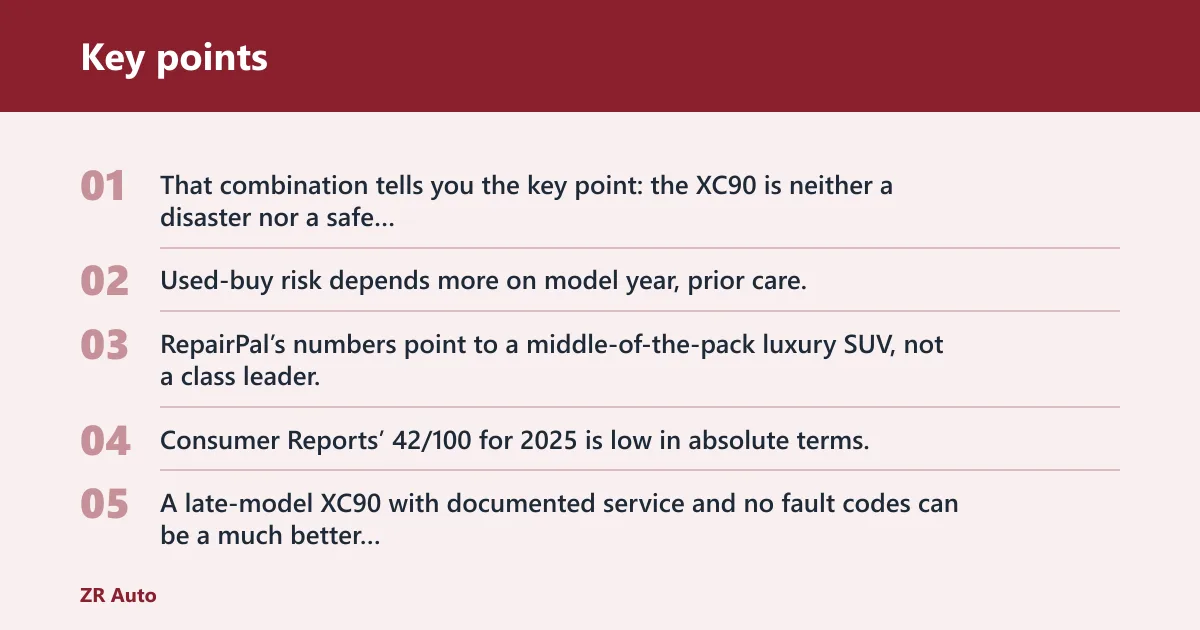
That combination tells you the key point: the XC90 is neither a disaster nor a safe default. Used-buy risk depends more on model year, prior care, and known weak spots than on the badge itself.
What the scores say
RepairPal’s numbers point to a middle-of-the-pack luxury SUV, not a class leader. Consumer Reports’ 42/100 for 2025 is low in absolute terms, but the Recommended status matters because it shows the vehicle can meet a broader standard once other factors line up.
That is why a single score can mislead. A late-model XC90 with documented service and no fault codes can be a much better purchase than an older one with a thin history, even if both wear the same nameplate.
Why age and generation matter more than a single rating
The first-generation XC90 and the second-generation XC90 have different risk profiles. The 2016 XC90 introduced the new SPA platform and Sensus infotainment system, then dealt with launch-year software complaints and oil consumption concerns. Later models improved, but not every issue disappeared.
Think in layers: generation, engine family, drivetrain, service history, and current condition. Leave out any one of those, and the reliability picture gets fuzzy fast.
Which Volvo XC90 years are the most reliable?
The safest used XC90 choices are generally later second-generation models, especially 2019-2021 and, by recent scoring, 2022, 2024, and 2025. These years tend to show fewer launch-year software complaints than the 2016-2018 period, and they usually make more sense for shoppers who want a lower-risk ownership path.
What changed after the launch years
The biggest improvement was not a redesign. It was the slow removal of early second-generation pain points. Software glitches became less common, infotainment behavior improved, and the platform matured enough that routine ownership became easier to predict.
RepairPal-based scoring lists 2022, 2024, and 2025 among the strongest recent years. That does not mean they are trouble-free. It means the odds are better when the vehicle has normal wear, full records, and no open recall or electronic fault history.
If choosing between a 2016 XC90 with patchy records and a 2020 XC90 with one-owner service history, updated software, and clean inspection results, the newer vehicle is generally the safer choice. The 2020 is the safer risk decision even if the purchase price is a little higher.
Which Volvo XC90 years should you avoid?
The clearest year to avoid is 2016, which is widely flagged as the one to skip because it brought launch-year issues with the SPA platform and Sensus system. The 2003-2005 XC90 T6 is the other major caution zone because of transmission risk. Older 2003-2008 models overall deserve extra scrutiny.
2003-2005 XC90 T6 transmission risk
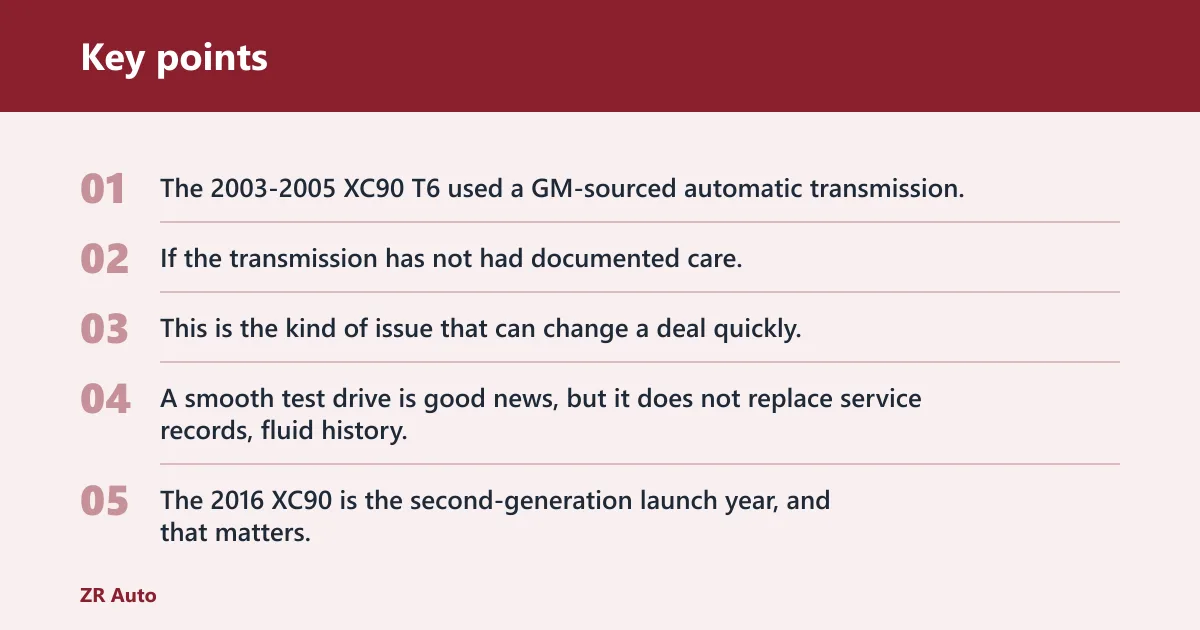
The 2003-2005 XC90 T6 used a GM-sourced automatic transmission, and reports of slipping or harsh shifts make those years the highest-risk early group. If the transmission has not had documented care, the repair reserve matters as much as the asking price.
This is the kind of issue that can change a deal quickly. A smooth test drive is good news, but it does not replace service records, fluid history, or a scan for stored faults.
2016 launch-year problems
The 2016 XC90 is the second-generation launch year, and that matters. Early second-generation XC90s were troubled by software glitches and oil consumption, so a nice-looking example can still carry avoidable risk if the owner ignored updates or warning signs.
It is not that every 2016 is bad. It is that the burden of proof is higher than it is on later years.
Years to approach only with strong records
First-generation models from 2004-2014 also had climate control system faults, which can turn a cheap SUV into an annoying one.
Ask for proof of routine service, transmission attention where relevant, and software updates. If the seller cannot document those items, walk away or price the truck as a repair project.
XC90 ownership costs and repair risk
Average annual repair cost for the XC90 is around $851, compared with the luxury midsize SUV average of $807. That gap is not huge, but it matters when a used XC90 already carries model-year-specific risk and possible electronic repairs.
Maintenance cost also changes with mileage. A well-kept 70,000-mile XC90 can be reasonable. A neglected 120,000-mile example with old fluids, worn suspension parts, and unresolved warnings can turn expensive very quickly.
How mileage changes the budget
Low- to mid-mileage late second-generation XC90s are the easiest to budget for, because their failure pattern is usually less about catastrophic wear and more about known repair items. As mileage rises, air suspension, electronics, and cooling-system work become more likely money points.
That is why a cheap purchase price can mislead you. A lower-mileage truck with a better record can cost less to own than a high-mileage bargain with missing history.
When an extended warranty makes sense
An extended warranty can make sense for a used XC90 if the vehicle still has factory coverage risk, has air suspension, or comes from a year with known electronic issues. It is less useful if the truck is already well past the period when major failures tend to appear and the price of coverage is high.
Use the warranty as a hedge, not as a substitute for inspection. If the contract excludes the systems that worry you, it is not a real solution.
XC90 failure points inspection guide
The most useful inspection is not generic. It should target the XC90’s known weak points: transmission behavior, oil use, infotainment operation, air suspension function, and camera software. Ask for evidence, not reassurance.
Common problem areas
Sensus infotainment complaints often involve touchscreen freezes, Bluetooth drops, and other connectivity faults. Air suspension is another higher-cost risk item because the system adds complexity and repair exposure. Recent model years have also seen backup camera problems tied to an NHTSA recall and software fix.
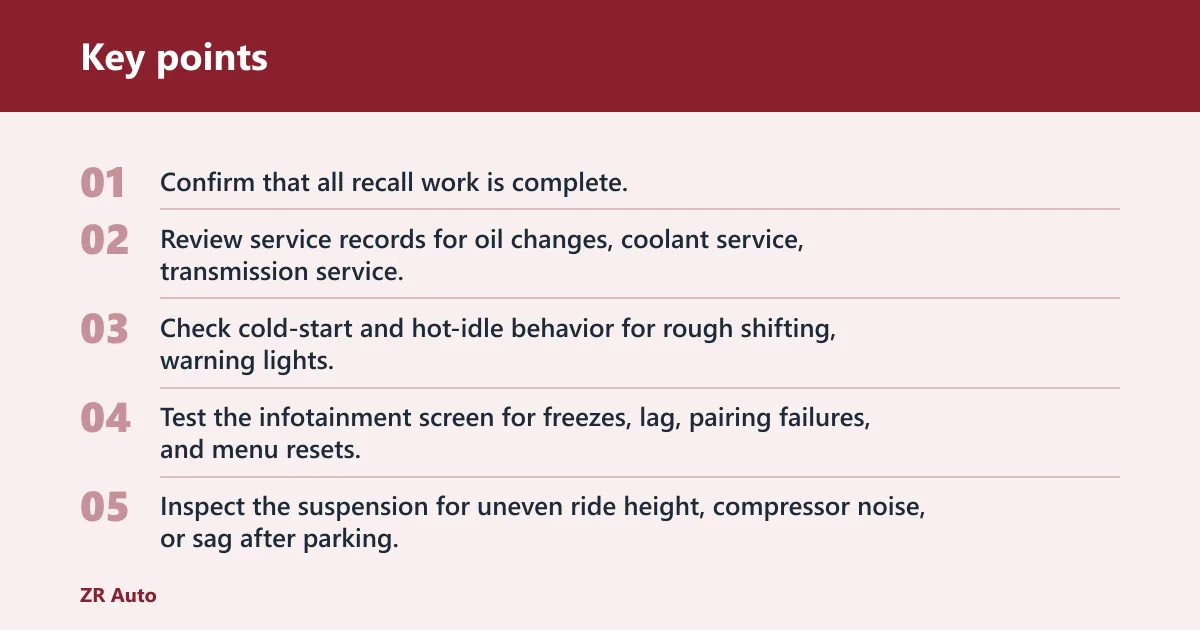
- Confirm that all recall work is complete, especially backup camera software updates on newer XC90s.
- Review service records for oil changes, coolant service, transmission service, and software updates.
- Check cold-start and hot-idle behavior for rough shifting, warning lights, or abnormal engine noise.
- Test the infotainment screen for freezes, lag, pairing failures, and menu resets.
- Inspect the suspension for uneven ride height, compressor noise, or sag after parking.
- Use a pre-purchase inspection to scan for stored codes and check for active leaks or wear.
| Common XC90 failure area | Inspection evidence to request |
|---|---|
| Transmission | Service records, smooth upshifts and downshifts, no slipping under throttle, no delayed engagement, and no transmission-related fault codes. |
| Oil consumption | Oil-change history, level checks over time, no visible smoke, no oil residue around the engine, and no owner notes about frequent top-offs. |
| Infotainment | Proof of software updates, touchscreen response during startup and navigation, and clean Bluetooth pairing with no repeated disconnects. |
| Air suspension | Even ride height, no compressor overrun, no overnight sag, and no warning messages related to chassis or suspension systems. |
| Backup camera | Verification that recall or software fix work is complete, plus a working camera image with no blackout, delay, or distortion. |
A common first-timer mistake is to judge an XC90 by a short test drive only. Picture a 2020 model that feels smooth around town, then shows a frozen center screen and a warning light after a 20-minute drive on a warm afternoon. That kind of symptom pattern is exactly why a scan and a real inspection matter.
How the XC90 compares with BMW X5 and Lexus RX on reliability
The XC90 usually sits between the BMW X5 and Lexus RX in buyer risk. The Lexus RX is generally the safer reliability bet and the lower-stress ownership choice. The BMW X5 can be strong dynamically, but used-buy repair exposure is often higher and more expensive when things go wrong.
The XC90’s advantage is value and utility. The tradeoff is that you need to be pickier about year, records, and inspection than you would with an RX. Against an X5, the XC90 can be the calmer ownership choice if you avoid the weak XC90 years and buy with evidence.
What matters most in a cross-shop
If your priority is the lowest repair risk, the Lexus RX usually wins. If you want three rows and are willing to inspect carefully, the XC90 can be the more sensible value play. If you want a sportier drive and can accept higher repair exposure, the X5 stays in the conversation.
Use the same yardstick for all three: service history, known problem areas, mileage, and the cost of correcting whatever the inspection finds.
Frequently asked questions
Is the Volvo XC90 reliable as a used luxury SUV?
It is reliable enough for the right buyer, but only by model year and condition. Later second-generation XC90s are the better bets. Early first-generation trucks and the 2016 redesign year bring more risk, so the best purchase is the one with records, updates, and a clean inspection.
What Volvo XC90 years should you avoid?
The early T6 models carry GM-sourced transmission risk, while the 2016 redesign year is known for software glitches and oil consumption concerns. Other early years also deserve caution.
How much does it cost to maintain a used Volvo XC90?
Average annual repair cost is around $851, versus $807 for the luxury midsize SUV class average. That difference is not extreme, but it becomes important when a specific XC90 has high mileage, missing records, air suspension, or known electronic problems that need correction.
What are the most common problems on a used XC90?
Common concerns include transmission issues on early models, oil consumption on some early second-generation trucks, Sensus infotainment freezes, Bluetooth and connectivity faults, air suspension repairs, and backup camera software problems on some recent model years. Each issue should be checked directly, not assumed.
Should I buy an extended warranty on a used Volvo XC90?
It can make sense for a later XC90 that still carries higher repair exposure, especially if it has air suspension or a history of electronic complaints. Do not buy coverage blindly, though. Compare the contract’s exclusions against the exact systems that worry you most.