Volvo S60 Best Years, Worst Years, and Common Problems
The safer Volvo S60 buys are generally 2017–2022 models with complete service records and no open recalls; the riskiest are often 2011–2015 cars, especially early T6 and turbo-four versions with transmission or cooling complaints. Skip that split and you can end up with a sedan carrying costly electronic faults, oil leaks, or drivetrain repairs that erase the price gap fast. This guide ranks S60 years by risk, lists the common failures by symptom, and shows which recalls and service documents matter before you buy.
Volvo S60 buyer matrix
| Year range | Likely failure mode | What to test on a drive | Recall or VIN check needed | Budget verdict |
|---|---|---|---|---|
| 2011–2012 | Higher complaint volume, oil consumption concerns, rough-shift or drivability complaints, more electrical warnings | Cold start, gentle and hard acceleration, shifting at low speed, warning lights after a full drive cycle | VIN recall status, service proof for any engine or software repair, complaint history in the vehicle report | Avoid on a low budget unless records are unusually complete; only consider if priced to absorb major repairs |
| 2013–2015 | Oil consumption risk on some cars, City Safety / AEB false alarms, rear latch issues, occasional transmission complaints | Check for smoke, low oil level, hard downshifts, abrupt warning chimes, rear-door latch operation | Recall completion proof, dealer software update history, engine repair invoices, open-recall check | Best value when records are full; stronger for mid-budget buyers than for bargain hunters |
| 2016 | Transition-year electronics and some powertrain complaints, plus carryover oil-consumption risk on affected engines | Transmission smoothness, infotainment boot-up, battery health, AEB warnings, oil level trend | VIN recall status and dealer campaign completion, especially software-related work | Conditional buy only with proof of repairs and clean road-test behavior |
| 2017–2018 | Generally lower risk, but still check batteries, software behavior, and any lingering body hardware issues | Confirm quick shifts, no delayed engagement, no random warnings, stable infotainment operation | Open-recall check plus software update history | Good buy for most shoppers if mileage and records make sense |
| 2019–2022 | Later-generation electronics and software issues can still appear, but these are usually easier to verify before purchase | Stop-and-go shifting, battery voltage behavior, infotainment stability, safety-system self-checks | VIN check, dealer service record, software campaign proof | Best buy for higher budgets and for shoppers who want the cleanest risk profile |
Which Volvo S60 years should you avoid?
The main years to avoid are usually 2011 and 2012, with 2013 also worth caution if the records are thin. One guide points to 2014 and 2015 as the most dependable, while another names 2017 and 2019 as the most reliable. The split usually comes down to condition and paperwork, but early cars bring more repair exposure and more complaint history.
First-generation years with higher repair risk
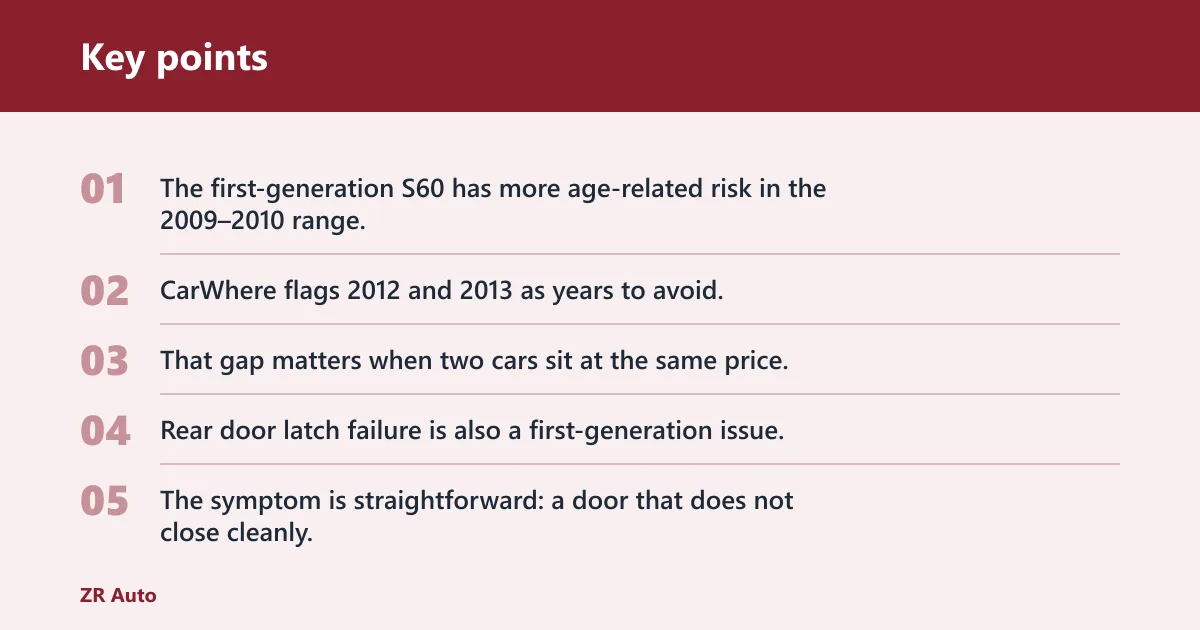
The first-generation S60 has more age-related risk in the 2009–2010 range, but the sharpest warning signs sit around 2011–2012. CarWhere flags 2012 and 2013 as years to avoid, and says the 2012 S60 had 121 owner complaints while the 2013 S60 had 85 owner complaints. That gap matters when two cars sit at the same price.
Rear door latch failure is also a first-generation issue, with CarWhere listing it across 2009–2017 Volvo S60s. The symptom is straightforward: a door that does not close cleanly, a warning that a door is open when it is not, or a latch that feels weak and misses the catch. CarWhere places the usual appearance around 80,000 miles.
Second-generation years with known problem clusters
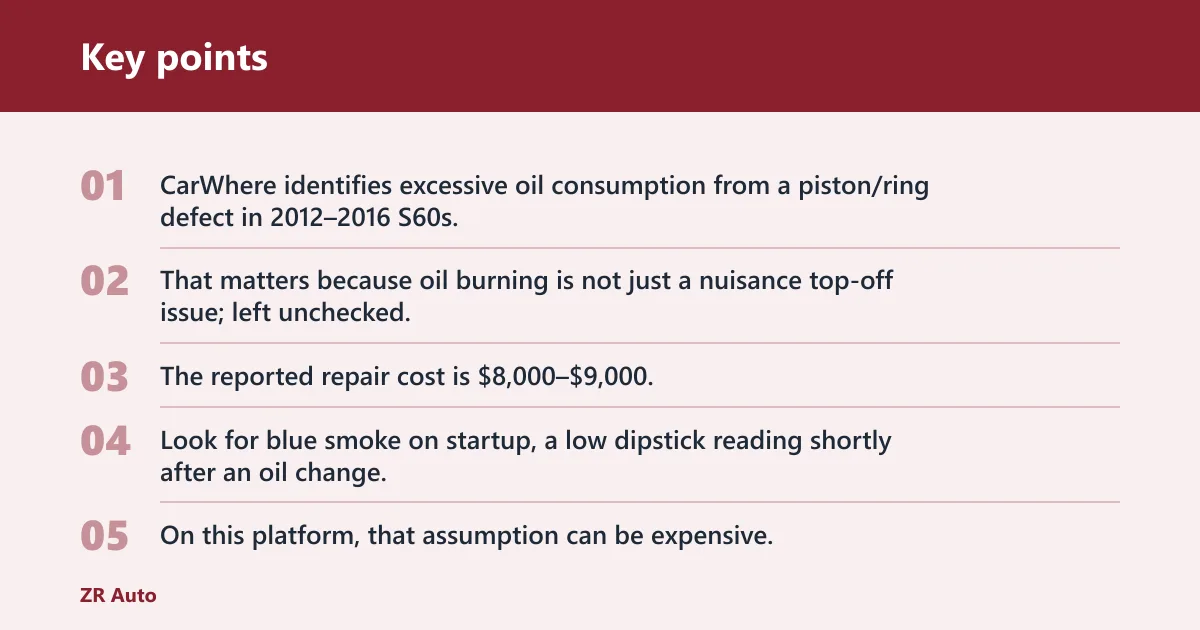
The second-generation S60 is not risk-free. CarWhere identifies excessive oil consumption from a piston/ring defect in 2012–2016 S60s, and also lists City Safety / automatic emergency braking malfunction in 2013–2016 cars. That means a newer-looking sedan can still hide expensive engine work or repeat warning lights if the seller never fixed the root issue.
Second-generation cars are often the better used buy, but only when the paperwork is strong. Those ratings do not remove the need for records. They only improve the odds.
Years that only work with full records
Some S60s are worth considering only if the service file is unusually complete. That includes 2013–2016 cars with proof of engine updates, oil-consumption repairs, battery replacement, and software campaigns. A cheaper asking price does not offset an unknown repair history when the model year falls inside the oil-consumption window.
Picture a 2014 S60 with 92,000 miles, a clean body, and a low price. If the seller cannot prove an oil-consumption repair or regular oil-level checks, the bargain can turn into an engine bill that costs more than the purchase discount. The same car with invoices and a clean VIN report is a different risk.
What are the best Volvo S60 years to buy?
The stronger used S60 picks are often 2014 and 2015 among the early cars, then 2017, 2019, and later models if maintenance is documented and all recalls are closed. These years usually avoid the worst complaint clusters, but the final buy decision still depends on oil level history, shifting behavior, and electrical health.
Best first-generation picks
For the first-generation car, later years are usually easier to live with than the early years, but they still need a careful check. A clean 2014 or 2015 car with invoices, a recent battery, and no warning lights is much more defensible than an earlier S60 with missing paperwork and a vague maintenance story. The goal is not age alone. It is known fixes.
Best second-generation picks
Among second-generation cars, 2017 and 2019 are strong choices in the sourced guidance. That does not mean every example is trouble-free. It means these years sit farther from the worst oil-consumption and complaint clusters, so a well-kept car is easier to justify. Higher-mileage examples still deserve a pre-purchase inspection.
What makes a good used example
A good S60 has three things: service records, recall proof, and a road test that stays boring. You want oil changes at sensible intervals, documented software or campaign work, and no unexplained warning lights. A seller who can show the paperwork saves you from guessing what was actually repaired.
Use this rule: if the car is priced as a bargain but the seller cannot prove the major fixes, treat it like a project, not a deal.
Volvo S60 common problems by model year
The most common S60 problems cluster into four groups: engine oil consumption, transmission issues, electrical faults, and body hardware failures. The exact mix depends on year, engine, and mileage. A well-kept 2017 car can be a better buy than a neglected 2014, but the year range still tells you where to look first.
Engine oil consumption and piston-ring defects
That matters because oil burning is not just a nuisance top-off issue; left unchecked, it can point to internal engine wear. The reported repair cost is $8,000–$9,000, and the issue typically appears around 50,000–127,000 miles.
Look for blue smoke on startup, a low dipstick reading shortly after an oil change, or a seller who says the car “just needs topping off.” A common first-timer mistake is assuming a quart between services is normal without checking whether the engine has a known consumption defect. On this platform, that assumption can be expensive.
Transmission rough shifting and failure risk
Transmission complaints show up as rough shifting, delayed engagement, flare on upshifts, or a lurch at low speed. Those symptoms can point to software adaptation issues, worn internal components, or broader drivability trouble. Early second-generation cars deserve extra attention here, especially if the seller cannot produce any transmission service history.
During the drive, pay attention to the first 10 minutes and the stop-and-go part of the route. Does the car hesitate when moving from Park to Drive? Does it slam into gear after a brief stop? Does the revs rise without a clean shift? Those cues separate normal behavior from a looming repair.
Electrical faults, warning lights, and battery issues
Electrical problems often start with dashboard warnings, dead batteries, or accessories that behave inconsistently. A Volvo S60 with a weak battery may throw unrelated warnings, which can confuse buyers into thinking several systems are failing at once. That is why battery age, charging health, and fault-code history matter during inspection.
If the dash shows safety-system warnings, or the car chimes without a clear reason, do not treat it as a harmless glitch. Some faults clear with software work, but repeat warnings can also signal sensor or module trouble.
Rear door latch failures and body hardware issues
Rear door latch failure is a body-system problem, not an engine problem, but it still affects daily use. The symptom is a door that does not latch cleanly, a door-open warning that appears intermittently, or a handle that feels loose or inconsistent.
Repair cost depends on labor and parts, so request an invoice if the seller says it was fixed. A latch replacement that looks cheap on paper can still matter if the door never shuts properly or the interior light stays on. That is not a cosmetic issue. It is a usability fault.
Infotainment and software update problems
Infotainment bugs can create false electrical alarms. A frozen screen, reboot loop, or missing menus may not mean the alternator is bad, but it can trigger other warning behavior and make the car feel unreliable. Ask whether the dealer installed any software updates and whether the seller has the campaign record to prove it.
Suppose a 2016 S60 starts with a navigation freeze, then the dash shows a battery warning the next day. That sequence can come from software, a weak battery, or both. The fix changes depending on the root cause, which is why a dealer record is more useful than a vague promise that “it was reset.”
Volvo S60 oil consumption issue
The oil-consumption problem is one of the most important S60 buying risks because it can turn into a major engine bill. That is enough to change the value equation completely.
Affected years and mileage patterns
The affected range is broad enough that mileage alone cannot rule it out. A 2012 car with 60,000 miles and a 2016 car with 110,000 miles can both sit in the risk band. Because the defect is internal, the car may look fine until you see the oil level drop between services or hear about repeated top-offs.
Symptoms a buyer can spot
Watch for smoke on startup, oil residue around the fill cap, and a seller who cannot explain how often the oil needs to be added. A pre-purchase oil-level check is useful, but it only gives a snapshot. The stronger clue is paperwork showing repeated oil use, engine tests, or a completed repair under a known campaign or warranty action.
Repair cost and buying risk
The stated $8,000–$9,000 repair range is high enough that a cheap purchase price may not help. If the car is priced well below market average, assume the discount may already reflect this risk. Only buy one if the seller can document the repair or prove the engine has been monitored and cleared through a reputable shop.
Volvo S60 transmission issues
Transmission issues on the S60 usually show up as rough shifting, hesitation, or a hard engagement into gear. They do not always mean the transmission is failing, but they are serious enough to demand a structured test drive. A smooth shift should feel boring, not dramatic.
Which years show the most concern?
Transmission concern is most relevant on early second-generation cars and on any high-mileage S60 with weak service history. The risk rises when fluid changes are missing or when the car has been driven with unresolved engine or battery faults. That is why year alone is not enough. You need the service trail.
Rough-shift symptoms on a test drive
Drive the car slowly through a parking lot, then accelerate gently onto a main road. You are listening for delayed engagement, a clunk into gear, or a pause before the car moves. Then try a few moderate accelerations. If the transmission slips, flares, or bangs into the next gear, keep looking.
Service history clues that matter
Ask for transmission service invoices, software updates, and any repair order tied to shifting complaints. If the seller says the car “learns your driving style,” that is not enough. You want proof that the transmission was either serviced or diagnosed, not just reset after a warning light.
Volvo S60 electrical problems
Electrical problems on the S60 can look bigger than they are, but they still matter because they affect drivability and safety features. Dashboard warnings, dead batteries, flaky infotainment, and driver-assist faults can all stem from the same weak point. On a used car, that means the battery and software history deserve real attention.
Dashboard warnings and dead batteries
Repeated warning lights after a full drive cycle are a red flag. So is a battery that dies after sitting for a short time. A weak battery can trigger unrelated fault messages, which is why the seller should be able to show when the battery was replaced and whether the charging system was checked.
Faulty electronics and false alarms
Infotainment and module glitches can create false alarms that look like serious failures. The screen may reboot, settings may disappear, or the car may report a fault that vanishes after restart. That still matters, because repeated glitches can point to a deeper power or communication problem across modules.
City Safety and AEB fault checks
During the road test, look for warning messages tied to the forward-collision system, odd braking alerts, or a system that refuses to arm normally. If those appear, ask for dealer diagnostics and recall completion proof before you move forward.
What should you check before buying a used Volvo S60?
Before buying, check service records, VIN recall status, software history, and a mechanic’s inspection. Those four items tell you whether the car has been maintained, whether open campaigns remain, whether the electronics have been updated, and whether the seller is hiding a current fault. A clean-looking S60 without proof is still a risk.
Service records and dealer paperwork
Request oil change records, repair orders, battery replacement proof, and any invoice that mentions engine consumption, transmission work, or safety-system faults. If the seller claims the car had a major repair, the invoice should name the part or campaign. A vague handoff note is not enough.
VIN history report and open recalls
Check the VIN for open recalls and compare the car’s records against available campaign information. NHTSA is the standard public reference point for recall status in the United States, but the seller should still show proof that the recall work was completed. A closed recall is not the same as a healthy vehicle; it only means one issue was addressed.
Mechanic inspection and software update history
Have a mechanic inspect the car for oil leaks, battery health, suspension wear, and scan-tool fault codes. Also ask for software update history from a dealer or service shop. That step matters because some electrical and safety warnings are software-related first, and hardware-related second. The paperwork should tell you which one it was.
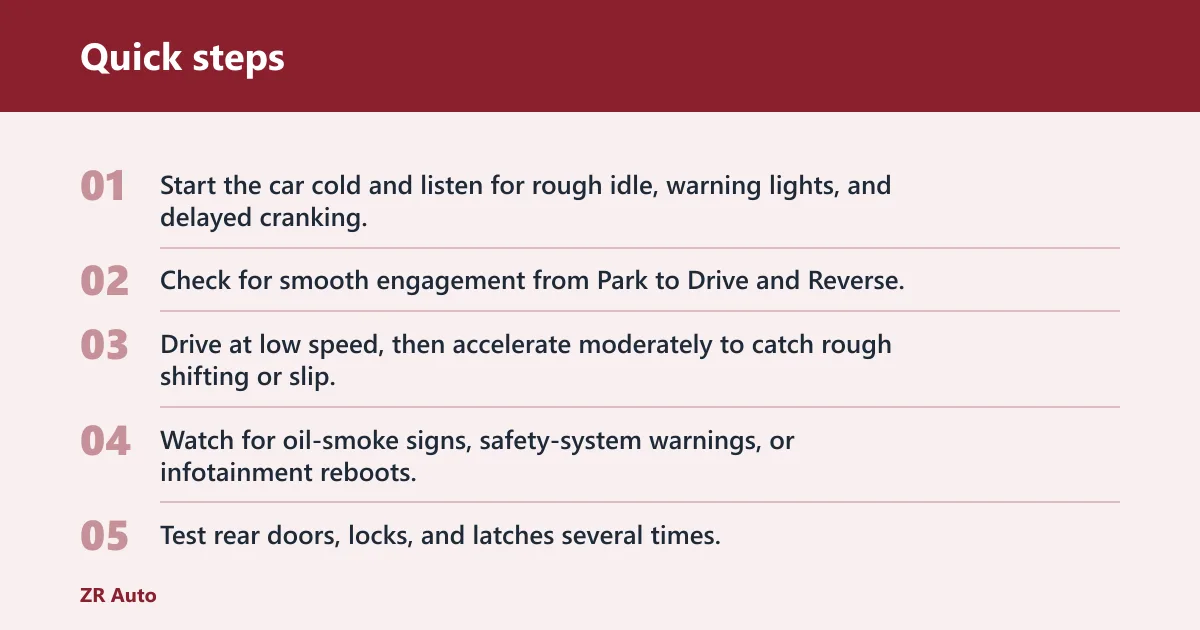
Road-test checklist for the seller meeting
- Start the car cold and listen for rough idle, warning lights, and delayed cranking.
- Check for smooth engagement from Park to Drive and Reverse.
- Drive at low speed, then accelerate moderately to catch rough shifting or slip.
- Watch for oil-smoke signs, safety-system warnings, or infotainment reboots.
- Test rear doors, locks, and latches several times.
- Confirm all recall and repair paperwork before you leave.
Say your seller hands you a 2015 S60 with 88,000 miles and a fresh oil change. If the car shifts cleanly, the dash stays quiet, and the file shows recall completion plus a recent battery, that car belongs in a very different risk bucket than an identical car with no paperwork and a low idle rattle.
Frequently asked questions
What Volvo S60 years should I avoid?
Start by avoiding 2011 and 2012, and treat 2013 with caution unless the records are excellent. The safest move is to skip the thin-file cars first.
What are the best years for a used Volvo S60?
Those years are better starting points because they sit outside the worst complaint clusters, but they still need service records, no open recalls, and a clean test drive.
What are the most common problems on a Volvo S60?
The biggest concerns are oil consumption from a piston/ring defect, rough shifting or transmission hesitation, electrical warning lights, weak batteries, City Safety / AEB faults, and rear door latch failure. Infotainment glitches can also create false warnings. The model year and maintenance history decide how serious those problems become.
Is the Volvo S60 reliable as a used car?
Yes, some years are reliable enough to buy with confidence, but reliability varies a lot by year and maintenance history. A well-kept 2017–2022 car with clean records can be a sensible used sedan. A 2011–2015 car with missing paperwork is a much riskier bet.
Which Volvo S60 years have oil consumption problems?
That makes records and oil-level history especially important on those years.
Does the Volvo S60 have transmission issues?
Yes, some S60s can show rough shifting, delayed engagement, or slipping under load. The concern is strongest when the service history is weak or the car has unresolved drivability faults. On a test drive, watch for hard gear changes, hesitation pulling away, and flare during acceleration.
Are there Volvo S60 years with serious electrical problems?
Yes. Electrical complaints are more common in some early and mid-second-generation cars, especially when battery health is weak or software updates were skipped. Repeated warnings deserve diagnosis, not dismissal.