Is There a Recall on the Dodge Durango?
Yes, some Dodge Durango SUVs have open recalls, and the dependable way to confirm one is to run the exact VIN through the NHTSA recall lookup or the Stellantis/Mopar recall page. NHTSA explains that recalls are safety-related defects, and recall repairs are generally completed at no charge to the owner. Use the VIN to verify whether there is an open recall, and use manufacturer or dealer records if you need proof that a repair was completed.
How to check your durango’s recall status
There can be, but the answer depends on the exact vehicle. A Dodge Durango recall is tied to the VIN, not the model year alone, and recall applicability depends on the vehicle’s build configuration. For a used buyer, the real question is whether this Durango has an open recall right now.
Why VIN lookup matters
The VIN is a 17-character identifier used to check a vehicle in the NHTSA recall database and the Mopar/Stellantis recall lookup. That matters because recall campaigns can cover multiple Durango model years, yet only certain build ranges or equipment packages are affected. A recall repair should be documented in the vehicle’s history, while an open recall is the item that still needs action.
Why used buyers should care first
If a seller says a Durango is “fine” but cannot show recall status, treat that as unfinished due diligence. NHTSA describes recalls as safety defects that should be corrected, and manufacturers typically repair them at no charge through a dealer. Before you buy, confirm whether the issue is open on airbags, brakes, steering, lighting, or other critical systems.
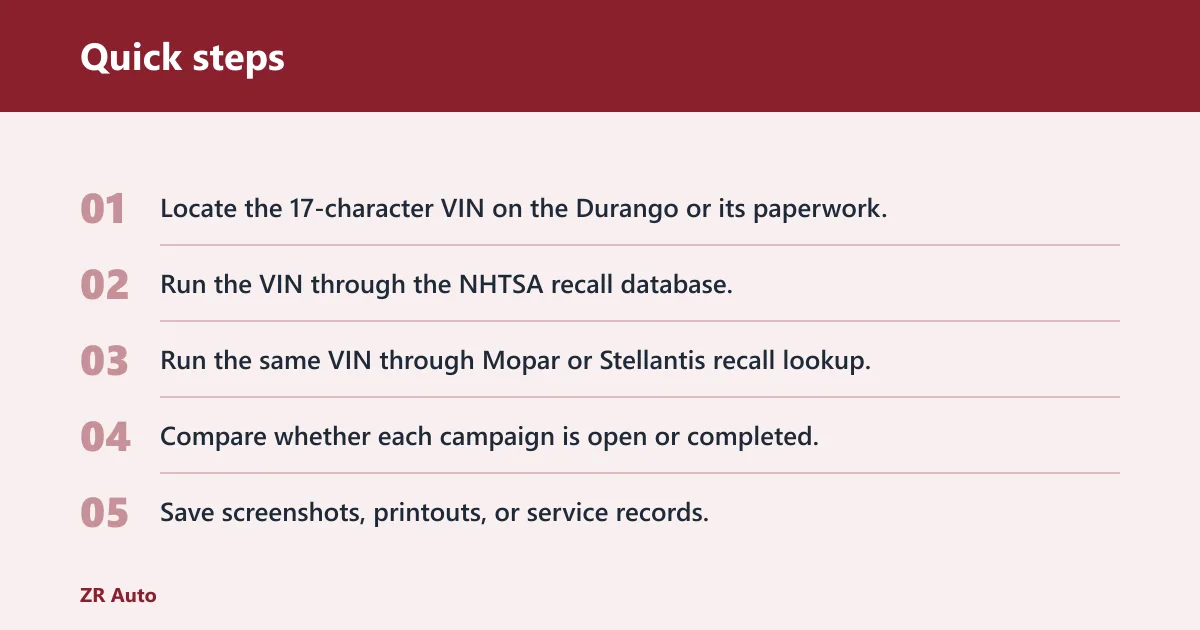
Start with the 17-character VIN, then check it in the NHTSA recall lookup and the Mopar/Stellantis recall page. Use the NHTSA result to see whether there is an open safety recall, and use the manufacturer or dealer record to confirm repair status if the campaign has already been addressed. If you need help verifying the status, call a dealer service department with the VIN and ask them to verify campaign status.
Find the VIN
You can usually find the VIN at the base of the windshield on the driver-side dashboard, on the driver door jamb label, and on title or registration paperwork. (Nhtsa)
Search the NHTSA recall lookup
Enter the VIN into the official NHTSA recall lookup. That search is the most direct way to see whether the vehicle has an open safety recall tied to the federal database. Read the result closely: open recalls need action, and if you need repair documentation, save the dealer or manufacturer paperwork that shows what was repaired and when. NHTSA’s safety-recall guidance explains the difference between open recalls and repair records.
Check Mopar or Stellantis recall lookup
Use the manufacturer lookup as a second check. Mopar or Stellantis can show owner notification details, campaign status, and dealer repair paths. If the NHTSA result and the manufacturer result line up, you have a stronger paper trail. If one source shows open and the other does not, ask the dealer service department to run the VIN through their system before you proceed.
- Locate the 17-character VIN on the Durango or its paperwork.
- Run the VIN through the NHTSA recall database.
- Run the same VIN through Mopar or Stellantis recall lookup.
- Compare whether each campaign is open or completed.
- Save screenshots, printouts, or service records.
- Use the result to decide whether to buy, negotiate, or require repair.
Does your Durango have an open recall?
An open recall means a safety-related issue has been identified but not yet fixed for that VIN. A completed remedy means the dealer performed the recall repair, part replacement, or software update and the campaign is no longer open for that vehicle. For a used buyer, the distinction matters more than the model year name on the tailgate.
Open recall versus completed remedy
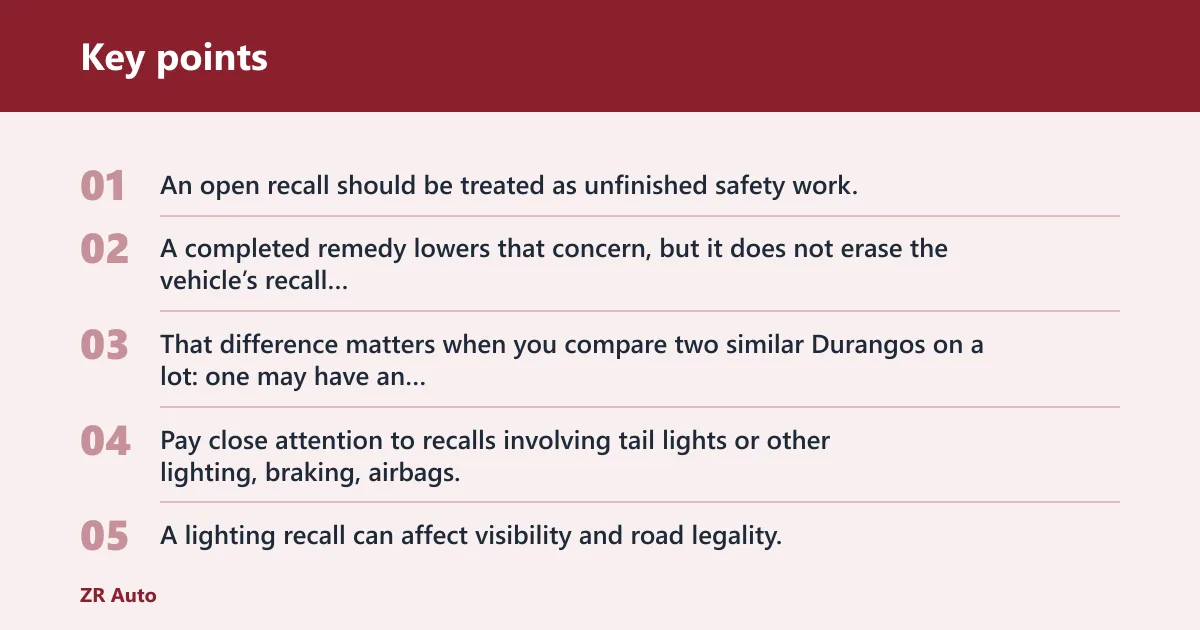
An open recall should be treated as unfinished safety work. A completed remedy lowers that concern, but it does not erase the vehicle’s recall history, so keep the proof. That difference matters when you compare two similar Durangos on a lot: one may have an open item that needs immediate attention, while another may simply show a past campaign that was already fixed.
Systems that matter most
Pay close attention to recalls involving tail lights or other lighting, braking, airbags, steering, and powertrain control items. A lighting recall can affect visibility and road legality. A brake or airbag recall can affect crash risk. Steering or powertrain campaigns can affect control or drivability, which is a stronger reason to delay purchase until the repair is documented.
Say your Durango shows an open lighting campaign and the seller is offering a quick sale. That is not a paperwork detail to leave for later. If the vehicle needs a dealer repair, use that information to negotiate price, require the seller to complete the repair, or walk away until the work is done.
Tail light recall checks
Lighting recalls come up often in searches because tail lights are visible, easy to notice, and tied to road safety. For a Dodge Durango, a tail-light concern can involve lamps, wiring, modules, or related lighting circuits, depending on the campaign. Do not assume every lighting complaint is a recall; confirm the VIN and the official campaign listing.
How to confirm a lighting campaign
Use the VIN in both the NHTSA and Mopar lookups, then read the affected system description. If the campaign mentions tail lamps, exterior lighting, lamp modules, or wiring harnesses, that is the record you need. If the lookup shows no open campaign, ask the dealer service department whether the vehicle has any documented lighting repair history anyway.
What to ask the dealer service department
Ask for the campaign number, the repair status, and a copy of the completed work order if the seller says the recall was fixed. Ask whether the VIN still shows any open lighting campaign in the dealer system. If the answer is yes, schedule the repair before delivery or require the seller to do it before closing.
Recall check checklist
Use this checklist to record lookup results, keep repair proof, and turn recall status into a buying decision. The table is formatted for easy review and extraction, so you can compare VIN, status, affected system, and next step in one place. Fill it out before you commit to the purchase.
| VIN | NHTSA result | Mopar result | Open vs completed recall status | Affected system | Dealer contacted | Repair date | Proof saved | Buyer decision |
|---|---|---|---|---|---|---|---|---|
| 1C4RDJAG0JC123456 | Open lighting recall listed | Open campaign matches VIN | Open | Tail lights | Yes, service department called | Not yet scheduled | Yes, screenshots saved | Require repair before purchase |
| 1C4SDJCT5MC654321 | No open recalls listed | Completed brake campaign shown | Completed | Braking | Yes, records verified | 2026-03-14 | Yes, work order saved | Proceed |
| 1C4RDHAG8KC987654 | Open airbag recall listed | Open campaign matches VIN | Open | Airbags | Yes, appointment requested | Not yet scheduled | No | Negotiate or delay purchase |
What should you do next?
If the recall is open, treat the repair as a purchase condition, not a later convenience. If the recall was completed, keep the proof and verify that the VIN, campaign number, and repair description match. If the seller cannot document the repair, call the dealer yourself or require the repair before you sign anything.
If the recall is open
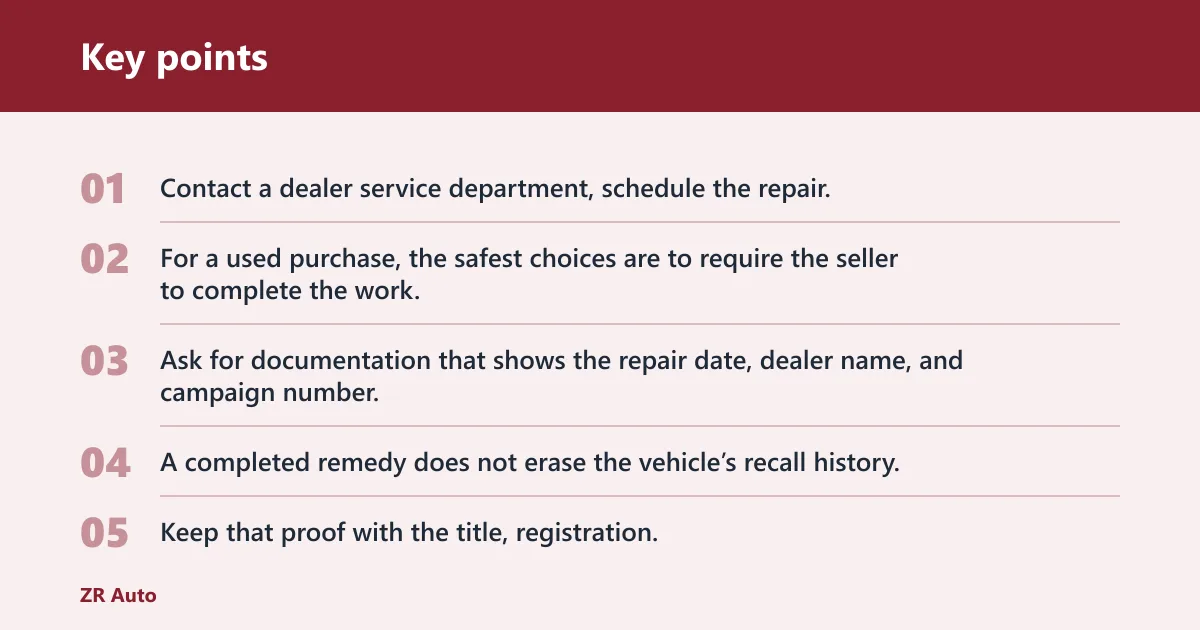
Contact a dealer service department, schedule the repair, and ask whether the remedy is available now. Recall repairs are typically free. For a used purchase, the safest choices are to require the seller to complete the work, hold back money until proof is provided, or adjust the price if the buyer must handle scheduling after purchase.
If the recall was completed
Ask for documentation that shows the repair date, dealer name, and campaign number. A completed remedy does not erase the vehicle’s recall history, but it does show the safety defect was addressed. Keep that proof with the title, registration, and service records so you can show the next buyer or dealer exactly what was fixed.
If the seller cannot document the repair
Do not rely on a verbal claim that “the recall was done.” Use the VIN lookups and ask the dealer service department to verify the campaign. If there is no proof and the campaign still shows open, assume the issue is still active. That is the point where you negotiate, delay the sale, or move on.
Suppose a 2017 Durango shows no open recalls in NHTSA, but the seller only has a vague statement about a prior tail-light fix. In that case, ask for the repair order. If the seller cannot produce it, the vehicle may still be fine to buy, but the missing proof should affect your confidence and your price discussion.
Frequently asked questions
Is there a recall on Dodge Durango?
Yes, multiple Dodge Durango model years have had recall campaigns, but the only dependable answer for a specific SUV comes from the VIN. Dodge Durango recalls may affect different model years, trims, and build dates, and some campaigns are already completed while others remain open. Check NHTSA and Mopar before you buy, not after.
Is there a recall on Dodge Durango tail lights?
Tail-light and lighting recalls do show up in Durango searches, but you need the VIN to confirm whether your vehicle is included. Look for campaign language tied to exterior lighting, lamp modules, or wiring. If the result is open, arrange dealer repair before purchase or driving.
Is there a recall on a 2015 Dodge Durango?
A 2015 Dodge Durango may have recall campaigns, but the year alone does not tell you whether a specific SUV has an open one. Use the VIN in NHTSA and Mopar. That is the only way to separate an active safety recall from a past campaign that was already repaired.
Is there a recall on a 2017 Dodge Durango?
A 2017 Dodge Durango can show recall history, but status varies by VIN. Check for open items first, then look for completed remedies in the manufacturer record. If the vehicle has an open recall on brakes, airbags, lighting, steering, or another safety system, require a dealer repair before closing.
Are there any recalls on the 2024 Dodge Durango?
A 2024 Dodge Durango may have recall status tied to its VIN, and a newer model year is not a guarantee of a clean record. Run the VIN through NHTSA and Mopar, then confirm whether the result is open or completed. Do not rely on model-year assumptions alone.
How do I check if my Dodge Durango has an open recall?
Find the 17-character VIN, then search it in the NHTSA recall database and the Mopar or Stellantis recall lookup. Compare the results and save them. If either source shows an open recall, contact a dealer service department and schedule the repair before buying, driving, or registering the vehicle.