Which VW Tiguan Engine Is Best for Reliability?
For most used Tiguan shoppers, the lowest-risk pick is the later 2.0 turbo four with the 8-speed automatic from the later Mk2 years. The most maintenance-sensitive choices are early 2.0 TSI units and any neglected timing-chain EA888. Get this wrong and you can end up with oil use, chain noise, cooling-system leaks, carbon buildup, or a transmission bill that wipes out the price gap. This guide ranks Tiguan engines by reliability risk, with year bands, common failure patterns, and the maintenance checks that matter most.
Which Tiguan engine is most reliable?
The best overall used Tiguan engine for reliability risk is the later 2.0 TSI EA888 in a well-kept vehicle, especially when paired with the 8-speed automatic and a clean service history. It is the safest mainstream U.S. choice because the worst early-chain issues matter less than they do on the oldest cars, and upkeep is more predictable than on neglected diesels or short-trip cars with direct-injection buildup.
Best overall pick by risk
Choose the later 2.0 TSI EA888 if you want the widest mix of parts support, familiar service procedures, and fewer age-related weak points than early first-generation Tiguans. Volkswagen’s current U.S. Tiguan still centers on the turbocharged 2.0-liter EA888 family, with the 2025 base output at 201 hp and the 2026 Tiguan Turbo listed at 268 hp. Output is not the same as reliability, but later calibrations usually come with better packaging and updated hardware. (Motortrend) (Motortrend)
Best pick for short trips
For short-trip use, the petrol Tiguan is the safer choice than the diesel. A 2.0 TSI warms up faster, avoids diesel aftertreatment stress on low-speed errands, and is less dependent on long runs to stay clean. The trade-off is carbon deposits and turbo wear if maintenance slips.
Best pick for higher-mileage use
For longer motorway mileage, the 2.0 TDI SCR diesel can make sense, especially in 190 ps form with 4Motion and DSG when the car has a full record of proper servicing. It suits steady-load driving better than repeated cold starts, but ownership risk rises if the previous owner used it mainly for short journeys or ignored the diesel system.
Tiguan reliability decision table
This table ranks major Tiguan engine families by reliability risk, not by speed. The score runs from 1 to 5, where 1 is lowest risk and 5 is highest risk for a used buyer.
| Engine | Years | Known risks | Best for | Avoid if | Inspection priority | Reliability score |
|---|---|---|---|---|---|---|
| 2.0 TSI EA888, later Mk2 | 2015-2017 | Carbon deposits, turbocharger wear, throttle body issues, general upkeep sensitivity | Most used buyers who want the safest all-round petrol choice | There is no service history, or cold starts are rough and noisy | Cold start, service records, coolant loss, boost response | 2 |
| 2.0 TDI SCR diesel, 190 ps | Later Mk2 diesel models | Diesel-system sensitivity, DSG service dependence, 4Motion complexity on some cars | Higher-mileage drivers and steady motorway use | The car will do mostly short trips or has patchy maintenance | Cold starts, DPF and EGR history, DSG service records, road-test smoothness | 3 |
| 1.4 TSI petrol, 150 hp | Earlier and mid-life examples | Lower-output direct-injection maintenance sensitivity, turbo wear, carbon buildup | Budget-conscious buyers wanting a cheaper entry point | You want the least fussy long-term ownership path | Service history, boost response, misfire signs, coolant level | 3 |
| 1.4 TSI petrol, 130 hp | Earlier and mid-life examples | Similar upkeep sensitivity, but with less reserve for heavy loads | Light-use drivers who value purchase price over pace | You need frequent motorway passing power or towing | Idle quality, oil service evidence, turbo spool, general drivability | 4 |
| Early 2.0 TSI EA888 | 2009-2012 | Timing chain tensioner failures, water pump leaks, electrical problems, carbon deposits, turbo concerns | Only buyers with room for a thorough inspection and repair budget | You want the lowest-risk used Tiguan | Cold-start chain noise, coolant loss, scan for fault codes, boost response | 5 |
Why early Tiguan years need extra care
Early first-generation Tiguans need the most caution because their fault pattern is broader and more costly to fix. The 2009-2012 models were more prone to timing chain tensioner failures and water pump leaks, and they also had electrical problems. Later first-generation cars from 2015 to 2017 are the strongest affordable entry point.
2009-2012 engine risks
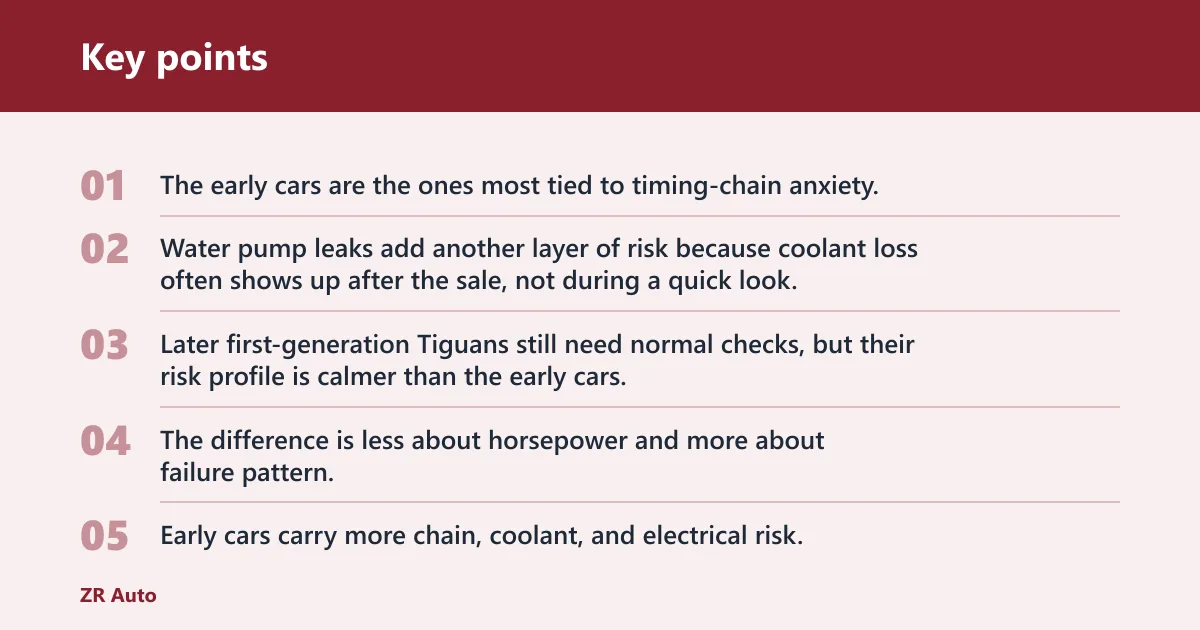
The early cars are the ones most tied to timing-chain anxiety. A noisy cold start, delayed oil pressure light-out, or a rough initial idle deserves attention, because chain hardware can turn a cheap purchase into a major repair. Water pump leaks add another layer of risk because coolant loss often shows up after the sale, not during a quick look.
2015-2017 engine risks
Later first-generation Tiguans still need normal checks, but their risk profile is calmer than the early cars. They are the better used buy if you want an older Tiguan without taking the earliest EA888 and cooling-system exposure. That said, service history still matters more than the badge on the tailgate.
What changed across first-generation years
The difference is less about horsepower and more about failure pattern. Early cars carry more chain, coolant, and electrical risk. Later first-generation cars are usually the better bet because the worst early-engine issues are less likely to drive ownership costs.
Is the 2.0 TSI Tiguan engine reliable?
Yes, the 2.0 TSI Tiguan engine is reliable enough for used-car duty when it has a clear service record and no signs of neglected cooling or chain maintenance. The EA888 family has gone through several generations of development, and later versions are often the safer used choice. The problem is not the design, it is the maintenance gap.
EA888 turbo engine strengths
The 2.0-liter turbocharged spark-ignition TSI is the core U.S. Tiguan engine family. It gives broad torque, widely available parts, and familiar diagnostics. Later versions are easier to live with than the early-chain cars, especially if the oil has been changed on time and the cooling system is dry.
Known weak points to check
Common Tiguan engine and powertrain problems include timing chain tensioner issues, water pump leaks, throttle body issues, turbocharger problems, and carbon deposits. Those are not all equally likely on every year, but they matter because they affect starting, idle quality, coolant level, and boost response. A used Tiguan that feels fine on a short loop can still hide one of those faults.
Best years within the family
Later-model years are the safer end of the EA888 range. Earlier 2009-2012 examples sit at the opposite end of the risk scale because of chain and cooling issues.
Is the diesel Tiguan the safer buy?
The 2.0 TDI SCR diesel is not automatically safer than petrol, but it can be the better long-run choice for the right driver. The 190 ps variant, especially with 4Motion and DSG in top-end Match trim, suits regular long-distance use. For short trips, it is the wrong tool and can become more troublesome than a petrol Tiguan.
2.0 TDI SCR and 190 ps use case
The diesel is strongest where steady load and warm-running mileage dominate. That is why it can make sense for high-mileage commuting, towing, or long motorway runs. It is weaker for low-speed urban use, where diesel aftertreatment and soot management can become a headache.
4Motion and DSG risk context
4Motion improves traction, but it adds drivetrain parts that need inspection and service records. DSG is not a dealbreaker, yet it raises the stakes for missing maintenance. If the fluid history is unclear, the risk level climbs quickly. A buyer who wants the simplest ownership path should usually prefer the least complex, best-documented car.
When diesel makes sense
Choose the diesel only if the driving pattern fits it. A Tiguan that sees long runs, steady speeds, and proper service will usually treat the TDI better than one used for school runs and grocery hops. If the car will mostly do short trips, petrol is the safer route.
What should you inspect before buying?
Focus on cold-start behavior, coolant level, boost delivery, and paperwork. Volkswagen recommends service every 10,000 miles, and that interval matters because the Tiguan’s known trouble spots get worse when maintenance slips. Volkswagen Tiguan reliability metrics also matter for ownership cost: the average annual repair cost is about $730, and the reliability rating is 3.
-
Start the engine cold.
Listen for chain rattle, rough idle, or a brief metallic noise in the first seconds after startup. That matters most on early 2009-2012 cars, where timing chain tensioner risk is higher.
-
Check coolant level and smell.
Look for drops in the reservoir and any sweet smell around the front of the car. Water pump leaks are a known early Tiguan issue, and coolant loss often shows up before an obvious puddle does.
-
Test boost response.
Drive the car through a clean pull at moderate throttle and watch for hesitation, limp behavior, or uneven surge. Turbocharger problems and throttle body issues can hide until the engine is asked for load.
-
Review service records.
Look for oil services at or near the 10,000-mile interval, plus DSG or diesel-system service where applicable. A missing history turns a reasonable engine into a riskier purchase fast.
-
Inspect for carbon buildup.
Ask how the car has been used and note rough idle, stumble, or weak low-end response. Direct-injection engines can collect deposits over time, and short-trip use makes that more likely.
Say your choice is between a 2011 Tiguan with no records and a 2016 car that has clean service stamps and dry coolant hoses. The newer car is the safer buy, even if the older one looks cheaper on the lot. The repair gap can be larger than the sticker gap.
Suppose a 2.0 TDI sounds smooth on a test drive but spent its life on short city hops. That diesel may still be the wrong fit, because the use pattern is part of the reliability story. Long, warm journeys are what the TDI wants.
Frequently asked questions
Which VW Tiguan engine is most reliable?
It avoids the worst early chain risk and is easier to live with than a neglected diesel or a budget car with no maintenance trail.
Which VW Tiguan years have the fewest engine problems?
The 2009-2012 models need the most caution because they were more prone to timing chain tensioner failures, water pump leaks, and electrical problems.
Is the TDI engine more reliable than the petrol Tiguan?
Not by default. The 2.0 TDI SCR can be a solid choice for high-mileage motorway driving, but it is more use-case sensitive than the petrol engine. For short trips, the petrol Tiguan is usually the safer and simpler buy because diesel systems dislike repeated cold, short runs.
What common engine problems should I check before buying a used Tiguan?
Check for timing chain tensioner noise, water pump leaks, turbocharger hesitation, throttle body faults, and carbon deposits. Also verify coolant level and the service record. A Tiguan with clean paperwork and a quiet cold start is a much better bet than one that only feels fine on a quick test drive.
Does the Tiguan engine last over 100,000 miles?
Yes, many can, if they get oil changes on time and the known weak points are handled early. The 10,000-mile service interval matters here. A well-kept Tiguan can run far past 100,000 miles, but neglected chain, cooling, or turbo problems shorten that path quickly.
Is the newer Tiguan Turbo engine likely to be reliable?
The newer Tiguan Turbo should be viewed as promising but still too new to judge with the same confidence as older engines. Its 268 hp output is not the main issue; the question is whether the updated hardware and calibration hold up over time. Early service discipline will matter a lot.
What engine should I avoid in a used VW Tiguan?
They are tied to timing chain tensioner failures, water pump leaks, and electrical issues. A cheap price does not help if the first round of repairs wipes out the savings.