Which VW Tiguan Trim Is Best to Buy Used?
This page uses a market-agnostic used-buying framework: it compares the Tiguan trims buyers are most likely to find on the used market, while noting where equipment, drivetrain and pricing differ by market. For most buyers, the SE is the best all-round buy. If you want the cheapest risk, choose the S; if you want the safest premium package, choose the SEL R-Line Turbo.
Tiguan trim matrix
This is the main used-buying trade-off. The lower you stay in the range, the less you usually pay upfront and the simpler the car tends to be to own. Move higher, and you gain comfort and image, but you also increase the chances of extra tyre, trim and feature-related costs later.
| Trim | Purchase-price risk | Expected repair exposure | Comfort and features | Resale desirability | Best for |
|---|---|---|---|---|---|
| S | Lowest | Lowest | Basic | Moderate | Cheapest risk and tight budgets |
| SE | Low to medium | Low to medium | Strong everyday value | Strong | Best daily-driver value |
| SE R-Line Black | Medium | Medium | High perceived value | Strong if priced right | Style/value sweet spot |
| SEL R-Line Turbo | Highest | Highest | Most complete | Mixed unless condition is excellent | Premium buyers who accept cost |
| eHybrid | Market-specific | Higher complexity | Strong where charging works | Depends on tax and charging demand | Company-car or tax-led buyers |
Which VW Tiguan trim is best to buy used?
The best used Tiguan trim for most buyers is the SE, because it usually gives the strongest mix of equipment, resale demand and manageable ownership costs. The answer changes if you care most about entry price, premium feel or company-car tax, because the eHybrid and top trims bring different ownership outcomes.
Best pick by budget band
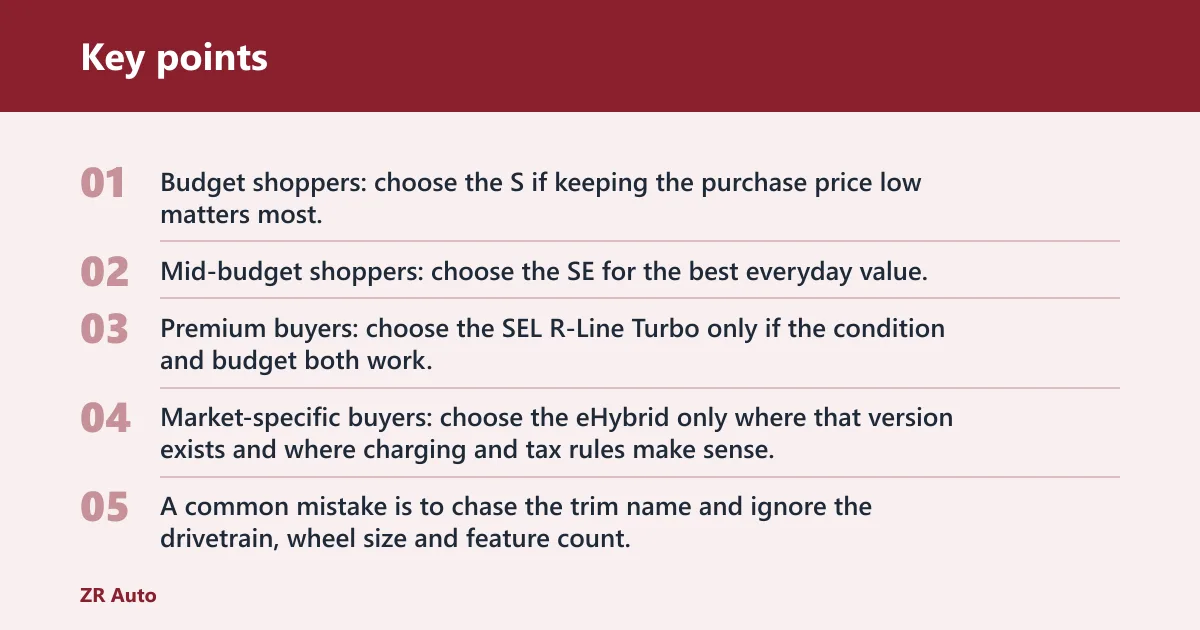
Budget shoppers: choose the S if keeping the purchase price low matters most. It is the value-focused entry trim, so you avoid paying for extra equipment that can raise both the price and the repair exposure.
Mid-budget shoppers: choose the SE for the best everyday value. It is the trim that most often feels complete without being over-specified, which makes it the easiest balance of comfort, demand and price.
Higher-budget shoppers: choose the SE R-Line Black if you want the style upgrade without jumping straight to the top trim. It is the compromise for buyers who want a more premium look but still care about sensible used-car value.
Premium buyers: choose the SEL R-Line Turbo only if the condition and budget both work. It is the most complete trim, but it is also the one most likely to tempt buyers into paying extra for features they do not need.
Market-specific buyers: choose the eHybrid only where that version exists and where charging and tax rules make sense. It is not the default answer for every used Tiguan shopper.
What changes the answer by market
Exact naming and equipment vary by market and model year, so compare the local listing, the build sheet and the service history rather than assuming every Tiguan badge means the same thing. That matters most for the eHybrid, which is a market-specific plug-in variant rather than a universal used-market default.
A common mistake is to chase the trim name and ignore the drivetrain, wheel size and feature count. A lightly specified SE can be a smarter used buy than a heavily optioned top trim with expensive tyres and more equipment to inspect.
One-sentence verdict on value versus risk
If you want the broadest mix of value, resale and manageable risk, buy the SE; if you want the cheapest entry, buy the S; if you want the most premium package and can afford the upkeep, buy the SEL R-Line Turbo.
Which VW Tiguan trim has the best features for the money?
The SE usually has the best features for the money because it adds the comfort and convenience equipment most owners notice every day without pushing you into the costlier upper end of the range. The SE R-Line Black can beat it on perceived value if you care about appearance, but it is less clearly the cheapest way to get useful equipment.
On a used car, equipment that improves daily use matters more than features that mainly improve the brochure. Heated seats, useful driver aids and sensible convenience equipment tend to age better in owner satisfaction than styling-led extras that can be expensive to restore after damage.
What are the VW Tiguan trim levels?
The current Tiguan lineup in the markets covered here includes four trims: S, SE, SE R-Line Black, and SEL R-Line Turbo. In market order, that is entry-level to top trim. Volkswagen positions the S as the value-focused starting point, the SE as the comfort and convenience upgrade, the SE R-Line Black as the sporty styling step, and the SEL R-Line Turbo as the top trim.
Used shoppers should treat those as a hierarchy, not a guarantee. The better question is which trim gives you the features you will actually use without adding avoidable cost.
-
Check the market listing. Confirm the exact trim name, drivetrain and model year first. Some markets add or rename grades, and the used value changes fast when the spec differs from the badge.
-
Match the trim to your budget. Choose the S if the lowest entry cost matters most, the SE if you want the best balance, the SE R-Line Black if you want style with substance, and the SEL R-Line Turbo if you want maximum equipment.
-
Inspect the expensive extras. Check tyres, wheels, roof hardware, seat functions, infotainment and any driver-assistance features that are harder to repair than standard trim parts.
Which trim has the lowest purchase-price risk?
The S has the lowest purchase-price risk because it usually costs the least to buy and gives you fewer expensive extras to worry about. The SE is close behind, but it often commands stronger used demand because buyers like the added convenience equipment.
The more you move up the trim ladder, the more you pay for image and equipment. That can be fine if the car is priced honestly, but it raises the chance of overpaying for features that do not hold value as well as the seller expects.
Why the base trim often costs less to own
Simple trims usually cost less to refresh because they have fewer costly components to fail. There is less to inspect, less to replace and less risk that a previous owner skipped maintenance on expensive extras that are not essential to the car’s job.
That does not make the base car better in every case. It means the risk profile is cleaner, which is exactly what some used buyers want.
Which trim is least exposed to repair bills?
The S and SE are usually the least exposed to repair bills, because they avoid some of the costlier cosmetic and convenience content found higher up the range. Once you move into the R-Line and top-trim territory, you add more expensive parts to inspect and, if needed, replace.
Used buyers should look hardest at wear items and trim-specific equipment on higher-spec cars. Bigger wheels, panoramic roof hardware where fitted, electric seat functions, parking tech and infotainment faults can turn a “nice spec” into a pricey car to sort out.
What to check on higher-spec used cars
-
Inspect the wheels and tyres. Large alloy wheels are more expensive to replace and more likely to show curb damage. They also reduce comfort on rough roads, which matters on a family SUV.
-
Test every electrical feature. Check the seats, climate controls, cameras, parking sensors, tailgate operation and infotainment functions. A missing function on a used top trim can cost far more to fix than the badge suggests.
-
Look for body and roof issues. Sunroof seals, drainage and water ingress matter on loaded-up trims. If the car has more equipment, there are more points to inspect.
Market-specific note on the eHybrid: the plug-in Tiguan uses a turbocharged 1.4-litre petrol engine with an electric motor and a 13kWh battery. It produces 242bhp combined, can do around 30 miles in electric mode, and is quoted with 12% Benefit-in-Kind in the supplied market data. That can make it attractive to company-car users, but the extra system complexity is part of the ownership equation.
Which Tiguan trim feels best every day?
The SE feels best every day for most buyers because it hits the balance between comfort, convenience and value. The SE R-Line Black feels more special if you want a premium look, but the SE is usually the easier car to live with if you care more about ride comfort and less about styling.
Wheel size, ride comfort, and 20-inch alloy wheels
Larger wheels usually reduce ride comfort and raise replacement-cost risk. DrivingElectric notes that the ride can be harsh on an R-Line test car with 20-inch alloy wheels, which is exactly the kind of trade-off used buyers should notice before paying extra for a sportier trim.
Say your shortlist includes two otherwise similar Tiguans, one on smaller wheels and one on 20-inch alloys. The larger-wheel car may look better, but it is more likely to feel firm over broken roads and cost more when the tyres need replacing.
Boot space and practicality trade-offs
Boot space matters most on a used SUV when you are trying to keep the car useful for family duty. In the market-specific plug-in model, the boot is listed at 476 litres after losing 139 litres to the battery, so the practicality penalty is real even if the tax savings are attractive.
If you regularly carry a pushchair or a weekly family load, a plug-in version can still work, but the reduced cargo space should be part of the decision rather than an afterthought.
Which trim holds value best used?
The SE usually holds value better than the S because it is easier to sell on the used market. Buyers tend to want comfort and convenience, but they do not always want to pay for the highest trim. That leaves the SE in a useful middle ground.
Why sport styling can help or hurt resale
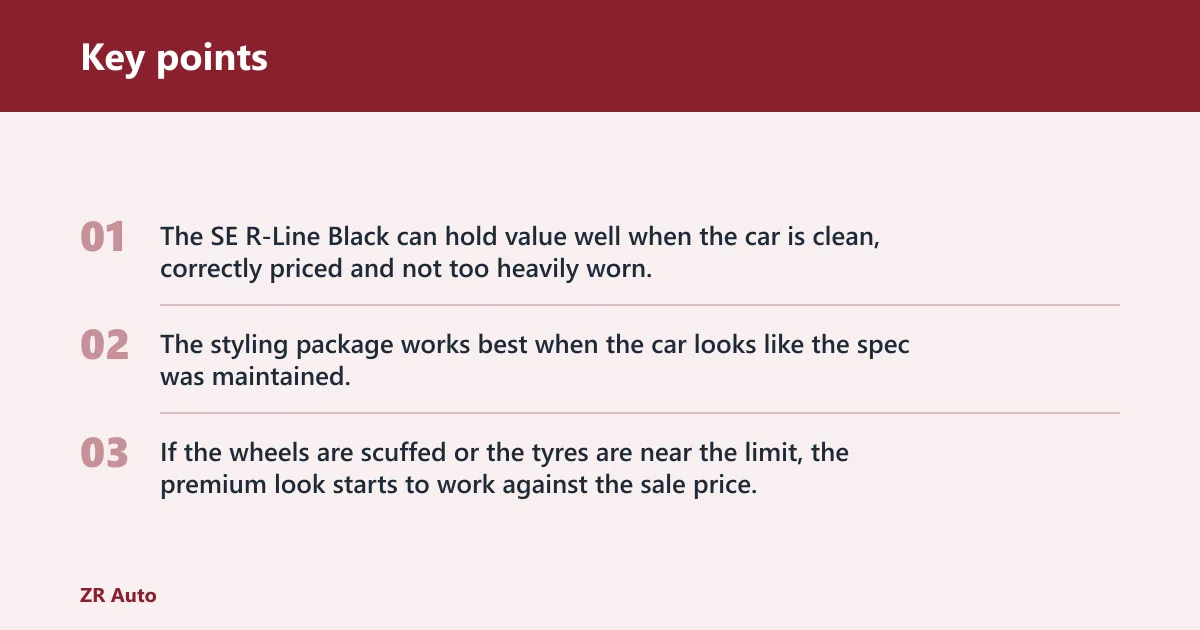
The SE R-Line Black can hold value well when the car is clean, correctly priced and not too heavily worn. Its sporty look helps it stand out, but it can also narrow the buyer pool if running costs are high or the wheels and trim are damaged.
The styling package works best when the car looks like the spec was maintained. If the wheels are scuffed or the tyres are near the limit, the premium look starts to work against the sale price.
When the top trim is harder to justify
The SEL R-Line Turbo is harder to justify used because its extra equipment does not always translate into the same amount of resale lift. It can still be the right buy if the condition is excellent and the price has already softened, but the maintenance burden remains a concern once warranty cover ends.
How the eHybrid can change the resale equation
The eHybrid can change resale value in the market where it is sold because company-car tax, charging habits and low-CO2 use cases can make it attractive. DrivingElectric quotes it at 157 to 177mpg, notes official CO2 emissions of 38-43g/km depending on trim and wheel size, and lists a starting price of £37,000 for the new car. Those figures matter most if you are comparing used pricing against tax savings rather than just sticker price.
Choose Tiguan S, SE, SE R-Line Black, or SEL R-Line Turbo if…
Choose the S if you want the lowest entry cost, plan to keep the car simple and would rather avoid paying for features you may not use. It is the strongest fit for budget-first shoppers who value low purchase risk more than a premium cabin.
Choose the SE if you want the best everyday value, expect to keep the car for years and want the easiest balance of comfort, demand and price. This is the trim most used buyers should start with.
Choose the SE R-Line Black if you want a more premium look, want the sporty styling package and can still keep the purchase sensible. It is the best compromise for buyers who care about appearance but do not want top-trim spending.
Choose the SEL R-Line Turbo if you want the most equipment, the strongest power and luxury positioning, and you are comfortable with higher ownership cost. Buy it only when the condition, service history and tyre/wheel condition are all strong.
Choose the eHybrid only if your market offers it, your charging routine fits it and the tax rules make it worthwhile. It can make sense for company-car use, but the battery package and market-specific cargo compromise should be part of the decision.
Frequently asked questions
Is the VW Tiguan SE R-Line Black worth it used?
Yes, if you want the sporty look and can find one priced sensibly. It is worth it as a style/value compromise, but it is not the cheapest car to own. Check the wheels, tyres and cosmetic condition carefully, because the premium look only works when the car has been kept tidy.
Which Tiguan trim has the best features for the money?
The SE usually has the best features for the money because it adds the comfort and convenience items most owners use every day without pushing the price into top-trim territory. If styling matters more than utility, the SE R-Line Black can be appealing, but it is not always the cheapest value play.
Should I buy a base Tiguan or a higher trim used?
Buy the base S if you want the lowest entry cost and the simplest ownership profile. Step up to the SE if you want the best balance of value and comfort. Choose a higher trim only if you will use the extra equipment enough to justify the higher purchase price and possible repair costs.
Is the top VW Tiguan trim too expensive to maintain used?
It can be. The SEL R-Line Turbo gives you the most equipment and the strongest premium feel, but more equipment means more things to inspect and potentially repair after warranty cover ends. If the price gap to an SE is large, the cheaper trim is often the safer used buy.
Which Tiguan trim feels most premium without overpaying?
The SE R-Line Black is the best fit for buyers who want a premium-looking Tiguan without paying top-trim money. It has the sportier appearance and a more upscale feel, but it stays closer to the middle of the range than the SEL R-Line Turbo. That makes it the sweet spot for many used shoppers.
Are R-Line Tiguan trims worth the extra money used?
Sometimes. They are worth it if you care about styling and can buy at a fair price, but the extra money should buy a clean car with good tyres and no missing features. If the gap to a standard SE is too wide, the everyday value usually drops away fast.