Ford Explorer vs Honda Pilot: Which Family SUV Should You Buy?
Choose the Honda Pilot if you want the simpler default for family duty; choose the Ford Explorer if you care more about power, towing, and long highway runs. This comparison focuses on 2025 models, since trim and equipment changes matter here. The Pilot is the calmer daily hauler, while the Explorer is the stronger-moving choice when your family load includes trailers, steep grades, or long interstate trips.
Head-to-head specs, cargo, and family fit
| Decision factor | Ford Explorer | Honda Pilot | Winner |
|---|---|---|---|
| Third-row access and daily family ease | Available 6- or 7-seat layouts, but the third row is less open and access is tighter. | 7- or 8-seat layouts with easier entry to the third row and friendlier child-seat loading. | Honda Pilot |
| Power and towing | 300 hp 2.3L turbo four-cylinder or 400 hp 3.0L turbo V6; up to 5,000 lb towing when properly equipped. | 285 hp 3.5L V6; up to 5,000 lb towing when properly equipped. | Ford Explorer |
| Fuel economy | EPA estimates are stronger on the 2.3L models than the Pilot, especially on highway driving. | EPA estimates are competitive, but the Pilot trades some efficiency for its larger V6 and standard family focus. | Ford Explorer |
| Cargo room behind the third row | 16.3 cu ft | 18.6 cu ft | Honda Pilot |
| Hands-on ownership convenience | Ford Mobile Service, Pickup & Delivery, and Ford Rewards can reduce service hassle. | Dealer service support varies by market; no matching Ford-branded convenience program to compare here. | Ford Explorer |
What this comparison covers
This guide compares the 2025 Ford Explorer and 2025 Honda Pilot as three-row midsize SUVs for families. It focuses on real-use questions: school runs, road trips, towing, third-row comfort, fuel costs, and ownership support. The right answer depends more on how often you need the third row, how much you tow, and how many miles pile up each year.
Which SUV is the default family pick?
The Honda Pilot is the better pick for most families because it strikes the easiest balance between space, ride comfort, and low-stress daily use. The Ford Explorer becomes the better pick when you want stronger power, a more confident tow rating, and more highway-focused driving. If your routine is mostly school runs and weekend errands, the Pilot fits more neatly.
Side-by-side family SUV comparison
Size, seating, and cargo
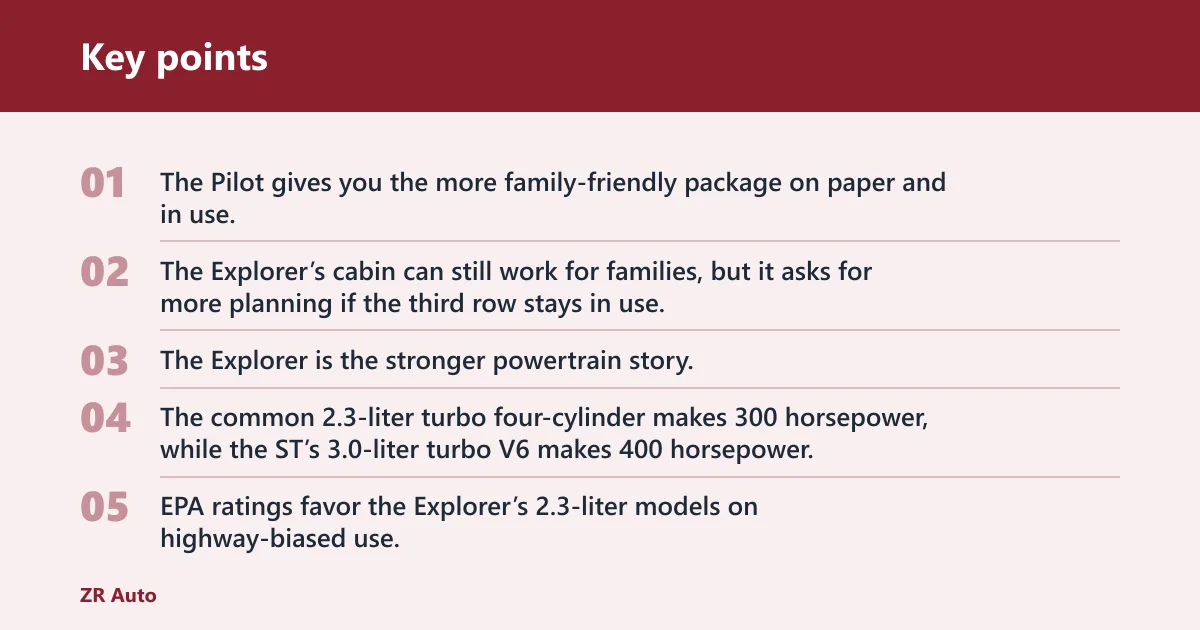
The Pilot gives you the more family-friendly package on paper and in use. It is about 200 inches long with about 18.6 cubic feet behind the third row, and it is available in 7- or 8-passenger layouts. The Explorer is 198.8 inches long with 16.3 cubic feet behind the third row, and it is usually a 6- or 7-passenger setup depending on trim.
That difference matters in daily life. The Pilot’s extra space behind the third row gives you more room for grocery bags, backpacks, or a compact stroller without folding seats right away. The Explorer’s cabin can still work for families, but it asks for more planning if the third row stays in use.
Powertrain, fuel economy, and towing
The Explorer is the stronger powertrain story. The common 2.3-liter turbo four-cylinder makes 300 horsepower, while the ST’s 3.0-liter turbo V6 makes 400 horsepower. The Pilot uses a 3.5-liter V6 with 285 horsepower, which is adequate for family duty but less urgent when the vehicle is full and the road tilts upward.
EPA ratings favor the Explorer’s 2.3-liter models on highway-biased use. The Pilot’s FWD model is rated 19/27/22 mpg city/highway/combined, while the AWD model drops to 19/25/21 mpg. Explorer ratings vary by engine and drivetrain; check the exact trim, but the 2.3-liter versions are the efficiency leaders in this matchup. For towing, both can reach 5,000 pounds when properly equipped, so the real separator is power reserve and how composed the vehicle feels while pulling that load.
Driver-assist and ownership support
Both SUVs offer current driver-assistance tech, but they do not package it the same way. The Explorer can be had with Ford Co-Pilot360 features and available BlueCruise on eligible trims, which can reduce fatigue on long, controlled-access highway drives when the vehicle and road are equipped for it. The Pilot uses Honda Sensing driver-assist features across its lineup, including adaptive cruise and lane centering support, but it does not offer a BlueCruise-style hands-free highway system.
Ford also adds ownership convenience features that matter after the sale. Ford Mobile Service can handle some maintenance at your home or office, Ford Pickup & Delivery can reduce the need to sit at the dealer, and Ford Rewards can trim some service and accessory costs. For Honda, service convenience depends more on the local dealer than on a comparable brand-wide program.
Safety note: for towing, child seats, roof loads, tires, and driver-assist use, follow the vehicle manual, never exceed the vehicle’s rated roof, hitch, or tow limit, keep items out of airbag zones and the driver’s view, and check local laws before you buy or install anything.
Which SUV works better for school runs?
The Honda Pilot is easier for school-run duty because it gives you simpler third-row access, a friendlier cabin layout, and more cargo room behind the third row. If you regularly load kids, backpacks, sports bags, and a stroller, the Pilot usually asks for fewer seat-folding moves. The Explorer can do the job, but the Pilot makes the routine less fiddly.
Carpool seating and third-row access
For a carpool-heavy household, the Pilot’s wider family focus shows up in the way people climb in and out. Its 7- and 8-seat configurations work better when one seat needs to stay open for a child or when the third row gets used on short notice. The Explorer’s available 6-seat layout is nice for easier second-row access, but that advantage matters more if you are moving adults than if you are managing multiple child seats.
Child seats and daily loading
Both SUVs are usable for child seats, but the Pilot is generally the less stressful choice when you need to reach across a second row to buckle a child or load a booster next to a folded seat. A common first-timer mistake is choosing the row with the better headline number, then discovering that the real problem is the awkward angle of daily buckling. The Pilot’s layout reduces that friction.
-
Check the seat path.
Try the same child seat setup you plan to use, including rear-facing and booster positions if needed. The goal is not only fit, but also whether you can reach the buckle without crowding the second-row occupant. -
Test the aisle access.
Slide the second row forward and back, then see how often a child needs to climb past a seatback or center console. That matters more in weekday use than a one-time full-cabin spec. -
Verify tether and latch points.
Use the owner’s manual for each seating position and confirm the correct anchors before you buy. Child-seat compatibility depends on seat shape and position, not just vehicle size.
Best trim type for stop-and-go use
For the Explorer, the best value usually sits around the mid-level trims rather than the pricey performance versions. For the Pilot, mid trims such as the EX-L or equivalent family-focused step make the most sense because they add comfort without pushing the price into luxury-SUV territory. In stop-and-go use, extra power matters less than easy controls, good visibility, and a third row you can reach quickly.
Which is better for road trips?
The Ford Explorer is the better road-trip SUV if you spend long stretches on the interstate and want more passing power, especially with the 3.0-liter V6. The Honda Pilot is the better road-trip SUV if you care more about a calmer ride, easier passenger access, and a less tiring cabin for mixed-age passengers. For many families, the Pilot is less demanding over a full day, while the Explorer feels stronger at speed.
Front- and second-row comfort
Front-row comfort is strong in both SUVs, but their personalities differ. The Pilot aims for relaxed family travel and usually feels less aggressive over rough pavement and traffic-choked routes. The Explorer feels more responsive and more settled when you are covering distance quickly, which can matter if you drive long highway legs with the cabin full.
Say your route includes two hours of interstate, a fuel stop, and then another hour of two-lane roads. The Explorer’s stronger engine can make merging and passing easier, but the Pilot’s calmer demeanor can leave passengers less fatigued by the end of the day. That is the trade-off in plain terms.
Third-row comfort on longer drives
The Pilot wins here because it starts with the better third-row packaging. Its extra cargo room behind the third row also helps keep bags out of passenger space, which matters when the rear bench is occupied for more than a quick trip. The Explorer’s third row is fine for short stints, but adults will notice the tighter packaging sooner.
Cabin tech and driver-assist on highways
Explorer shoppers who want more highway assistance should look for BlueCruise-equipped trims, since that feature can reduce fatigue on eligible roads. The Pilot counters with Honda Sensing features that help with lane keeping and following distance without changing the car into a hands-free highway cruiser. If your road trips are long and repetitive, the Explorer’s available hands-free tech is the more distinctive feature.
Which one tows and handles winter better?
The Ford Explorer has the edge if towing is part of the plan, because its stronger engines give it more reserve while staying within the same 5,000-pound ceiling when properly equipped. For winter driving, both can be had with AWD, so the better answer is the one with the tires, driver skill, and trim content you actually need. The Explorer is the stronger tow SUV; the Pilot is the simpler daily family SUV.
Tow ratings and package requirements
Do not assume the tow number is ready out of the box. Both SUVs can reach 5,000 pounds only when properly equipped, and the exact tow package and hitch setup vary by trim. If you plan to pull a camper, boat, or utility trailer often, check the manufacturer’s towing chart for the exact trim and drivetrain before you commit.
For family camping, the Explorer’s stronger engine line makes hill starts, merging, and trailer stability feel less strained. The Pilot can tow the same maximum rating, but it does so with less power overhead, so the load matters more when the trailer is heavy or the route is steep.
Trailer stability and camper use
The smart question is not only whether the SUV can tow, but whether it can tow without making every trip feel busy. The Explorer is the better fit for frequent trailer duty because its 2.3-liter and 3.0-liter engines give you a wider comfort margin. If towing is occasional and light, the Pilot still makes sense.
AWD, traction, and cold-weather value
Both SUVs offer AWD, which helps with snow starts, wet pavement, and loose surfaces. That said, AWD is not a substitute for winter tires, and it does not change the fact that the Pilot’s family-first setup is easier to live with every day. If you see frequent snow and also tow, the Explorer’s power advantage may matter more. If winter means school runs and slushy parking lots, the Pilot’s calmer setup is enough.
Ford Explorer decision table
| Family scenario | Ford Explorer | Honda Pilot | Recommended pick | Best trim type |
|---|---|---|---|---|
| School-run carpooling | Works well, especially with a 6-seat layout, but access and cargo space are tighter. | Easier third-row access and more cargo room behind the third row. | Honda Pilot | Mid trim with power liftgate and useful driver aids |
| Long-road-trip comfort | Stronger passing power and available BlueCruise on eligible trims. | Calmer ride and easier rear-seat packaging for mixed-age passengers. | Honda Pilot | Mid or upper-mid trim with AWD if needed |
| Towing a camper | Up to 5,000 lb, with more engine reserve for grades and merging. | Up to 5,000 lb, but with less power reserve. | Ford Explorer | Higher-output engine trim with the correct tow package |
| Third-row space for teens and adults | Usable for short trips, but tighter than the Pilot. | Better shaped for real third-row use. | Honda Pilot | 7-seat or 8-seat family trim |
| Long-term ownership cost | Potentially higher fuel and tire costs on more powerful trims; service convenience can help. | Typically the more predictable daily ownership choice for family use. | Honda Pilot | Well-equipped mid trim without overspending on extras |
The Pilot wins three of the five family scenarios because it is easier to live with. The Explorer wins towing and, for some shoppers, the highway experience. That split is the real takeaway: use the Pilot for people-moving, and the Explorer for power-demanding duty.
Choose Ford Explorer if… / Choose Honda Pilot if…
Choose Ford Explorer if… you want the stronger engine lineup, plan to tow a camper or boat with some regularity, and spend a lot of time on highways where available hands-free driving matters. It also makes sense if you value Ford’s ownership support programs and want a family SUV that leans a little more toward performance.
Choose Honda Pilot if… you want easier third-row access, more usable cargo space behind that row, and the more relaxed daily-family setup. It is the better default for school runs, mixed-age carpools, and families that care more about comfort and packaging than about extra power.
Frequently asked questions
Ford Explorer or Honda Pilot, which is better for a family?
The Honda Pilot is better for most families because it is easier to load, easier to live with in stop-and-go driving, and more practical when the third row is used often. The Ford Explorer is the better family SUV if your version of family life includes towing, long highway miles, or a stronger powertrain.
Which SUV has more space, the Explorer or Pilot?
The Honda Pilot has the more useful family space, especially behind the third row, where it offers 18.6 cubic feet versus 16.3 cubic feet in the Explorer. The Explorer is close in exterior length, but the Pilot makes better use of its cabin for people and gear.
Is the Ford Explorer better than the Honda Pilot for road trips?
It depends on what you value. The Explorer is better if you want more passing power and available BlueCruise on eligible trims. The Pilot is better if you want a calmer ride, easier third-row packaging, and less cabin fuss for long days with kids in back.
Which is more reliable, Ford Explorer or Honda Pilot?
This comparison should not pretend reliability is a simple one-number answer. For a used buy, condition, maintenance history, and trim matter more than badge alone. The Pilot is usually the safer family-value bet, while the Explorer can be smart if you verify service records and avoid neglected high-output trims.
Which SUV has better fuel economy, Explorer or Pilot?
The Explorer’s 2.3-liter models are the better fuel-economy play in this matchup, especially on highway-heavy driving. The Pilot’s FWD rating is 19/27/22 mpg, and AWD lowers that to 19/25/21 mpg. Always compare the exact drivetrain you plan to buy, because AWD changes the numbers.
Which family SUV is cheaper to buy and own?
The Pilot is usually the lower-stress ownership choice because its family-first layout fits daily use without asking you to pay for extra performance you may not need. The Explorer can add value if you use the towing and highway features, but fuel, tires, and higher-trim pricing can push costs up.
Which SUV has better third-row seating for kids and adults?
The Honda Pilot has the better third row for both kids and adults because it is easier to access and has the more usable cabin layout. Adults still should not expect full-size SUV comfort, but the Pilot gives them a better place to sit for a real trip than the Explorer does.
Which one is better for towing and winter driving?
The Ford Explorer is better for towing because its stronger engine lineup gives you more reserve while still reaching 5,000 pounds when properly equipped. For winter driving, both can be had with AWD, so the better pick is the one with the right tires and the trim that matches your other priorities.
Should I buy the ford Explorer or honda Pilot used?
Buy the Pilot used if you want the safer family-value path and expect to keep the SUV in school-run service. Buy the Explorer used if you find a well-maintained example with the tow and highway equipment you need. On either one, check the service records, tires, brakes, and whether the exact trim has the features you expect.