What Are the Best Dodge Durango Years to Buy?
Many shoppers may find 2018–2024 the strongest Dodge Durango range to consider, with 2020–2024 often preferred for V8 towing and 2014–2016 sometimes chosen when the lower used price matters more than older tech. Pick the wrong year and you can end up with bigger repair bills, weaker safety tech, and fuel costs that wipe out the savings. Below, you’ll get a year-by-year ranking by family use, towing, V6 or V8 running costs, and the recalls and ownership costs that matter.
Best durango years and the ones needing a discount
For most used buyers, the safest sweet spot sits in the later third-generation years, especially 2018 and newer. If you want V8 power for towing, 2020–2024 are the cleanest bet because they pair the 8-speed automatic with improved tech and a wider spread of well-equipped trims. Older years can work, but only at the right price.
Best years for most buyers
2018–2019 and 2021–2024 are the strongest all-around choices for family hauling. They have more mature electronics, the 3.6L V6’s lower fuel and maintenance burden, and more safety and infotainment features than early third-generation trucks.
Best years for towing and V8 shoppers
2020–2024 are often the preferred years for buyers who plan to tow. The 5.7L HEMI V8 works well with the 8-speed automatic, and later model years usually bring better equipment mixes in R/T, Citadel, and performance trims. If the sticker price is close to a V6 model, the V8 often makes more sense for heavy trailers.
Years that need a discount to make sense
2014–2016 can be value buys, but only when the asking price clearly reflects age, fuel use, and repair exposure. Early first-year or early-refresh examples need a larger discount because small electrical faults, worn suspension parts, and skipped maintenance can turn a cheap entry price into a costly ownership bill.
| Model year | Reliability risk | Repair-cost exposure | Towing value | Trim/engine availability | Buy decision |
|---|---|---|---|---|---|
| 2011 | High | High | Fair | Good | Skip |
| 2012 | High | High | Fair | Good | Watchlist only |
| 2013 | High | High | Fair | Good | Watchlist only |
| 2014 | Medium-high | Medium-high | Good | Very good | Buy only at a discount |
| 2015 | Medium-high | Medium-high | Good | Very good | Watchlist |
| 2016 | Medium | Medium | Good | Very good | Buy if maintained |
| 2017 | Medium | Medium | Good | Very good | Watchlist |
| 2018 | Low-medium | Medium | Good | Very good | Buy |
| 2019 | Low-medium | Medium | Good | Very good | Buy |
| 2020 | Low | Medium | Excellent | Excellent | Buy |
| 2021 | Low | Medium | Excellent | Excellent | Buy |
| 2022 | Low | Medium | Excellent | Excellent | Buy |
| 2023 | Low | Medium | Excellent | Excellent | Buy |
| 2024 | Low | Medium | Excellent | Excellent | Buy |
Why some Durango years are better than others
Durango value changes with generation, refresh, and powertrain maturity. The best used years are not the newest ones by default; they are the years after early production bugs got sorted out, before the price premium climbs too high. First-year redesign models usually bring more risk because the first production run is where missed fixes tend to show up.
Generation changes that matter
The third generation, launched for 2011, brought a newer platform, more efficient powertrains, and a stronger 8-speed automatic in later years. That matters because the earliest third-gen trucks can show more electronic complaints and more age-related wear now, while later years usually feel better sorted.
Refresh years and what changed
2014 was a meaningful refresh year, and refreshed Durangos generally bring better cabin tech and broader trim availability than earlier versions. Later years added newer infotainment, more driver-assist content, and wider trim spreads, which helps if you want a family SUV that does not feel stripped.
Why first-year models carry more risk
First-year or early-production models often have the longest list of small fixes, even when the platform itself is sound. On a used Durango, that can mean more electrical annoyances, more infotainment glitches, and more variation in build quality. A clean late-year example usually beats a cheaper early-year truck with gaps in its history.
Say your budget reaches a 2014 R/T with 95,000 miles or a 2018 GT with 110,000 miles. The newer truck may be the smarter buy if the records are clean, because it usually brings updated electronics and less age-related repair exposure, even at slightly higher miles.
Dodge Durango used-buy decision matrix
This matrix weighs four things that matter in the real market: reliability risk, repair-cost exposure, towing value, and whether the year has the engine or trim mix you want. A low asking price only matters if it can cover likely repairs and the fuel bill that comes with V8 ownership.
How the matrix scores reliability risk
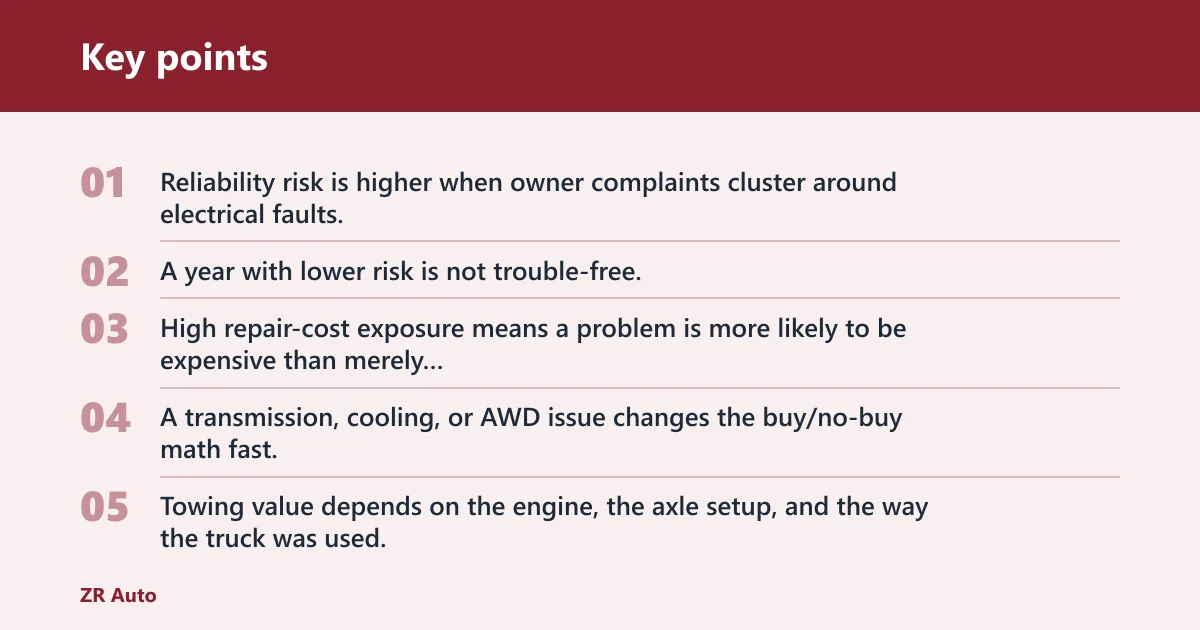
Reliability risk is higher when owner complaints cluster around electrical faults, transmission behavior, cooling-system issues, or suspension wear. A year with lower risk is not trouble-free; it simply gives you fewer expensive unknowns when shopping used.
How to read repair-cost exposure
High repair-cost exposure means a problem is more likely to be expensive than merely annoying. A sensor fault or dead battery is one thing. A transmission, cooling, or AWD issue changes the buy/no-buy math fast, especially on a high-mileage V8.
How towing value and engine availability change the ranking
Towing value depends on the engine, the axle setup, and the way the truck was used. The 5.7L HEMI and performance V8s give you more reserve power, but they also bring higher fuel use, bigger tire and brake bills, and more insurance exposure than a 3.6L V6 model.
| Year | Best fit | Main risk | Engine/trim note | Decision |
|---|---|---|---|---|
| 2011 | Budget shoppers | Older electronics and age wear | Good trim spread, but now too old for most buyers | Skip |
| 2012 | Cheap family hauler | Repair stacking on aging parts | Acceptable only with strong records | Watchlist |
| 2013 | Low-price V6 shopper | Age-related maintenance | Better as a short-term buy than a keeper | Watchlist |
| 2014 | Value buyer | Mixed early-refresh issues | Good trim and engine variety | Buy at a discount |
| 2015 | Family use | Used-market condition swing | Worth it only with documented maintenance | Watchlist |
| 2016 | Balanced budget | Wear items and history gaps | Strong if priced below cleaner 2018+ trucks | Buy if maintained |
| 2017 | Middle-ground shopper | Feature variation by trim | Better only when the price is right | Watchlist |
| 2018 | Most buyers | Typical used-SUV wear | Very good V6 and V8 spread | Buy |
| 2019 | Most buyers | Typical used-SUV wear | Strong family and towing balance | Buy |
| 2020 | Towing | Price premium | Excellent for V8 and higher trims | Buy |
| 2021 | Family/towing | Price premium | Strong feature set across trims | Buy |
| 2022 | Family/towing | Price premium | Good if you want newer safety tech | Buy |
| 2023 | Family/towing | Price premium | Excellent for loaded GT and R/T builds | Buy |
| 2024 | Family/towing | Price premium | Best choice if the budget allows it | Buy |
What are the best Dodge Durango years for most buyers?
For most buyers, 2018–2024 are the best Durango years because they balance modern features, broader trim choice, and lower risk than older trucks. If you want a family SUV first and a tow rig second, these years usually make more sense than chasing the cheapest badge on the lot.
Best value years
2018 and 2019 are the value sweet spot for many shoppers. They are old enough to cost less than the newest trucks, but new enough to avoid the worst age-related headaches of the early third generation.
Best balance of features and upkeep
2020–2024 give you the best blend of equipment and ownership confidence. The 8-speed automatic, stronger trim mix, and broader availability of driver aids make them easier to live with. For a buyer who wants one vehicle to handle school runs, road trips, and occasional towing, these are the years to target.
Best picks for family use
For family duty, the 3.6L V6 in GT or Citadel trims is usually the smartest combination. You get enough power for daily use without the fuel and tire costs that come with the 5.7L HEMI. Rear-wheel drive can save money up front, but AWD helps if you face snow, rain, or boat ramp use.
Which Dodge Durango years should you avoid?
The earliest third-generation years may be less attractive unless the price is especially low and the service records are strong. 2011–2013 are the least attractive used buys for most shoppers because age, electronics, and wear combine to create higher repair exposure than the market usually prices in.
Years with recurring problem clusters
Early years are more likely to bring owner complaints tied to electrical issues, infotainment glitches, transmission behavior, and worn suspension components. Those problems may not kill a deal by themselves, but they matter when the truck already has high miles or incomplete maintenance records.
Years where repairs can erase the low price
A cheap purchase can be a bad deal if the truck needs tires, brakes, battery work, cooling-system attention, or transmission service right away. On a Durango, those costs add up quickly because the vehicle is heavy, often AWD, and sometimes fitted with large wheels that raise tire prices.
When an avoid year becomes a watchlist year
Sometimes a year moves from “avoid” to “maybe” if the seller has full records, recall completion proof, and a price that clearly beats cleaner alternatives. That usually means a manual inspection and a pre-purchase scan are required, not optional.
Suppose you find a 2012 Durango Limited with a fresh set of tires but no proof of transmission service and a lit check-engine light. The cheap price does not fix the risk. A better choice is a later-year V6 truck with fewer miles and a cleaner record, even if it costs more up front.
Trim and engine choices that change used-buy value
Trim and engine choice change the whole ownership story. Two Durangos from the same year can have very different fuel use, tow rating, comfort level, and repair exposure. That is why year-only rankings miss the point.
SXT and GT value cases
SXT and GT trims usually make the best used buys for shoppers who want the Durango shape without paying for V8 fuel bills. GT is often the stronger choice because it tends to bring more features and better resale appeal. SXT is fine if price matters more than equipment.
Citadel comfort versus cost
Citadel is the comfort pick. It often brings more luxury content, but that also raises the buy-in price and can increase tire, brake, and repair costs if the truck wears larger wheels and more electronics. Choose Citadel only if you will use the added equipment.
R/T and other performance variants
R/T and SRT or similar high-performance variants are the right answer only for buyers who want the V8 experience and can pay for it. They offer stronger acceleration and better tow confidence, but ownership costs rise through fuel, tires, brakes, and insurance. A cheap performance Durango is rarely cheap to own.
3.6L V6 versus 5.7L HEMI V8
The 3.6L V6 is often the safer bet for many used buyers because it tends to use less fuel and is usually reported to cost less to maintain. The 5.7L HEMI V8 adds real towing muscle and a more relaxed feel under load, but it brings more fuel use and usually higher long-term operating costs. For light towing, the V6 is often enough.
AWD versus RWD and towing tradeoffs
AWD helps with traction in poor weather and on slippery boat ramps, and it can make a heavy SUV feel more planted. RWD usually means simpler maintenance and sometimes lower purchase prices. For towing, either can work, but the right tires, cooling health, and brake condition matter more than the badge on the tailgate.
Is a Dodge Durango a reliable used SUV?
A properly chosen Durango can be a reasonably reliable used SUV, but its reliability depends heavily on year, engine, trim, and maintenance history. The platform is strongest in later third-generation years with completed recalls and clean records. Poorly maintained examples can become expensive fast.
What owner complaint patterns suggest
Owner complaints tend to cluster around electrical annoyances, transmission behavior, suspension wear, and occasional cooling-system or sensor issues. Those clusters do not affect every truck, but they are worth paying attention to because they can create repair bills that are larger than the savings from a low asking price.
How recall completion changes the answer
Recall completion matters because a repaired truck is easier to trust than one with open campaigns hanging over it. A Durango with documented recall work and service history deserves more consideration than a similar truck with missing paperwork, especially if warning lights or drivability symptoms are present.
Where the Durango fits among used three-row SUVs
The Durango sits near the top of the class for towing and V8 availability, but not every buyer needs that. If you prioritize fuel economy and low running costs, a different three-row SUV may fit better. If you want towing strength and a muscular feel, the Durango remains compelling.
What to check before you buy a used Durango
Start with records, then verify recall completion, then test the truck hard enough to expose issues. On a Durango, the cheapest warning signs to fix are the ones you catch before purchase. The most expensive ones show up after the title changes hands.
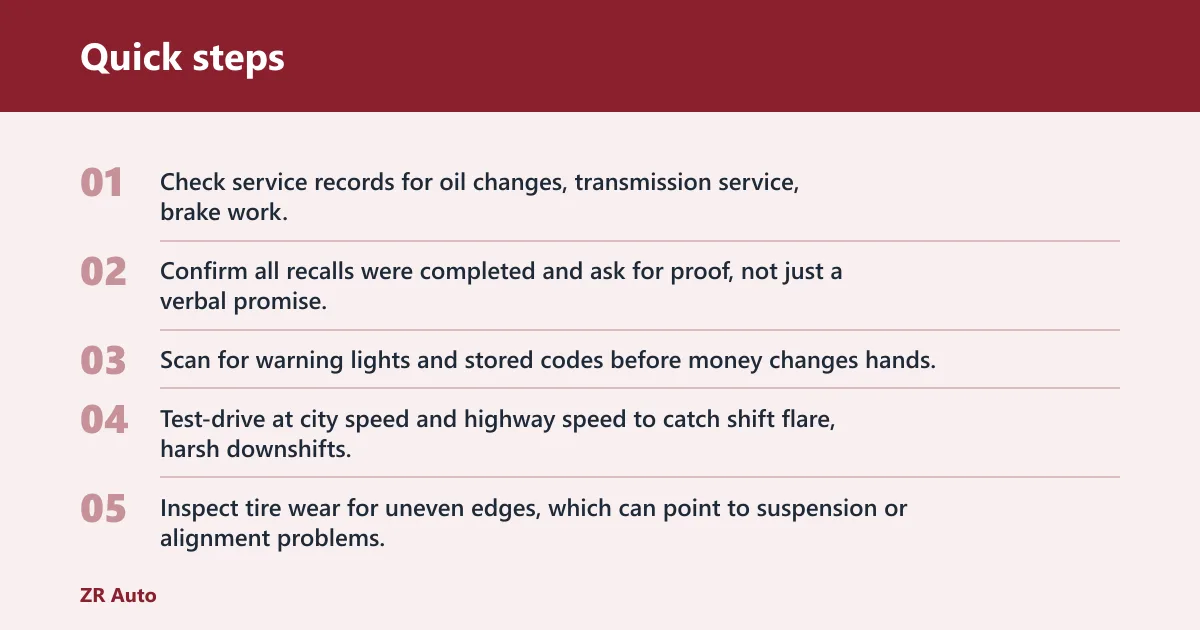
- Check service records for oil changes, transmission service, brake work, cooling-system service, and AWD maintenance if equipped.
- Confirm all recalls were completed and ask for proof, not just a verbal promise.
- Scan for warning lights and stored codes before money changes hands.
- Test-drive at city speed and highway speed to catch shift flare, harsh downshifts, vibration, or steering pull.
- Inspect tire wear for uneven edges, which can point to suspension or alignment problems.
- Check brake thickness, rotor condition, and pedal feel, especially on V8 or towing-use trucks.
- Look for signs of trailer use such as a hitch, wiring modifications, sagging rear suspension, or heat marks around the hitch area.
Service records and maintenance gaps
Missing records do not prove neglect, but they raise risk. A Durango with a clean file is easier to price because you can separate age-related wear from skipped maintenance. That matters most on V8 trucks and higher-mileage AWD models.
Recall completion and warning lights
Open recalls are a real negotiating point, but they are not the same as a hidden mechanical defect. If a seller cannot show recall completion, treat the truck as higher risk until the work is done. Any warning light should trigger a scan before purchase.
Test-drive symptoms that point to costly repairs
Watch for delayed engagement, hard shifts, shuddering, steering wander, clunks over bumps, overheating, or electrical glitches in the infotainment and instrument cluster. Those symptoms can point to repairs that cost far more than routine maintenance.
Inspection items for towing wear, tires, and brakes
Towing abuse often shows up in the rear suspension, tires, brakes, and cooling system. If the rear sits low, the brake pedal feels soft, or the cooling fan runs hard after a short drive, assume the truck has worked for a living and price it accordingly.
Frequently asked questions
What’s the best year dodge durango to buy
Those years give you the best mix of modern tech, available V8 power, and manageable used-market risk. If budget is tight, 2016–2019 can still work with strong records.
What is the best year for the dodge durango?
There is no single best year for every buyer, but 2021–2024 are the strongest all-around choices if the budget allows them. They combine mature third-generation hardware with better feature sets and lower age-related repair risk than earlier models.
What year is the most reliable dodge durango
Reliability is strongest in the later third-generation years, especially 2018 and newer, because the platform had more time to mature. A clean, well-maintained 2020–2024 truck with completed recalls is usually a safer used buy than an older, cheaper Durango with missing records.
What years of dodge durango to avoid
Most shoppers should avoid 2011–2013 unless the price is very low and the records are excellent. Those years are old enough that age-related wear, electrical complaints, and repair stacking can wipe out the purchase-price advantage quickly. They belong on a watchlist, not at the top of your search.
Which dodge durango model is the best?
The best model depends on use. Citadel makes sense only if you want the added comfort and are comfortable with the higher ownership cost.
Is a dodge durango a reliable car?
A Dodge Durango can be reliable, but only when you choose the right year, engine, and trim, then verify service history and recalls. It is not a low-cost appliance SUV. It is a strong three-row choice for towing and V8 shoppers, less so for buyers chasing the cheapest ownership.