Is the Ford F-150 Reliable for a Used Truck?
Yes, an F-150 can be a dependable used truck, but the safer bets are 2015+ trucks with the 5.0L V8 or 2.7L EcoBoost, plus documented maintenance; avoid buying by mileage alone. Skip that filter, and you can face costly transmission, timing, or turbo repairs. This guide breaks down reliability by engine, mileage band, and the service records that matter most.
Quick verdict on used F-150 reliability
The Ford F-150 can be a solid used buy when you judge the specific powertrain, mileage band, and service proof instead of the badge alone. Work-truck use, family use, and towing-heavy use age these trucks very differently. A clean truck with records is often the better buy than a lower-mile truck with no paperwork.
Who the F-150 fits best
If you want a used full-size pickup with broad trim choice, many engine options, and easy parts support, the F-150 fits well. That includes XL work trucks, mid-trim daily drivers, and high-content Platinum trucks. The trim matters because tech, comfort, and repair exposure change with equipment.
Ford positions the 2026 F-150 at a starting MSRP of $37,290, with a best-in-class maximum available towing figure of 13,500 lbs, a best-in-class maximum available payload of 2,440 lbs, and a best-in-class maximum available torque of 640 lb-ft. Ford also says the F-150 is #1 for initial quality among full-size pickups. Those are current-model signals, but used-buy reliability still comes down to how a particular truck was built, used, and serviced.
Where reliability depends on engine and use
A work truck that idled all day and towed on weekends will not age like a family truck that saw school runs and light hauling. Towing-heavy use pushes cooling, transmission, brakes, and engine oil harder. Family use often means less stress, but more short trips, which can still be rough on fluids and batteries.
Suppose you are looking at a 2020 Lariat with the 3.5L EcoBoost V6 and a folder full of towing receipts. That truck can still be a smart buy, but only if the records show oil changes, transmission service, and no unresolved turbo or cooling complaints. A 2020 XL with fewer miles and no records is not automatically the better truck.
What buyers should verify before paying
Check service intervals, recall completion, and evidence of the truck’s actual job. A used F-150 with clear maintenance proof usually gives you a better reliability read than one with a clean detail and no history. If the seller cannot show records, plan for more risk in the first year of ownership.
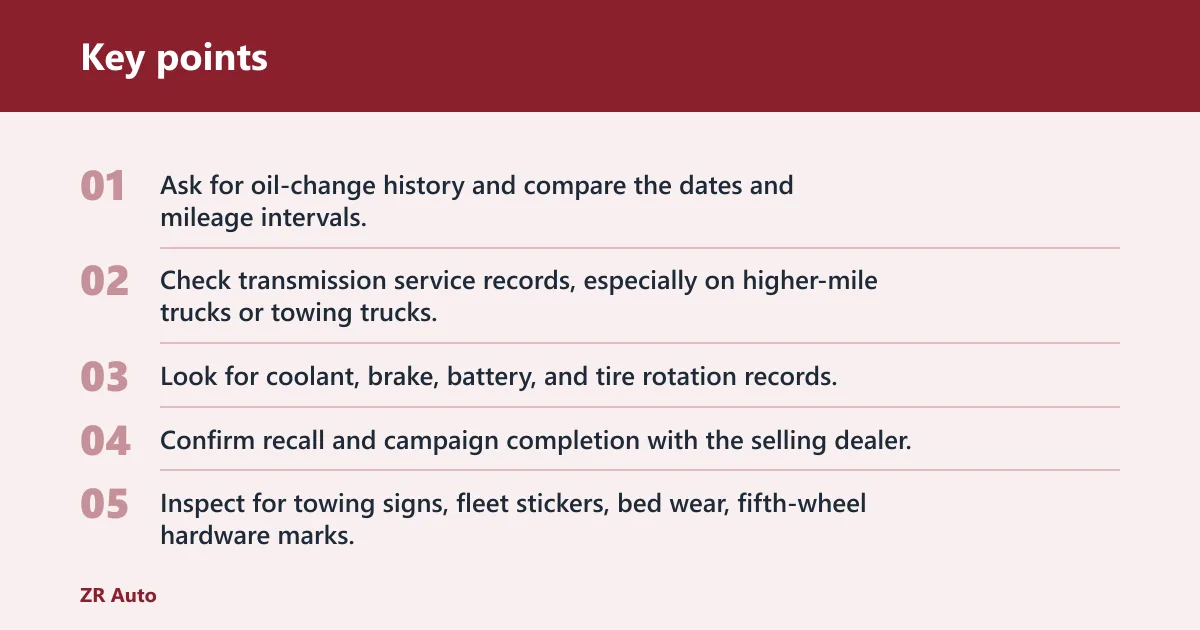
- Ask for oil-change history and compare the dates and mileage intervals.
- Check transmission service records, especially on higher-mile trucks or towing trucks.
- Look for coolant, brake, battery, and tire rotation records.
- Confirm recall and campaign completion with the selling dealer.
- Inspect for towing signs, fleet stickers, bed wear, fifth-wheel hardware marks, and trailer-brake wiring.
Is the Ford F-150 reliable?
Yes, the F-150 can be reliable, but the answer changes with engine choice, mileage, and use history. A low-mile truck with neglected fluids can be a worse buy than a higher-mile truck with regular service. Newer trucks add more technology, which can improve convenience but also add repair points when equipment ages.
Why the badge alone is not enough
Ford sells the F-150 across trims from XL to Platinum, and the parts list can look very different from one truck to the next. An XL with the 2.7L V6 EcoBoost is a different ownership case from a Platinum with BlueCruise and more driver-assist hardware. The badge says “F-150”; the service trail says much more.
Ford says the XL includes a 2.7L V6 EcoBoost engine, while the 5.0L V8 is available on the Lariat and Tremor, among other trims. BlueCruise is offered on Platinum, King Ranch, Lariat, Tremor, and select XLT models. Those features can add used-truck value, but they also add more systems to verify before purchase.
How towing, idling, and mileage change outcomes
Towing loads heat-soak powertrains and push suspension and brakes harder. Long idle time can be rough on oil quality, batteries, and cooling system health. Once the truck passes 100,000 miles, the quality of past service matters more than the odometer itself because wear patterns become less predictable.
Short-trip city use is a different risk band from contractor use or tow-haul duty. City miles can be gentle on the drivetrain but hard on batteries and brakes. Highway miles can be easier on some components, but not if the truck spent its life pulling a trailer at speed.
What newer model-years add in complexity
Newer F-150s may have more driver-assist tech, more electrical content, and more complex powertrains. That can improve day-to-day use, but it also means more modules, sensors, and software-dependent systems to inspect. Used buyers should treat added equipment as value only when the records and test drive support it.
F-150 reliability scorecard
This scorecard is a buying guide, not a blanket verdict. Read it by generation, engine, mileage band, and ownership history. The same truck can move from “buy” to “no-buy” if it has towing abuse, missing service records, or unresolved warning lights.
| Generation/year | Engine | Mileage band | Known ownership risk | Buy/no-buy guidance |
|---|---|---|---|---|
| 2015-2017 | 2.7L EcoBoost, 3.5L EcoBoost, 5.0L V8 | Under 80,000 miles | Lower risk if service is documented; turbo trucks need clean oil history | Buy if records are strong and the test drive is clean |
| 2015-2017 | Any engine | 80,000-120,000 miles | Wear items, transmission history, and cooling-system condition start to matter more | Buy only with proof of fluid service and a pre-purchase inspection |
| 2018-2020 | 3.5L EcoBoost, 5.0L V8, hybrid where equipped | Under 75,000 miles | Usually a good used-buy band if not worked hard; added electronics raise inspection needs | Buy if recall status is clear and electronics behave normally |
| 2018-2020 | 3.5L EcoBoost, hybrid | 75,000-125,000 miles | Towing history and service gaps can turn into expensive repairs | Buy cautiously; favor trucks with regular dealer records |
| 2021-2024 | 3.5L full hybrid V6 PowerBoost, 3.5L EcoBoost, 5.0L V8 | Under 50,000 miles | Tech-rich trucks can be excellent, but hybrid and driver-assist systems need clean diagnostics | Buy if warranty status, software, and service records are in order |
| 2021-2024 | 3.5L full hybrid V6 PowerBoost | 50,000-100,000 miles | Higher complexity means more to verify in batteries, hybrid control systems, and cooling | Buy only after a strong inspection and clear ownership proof |
| Any year | Any engine | Over 100,000 miles | History matters more than age; neglected maintenance can create costly surprises | Buy only with records, a scan for codes, and a careful road test |
Which F-150 engines are safest used bets?
The safest used bet depends on your use case, but the 5.0L V8 is usually the simplest traditional gas choice, the 2.7L EcoBoost is often a strong balance of efficiency and capability, and the 3.5L EcoBoost is the stronger tow-rated turbo option. The hybrid adds torque and utility, but also more system complexity.
3.5L EcoBoost V6
Ford says the 3.5L EcoBoost V6 can tow up to 13,500 lbs, which makes it a serious choice for towing-heavy buyers. Its twin-turbo architecture gives strong output, but it also adds maintenance and repair exposure when oil changes are late or service history is thin. Buy it for power, not for simplicity.
A common first-timer mistake is choosing this engine only because the tow rating looks best. If the truck spent years hauling a trailer or sitting at high idle, the extra stress can show up later in cooling, turbo, or transmission repair bills.
3.5L full hybrid V6 PowerBoost
Ford says the 3.5L full hybrid V6 produces 578 lb-ft of torque and is rated to tow up to 11,600 lbs. It also supports Pro Power Onboard availability, which is useful for jobsite or tailgate power. That package adds torque and capability, but it also adds hybrid hardware that deserves close inspection.
For used buyers, the hybrid makes the most sense when you want the utility and have strong service proof. Pay close attention to battery condition, hybrid warnings, software updates, and any history of charging or electrical faults. If the seller cannot explain the truck’s service history clearly, treat the hybrid as a higher-risk buy than a simple gas V8.
5.0L V8
The 5.0L V8 is often the most straightforward used-truck choice because it avoids turbo hardware and keeps maintenance familiar for many shops. Ford says the Lariat can be equipped with a 5.0L V8, and the engine is also found in other trims such as Tremor. That broad availability helps with parts familiarity and shopping.
If you want a used F-150 that balances capability and lower mechanical complexity, start here. It is not immune to wear, but it usually gives you a cleaner ownership path than a heavily used turbo truck with vague records.
| Engine | Maintenance complexity | Towing fit | Likely repair-cost exposure |
|---|---|---|---|
| 2.7L EcoBoost V6 | Moderate | Light to medium towing | Moderate if service is current; turbo-related parts can raise costs |
| 3.5L EcoBoost V6 | Higher | Heavy towing | Higher if oil changes, cooling service, or turbo care is missing |
| 3.5L full hybrid V6 PowerBoost | Highest | Medium to heavy towing | Higher because hybrid hardware adds diagnosis and repair complexity |
| 5.0L V8 | Lower | Light to heavy towing | Usually lower than the turbo and hybrid setups if maintained well |
What F-150 years should you avoid?
It is better to avoid specific trucks than to ban an entire year range. The risk rises when service records are missing, the truck towed hard, or warning lights were ignored. A high-mile truck can still be a smart buy if it was maintained, while a lower-mile truck can be a no-buy if the history is thin.
Problem patterns by generation
Older trucks and hard-used turbo trucks deserve closer inspection because age, mileage, and work history stack together. The point is not that one year is always bad. The point is that ownership profile changes the odds. A fleet truck with repeated short service intervals may outlast a cleaner-looking retail truck, or it may be the one that needs the first expensive repair.
Used shoppers should be especially careful with trucks that show signs of neglect, modified towing equipment, or repeated electrical complaints. Those issues can turn into expensive diagnosis time, which matters just as much as the repair itself.
When high mileage is fine
High mileage is acceptable when the truck has records, clean starting behavior, and normal shifting. If the maintenance cadence is clear and the truck passes inspection, 100,000-plus miles is not automatically a problem. The mileage band matters less than how the truck was used inside that band.
When a low-mile truck still needs caution
A low-mile truck that sat unused, idled a lot, or skipped fluids can still be risky. Rubber, batteries, seals, and fluid condition do not care only about odometer numbers. If the truck looks nearly new but has no maintenance proof, do not assume the age saved it.
How can you tell if a used F-150 was maintained well?
A well-maintained F-150 usually leaves a paper trail. You want oil-change cadence, transmission service, coolant and brake records, recall completion, and a believable story for how the truck was used. That is the fastest way to separate a good truck from a nice-looking risk.
Service records that matter
Look for regular oil changes at sensible intervals, especially on turbo and hybrid trucks. Ask for transmission service history, brake service, coolant work, and battery replacement records. Missing one entry is not fatal; a missing pattern is.
Say your seller offers a 2019 XLT with the 3.5L EcoBoost and says it “always got serviced.” If the folder shows repeated oil changes, a transmission service, and a recent brake job, that is useful proof. If the answer is only verbal, you have very little to go on.
Recall and campaign checks
Before buying, confirm that recall work and service campaigns are complete. This matters more on newer trucks with more electronics and driver-assist content. A good dealer can often verify the status quickly, and that step should be part of your purchase routine.
Signs of towing or fleet use
Look for hitch wear, trailer wiring, bed scuffs, rear suspension sag, and brake wear that seems heavy for the mileage. Fleet use is not a dealbreaker by itself, but it usually means the truck saw more hours, more idling, and more scheduled driving than a private-use truck. That changes the wear pattern.
F-150 ownership costs and support
Reliability does not stop at the purchase price. Maintenance complexity, dealer support, and service convenience all affect how the truck feels to own. A truck that is easy to service and easy to schedule is often the better long-term buy, even if it costs a little more up front.
Maintenance complexity by engine
The 5.0L V8 is usually the easiest path for routine maintenance and long-term familiarity. The 2.7L and 3.5L EcoBoost engines add turbo hardware and more parts to watch. The hybrid adds another layer of diagnosis that can matter once the truck ages past the first few years.
Dealer support and convenience
Ford Mobile Service can handle oil and filter changes, brakes, batteries, and tire rotation, which can cut downtime after purchase. Ford Pickup & Delivery adds dealer pickup, service, and return. For a used-truck owner, that support can reduce the friction of staying current on maintenance.
Where BlueCruise and Co-Pilot360 fit in value
Ford Co-Pilot360 Assist 2.0 adds driver-assist tech on select trims, while BlueCruise is offered on Platinum, King Ranch, Lariat, Tremor, and select XLT models. These systems can make a used truck more appealing, but they also create more hardware and software to inspect. Treat them as value only if they work correctly and the truck has a clean service record.
For many shoppers, the best used F-150 is not the highest-trim truck. It is the one with the right engine, honest mileage, clean records, and enough equipment to fit the job without adding unnecessary repair risk.
Frequently asked questions
Is the Ford F-150 reliable for a used truck?
Yes, it can be reliable as a used truck, but only if you match the engine and mileage band to the truck’s service history. The safest buys usually have records, no warning lights, and no signs of heavy towing abuse. A clean 5.0L V8 or well-documented EcoBoost is often a better bet than a mystery truck.
Is the 2017 F-150 a reliable truck?
A 2017 F-150 can be a reliable truck if the specific example has regular service, a clean test drive, and no unresolved complaints. It is best treated as a truck-by-truck purchase rather than a blanket year recommendation. Engine choice and towing history can change the risk a lot.
What are the most reliable Ford F-150s?
The most reliable used F-150s are usually the ones with clear maintenance records, sensible mileage, and simpler powertrains, especially the 5.0L V8 and some well-kept EcoBoost trucks. The best truck is the one that was used lightly or maintained heavily, not the one with the fanciest trim badge.
What Ford F-150 years should I avoid?
Avoid trucks with missing service records, unresolved recall work, or clear signs of hard towing and neglected fluids, regardless of model year. Rather than naming one year as bad for everyone, focus on the specific truck’s engine, mileage, and inspection results. A low-mile truck can still be a bad buy.
Which Ford F-150 engine is best used?
For many used buyers, the 5.0L V8 is the best balance of simplicity, familiarity, and long-term ownership confidence. The 2.7L EcoBoost can also be a smart pick when service is documented. If you need max tow strength, the 3.5L EcoBoost is strong, but it needs better maintenance proof.