Is the Ford Explorer a Good Used SUV?
Used Ford Explorers can be worth buying if you target newer 2020-plus models or a clean 2011–2019 V6/XLT example and avoid neglected early EcoBoost versions. Pick the wrong one and repair bills can outrun the SUV’s purchase price, especially for transmission, cooling, and water-pump issues. This guide scores the Explorer by generation, trim, and inspection clues so you can choose the right one and skip the weak ones.
Ford Explorer buy scorecard
The Explorer can make sense as a used three-row SUV when you want family space, available all-wheel drive, decent towing ability, and newer tech without paying for a brand-new 2026 Ford Explorer. The value swings sharply by model year, engine, and care history, so the best buy is usually the cleanest one in the right generation, not the cheapest one on the lot.
| Buyer type | Budget | Recommended years/trims | Red flags | Must-check inspection items | Reliability | Value | Risk |
|---|---|---|---|---|---|---|---|
| Budget commuter/family hauler | Lowest purchase price | 2013–2019 XLT or Limited with a documented V6 and regular service | Missing records, coolant loss, overheating history, rough shifts, neglected turbo examples | Scan for leaks, tire wear, brake life, transmission behavior, suspension noise | 7 | 8 | 5 |
| Road-tripper | Midrange | 2020–2023 XLT, Limited, or ST-Line with strong history | Suspension wear, uneven tires, infotainment faults, unresolved recalls or warning lights | AWD engagement, highway steering feel, driver-assist verification, cabin electronics | 8 | 7 | 4 |
| Tech-first shopper | Mid to high | 2022–2025 models with Ford Co-Pilot360 and available BlueCruise on supported configurations | Feature mismatch between trim and build sheet, missing camera or sensor functions | Confirm Co-Pilot360 content, infotainment response, wireless functions, BlueCruise availability | 8 | 6 | 4 |
| Performance buyer | Higher running budget | Explorer ST with complete service history | Brakes, tires, fuel use, insurance cost, modified tuning, hard launch wear | Brake thickness, tire age, transmission smoothness, evidence of abuse, cooling condition | 6 | 5 | 7 |
| Long-term ownership buyer | Best value within budget | Clean, naturally aspirated or well-maintained V6 examples with full records | Skipped fluids, repeated repairs, accident repairs, warning lights, neglected AWD service | Oil change history, coolant service, axle and transfer case fluid notes, inspection results | 8 | 8 | 3 |
Is the Ford Explorer a good used SUV?
Yes, if you shop carefully. The Explorer fits buyers who need three rows, usable cargo space, available all-wheel drive, and towing flexibility without moving up to a larger body-on-frame SUV. It is a better used buy when the price reflects age, mileage, and service history rather than the badge alone.
Where the Explorer fits among used three-row SUVs
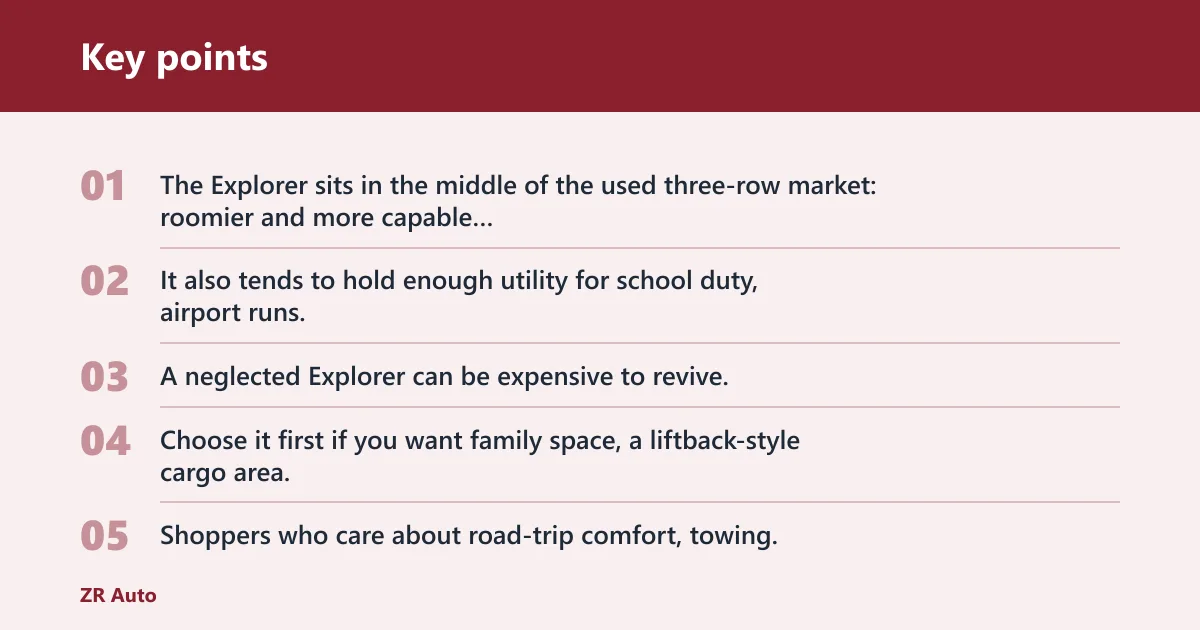
The Explorer sits in the middle of the used three-row market: roomier and more capable than many midsize crossovers, but usually less expensive than luxury nameplates. It also tends to hold enough utility for school duty, airport runs, and towing a light trailer, which keeps demand strong.
The catch is cost spread. A neglected Explorer can be expensive to revive, while a maintained one can be a good value because depreciation has already done much of the work for you.
Who should consider it first?
Choose it first if you want family space, a liftback-style cargo area, and a model that can be found with AWD and useful infotainment features. Shoppers who care about road-trip comfort, towing, or driver-assist technology often find the Explorer easier to fit than smaller two-row SUVs.
Say your daily routine includes two child seats, a stroller, and weekend luggage. A clean Explorer with folding third-row seats can cover that without forcing you into a full-size SUV.
Who should keep shopping?
Keep shopping if the budget only allows a high-mileage example with spotty records, if you need the lowest fuel and tire costs possible, or if you want simple ownership above all else. In that case, a rival three-row SUV with a stronger reliability record in the same price band may be a better fit.
Which used Explorer years and trims are worth it?
The best-used Explorer depends on generation. Older models can be cheaper and still make sense, but the safer bets usually come from cleaner mid- to newer-generation examples with clear service history, especially if the trim does not add unnecessary cost.
Older models: value buys versus dated tech
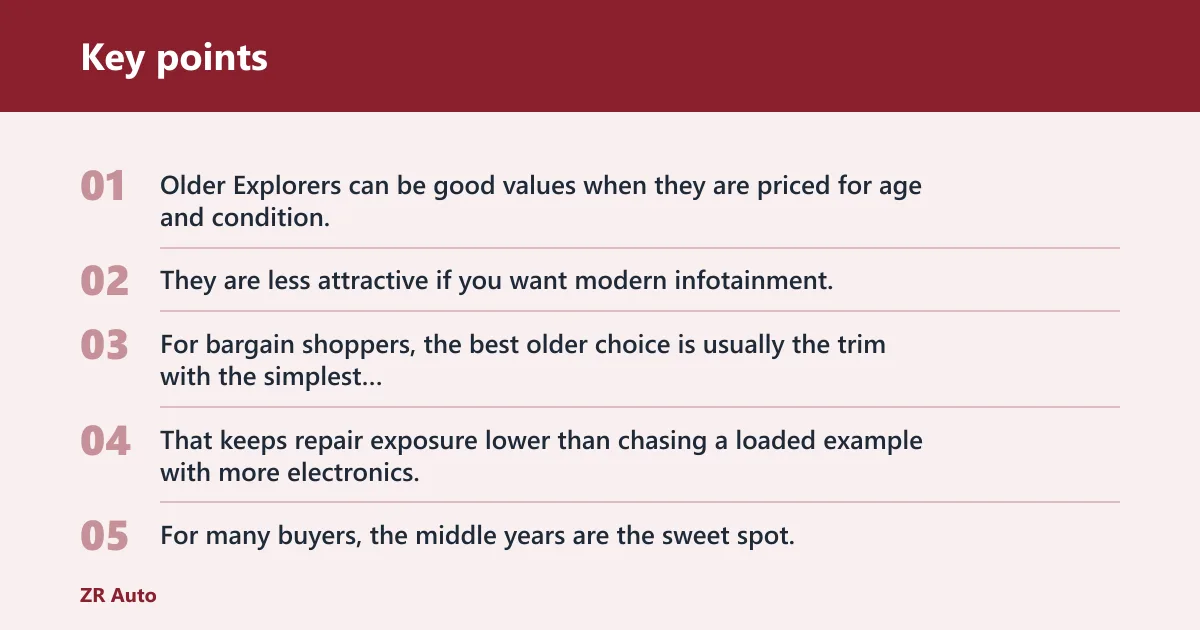
Older Explorers can be good values when they are priced for age and condition, especially when the seller has records and the vehicle has not been neglected. They are less attractive if you want modern infotainment, more advanced driver-assist content, or a quieter cabin than current rivals offer.
For bargain shoppers, the best older choice is usually the trim with the simplest equipment package and the clearest maintenance trail. That keeps repair exposure lower than chasing a loaded example with more electronics.
Mid-cycle models: the balance point for many shoppers
For many buyers, the middle years are the sweet spot. You get better cabin tech than older models, more available safety equipment, and a used price that can still make sense against the current 2026 Ford Explorer baseline.
Look for trims that match your needs, not your status goals. An XLT often gives a better value balance than a pricier trim whose extra equipment raises tire, brake, or insurance costs.
Newer models: tech, price, and warranty math
Newer used Explorers cost more, but they usually bring better infotainment, more driver-assist content, and a cleaner starting point for service history. Ford’s current lineup includes a 2026 Explorer, which makes late-model used examples easier to compare against a new one on equipment and price.
Ford also lists BlueCruise on supported configurations, and Ford says it enables hands-free highway driving on 97% of controlled access highways in the U.S. and Canada. That matters only if the vehicle has the right hardware and the feature is actually present on the exact unit you are buying.
Ford describes Co-Pilot360 as technology designed to help drivers feel in control behind the wheel. On a used Explorer, that means verifying the package and not assuming every camera, warning system, or assist feature is included.
Explorer ST: performance tradeoffs and costs
The Explorer ST is appealing if you want stronger acceleration and a sportier feel, but it is the worst place to hunt for cheap ownership. Bigger brakes, more tire wear, and a higher likelihood of hard use can push running costs above those of a standard XLT or Limited.
A common first-timer mistake is buying the quickest trim because it feels like the best deal. On an ST, worn tires and brakes often tell you more about past use than the odometer does.
What should you check before buying?
Start with records, then move to symptoms. On a used Explorer, a clean history, a consistent maintenance trail, and a calm test drive matter more than a promising price or a low odometer reading.
Service records, accident history, and mileage clues
Look for oil changes, coolant service, brake work, transmission service if applicable, and evidence that suspension and AWD components were not ignored. A vehicle with about 90,000 miles and complete records is often a better bet than one with about 60,000 miles and service gaps.
Why is a used Ford Explorer so cheap? Often because the market discounts higher-mileage examples, older trim levels, prior accident repairs, or models with known maintenance exposure. Cheap can be fine, but cheap plus missing records is where risk rises fast.
AWD, tires, brakes, suspension, and leak checks
Check for uneven tire wear, cupping, brake vibration, clunks over bumps, and fluid spots under the engine bay and drivetrain. AWD models deserve extra attention because neglected service or mismatched tires can lead to costly driveline problems.
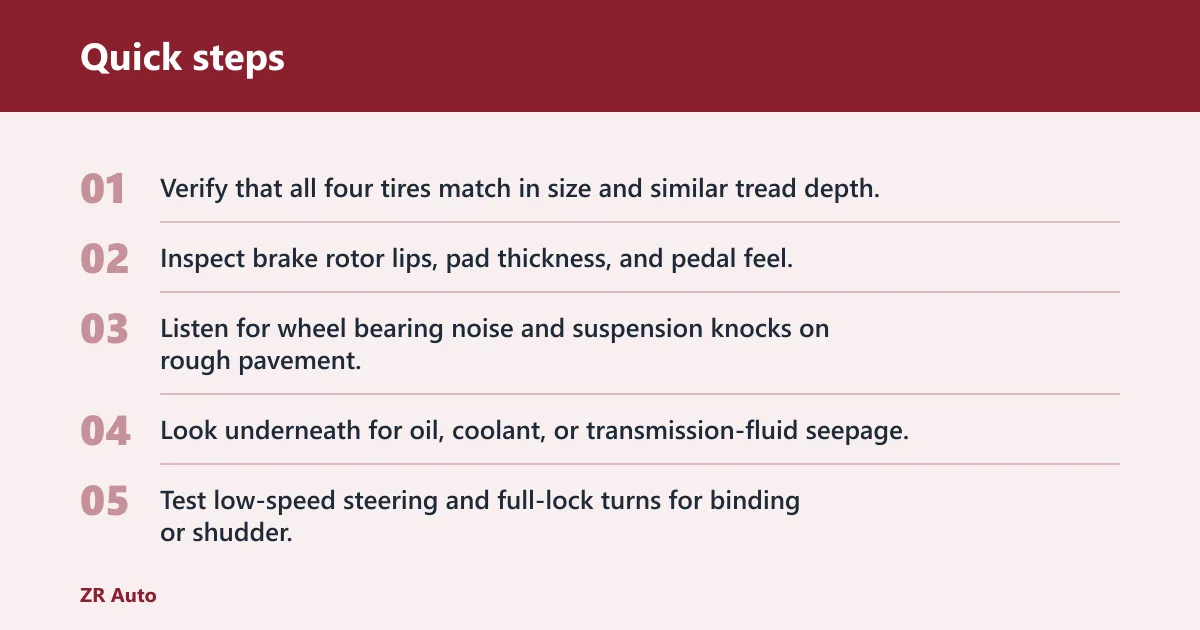
- Verify that all four tires match in size and similar tread depth.
- Inspect brake rotor lips, pad thickness, and pedal feel.
- Listen for wheel bearing noise and suspension knocks on rough pavement.
- Look underneath for oil, coolant, or transmission-fluid seepage.
- Test low-speed steering and full-lock turns for binding or shudder.
Suppose a buyer sees one front tire much newer than the others and hears a faint whine on tight parking-lot turns. That can point to uneven wear, missed alignment work, or driveline stress, any of which should push the deal into a deeper inspection.
Infotainment, ford Co-Pilot360, and BlueCruise verification
Confirm that the infotainment screen boots quickly, the backup camera is clear, the audio and phone pairing work, and every advertised driver-assist feature is present. Ford’s showroom includes fuel economy filters in MPG and L/100KM, seating filters for passenger capacity, towing filters for payload and towing comparison, and a price filter for side-by-side shopping; use those specs to compare what you are getting.
Also verify any BlueCruise claim on the exact vehicle. Ford says the system works on supported highways, so a used listing that merely mentions “hands-free” is not enough without the proper package and hardware.
Pre-purchase inspection items that matter most
Bring a scan tool or ask a shop to check for stored codes, pending codes, and transmission, AWD, or emissions faults. A pre-purchase inspection should also include coolant-system pressure checks, brake measurement, tire age, and a road test that reaches highway speed.
Ford’s mobile service can handle oil changes, brakes, batteries, tire rotation, and more. Ford Pickup & Delivery can collect a vehicle from home or work, service it, and return it, which can lower the friction of owning a used Explorer that needs regular care.
How reliable is a used Explorer after 100,000 miles?
After 100,000 miles, condition matters more than the odometer. A well-serviced Explorer can still be a reasonable buy, but one with neglected cooling, uneven service, or repeated warning lights becomes much harder to justify, even if the price looks tempting.
Condition signals that matter more than the odometer
Look for stable idle quality, smooth shifting, clean fluid condition, and a cabin without warning lights or electrical glitches. Mileage matters, but service quality and usage type matter more when you are trying to decide whether the truck has life left or liability attached.
Likely repair categories to budget
At higher mileage, budget for tires, brakes, battery, suspension wear items, and possible cooling- or transmission-related work. If the vehicle tows often, those costs can come sooner, and if it is an ST, the brake and tire budget tends to climb faster.
That is why a used Explorer can feel cheap upfront and expensive later. Depreciation reduces the purchase price, but maintenance, fuel, and repairs do not disappear with it.
How ownership costs change with age and use
Fuel use, tires, brakes, and depreciation are the biggest routine cost drivers. Add repair risk if the vehicle has long service gaps, AWD use without records, or signs of hard towing, and the ownership math changes quickly.
The best cost control comes from buying the cleanest example you can afford, then servicing it on schedule. That approach usually beats chasing the lowest sticker price.
Explorer ownership costs and alternatives
The Explorer can be good value when you need size and capability, but it is not the cheapest used three-row to own. Buyers should compare fuel use, tire replacement, brake wear, and depreciation against rivals before deciding.
Fuel, tires, brakes, and depreciation
Fuel costs depend on engine choice and drivetrain. Tires and brakes are often more expensive than on smaller crossovers because the Explorer is heavier and, in some trims, wears larger wheels and performance-oriented parts.
Depreciation helps used shoppers, but it also explains why some listings look unusually affordable. A lower asking price can simply reflect the market’s expectation of future repair cost.
Tow use, cargo needs, and family space
If you tow, haul sports gear, or need a third row that works more than twice a year, the Explorer’s packaging is a real advantage. It is also easier to justify than a smaller SUV if you need both seating and cargo room at the same time.
When a rival three-row SUV is the better buy
Choose a rival if it offers a stronger reliability record in the same price range, lower tire and brake costs, or a cleaner service history for the money. Shopping by buyer type is smarter than shopping by badge.
How Ford dealer service support affects convenience
Dealer support can matter more than shoppers expect. Mobile service and Pickup & Delivery reduce downtime, which helps if you keep the SUV for years and want routine work handled with less disruption.
Frequently asked questions
Is the Ford Explorer a reliable SUV?
It can be reliable when maintained well, but reliability varies sharply by generation and care. Treat service records, accident history, and a clean inspection as the real filter. A neglected Explorer is a poor bet no matter how good the price looks.
What Ford Explorer engine is best to buy used?
The safest used choice is usually the engine with the cleanest records and the least evidence of abuse, not the most powerful one. For many shoppers, a well-kept V6-powered XLT or similar trim offers a better ownership balance than a harder-driven turbo or performance setup.
What is the Ford Explorer like after 100,000 miles?
After 100,000 miles, the Explorer can still be useful if the drivetrain is quiet, the cooling system is healthy, and the service log is complete. If you see rough shifting, coolant loss, or uneven tire wear, expect higher repair exposure and lower value.
Why is a used Ford Explorer so cheap?
Used Explorers can be cheap because of depreciation, higher mileage, accident history, or maintenance gaps. Some listings are fair bargains, but many are priced to reflect future tire, brake, suspension, or transmission spending. The asking price alone does not prove value.
What should I check before buying a used Ford Explorer?
Check service records, warning lights, tire wear, brake life, coolant and oil leaks, AWD function, and the behavior of the infotainment and driver-assist systems. Then verify the exact equipment list, because Ford Co-Pilot360 and BlueCruise content can vary by year and trim.