Ford Escape Years to Avoid and Best Years to Buy
By the Gear Answers editorial team | Methodology: model years below are scored with a transparent risk matrix that weighs (1) NHTSA recall count for the model year, (2) NHTSA complaint pattern and severity, (3) whether the year is a launch/redesign year, (4) powertrain-specific issue concentration, and (5) age-related wear exposure. This is a used-buyer risk guide, not a prediction that every vehicle from a given year will fail. Complaint totals are not apples-to-apples across years because older vehicles have had more time in service, sales volume varies, and some years include multiple engines, hybrid systems, or PHEV hardware under one model-year label.
Inspection note: this article is written for shoppers doing a short list before a pre-purchase inspection. The most reliable way to judge any individual Escape is still a VIN-level recall check, service-record review, and a cold-start inspection. For related problem patterns and buying checks, see Ford Escape transmission problems, the recall lookup, and this used SUV inspection checklist.
Many buyers consider 2017-2019 the lower-risk used gas years for value, 2021-2022 hybrids for efficiency, and 2023-2024 if the price works; years that usually require the most caution include 2005-2008, 2013-2014, and some early 2020 builds. Pick wrong, and you can end up with transmission failure, coolant-intrusion engine damage, repeat recalls, or poor crash-tech value. This guide scores Escape years by used-buyer risk, separates gas from hybrid and plug-in hybrid choices, and lists the inspection points that matter before you buy.
A strong all-around used gas pick is often the 2019 Ford Escape because it sits near the end of the 2013-2019 generation, where major trouble spots are better documented and the model year carries fewer broad caution flags than 2013-2014 or 2020. That does not make 2019 “problem-free”; it means the risk mix is usually easier to inspect and price correctly.
Quick picks
- Best overall used gas year: 2019. Highest score here among gas years because it is a late third-generation model, not a launch year, and it avoids the 2013-2014 risk peak.
- Best budget year: 2010-2012, with 2012 the easiest place to start. These years score well for lower complexity and fewer widely discussed powertrain red flags than 2013-2014.
- Best hybrid choice: 2021-2022 hybrid if recall work is complete and pricing beats a 2023. These years score better than 2020 mainly because they are not the first model year of the generation, though battery-cooling and software-history checks still matter.
- Best plug-in hybrid choice: 2023-2024 PHEV if charging matters more than long-term data depth. These are newer, so durability history is shorter and the confidence band is wider.
- Years most buyers should skip first: 2005, 2008, 2013, 2014, and 2020. Those years show the heaviest overlap of complaint concentration, recall burden, launch-year penalty, or well-documented engine/transmission concern patterns.
Escape year decision table
How the matrix scores risk and recalls
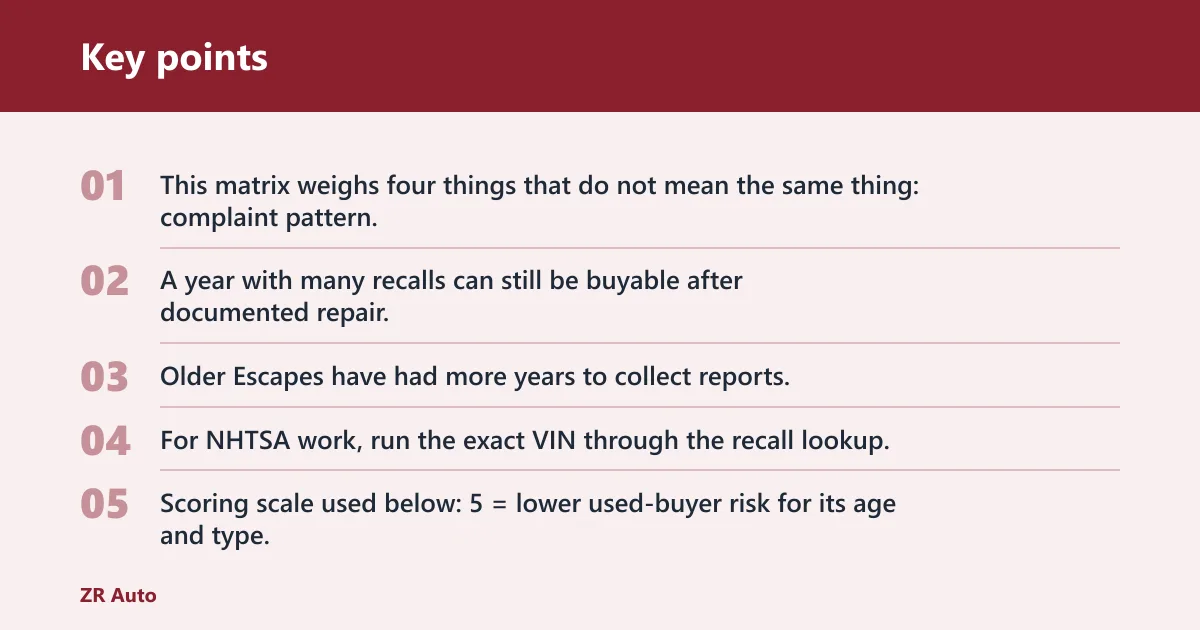
This matrix weighs four things that do not mean the same thing: complaint pattern, recall burden, known failure concentration, and inspection priority. A year with many recalls can still be buyable after documented repair, while a year with fewer recalls can still be risky if failures cluster around a transmission or a coolant-intrusion engine issue.
Complaint totals also need context. Older Escapes have had more years to collect reports, high-volume model years naturally draw more owner filings, and mixed powertrain years can hide which engine is actually causing the trouble. For NHTSA work, run the exact VIN through the recall lookup, then compare it with the NHTSA model-year complaint and recall pages and Ford’s owner recall portal for completion status.
Scoring scale used below: 5 = lower used-buyer risk for its age and type, 4 = generally solid but still inspect carefully, 3 = mixed/conditional buy, 2 = caution unless records and price are strong, 1 = high-risk year or powertrain that most shoppers should skip.
Gas, hybrid, and plug-in hybrid years at a glance
| Year / powertrain | Score | Major failure risk | Recall burden | Recommended buyer type | What to inspect first |
|---|---|---|---|---|---|
| 2001 gas Verdict: buy only if very cheap and very clean. |
2/5 | Medium-high due to age, rust exposure, and old-transmission wear. | Age matters more than recall volume now. | Risk-tolerant cash buyer needing short-term transport. | Undercarriage rust, transmission engagement into drive and reverse, coolant condition. |
| 2002 gas Verdict: similar to 2001; condition decides. |
2/5 | Medium-high. | Moderate legacy burden. | Only for very low-budget buyers. | Rust, delayed shifts, front-end looseness, service records. |
| 2003 gas Verdict: workable only with strong records. |
2/5 | Medium-high. | Moderate legacy burden. | Cheap commuter shopper. | Transmission slip, cooling-system leaks, rear shock tower rust areas. |
| 2004 gas Verdict: inspect harder than the price suggests. |
2/5 | Medium-high. | Moderate. | Buyer willing to budget immediate repairs. | Drive/reverse engagement, subframe and underbody corrosion, steering feel. |
| 2005 gas Verdict: usually skip. |
1/5 | High due to age-related transmission risk and repeated used-buyer caution flags. | Meaningful legacy burden. | Only if near-free and professionally inspected. | Harsh shifts, slipping, rust, neglected cooling system. |
| 2006 gas Verdict: better than 2005, still old-car risk. |
3/5 | Medium. | Moderate. | Budget buyer who can reject rough examples fast. | Cold-start idle, transmission flare, wheel-well rust. |
| 2007 gas Verdict: best first-generation target. |
4/5 | Medium, lowered by end-of-generation sorting. | Moderate. | Budget buyer wanting the safest first-gen bet. | Rust, transmission operation, maintenance proof. |
| 2008 gas Verdict: usually avoid unless history is unusually strong. |
1/5 | High due to transmission-complaint reputation and used-buyer caution overlap. | Moderate-high. | Only for risk-tolerant bargain hunters. | Delayed engagement, refusal to move in drive or reverse, fluid service records. |
| 2009 gas Verdict: acceptable but not the first pick. |
3/5 | Medium. | Moderate. | Buyer priced out of 2010-2012. | Shift quality, ABS warning lights, underbody corrosion. |
| 2010 gas Verdict: strong budget buy. |
4/5 | Medium-low for the age. | Moderate. | Budget commuter. | Transmission smoothness, rust, cooling-fan operation, service history. |
| 2011 gas Verdict: one of the safest low-cost choices. |
4/5 | Medium-low. | Moderate. | Buyer who wants simple transportation over latest tech. | Cold start, transmission engagement, tire-wear signs of suspension neglect. |
| 2012 gas Verdict: best budget-year starting point. |
5/5 | Medium-low. | Moderate. | Low-budget family daily driver. | Shift flare, rust, steering/suspension noise, maintenance records. |
| 2013 gas 1.6 EcoBoost Verdict: avoid. |
1/5 | Very high. NHTSA lists a heavy recall and complaint load for 2013, including engine-related complaints and multiple recalls for this model year (NHTSA 2013 Escape). | High. | Not recommended for mainstream used buyers. | Coolant loss, overheating history, misfire, rough running, recall completion. |
| 2013 gas non-1.6 Verdict: still high risk. |
1/5 | High due to redesign-year complaints and door/body concerns documented in NHTSA owner reports (NHTSA 2013 Escape). | High. | Only if deeply discounted with documented repairs. | Transmission hesitation, driver door check-arm area, window binding, coolant evidence. |
| 2014 gas 1.6 EcoBoost Verdict: avoid unless records are exceptional and price is very low. |
1/5 | Very high because 2013-2014 1.6-liter EcoBoost years are linked to overheating/coolant-loss concerns and related recall history documented by NHTSA and Ford (NHTSA 2014 Escape; Ford recall portal). | High. | Risk-tolerant buyer only. | Cooling-system pressure loss, smoke smell, misfire codes, recall proof. |
| 2014 gas non-1.6 Verdict: better than 1.6, still not a preferred year. |
2/5 | High. | High. | Buy only with strong history. | Door spot-weld area, latch feel, transmission behavior, coolant traces. |
| 2015 gas Verdict: transitional; buy selectively. |
3/5 | Medium. | Moderate. | Buyer wanting newer styling without 2013-2014 risk peak. | Cold misfire, coolant smell, door-check operation, software update history. |
| 2016 gas Verdict: recommended. |
4/5 | Medium-low for the generation, though still inspect for coolant and shift concerns. | Moderate. | Balanced-value buyer. | Coolant level stability, transmission shift quality, door opening resistance. |
| 2017 gas Verdict: strong used choice. |
4/5 | Medium-low. | Moderate. | Mainstream used-SUV shopper. | Cold start for misfire, smooth 2-3 shifts, recall completion. |
| 2018 gas Verdict: recommended. |
4/5 | Medium-low. | Moderate. | Family daily driver. | Coolant smell, turbo lag with warning lights, door-check area. |
| 2019 gas Verdict: top overall used gas pick. |
5/5 | Low-medium by this matrix: late-cycle year, broad parts availability, and fewer major red flags than 2013-2014 or 2020. | Moderate. | Most buyers wanting value and familiar repairs. | Service history, transmission smoothness, coolant-system work. |
| 2020 gas Verdict: avoid unless records and price are unusually strong. |
1/5 | Very high for a new-generation launch year. NHTSA shows a large recall footprint and substantial complaint activity for 2020 (NHTSA 2020 Escape). | Very high. | Not for conservative buyers. | VIN recall check, software updates, transmission response, electronic faults. |
| 2020 hybrid Verdict: better than 2020 gas, still caution. |
2/5 | Medium-high because the year itself is recall-heavy and is still a launch-year build. | Very high. | Efficiency-first buyer who accepts recall follow-up. | Battery cooling, charging-system warnings, VIN recall status. |
| 2020 PHEV Verdict: shop only with complete dealer records. |
2/5 | Medium-high. | Very high. | PHEV shopper focused on low miles and warranty residue. | Charge-port operation, battery-related campaigns, software history. |
| 2021 gas Verdict: fair, but hybrid looks better. |
3/5 | Medium. | Moderate. | Buyer wanting newer safety tech at lower cost than 2023+. | Transmission calibration feel, electronics, open recalls. |
| 2021 hybrid Verdict: best fourth-generation efficiency pick so far. |
4/5 | Medium-low relative to 2020 because it avoids the first-year penalty and the hybrid configuration has looked more stable for many used shoppers so far. | Moderate. | High-mile commuter. | Battery cooling fan noise, hybrid-system warnings, brake feel, recall completion. |
| 2021 PHEV Verdict: good if you can charge regularly. |
3/5 | Medium. | Moderate. | Short-trip owner with home charging. | Charge history, battery temperature-management records, dealer campaign history. |
| 2022 gas Verdict: mixed; inspect closely. |
3/5 | Medium because long-term data is still developing and complexity remains higher than older gas-only years. | Moderate-high. | Buyer getting a clear price break over 2023. | VIN recall check, electronics, transmission hesitation. |
| 2022 hybrid Verdict: worthwhile if updates are complete. |
4/5 | Medium-low; hybrid pattern looks better than 2022 gas in many shopper cases, but VIN-level campaign history still matters. | Moderate-high. | Efficiency-first buyer who wants newer safety features. | Battery cooling, regenerative-brake feel, recall completion. |
| 2022 PHEV Verdict: fine only after campaign verification. |
3/5 | Medium. | Moderate-high. | PHEV shopper with access to charging and dealer records. | Charge-port, battery-system software, open recall status. |
| 2023 gas Verdict: safer bet than 2020-2022 gas so far. |
4/5 | Medium-low, with shorter long-term history. | Moderate. | Buyer keeping it five years rather than fifteen. | Recall status, infotainment glitches, transmission smoothness. |
| 2023 hybrid/PHEV Verdict: recommended if pricing is reasonable. |
4/5 | Medium-low, but the confidence band is still narrower than for an older proven used model. | Moderate. | Efficient family daily driver. | Battery health records, charging operation, software campaigns. |
| 2024 gas Verdict: current sweet spot if the budget allows. |
4/5 | Low-medium with limited long-run history. | Moderate to still-developing. | Buyer who wants newer safety systems without launch-year risk. | VIN recall check, full dealer service history, electronics. |
| 2024 hybrid/PHEV Verdict: best newer efficiency pick if discounted from new. |
4/5 | Low-medium with limited age data. | Moderate to still-developing. | Efficiency buyer planning medium-term ownership. | Battery records, cooling operation, charge performance, recalls. |
| 2025 gas/hybrid/PHEV Verdict: too new for hard long-term judgment. |
3/5 | Unknown-to-medium due to short durability record. | Developing. | Buyer prioritizing warranty over used-car savings. | Build-date campaigns, software updates, dealer history. |
| 2026 gas/hybrid/PHEV Verdict: promising, but dataset age is tiny. |
3/5 | Unknown; too new for a credible long-term durability call. | Developing. | Buyer comfortable paying for newer inventory. | VIN-based recall check, initial service records, electronics. |
How to use the matrix for your budget and risk tolerance
If the budget is tight, put lower mechanical complexity first and newer tech second. That points most buyers toward 2010-2012 or a clean 2007, not an attractively priced 2013-2014 turbo model with a known coolant-loss or overheating history.
Suppose two Escapes cost the same: a 2014 1.6 EcoBoost with leather and a 2012 gas model with fewer features. Before buying either one, compare the known issue pattern with Ford Escape transmission problems and work through a used SUV inspection checklist.
What Ford Escape years should you avoid?
Start by avoiding 2005, 2008, 2013, 2014, and 2020 unless the price is unusually low and the records are unusually complete. Those years pile up too many risk signals at once: higher complaint concentration, heavier recall activity, launch-year risk, or concentrated engine and transmission complaints that can turn a cheap buy into a major repair.
High-risk years with concentrated engine or transmission complaints
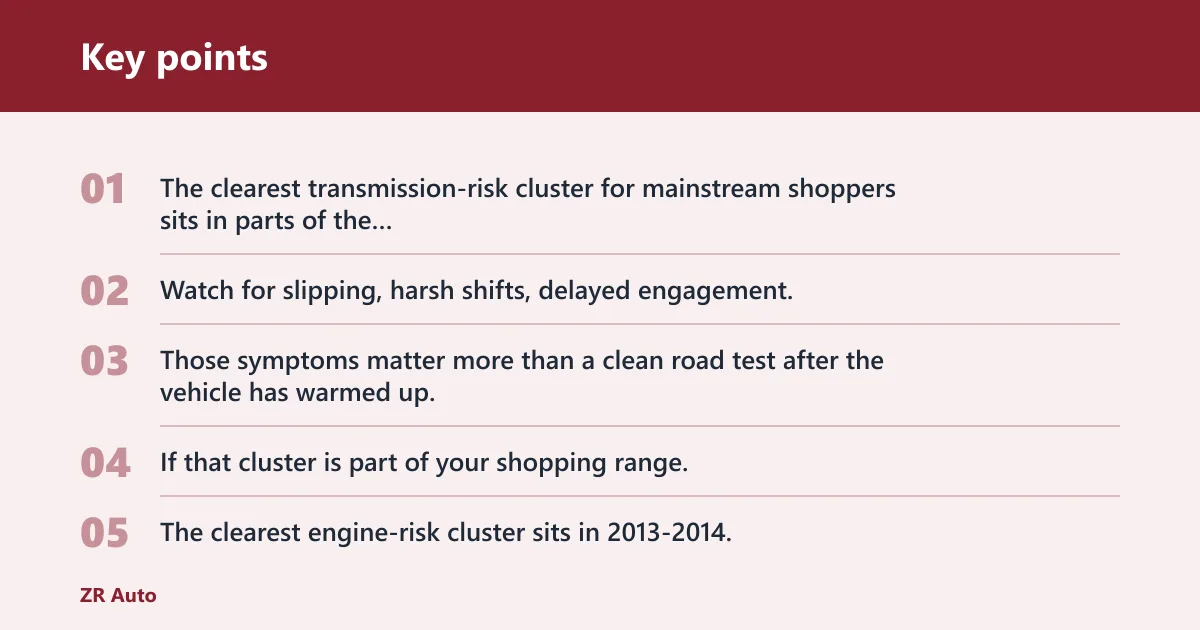
The clearest transmission-risk cluster for mainstream shoppers sits in parts of the 2005-2008 span. Watch for slipping, harsh shifts, delayed engagement, and a refusal to go into drive or reverse. Those symptoms matter more than a clean road test after the vehicle has warmed up, so insist on a cold start and a full stop-to-go drive. If that cluster is part of your shopping range, review Ford Escape transmission problems before you inspect.
NHTSA and Ford recall records for those years are the first places to verify, and those are also the years where you need to check hardest for coolant loss, overheating, rough running, misfires, and signs of prior head-gasket or engine work (NHTSA 2013 Escape; NHTSA 2014 Escape; Ford recall portal).
Why 2013-2014 draw outsized caution
2013 is the clearest warning year in this guide because it combines redesign-year risk with heavy official activity. NHTSA’s 2013 Escape page shows a large complaint count and double-digit recalls for the model year, which is enough to move it into the highest-risk band here even before you separate engines by VIN (NHTSA 2013 Escape).
2014 often falls into the same warning band because it carries much of the same engine-related concern set, especially with the 1.6-liter turbo. Even when recall work is complete, that does not erase wear or damage from past overheating, repeat coolant loss, or rough running that was never repaired correctly.
Years that are acceptable only with strong records and pricing
2001-2004, 2006, 2009, 2015, 2021 gas, and 2022 gas all fall into the “buy only after careful screening” group. None is an automatic reject. None should be treated as a default recommendation either.
A common first-timer mistake is to treat a lower complaint count on a newer year as proof that it is safer. On a 2022 gas Escape, the better reading is narrower: the model is newer, the data trail is shorter, and repair-cost exposure can still run higher than on an older, simpler 2012.
When a low purchase price still does not make sense
Skip the deal if the seller cannot show recall completion, coolant-system history, or transmission service evidence on the problem years. Cheap turns expensive fast when the first week brings a misfire diagnosis, a cooling-system pressure test, or a transmission that will not engage reverse. A fast VIN check through the recall lookup is the minimum starting point.
Which Ford Escape years are best for budget buyers?
The best budget targets are 2010-2012, with 2012 as the easiest year to recommend first. In this methodology, those years score well because they usually avoid the best-known 2013-2014 engine concerns while staying newer than the rust-prone oldest first-generation trucks many low-budget shoppers cross-shop.
Best low-cost years if you want simple transportation
Start with 2012, then 2011, then 2010. They are old enough to be affordable, common enough that service history often exists, and simple enough that a pre-purchase inspection can tell you a lot in short order.
After that, 2007 is the best first-generation fallback. It benefits from the usual end-of-cycle pattern, where many early bugs have already been sorted out, though age and rust are still major decision points.
Older years worth considering only after inspection
2006 and 2009 can still work as low-cost commuters. The issue is not reputation alone. The issue is whether the specific SUV shifts cleanly, stays cool, shows no serious rust underneath, and has enough records to show it was not driven with warning signs ignored.
Budget traps
The budget traps are 2005, 2008, 2013, and 2014. The reason is not a single ranking list; it is the overlap of age-related wear, transmission risk in the older pair, and engine/recall concerns in the newer pair. On all four, a cheap asking price is often just a down payment on deferred repairs.
Which hybrid or plug-in hybrid Ford Escape years make sense?
The safer used targets are 2021-2022 hybrids for mainstream buyers and 2023-2024 PHEVs for shoppers who will actually plug in. Hybrids and PHEVs need their own rules because battery cooling, charging hardware, and software campaign history matter differently than they do on gas-only Escapes.
Best used hybrid years versus best used PHEV years
For hybrids, 2021 is the cleanest starting point in this guide.
For PHEVs, 2023-2024 is the sharper play than 2020-2022 because it avoids the worst launch-year noise and gives you a more settled version of the same idea. The tradeoff is price and the still-short long-term durability record.
Battery, charging, and cooling-system checks before purchase
- Confirm all recalls and campaigns by VIN, not by seller memory.
- Check for battery or hybrid-system warning lights at startup and after the test drive.
- Review service records for battery-related work, cooling-system work, and software updates.
- On PHEVs, test charge-port operation and confirm the vehicle accepts and completes a charge normally.
- Listen for unusual battery-cooling fan behavior and watch for energy-management warnings.
When a gas Escape is the lower-risk choice
If you do not have regular charging access, or if dealer records are incomplete, a 2018-2019 gas Escape is often the easier used purchase. You give up hybrid efficiency, but you also cut uncertainty around battery history and charging-system neglect.
Is the 2020 Ford Escape a year to avoid?
Yes, 2020 is the fourth-generation year most buyers should approach with the most caution. It combines redesign-year risk with heavy official activity, and NHTSA’s 2020 Escape page shows a large recall footprint and substantial complaint volume for the model year (NHTSA 2020 Escape). That does not mean every 2020 is bad; it means 2020 needs stronger records and a better discount than later fourth-generation years.
What changed in the 2020 redesign
The 2020 model launched the current generation. Per the generation split used here, Ford Escape generations are grouped as 2001-2007, 2008-2012, 2013-2019, and 2020-present. That matters because redesign years often bring more software, electronics, calibration, and build-quality variation than late-cycle years.
Early complaints, recalls, and what they mean today
A completed recall is good news, but it is not a blanket pardon. Recall work can fix a defined safety defect. It does not automatically erase a year’s pattern of repeat owner dissatisfaction, and it does not repair unrelated durability problems that appear after the warranty period.
Picture a 2020 hybrid with every recall done, clean paint, and a fair price. It can still make sense, but only after you confirm stable charging behavior, no warning lights, complete software history, and a test drive that does not show odd transmission or electronic behavior. Start with the recall lookup, then ask for Ford dealer repair orders if any campaign was completed.
Which 2020-present years look safer so far?
For gas models, 2023-2024 looks safer than 2020-2022 so far, with the normal warning that those years have spent less time in service. For hybrids, 2021-2023 is the stronger lane by this matrix. That is a methodology-based conclusion here, not a claim of proven long-term superiority.
Match the year to your mileage plan, budget, and risk tolerance
If the plan is high annual mileage on a strict budget, 2011-2012 makes more sense than a risky cheap turbo year.
How to weigh complaints, recalls, and repair-cost exposure
Use complaints to spot patterns, recalls to spot official safety action, and inspection results to judge the actual vehicle in front of you. A year with fewer complaints but costly battery or electronics systems may still cost more to own than an older year with more age but lower parts complexity.
The 2019 gas Escape is a good example of the balance point. It is newer than the 2010-2012 budget sweet spot, but old enough that the market knows its patterns, and it avoids the biggest red flags associated with 2013-2014 and 2020.
What should you check before buying a used Ford Escape?
Check the transmission from a cold start, inspect for coolant loss or misfire signs, confirm recalls by VIN through the NHTSA database or a Ford dealer, review service history for actual repair orders, and look underneath for rust. On hybrids and PHEVs, add battery-system records, charging checks, and cooling-system verification, because those systems change both failure modes and repair costs. The short version is: use the used SUV inspection checklist and do not skip the recall lookup.
Pre-purchase inspection checklist for gas, hybrid, and PHEV models
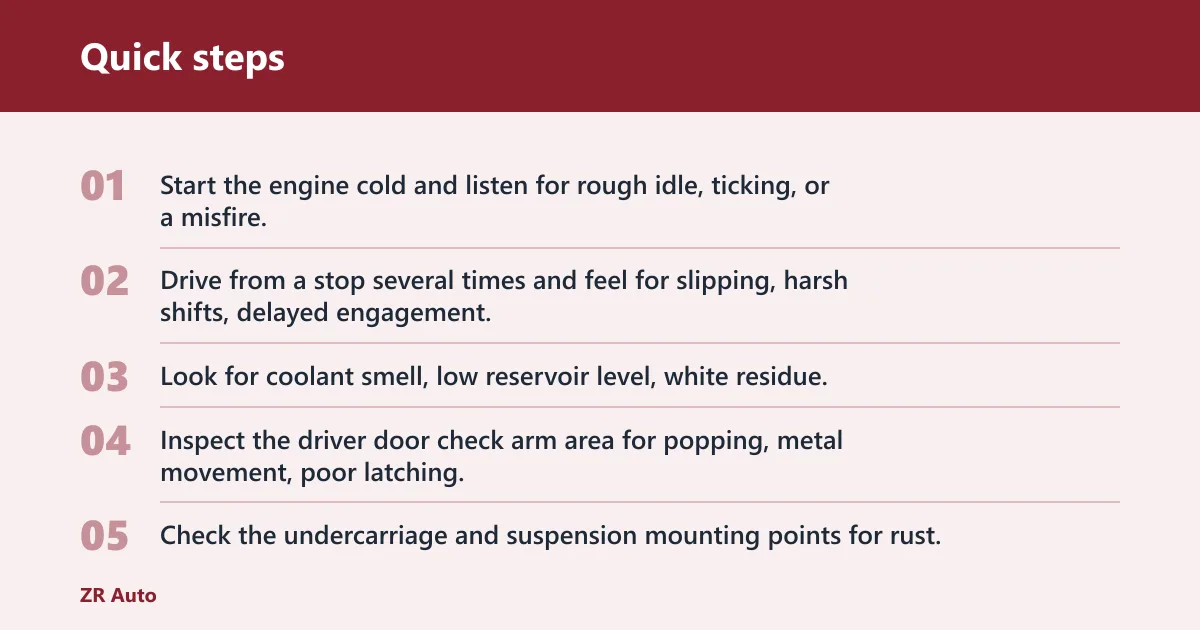
- Start the engine cold and listen for rough idle, ticking, or a misfire.
- Drive from a stop several times and feel for slipping, harsh shifts, delayed engagement, or refusal to take drive or reverse.
- Look for coolant smell, low reservoir level, white residue, or evidence of repeated top-offs.
- Inspect the driver door check arm area for popping, metal movement, poor latching, or a sticking window.
- Check the undercarriage and suspension mounting points for rust.
- Review service records for transmission fluid service, coolant-system work, head-gasket or engine replacement history, and completed recalls.
- On hybrids and PHEVs, review battery-related records and test charging operation if equipped.
Should you buy after a recall repair?
Yes, sometimes. A recalled Escape can still be worth buying after repair if the recall fixed a defined defect and the year is not also known for separate durability problems outside that repair.
Frequently asked questions
What are the best Ford Escape years to buy used?
For low-budget buyers, 2010-2012 is the better hunting ground.
Is the 2013 Ford Escape reliable?
No, 2013 is not a year to call reliable without major qualifiers. NHTSA’s 2013 Escape page shows unusually heavy recall and complaint activity for the model year, and the 1.6-liter EcoBoost version deserves the most caution (NHTSA 2013 Escape).
Which Ford Escape model years have transmission problems?
The heaviest used-buyer concern clusters around 2005-2008, with symptoms such as slipping, harsh shifts, delayed engagement, and refusal to go into drive or reverse. Some newer years can still show hesitation or calibration complaints, but the old cluster is where transmission risk most often drives the purchase decision.
What is the safest Ford Escape year to buy used?
For the broadest group of used shoppers, 2019 is the safest single gas-year target by the scoring method used here because it avoids the early third-generation trouble peak and is late enough in the cycle that common issue patterns are well known. If hybrid efficiency matters, 2021 hybrid is the safer current-generation place to start than 2020.
Should I buy a Ford Escape after a recall repair?
A completed recall is a positive sign, but it does not wipe out every risk tied to that model year. Buy after repair only if the recall is documented by VIN and the Escape also passes a year-specific inspection for transmission behavior, coolant issues, door structure concerns, and hybrid or charging-system health.
Which Ford Escape years have the fewest complaints?
Newer years often look cleaner simply because they have spent less time on the road, so low complaint totals should not be read by themselves. For used shoppers today, model-year complaint totals are most useful when paired with recall history, powertrain-specific issues, and time in service rather than treated as a stand-alone ranking.
Sources
- NHTSA: 2013 Ford Escape recalls, complaints, investigations, and manufacturer communications
- NHTSA: 2014 Ford Escape recalls, complaints, investigations, and manufacturer communications
- NHTSA: 2020 Ford Escape recalls, complaints, investigations, and manufacturer communications
- Ford owner recall portal
- Recall lookup
- Ford Escape transmission problems
- Used SUV inspection checklist