How to Reset the TPMS Light on a Kia Sportage
Reset the TPMS light on a Kia Sportage by first setting all tires to the door-jamb pressure. If the light stays on, use the cluster reset on some older models or drive 10–20 minutes, while direct-sensor systems may need a relearn tool. A persistent light can hide a true low-pressure tire or sensor fault. This guide shows which reset method fits your Sportage, then what to check if the warning returns.
What you’ll need
- Tire-pressure gauge for cold pressure checks
- Air source for topping up tires
- Owner’s manual or driver-side door placard
- Optional scan tool for faulted or newer systems
- A safe, level parking spot
Which reset method does your Sportage use?
The right reset path depends on model year, because Kia changed the Sportage TPMS setup across generations. Older models often use a manual TPMS SET button. Many 2022-2026 trims rely on automatic relearn behavior, and some faulted systems need scan-tool diagnosis instead of a button press.
Pre-2015 Sportage: likely manual TPMS SET button reset
Pre-2015 Sportage models are often the easiest to reset manually. The TPMS SET button is commonly under the steering wheel or near the dash panel, and the ignition usually needs to be on without starting the engine. If the light returns, treat it as a pressure or sensor problem, not a failed reset.
2016-2021 Sportage: manual reset on many trims, but check the menu or button location
Many 2016-2021 Sportage models still use a physical reset button, but the exact location can vary. Some are placed under the dashboard or near the fuse box. If your trim includes a tire-pressure menu, use the owner’s manual to confirm the reset path before pressing anything.
2022-2026 Sportage: often automatic relearn, with some trims using a different reset path
Newer Sportage models may relearn automatically after correct pressures are set and the vehicle is driven. That means there may be no separate button to press. If the warning persists after a proper drive cycle, the issue is more likely a sensor fault, a pressure mismatch, or a relearn problem.
How do you reset the TPMS light?
Start with the tires, not the button. The TPMS light usually clears only after the tires are inflated to the correct cold pressure listed on the driver-side door placard or in the owner’s manual. On many Sportage models, the reset then happens with ignition on, followed by a short drive.
Step 1: Set all tires to the correct cold pressure
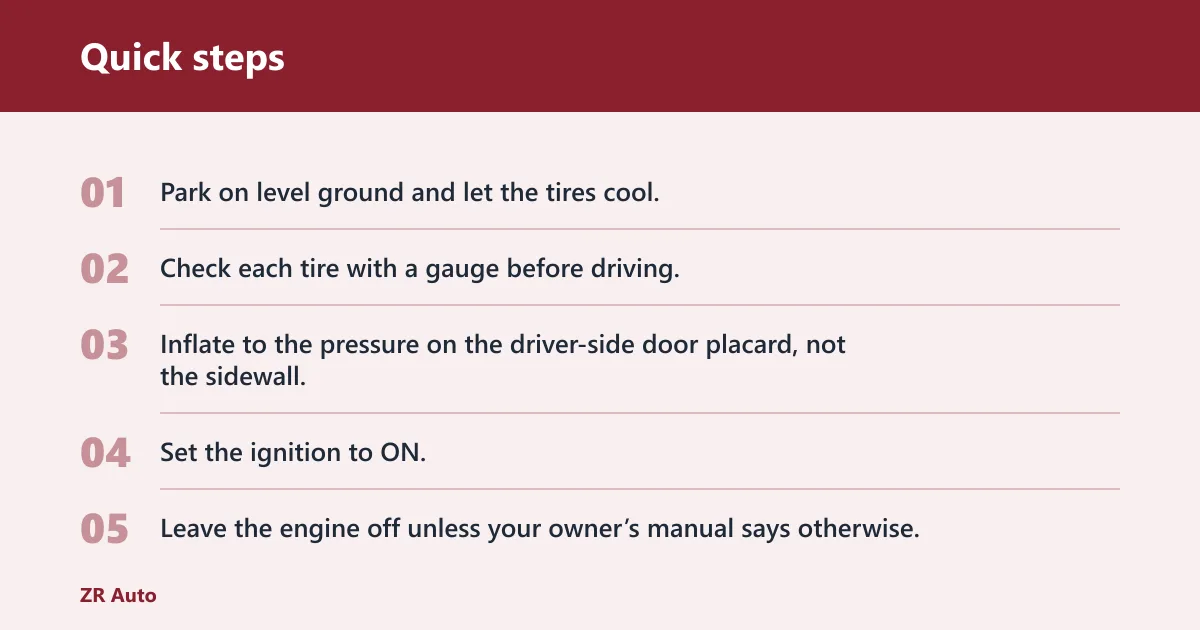
- Park on level ground and let the tires cool.
- Check each tire with a gauge before driving.
- Inflate to the pressure on the driver-side door placard, not the sidewall.
That pressure varies by model year and trim, so the placard is the reference that matters. A reset will not fix a tire that is still low or leaking.
Step 2: Turn the ignition on without starting the engine
- Set the ignition to ON.
- Leave the engine off unless your owner’s manual says otherwise.
- Wait for the cluster to power up fully.
This powers the TPMS system on many Sportage models. Some reset procedures will not start unless the vehicle is in the correct ignition state.
Step 3: Hold the TPMS SET button for 3 to 5 seconds
- Find the TPMS SET button under the dash or near the fuse box.
- Press and hold it for 3 to 5 seconds.
- Watch for a blink or chime, then release the button.
A 2023 Sportage procedure uses about 3 seconds, and some manuals describe 3 to 5 seconds as the normal hold time. If your model has no button, skip this step and move to the drive cycle.
Step 4: Drive the vehicle if the system needs relearn
- Drive at steady road speed after the reset.
- Use 10 to 20 minutes as the practical relearn window.
- Keep the speed steady when possible; around 48 km/h is commonly cited for relearn on some Sportage procedures.
Some Sportage models clear the warning only after the system sees all sensors during a drive cycle. If the light blinks, then returns after a short drive, stop treating it like a button-reset issue.
Sportage TPMS reset matrix
This matrix separates the common Sportage reset paths by generation. Use it to choose the right next step before you chase a dead-end reset routine.
| Model range | Likely reset method | Button location or menu path | Ignition state | Drive-cycle requirement | What to check if the light returns | Likely fault type |
|---|---|---|---|---|---|---|
| Pre-2015 | Manual TPMS SET button | Under the steering wheel or under the dash | ON, engine off | Often yes; drive 10 to 20 minutes | Confirm cold pressure, then inspect for a slow leak or damaged sensor | Pressure issue |
| 2015-2021 | Manual button on many trims | Near the fuse box, under the dash, or in a cluster menu on some trims | ON, engine off on many procedures | Usually yes; steady driving may be required | Recheck placard pressure, then scan for a stored TPMS fault | Pressure issue or sensor issue |
| 2022-2026 | Often automatic relearn | No physical button on some trims; follow the vehicle menu if equipped | Vary by trim | Yes on many systems; drive 10 to 20 minutes | Check sensor IDs, pressure, and any relearn prompt in the cluster | Sensor issue or needs scan tool |
Why did the light come back on?
If the TPMS light returns quickly, the problem is usually still present. A reset cannot erase a low tire, a leak, or a dead wheel sensor. A blinking light during relearn can also mean the system is still calibrating or has detected a sensor fault.
Pressure issue
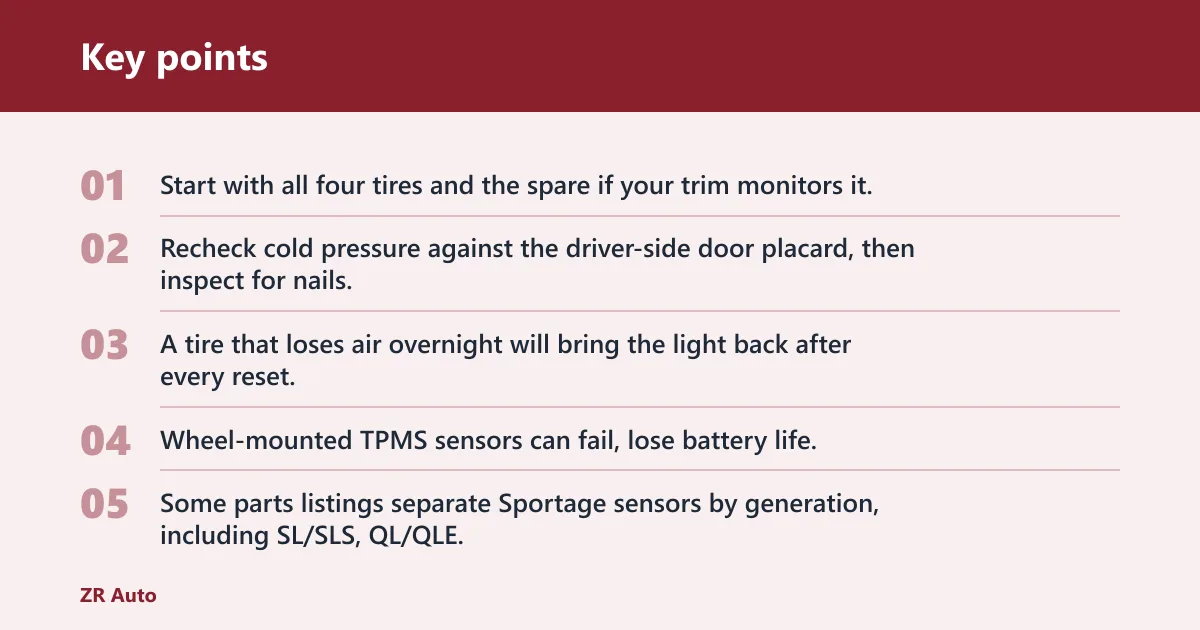
Start with all four tires and the spare if your trim monitors it. Recheck cold pressure against the driver-side door placard, then inspect for nails, valve damage, or a slow leak. A tire that loses air overnight will bring the light back after every reset.
Sensor issue
Wheel-mounted TPMS sensors can fail, lose battery life, or stop communicating after tire service. Some parts listings separate Sportage sensors by generation, including SL/SLS, QL/QLE, and NQ5, so the replacement must match the vehicle family and frequency requirements.
Needs scan tool
If pressure is correct and the warning still returns, a scan tool may be needed to read TPMS codes, confirm sensor IDs, or complete a relearn. That is more likely on newer Sportage trims and on vehicles with mixed or aftermarket sensor parts.
Common mistakes
A reset fails fastest when the driver skips the pressure check. The next most common mistake is using the wrong pressure reference, such as a sidewall number instead of the door placard. Skipping the drive cycle also leaves many Sportage systems stuck in relearn mode.
- Do not press reset before correcting tire pressure.
- Do not guess pressure from the tire sidewall.
- Do not assume every Sportage uses the same button location.
- Do not stop after the light blinks; complete the drive cycle if required.
- Do not ignore a light that comes back after inflation.
Suppose a 2024 Sportage shows a TPMS warning after a tire rotation and all four tires read correctly cold. In that case, the likely next step is a relearn drive, not more air. If the warning returns again after 20 minutes, the scanner is the better next move.
A common first-timer mistake is adding air to match the tire sidewall number instead of the door placard. On a Sportage, that can leave the system unhappy even though the tire seems “full,” because the reference pressure is still wrong for that trim.
If that didn’t work, try this next
Move through the checks in order. That keeps you from replacing parts before the cause is clear. Most Sportage TPMS problems resolve at the pressure or relearn stage, but sensor faults need a different fix path.
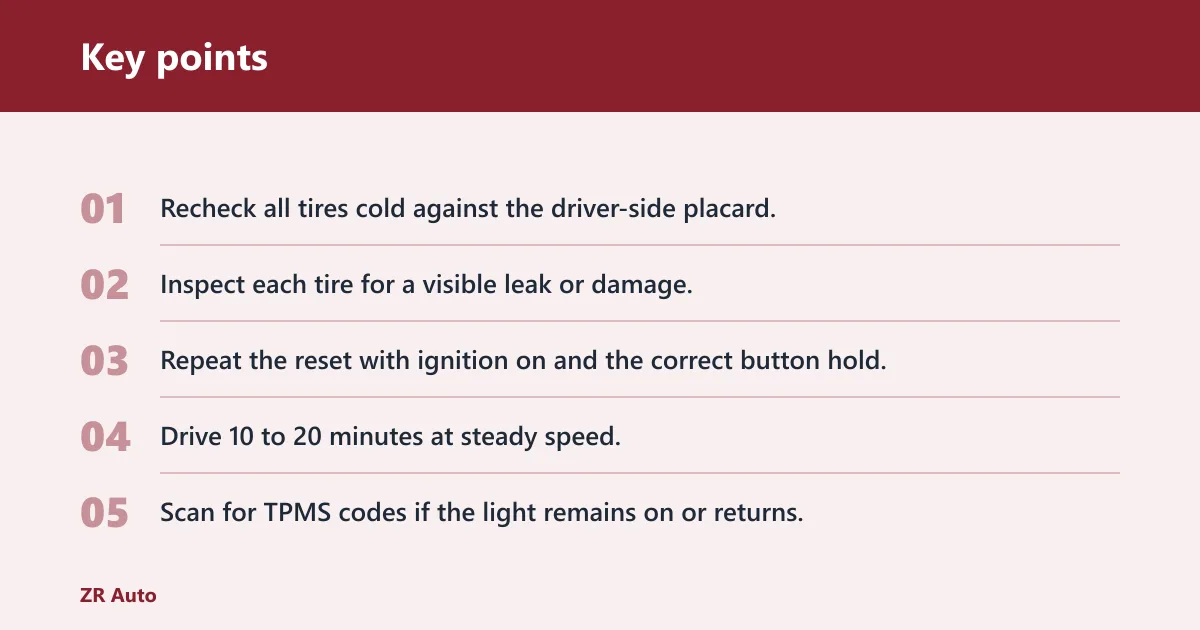
- Recheck all tires cold against the driver-side placard.
- Inspect each tire for a visible leak or damage.
- Repeat the reset with ignition on and the correct button hold.
- Drive 10 to 20 minutes at steady speed.
- Scan for TPMS codes if the light remains on or returns.
For 2022-2026 models, this is especially important because many trims use automatic relearn behavior. If the vehicle never completes the relearn, the issue may be an incompatible sensor or a missing sensor ID rather than a tire-pressure problem.
TPMS sensors for some Sportage variants are listed at 599 Kč on parts pages, which is a reminder that a warning light can point to a real part problem, not only low air. Replace or relearn sensors only after the pressure check and drive cycle have been completed.
Frequently asked questions
How to reset the tpms light on a kia sportage
Set all tires to the cold pressure on the driver-side door placard, switch the ignition on, and use the TPMS SET button if your model has one. Then drive 10 to 20 minutes at steady speed if the system needs relearn. If the light returns, scan for a sensor or pressure fault.
How to reset the tpms light on a 2023 kia sportage
For a 2023 Sportage, the reset procedure commonly uses the TPMS SET button under the steering wheel near the fuse box, held about 3 seconds with the ignition on. After that, drive at least 10 to 20 minutes. If the warning comes back, check sensor status instead of repeating the button press.
How to reset the tpms light on a kia sportage 2014
A 2014 Sportage typically uses a manual reset button under the dash or near the steering wheel area. Set the tires to the placard pressure first, turn the ignition on without starting, and hold the button for a few seconds. If the light stays on, inspect for a leak or sensor fault.
How to reset the tpms light on a 2023 kia sportage: the 2023 model is one
The 2023 model is one of the clearer button-reset examples. Hold the TPMS SET button about 3 seconds with the ignition on, then drive steadily for 10 to 20 minutes. If the light comes back soon after, the issue is likely not the reset procedure itself.
How to reset the tpms light on a kia sportage 2024
A 2024 Sportage is more likely to use automatic relearn behavior than older generations. Confirm the door-placard pressure, then complete the drive cycle so the system can relearn. If the warning persists after that, check for sensor mismatch, sensor failure, or a tire that is still losing air.