Why Is My Dodge Durango Having Trouble Starting?
Use the symptom pattern first: no-crank points to battery, cables, starter, or interlock; crank-no-start points to fuel, spark, or sensor input; intermittent starts usually point to voltage drop or a weak relay. Separate those paths before replacing parts.
Dodge Durango starting symptom guide
No-crank vs. crank-no-start
No-crank means the engine does not rotate when you press the start button or turn the key. Crank-no-start means the engine spins normally, but it never catches and runs. Those two symptoms usually lead to different fault paths, so listen carefully before replacing parts.
Slow-crank vs. intermittent start
Slow-crank points to low voltage, high resistance in the cables, or a starter drawing too much current. Intermittent no-starts can show up after sitting, after a short drive, or when hot. That pattern often points to a relay, a weak battery, or a starter with worn internal parts.
What each symptom usually points
Use the symptom to narrow the system. No-crank usually starts with the battery and starter path. Crank-no-start usually moves toward fuel delivery, fuel pressure, or engine management input. A click with no crank often points to starter engagement or voltage drop. For related symptoms, see Dodge Durango no-start troubleshooting and how to test a car battery.
What should you check first if your Dodge Durango won’t start?
Start with the 12-volt battery, then inspect the terminals and cable ends, then try a safe jump-start. A healthy resting battery is about 12.6V; 12.4V is about 75% charged, and 12.2V is about 50% charged. If a jump makes it run, suspect the battery or charging system.
Check battery state of charge
A dead battery can block power from reaching the starting system. Common signs include dim dash lights, slow cranking, repeated clicking, or no response at all when you press the start button. If the battery is flat, a jump-start is a temporary test, not a fix.
Inspect terminals and cable ends
Corrosion or a loose terminal can interrupt the starting-current path even when the battery itself is good. Check both battery posts, the cable clamps, and the ground connection. A clean battery with loose hardware can act just like a dead battery because the starter never gets full current.
Try a safe jump-start
Use the jump-start only as a diagnostic step. If the Durango starts and keeps running, the battery may be weak, the alternator may not be charging, or a connection may be high-resistance. If it still does not crank with a known-good donor battery, move on to the starter circuit and the fuse or relay path. See also how to jump-start a car safely and Dodge Durango starter replacement guide.
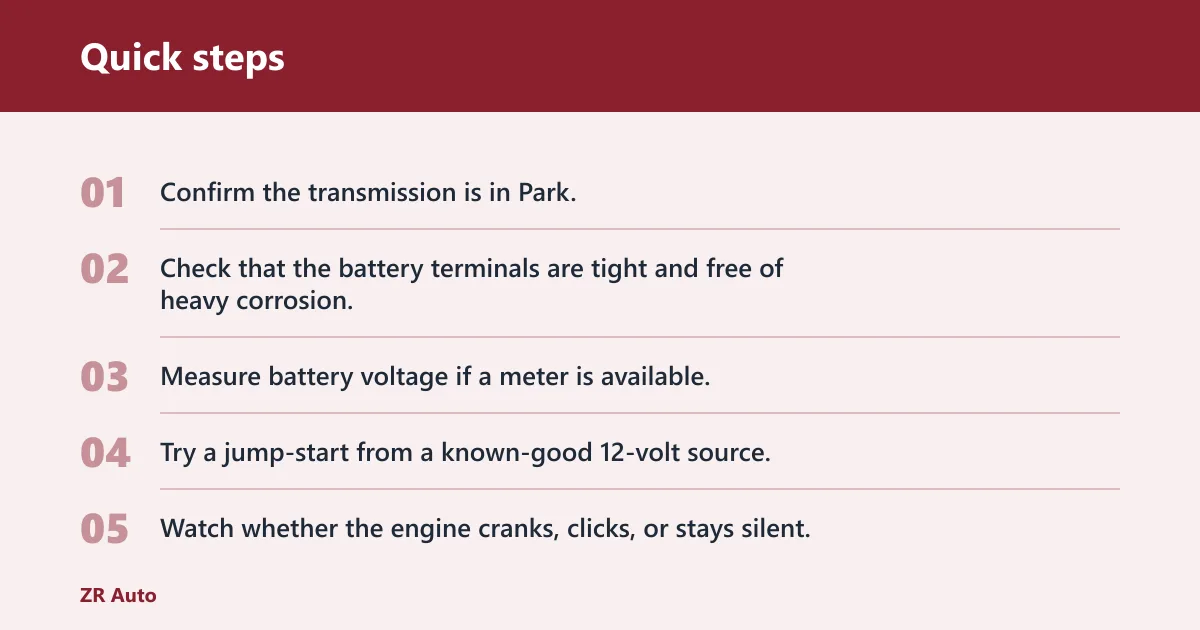
- Confirm the transmission is in Park.
- Check that the battery terminals are tight and free of heavy corrosion.
- Measure battery voltage if a meter is available.
- Try a jump-start from a known-good 12-volt source.
- Watch whether the engine cranks, clicks, or stays silent.
Durango starting problems diagnosis table
| Symptom | Most likely cause | Quick test | Next action |
|---|---|---|---|
| No lights, no crank, no response | Dead battery | Measure battery voltage or try a jump-start | Charge or replace the battery, then retest |
| Slow crank and dim lights | Weak battery | Check voltage under load and after sitting overnight | Test battery capacity and charging system |
| Single click, no crank | Bad starter | Listen for repeated click with full battery voltage | Test starter current draw and replace if needed |
| Rapid clicking, no crank | Low battery voltage or poor cable connection | Inspect terminals and verify battery charge | Clean and tighten connections, then retest |
| Crank-no-start after sitting overnight | Weak battery or charging fault | Check battery state of charge before the next start attempt | Test alternator output and battery health |
| Starts with a jump, then dies later | Bad alternator | Look for fading lights and low system voltage | Test charging system and drive belt condition |
| Cranks normally, fuel smell absent, never fires | Fuel pump | Listen for pump prime and verify fuel delivery | Check fuel pressure and pump power supply |
| Crank-no-start after refueling | Low-fuel-pressure case or fuel delivery fault | Check whether the engine briefly catches then stalls | Inspect fuel pressure, pump, and related controls |
| Push-button lights up, accessories work, but no crank | Push-button start fault or interlock issue | Check brake-pedal input and shifter position | Test start button circuit and related input signals |
| Service unavailable message with start-stop disabled | Stop/start battery behavior | Check battery age, voltage, and repeated warning messages | Test the battery and charging system with scan data if available |
| No crank, blown fuse suspected | Fuse or relay issue | Check related starter and ignition relays | Replace only after confirming the cause of the blown fuse |
| Intermittent no-start with no clear pattern | Voltage-sensitive module or cable fault | Inspect grounds, terminals, and battery voltage during crank | Move to a detailed electrical diagnosis |
Why does my Dodge Durango click when I try to start it?
A click with no crank usually means the starter is trying to engage but cannot turn the engine, or battery voltage collapses under load. If the battery holds 12.6V at rest but drops below about 9.6V during crank, that points to a weak battery or excessive current draw. See how to test a car starter.
Starter motor signs
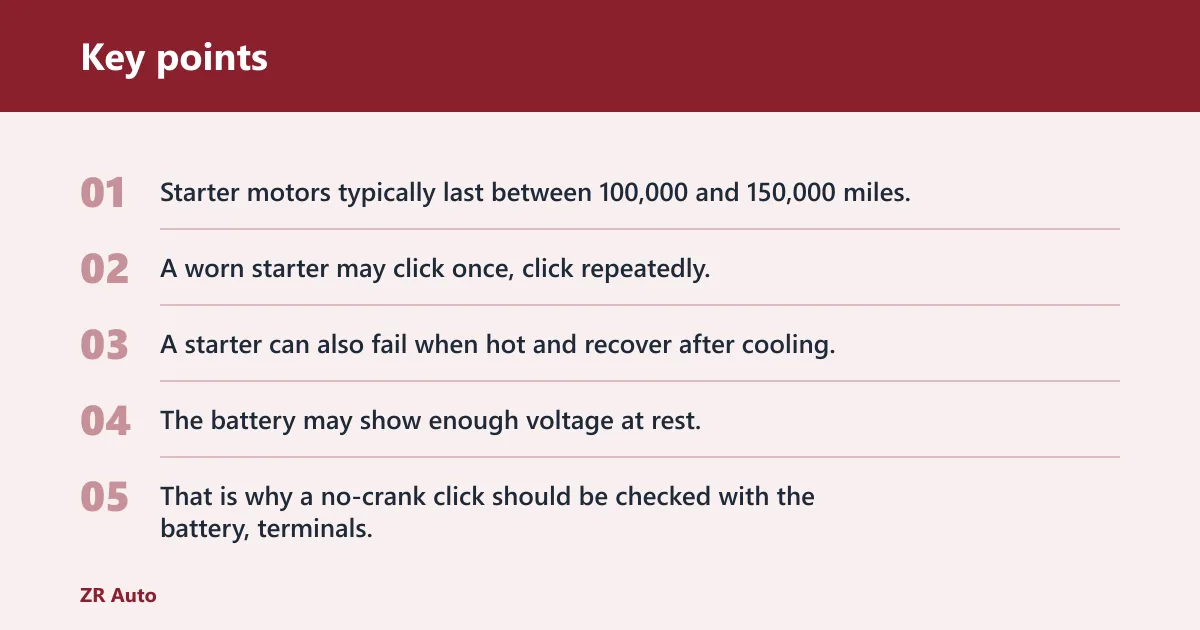
Starter motors typically last between 100,000 and 150,000 miles, but lifespan depends on heat, use, and electrical condition. A worn starter may click once, click repeatedly, or work on one attempt and fail on the next. A starter can also fail when hot and recover after cooling.
Battery voltage drop under load
A weak battery can mimic starter failure. The battery may show enough voltage at rest, but the voltage can fall too far when the starter draws current. That is why a no-crank click should be checked with the battery, terminals, and starter circuit in that order.
Relay or fuse path checks
If the click comes from the relay area rather than the starter itself, the problem may be in the control path. A fuse, relay, brake-pedal input, or park/neutral interlock can prevent the starter from receiving the command to engage. That is common in push-button systems. Related reading: push-button start system troubleshooting.
Can a bad alternator cause starting trouble?
Yes. A bad alternator can leave the battery undercharged, which leads to slow cranking, dim lights, and repeated no-starts after sitting. A healthy charging system should generally produce about 13.8–14.4V at idle with accessories off; if voltage stays below about 13.5V, suspect a charging fault.
How charging faults mimic battery failure
If the alternator is not restoring the battery after driving, the battery slowly becomes too weak to crank the engine. The result can look like a battery problem even when the battery itself is still serviceable. Watch for dimming lights, warning lamps, or repeated jump-start need. For a deeper check, see how to test a car alternator.
What happens after sitting overnight
Say your Durango starts after a jump, drives for 15 minutes, then struggles again the next morning. That pattern fits a charging fault more than a one-time battery drain. The alternator may not be maintaining charge, or a parasitic draw may be pulling the battery down while parked.
Why does my Dodge Durango crank but not start?
Crank-no-start usually shifts attention away from the battery and starter and toward fuel delivery, fuel pressure, spark, or an engine control input. If the engine cranks at normal speed but never fires, the starter path is doing its job. The next check is whether fuel and ignition reach the engine at the right time.
Fuel pump and fuel pressure clues
The fuel pump is responsible for fuel delivery and fuel pressure. If the pump does not prime, loses pressure, or cannot maintain pressure under load, the engine may crank forever without starting. A failure after refueling or a stall that follows a brief stumble can point in that direction. See Dodge Durango fuel pump replacement guide.
Low-fuel-pressure symptoms
Low fuel pressure often causes long cranking, rough starting, or an engine that fires briefly and dies. In some cases, the engine may start when cold and refuse to start when hot. That pattern is useful because it separates fuel pressure issues from a pure battery problem.
Ignition and interlock checks
On push-button Durango models, accessory power does not guarantee crank power. The system still needs the brake-pedal input, the shift position, and the module logic that authorizes starting. If the button lights up but nothing happens, the electrical interlock path deserves a close look.
Why is my Dodge Durango push button start not working?
Push-button start problems often come from the electrical interlock path rather than the button itself. If accessory power works but the engine will not crank, check the brake pedal signal, shifter position, and battery voltage first. A low battery can keep modules awake without giving the starter enough current to engage.
Accessory power versus crank behavior
Accessory mode can turn on the radio and displays while still blocking starter engagement. That is why a Durango may seem alive but still refuse to start. The vehicle needs enough voltage and the right input signals before it will authorize crank.
Stop/start battery sensitivity
Could the stop/start system cause a no-start on a Dodge Durango? Yes, especially when the battery is weak. Stop/start systems can be sensitive to reduced voltage, and a service unavailable message can appear when battery health drops. That warning may arrive before a full no-start condition.
Service messages to watch
Watch for repeated stop/start warnings, reduced accessory behavior, or a battery message on the dash. Those clues mean the vehicle may be protecting itself from low voltage. The system may disable stop/start first, then begin showing broader starting complaints if the battery continues to weaken.
When should you stop diagnosing at home?
Stop at-home checks when the Durango still will not start after a known-good jump, when battery voltage and terminal condition look normal, or when the symptom points to starter, fuel pressure, or module control testing. At that point, a shop can test current draw, charging output, fuel pressure, and control signals more efficiently.
Repeated no-start after a jump
If the vehicle starts once with a jump and then fails again, the cause may be the alternator, the battery, or a parasitic draw. That is enough reason to move beyond basic checks. Replacing parts without testing can hide the real fault.
Battery tests good but symptom stays
If the battery shows healthy voltage, the terminals are clean, and the Durango still only clicks or only cranks, the starter circuit needs deeper diagnosis. A failing starter, relay fault, or control-module issue can remain even when the battery is not the problem.
Frequently asked questions
Why is my Dodge Durango having trouble starting?
Most starting trouble on a Durango falls into one of three groups: no-crank, crank-no-start, or intermittent start. No-crank often points to the battery, terminals, starter, or interlock path. Crank-no-start usually points to fuel delivery or engine control. The symptom pattern tells you where to look first.
Why is my Dodge Durango not starting but the battery is good?
If the battery is good, the next suspects are the starter, cables, relay, fuse, or an interlock problem. Corrosion or a loose cable can block current even with a charged battery. If the engine cranks but will not fire, fuel pressure or ignition control becomes more likely.
What should I check first if my Dodge Durango won’t start?
Check the 12-volt battery first, then inspect the terminals and cable ends, then try a safe jump-start. That order narrows the fault quickly and avoids unnecessary parts replacement. If the vehicle only responds to a jump, battery health or charging output moves higher on the list.
Can a bad alternator cause a Dodge Durango to have trouble starting?
Yes. A bad alternator can leave the battery undercharged, which leads to slow cranking, dim lights, and repeated no-starts after sitting. The vehicle may start after a jump and fail again later. That makes charging-system testing a key step after the battery and connections are checked.
Is the starter a common problem on a Dodge Durango?
The starter is a normal wear item and may fail after many miles. Starter motors typically last between 100,000 and 150,000 miles, but heat and repeated short trips can shorten that. Clicking with a healthy battery and good cables is one of the clearest starter clues.