Is the Volvo XC90 T8 Hybrid Worth Buying Used?
Yes, but only if you can verify regular charging, a clean battery and electronics history, and a price that reflects PHEV risk; otherwise the regular XC90 is the safer used buy. Ignore that, and repair bills for hybrid components, software faults, or a weak battery can erase the fuel-savings advantage fast. This guide identifies the XC90 T8 years to favor, what to inspect, and when to walk away.
Volvo XC90 T8 used verdict
The XC90 T8 makes sense as a used buy for a shopper who can charge at home, wants a quiet plug-in hybrid SUV, and values seven-seat flexibility more than absolute running-cost simplicity. It is less appealing if the previous owner treated it like a normal gas SUV and barely plugged it in.
The core hardware is straightforward on paper: a 2.0-liter turbocharged four-cylinder, an electric motor, all-wheel drive, and an 8-speed automatic. Newer versions are rated at 455 hp combined and 523 lb-ft of torque, with the kind of quick 0-60 pull that makes the XC90 feel fast for a three-row SUV. Car and Driver lists a 4.8-second 60-mph time.
Who should buy one?
Buy one if you can confirm the seller actually used the charging cable, the EV range is still believable, and the service records show software updates and routine maintenance. The XC90 T8 works best for short daily drives, school runs, and commuters who can recharge overnight.
Who should skip it?
Skip it if you need the cheapest long-term three-row Volvo, plan to rely on gasoline only, or want a set-and-forget used SUV. A neglected T8 loses much of its appeal when the battery is seldom charged, because the owner gets the complexity without the efficiency payoff.
Why charging history matters more than trim badge
The value of a used XC90 T8 changes a lot with ownership pattern. A well-charged example can make sense as a premium family SUV. A rarely charged one often behaves like a heavier, more complicated XC90 that no longer pays back its PHEV premium.
Say your commute is 18 miles each way and the seller shows a history of regular charging. That is the sort of use case that can preserve the hybrid advantage. Now suppose the same SUV spent most of its life on long highway trips with no plug-in routine. The battery may still work fine, but the value case is weaker.
XC90 T8 buy checklist
Use mileage bands to judge risk instead of assuming all XC90 T8s age the same way. Around 40,000 miles, battery condition and software history tend to matter most. Around 60,000 miles, suspension wear and charging behavior tend to matter more. At around 80,000 miles and beyond, the purchase often needs to be priced like an out-of-warranty luxury hybrid.
| mileage band | what to inspect | red flags | go/no-go verdict |
|---|---|---|---|
| under 40,000 miles | Charging history, cabin electronics, EV range consistency, brake feel, and whether the battery actually gets used | No home charger, no charging records, EV range that seems far below expectations, infotainment reboots, warning lights | Go only with proof of regular charging and clean software behavior |
| 40,000 to 60,000 miles | Battery health signs, regenerative braking feel, suspension bushings, tire wear, and adaptive cruise / lane assist function | Rough brake transition, uneven tire wear, clunks over bumps, glitchy Pilot Assist, slow or frozen screens | Conditional go if the test drive is clean and the price reflects PHEV risk |
| 60,000 to 80,000 miles | Home charging dependence, AC charging behavior, air suspension condition if fitted, software updates, and any stored fault codes | Charging faults, suspension sag, infotainment lag, repeated warning messages, weak real-world EV range | Buy only if service history is strong and inspection is clean |
| 80,000 miles and up | Battery usable range, electronics, suspension, brake wear, charging port condition, and evidence of regular dealer or specialist service | Any unresolved hybrid fault, chronic screen issues, dead accessory systems, or a seller with no charging proof | No-go unless it is priced well below cleaner alternatives |
Hybrid checks that matter most
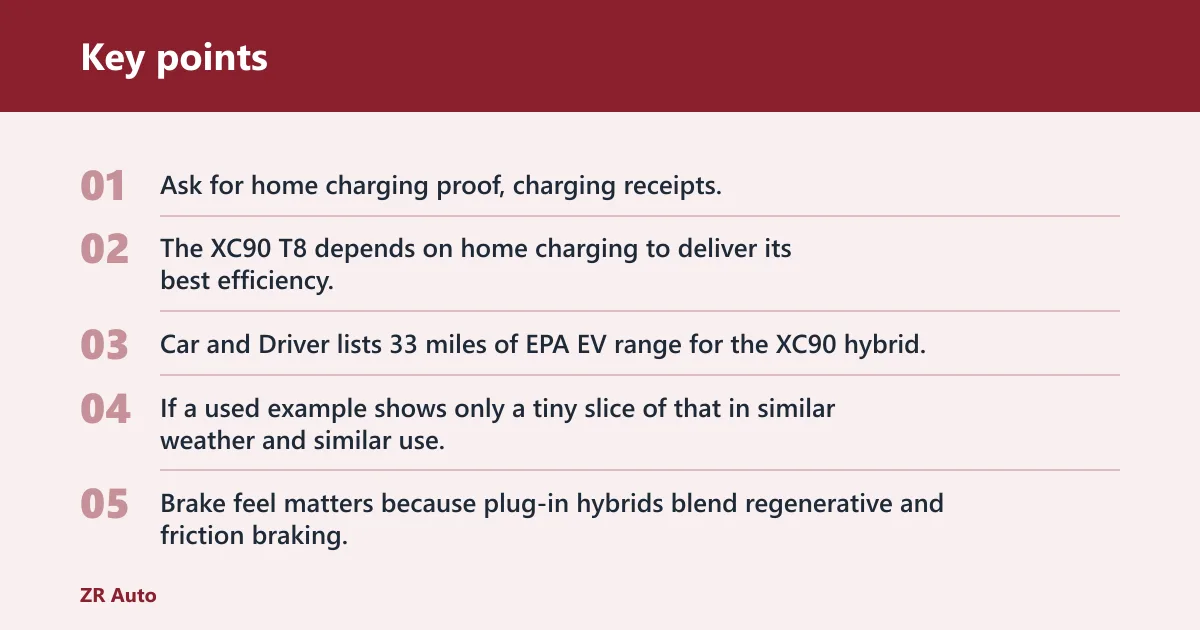
Start with the charging routine. Ask for home charging proof, charging receipts, or at least a believable ownership story that matches the odometer. The XC90 T8 depends on home charging to deliver its best efficiency, and a plug-in hybrid that lived on gasoline only usually makes less financial sense.
Check EV range sanity next. Car and Driver lists 33 miles of EPA EV range for the XC90 hybrid, while DrivingElectric’s test data puts the Recharge T8 at 42-44 miles, with a realistic electric range around 25 miles. If a used example shows only a tiny slice of that in similar weather and similar use, treat it as a warning sign.
Brake feel matters because plug-in hybrids blend regenerative and friction braking. The transition should feel natural. A grabby pedal, odd pulsing, or inconsistent stopping can point to software calibration issues, worn brakes, or a car that has not been driven in a healthy mix of battery and gasoline use.
Also check the charger side. A bad wall unit, damaged cable, or charging-port issue can make the battery look weaker than it is. A common first-timer mistake is blaming the car when the real problem is a failed home charger or a connector that only charges intermittently.
Software and suspension checks
Infotainment should boot cleanly and respond without repeated lag. The XC90 family has used Volvo’s Sensus infotainment on a 12.3-inch portrait-mode touchscreen in early versions, while later examples moved to a 9-inch tablet-style interface. Either way, repeated freezes, delayed camera displays, or random restarts are not minor on a luxury SUV.
Suspension matters too. The XC90 rides firmly, and larger wheels can make that more obvious. Air suspension can improve comfort, but it also adds complexity. If the car has it, check for sag, uneven stance, or noisy operation. If it does not, expect a firmer ride than some rivals.
Is the XC90 T8 a good used buy?
It is a good used buy only when the plug-in system was actually part of the previous owner’s routine. The XC90 T8 adds quiet commuting, quick acceleration, and better urban efficiency, but it also adds charging dependence and more electronics to monitor. A regular XC90 is the safer choice if the hybrid side was ignored.
What the plug-in hybrid adds
The T8 gives you electric-only driving for short trips and a strong combined-output powertrain for merging, passing, and family hauling. That can matter if your week has a lot of school runs and errands, then the occasional longer highway trip. It is a useful setup when the battery gets used the way Volvo intended.
DrivingElectric says the XC90 Recharge T8 can seat 7 people and lists 448 bhp combined in hybrid mode. That lines up with the model’s appeal: a three-row luxury SUV that can feel brisk without giving up full-size family utility.
What the premium costs you
The premium is not just the purchase price. It also shows up in inspection effort, software risk, and the chance that a previous owner treated it like a normal SUV. If the battery is rarely charged, the fuel savings shrink while the hybrid system remains a source of complexity.
When a regular XC90 makes more sense
Choose the non-hybrid XC90 if you lack home charging, drive mostly long highway miles, or want lower complexity after warranty. For many used shoppers, the regular XC90 is the better value because it removes battery dependence while keeping the same basic cabin, seating, and towing shape.
How much range does it really get?
Expect the published range and the real range to differ. Car and Driver lists 33 miles of EPA EV range for the XC90 hybrid. DrivingElectric’s testing puts the XC90 Recharge T8 in a 42-44 mile band, but says a realistic electric range is around 25 miles. Weather, terrain, and charging habits change the outcome quickly.
EPA numbers versus real EV range
The battery pack story matters here. Earlier XC90 Recharge versions used a 14.7-kWh battery, while later versions in the market gained a larger pack in some competitor coverage. The exact usable range depends on the version, but the key point is the same: real-world EV range is short enough that home charging is part of the ownership equation.
Hybrid mpg on longer trips
Once the battery is depleted, the XC90 T8 behaves more like a conventional luxury SUV. That is where highway and mixed-trip mpg matter more than brochure range. If the car is rarely charged, the fuel-economy advantage shrinks, and the owner may be carrying extra mass for very little return.
Charging speed and home charging needs
This is not the kind of plug-in hybrid that thrives on public charging alone. Home charging is the cleanest way to keep the battery in rotation. Without it, the T8’s appeal drops sharply, especially if the seller drove it mostly as a gas SUV.
Suppose a buyer sees 26 miles of EV range on the cluster after a full charge in mild weather. That is a believable sign. Suppose the same car can barely show a meaningful electric buffer after a charge, yet the seller insists it was “always maintained.” The issue may be battery degradation, poor charging habits, or a charging-system fault that deserves more diagnosis.
Which model years are worth buying?
The safest used XC90 T8 is usually the newest, cleanest example with full charging and software history. Early T8s are still worth considering, but later Recharge versions are better buys when the battery story is stronger and the electronics are up to date. The best example is often more important than the exact badge.
Early T8 versus later Recharge versions
Early XC90 T8 models tend to feel more tied to the original plug-in formula. Later Recharge versions are the better choice if you want the more developed hybrid setup and the version of the SUV that most clearly fits modern plug-in expectations. The distinction matters because the buyability story changes with battery generation and software maturity.
Battery size differences
Earlier versions are commonly associated with the 14.7-kWh pack, while later competitor coverage also points to an 18.8-kWh battery in newer versions. Bigger battery capacity helps only if the car is actually charged. A larger pack does little for a neglected example that lived on gasoline.
Safest used spec to target
The safest used bet is a later Recharge T8 with documented charging, no recurring infotainment faults, no suspension warnings, and a price that leaves room for out-of-warranty hybrid repairs. Fewer options are better than a heavily optioned car with a fuzzy service history. If air suspension is fitted, inspect it carefully before you commit.
Does it work as a family hauler?
Yes, but with limits. The XC90 T8 is useful for a family of seven, and it still feels like a proper luxury SUV. The third row is tight for adults, though, and the battery packaging does take a toll on cargo flexibility compared with some non-hybrid alternatives.
Seven-seat practicality
The same source says the XC90 Recharge can seat 7 people. That makes it one of the more usable plug-in luxury SUVs for family duty. The problem is not whether the third row exists. It is whether you expect it to work for adults on long drives. It does not.
Boot space with seats up and folded
The same source lists 262 litres of boot space in seven-seat mode and 640 litres in five-seat form. That split is typical of a three-row SUV, but it means luggage space is limited when all seats are in use. Fold the third row and the XC90 becomes much more practical for road trips.
Towing and road-trip usefulness
The XC90 T8 can tow up to 5,290 pounds, which makes it genuinely useful for family hauling, small trailers, and weekend gear. DrivingElectric also lists a towing capacity of 2,400 kg. That is a meaningful capability for buyers who want one vehicle to cover school duty and occasional towing. (Caranddriver)
Picture a family of five using the third row only for short hops. The XC90 T8 works well there. Now picture two taller adults in back for a four-hour trip with luggage. The third row becomes the weak point, and cargo space will run out quickly.
What ownership costs can bite later?
After warranty, the XC90 T8 can be expensive in the ways that matter most to used luxury shoppers: electronics, hybrid components, suspension parts, and branded service. It is not the sort of SUV that rewards guesswork. The price gap to a regular XC90 can vanish if the hybrid system needs attention.
Maintenance after warranty
Routine maintenance is not the main concern. The concern is a repair pattern that involves multiple systems at once. A hybrid SUV can need normal wear items plus battery-related diagnosis, charging-system checks, and software updates. That adds cost and complexity even when nothing has “failed” outright.
Battery and electronics risk
The battery itself should be judged by usable range and charging behavior, not by panic. There is no reason to assume failure is common. The real issue is whether the pack still supports useful electric driving, and whether the car’s electronics behave properly in daily use.
Insurance and depreciation context
Insurance and depreciation often favor simpler competitors over time, especially once warranty coverage ends. The XC90 T8 can still be a smart buy, but only if the discount reflects the chance that future repairs will be more expensive than on a non-hybrid SUV. That is the tradeoff to price in.
Frequently asked questions
Is the Volvo XC90 T8 hybrid a good used buy?
Yes, if the previous owner charged it regularly and the battery, software, and suspension checks are clean. It is a poor buy if it was treated like a gas SUV, because the hybrid premium then buys complexity without delivering the electric driving and fuel-saving benefits that justify it.
How long does the Volvo XC90 T8 battery last on a used model?
There is no fixed mileage cutoff that automatically means the battery is “done.” The smarter test is usable range and charging consistency. A healthy used example should still deliver believable EV range for its version, with no charging faults, warning lights, or dramatic drop-off from expected electric driving.
What model years of the Volvo XC90 T8 are worth buying used?
Later Recharge versions are the safer target because they tend to bring the more developed hybrid setup and better battery story. Early T8s can still be worthwhile, but only with stronger documentation and a lower price. In all cases, service records and charging history matter more than badge wording.
How much electric range does the XC90 T8 actually get?
Car and Driver lists 33 miles of EPA EV range. The same source says the XC90 Recharge T8 has 42-44 miles in its test data range band, but also says a realistic electric range is around 25 miles. Real-world range depends heavily on temperature, speed, terrain, and charging habits.
Does the XC90 T8 have enough room for a family of seven?
Yes, with caveats. The XC90 Recharge can seat 7 people, and it is useful for family duty, but the third row is tight for adults and cargo space shrinks when all seats are up. It works best when the third row is for children or occasional use.
What should I check before buying a used Volvo XC90 T8?
Verify charging history, confirm the EV range is believable, test brake feel, scan the infotainment for glitches, and inspect the suspension carefully. Also check the charger port, cable, and any adaptive driver-assistance features. If the seller cannot show regular charging, treat that as a major warning sign.