
What Are the Most Common Volvo XC90 Problems?
The most common Volvo XC90 problems are infotainment and software faults, ignition and battery issues, air-suspension or suspension wear, and in some models coolant, transmission, or engine-oil leaks; the costly risk starts when a warning light hides a mechanical fault. Miss the pattern and you can buy a noisy nuisance, or inherit a repair that costs far more than the car’s price advantage. This guide ranks XC90 faults by buying risk and diagnosis odds, so you can separate easy fixes from wallet-draining failures.
Volvo XC90 problems overview
XC90 faults split cleanly by generation. The second-generation Volvo XC90 uses the SPA platform and is known first for software and electronic complaints, while the first-generation truck has more old-school drivetrain and engine issues, including automatic transmission complaints and mechanical wear. That difference matters because the same warning light can mean a reboot on one model and a costly repair on the other.
For used buyers, the biggest mistake is treating every fault as equal. A frozen screen or a dead Bluetooth connection is annoying, but low voltage or a bad battery can mimic far more serious module failures. By contrast, oil consumption, transmission slip, AWD loss, or hybrid brake deactivation move the car into a much higher-risk zone.
Which problems matter most to used buyers?
Start with faults that affect drivability, safety, and repair cost. Oil burning on some early 2.0-liter gasoline engines, transmission slip, loss of drive, air-suspension faults, and T8 hybrid issues generally deserve more attention than a delayed menu screen. Older XC90s also deserve scrutiny for gearbox health and turbo-related noise, especially on higher-mileage diesel and gasoline examples.
Where software ends and hardware begins
Volvo support says related systems should be restarted when functions do not work, and that advice fits the infotainment and some electronic complaints. If the issue clears after a restart or software update, the risk is lower. If the same symptom returns with voltage verified and no stored low-battery condition, the odds shift toward a failing module, sensor, actuator, or wiring fault.
Are software and infotainment problems common on the Volvo XC90?
Software and electronics are commonly cited weak spots in the XC90 II, and infotainment complaints often involve slow response, freezing of the central display, or black-screen behavior. Bluetooth and smartphone pairing problems are also common complaint areas. On Sensus-equipped cars, the screen controls climate and media, so a freeze can feel bigger than a simple radio fault.
Sensus freezes, lag, and black screens
If the screen is slow, stops responding, or reboots on its own, begin with a system restart and check for update history. That is the right first step because Volvo’s support guidance points to restarting related systems when functions fail. A one-off freeze after service is far less worrying than repeated lockups with other electrical faults.
Bluetooth, phone pairing, and climate-control glitches
When Bluetooth drops phones, media skips, or climate settings seem stuck behind the display, the cause may still be software rather than a bad control unit. Low onboard voltage can also create false electronic symptoms. If the battery is weak, the XC90 may behave as though multiple systems are failing at once.
Say your XC90 screen freezes after startup, but the gauges and lighting behave normally. That points more toward Sensus software than a major electrical fault. Suppose the screen freezes and the car also throws several warning messages after a short battery drain. That combination pushes battery testing to the top of the list.
Can a weak 12V battery cause XC90 warnings?
Yes. A weak 12V battery can trigger many warning messages, and low onboard voltage can mimic module faults on XC90s of both generations. This matters because stacked warnings often send buyers chasing sensors, steering modules, or braking faults when the root problem is simple battery weakness or poor charging behavior.
Why low voltage can mimic module failures
Modern XC90s rely on many control units. When voltage drops, modules may log faults that vanish after a proper charge or battery replacement. That is why a car with random warnings, a sluggish screen, and intermittent start behavior should be checked for battery health before anyone orders expensive parts.
Which warning clusters point to battery trouble?
Look for a cluster that includes infotainment glitches, start-stop complaints, and multiple unrelated warning lights appearing together. If the car starts poorly after sitting overnight, or if accessories behave erratically, the battery becomes a prime suspect. A single isolated fault is less suggestive than a string of unrelated alerts arriving at once.
Fast checks before blaming sensors or control units
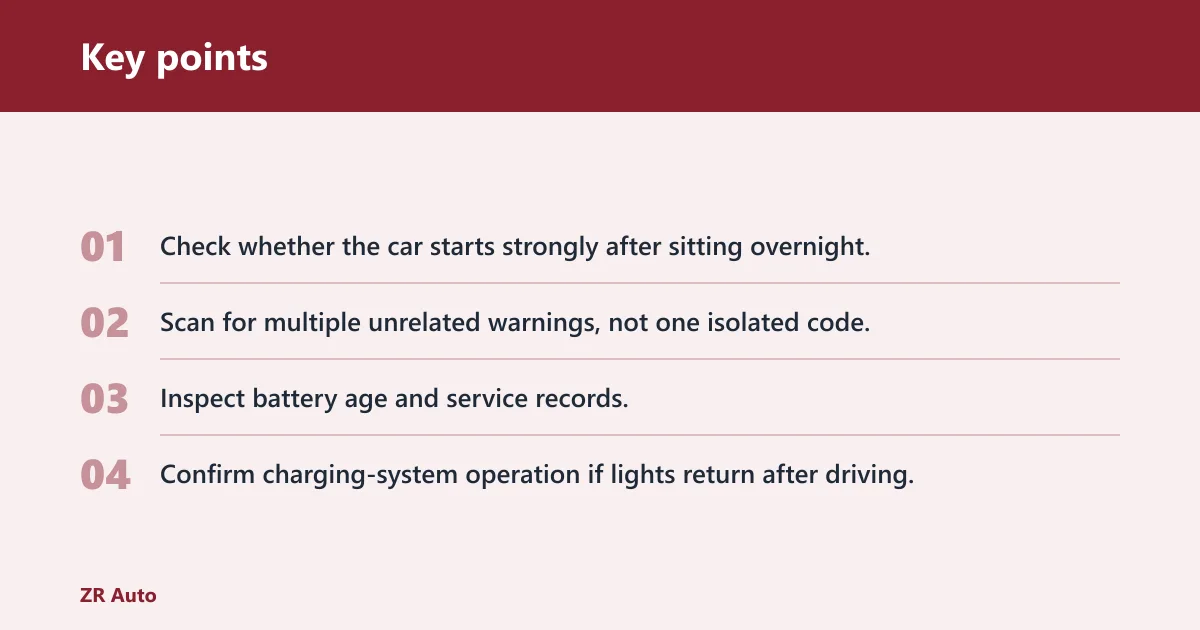
- Check whether the car starts strongly after sitting overnight.
- Scan for multiple unrelated warnings, not one isolated code.
- Inspect battery age and service records.
- Confirm charging-system operation if lights return after driving.
XC90 fault triage table
| Symptom | Likely cause | How to confirm in 10 minutes | Buy/no-buy risk |
|---|---|---|---|
| Central display freezes or lags | Sensus software fault | Restart the system and check whether the fault clears after reboot | Buyable if it resets; lower risk |
| Bluetooth drops phone connection | Infotainment software or pairing fault | Pair a phone again and test media, calls, and contacts | Usually buyable unless repeated with other faults |
| Many warning messages at once | Weak 12V battery or poor charging | Check start strength and battery age, then scan for unrelated codes | Buyable if battery-only; no-buy if warnings stay after correction |
| Oil level drops between services | Early 2.0-liter gasoline engine oil consumption | Check service records for piston or piston-ring work and oil top-up history | Higher risk on affected engines |
| Whining, buzzing, or rattling from engine | Balancer-shaft module noise | Listen cold and warm; compare with service history for updated parts | High risk if persistent |
| Transmission slip on acceleration | Automatic gearbox wear or fluid issue | Test light-throttle and hard-throttle shifts, then check for flare or delay | No-buy if slip is repeatable |
| Loss of drive | Transmission or driveline fault | Verify engagement in reverse and drive; check for warning messages | No-buy unless a clear, documented fix exists |
| Rear-end sagging or compressor noise | Air suspension fault | Cycle ride height and listen for pump activity | Buyable only with repair allowance |
| AWD warning or front-wheel-only feel | AWD coupling or driveline issue | Check for traction behavior on loose ground and scan for drivetrain codes | Medium to high risk |
| Brake or hybrid warnings on T8 | Plug-in hybrid control fault | Check hybrid mode behavior, charge status, and fault history | High risk |
| Engine oil smell or visible seepage | Gasket, cover, or leak issue | Inspect around the engine and undertray after a short drive | Depends on leak size; inspect carefully |
Does the Volvo XC90 have oil consumption problems?
Some early 2.0-liter gasoline engines do. The issue is tied to certain 2016 model-year engines, and the practical concern is simple: oil use can look minor at first, then become expensive if the car needs repeated top-ups or internal work. This is not a blanket XC90 problem across all engines.
Which early 2.0-liter gasoline engines are involved?
The concern centers on early 2.0-liter gasoline engines, not every XC90 engine. If the car is from the early second-generation period and has poor oil records, the risk rises. The correct question is not whether XC90s burn oil in general, but whether this specific engine has the documented issue.
What piston and piston-ring updates changed
Some affected engines received updates to pistons and piston rings. That is useful because a car with documented updated parts may be a safer buy than one with no repair history at all. Service paperwork matters more than a seller’s reassurance.
A quick used-buying check for service history
Look for invoice lines that mention piston, piston-ring, or engine update work. Then check whether oil top-offs were frequent before the repair. If the history is thin and the engine is in the affected year range, treat the car cautiously.
What engine noises should you not ignore?
Do not ignore repeated whining, buzzing, or rattling from the engine bay on early 2.0-liter XC90s. The balancer-shaft module is a known noise source on some early engines, and a noisy turbo or accessory can also point to deeper trouble. Persistent mechanical noise is more serious than a temporary software complaint.
Balancer shaft noise on early 2.0-liter engines
Early XC90 2.0 engines could make whining, buzzing, or rattling noises from the balancer-shaft module. A redesigned component was planned for 2018, so history and build timing matter. If the sound is present cold and warm, do not assume it is cosmetic.
Turbo-related and mechanical noise clues
A turbo whistle is not automatically bad, but a harsh scrape, rattle, or grinding note is different. Mechanical noise that changes with rpm, or noise that appears alongside oil use, deserves a deeper look. That combination can point to a costly repair path.
Picture a 2016 XC90 with a quiet idle, but a buzzing sound appears during gentle acceleration and the oil level drops between services. That is more concerning than a one-time rattle at startup. The noise plus oil history matters more than either symptom alone.
Are transmission and AWD faults common?
Transmission complaints are part of the older XC90 story, especially on first-generation cars with automatic gearbox issues. Loss of drive, slip, or delayed engagement is a serious warning. AWD faults also matter because a driveline problem can hide behind a car that still moves normally on dry pavement.
Older XC90 automatic gearbox complaints
First-generation XC90s, including 2005 model-year examples, have a history of automatic transmission complaints. On a used 2003-era or mid-2000s car, smooth shifting is not enough; the gearbox should also behave correctly under load, on hills, and during kickdown.
Loss of drive and slip symptoms
Slip usually shows up as flare between gears, delayed engagement, or a momentary loss of pull during acceleration. Loss of drive is worse. If the car hesitates badly in reverse or forward gear, that is a strong no-buy signal unless repair documentation is complete and credible.
AWD checks that take minutes, not hours
Check for even takeoff on a loose surface and listen for driveline shudder. Also inspect whether warning messages appear during low-speed turns or acceleration. An AWD issue may not announce itself loudly, but it can still become expensive fast.
What should you inspect on a used XC90?
Start with the generation, then the engine, then the options. First-gen cars deserve scrutiny for transmission and mechanical wear, while second-gen cars need software, battery, oil, and hybrid checks. Optional air suspension raises the repair bill, and T8 models add high-voltage and brake-related complexity.
First-gen versus second-gen risk checks
For a first-generation XC90, focus on gearbox operation, turbo noise, and diesel or automatic-transmission history. For a second-generation car, focus on software behavior, battery health, and service records. The risk pattern changes enough that you should not shop them the same way.
Air suspension inspection points
Air suspension is optional equipment, and it is often considered a higher-cost failure point. Check ride height on all corners, listen for compressor noise, and see whether the car settles unevenly after parking. A smooth test drive does not rule out a tired air system.
T8 hybrid items that add complexity
T8 hybrid versions can have extra reliability concerns because the system adds plug-in hardware, battery management, and more control logic. Recall information also points to braking deactivation in plug-in hybrid modes and high-voltage battery overheating issues for 2020 to 2022 XC90s. That makes service history and recall completion essential.
Quick checklist before you buy
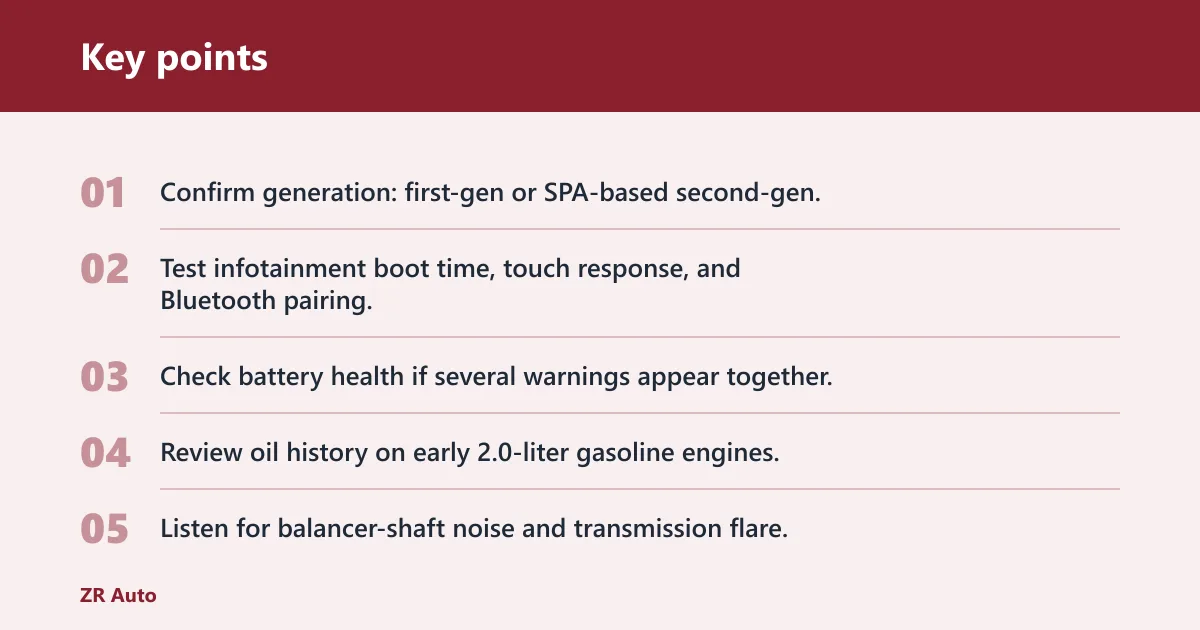
- Confirm generation: first-gen or SPA-based second-gen.
- Test infotainment boot time, touch response, and Bluetooth pairing.
- Check battery health if several warnings appear together.
- Review oil history on early 2.0-liter gasoline engines.
- Listen for balancer-shaft noise and transmission flare.
- Inspect air suspension and AWD behavior if equipped.
- For T8 models, verify hybrid faults and recall history.
Frequently asked questions
What are the most common problems with a Volvo XC90?
The most common Volvo XC90 problems are infotainment and software faults, battery-related warning clusters, suspension wear, and on some versions transmission or engine issues. Early second-generation cars are more likely to show electronic complaints, while first-generation XC90s are more likely to raise gearbox and mechanical concerns.
Which Volvo XC90 years are most affected by common faults?
Early second-generation models from 2015 are more prone to initial problems, especially software and electronic complaints. On the older generation, 2003-era and 2005 model-year cars show more gearbox and mechanical complaints. Age, mileage, and service history still matter more than any single badge year.
Can a weak 12V battery cause multiple Volvo XC90 warnings?
Yes. A weak 12V battery can trigger many warning messages and create fake module-fault symptoms. That is why stacked warnings should not be treated as proof of a failed control unit. Check battery condition first, especially if the screen, start behavior, and warning lights all act oddly together.
Is the transmission a common problem on older Volvo XC90s?
Yes, it is one of the main concerns on first-generation XC90s. Automatic gearbox complaints, slip, delayed engagement, and loss of drive are serious. If the transmission hesitates or flares under load, that should move the car toward no-buy unless repair records clearly support a good outcome.
Do Volvo XC90 hybrid models have extra reliability issues?
They can. That does not make every hybrid bad, but it does raise the inspection burden and repair risk.
What should I check before buying a used Volvo XC90?
Check the generation, service history, battery health, infotainment behavior, transmission response, and whether any oil consumption or balancer-shaft noise is present. If the car has air suspension or T8 hardware, inspect those systems too. For first-gen cars, give extra weight to gearbox and driveline checks.
Is the 2005 volvo xc90 reliable?
The 2005 Volvo XC90 can be decent if it has strong maintenance history, but it sits in the more troublesome first-generation group. Automatic transmission complaints and mechanical wear deserve close attention. A clean service record helps, but a smooth test drive alone is not enough.
Is 2010 volvo xc90 reliable?
A 2010 Volvo XC90 can be a reasonable buy if the drivetrain is healthy and service history is complete. It still belongs to the older generation, so transmission condition, suspension wear, and engine noise matter more than cosmetic condition. A pre-purchase inspection is still the smart move.