Why Is My Ford F-150 EcoBoost Rattling or Losing Power?
A cold-start rattle on an EcoBoost F-150 is often described as cam phaser or timing-chain related, while hesitation or full power loss often points first to misfires, boost leaks, fuel delivery, or sensor faults. Skip the guesswork, because a small fault can turn into catalyst damage, turbo wear, or a no-start condition. This guide shows the fastest symptom-based tests so you can narrow the fault before replacing parts.
What the symptoms usually mean
The first split is simple: cold-start rattle is usually a noise-and-oil-pressure problem, while hesitation under boost points more often to air, spark, fuel, or boost control. Ford F-150 EcoBoost engines are turbocharged, direct-injection setups, so several systems can create the same complaint. Ford owner materials emphasize checking oil level regularly and using the specified oil grade, and Motorcraft maintenance schedules list oil and filter service intervals by engine and duty cycle.[Ford Owner’s Manual; Motorcraft maintenance schedule]
Note whether the problem is only cold, only under load, only at idle, or present all the time. That pattern tells you where to start.
What you’ll need
- OBD-II scanner
- Basic hand tools and a flashlight
- Owner’s manual and service schedule
- Fuel-pressure test support if a shop is involved
- Boost-leak test support if a shop is involved
Why is my F-150 EcoBoost rattling on cold start?
A cold-start rattle is most often tied to cam phasers, timing-chain tensioners, or guides that depend on oil pressure. Low oil can contribute to the noise and can also make the engine feel weak for a short time. If the rattle is loud, lasts longer than a brief startup window, or comes with a flashing check-engine light, stop driving. Ford service information and NHTSA recall/TSB records for some model years have included cam phaser and timing-related concerns, so this symptom should be taken seriously rather than dismissed as “normal.”[Ford service info; NHTSA recall/TSB records]
Start with oil level and condition
- Park on level ground and let the engine sit for at least 5 minutes.
- Check the dipstick, then verify the oil matches the service schedule.
- If the level is low, add oil only as needed to bring it into the correct range, and do not overfill.
If your truck rattles for about 2 to 3 seconds only on the first cold start of the day, that pattern may point more toward oil-pressure-controlled components than a turbo fault.
Move to cam phasers and timing control
- Scan for diagnostic trouble codes with an OBD-II scanner.
- Look for timing-related codes and misfire codes, then note which cylinder is flagged.
- If the rattle persists, have a shop inspect cam phaser operation, timing-chain tensioner function, and chain guides.
Is EcoBoost rattle always a timing chain problem? No. Cam phasers and their oil-pressure control can still make a cold-start racket that sounds like chain wear, and Ford/NHTSA materials have documented timing-related concerns on some EcoBoost applications.[Ford service info; NHTSA recall/TSB records]
Why does my Ford F-150 lose power when accelerating?
Loss of power under acceleration usually means one of four things may be failing: air supply, fuel delivery, ignition, or boost control. Read codes first. That narrows the search faster than swapping plugs, coils, or a turbo on guesswork. OBD-II code definitions are especially useful here because P0300-P0306, P0299, lean fuel-trim faults, and variable-cam timing codes often point you toward the first system to inspect.[OBD-II code references]
Read codes before parts replacement
- Plug in an OBD-II scanner and record all stored and pending codes.
- Note whether the truck has misfire codes, underboost or overboost codes, or fuel-trim faults.
- Clear nothing until you have the code numbers and freeze-frame data.
Use the codes to narrow the fault fast
- P0300: random or multiple misfires; usually start with plugs, coils, vacuum/boost leaks, and fuel delivery.[OBD-II code references]
- P0301-P0306: cylinder-specific misfire; usually start with the plug, coil, injector, and compression on that cylinder.[OBD-II code references]
- P0299: underboost; usually start with charge-air leaks, wastegate control, bypass valve issues, and turbo plumbing.[OBD-II code references]
- Fuel-trim lean codes such as P0171/P0174 or bank-specific lean faults: usually start with unmetered air leaks, low fuel delivery, or a faulty sensor reading.[OBD-II code references]
- Variable-cam timing codes such as P0010-P0019 or cam correlation faults: usually start with oil level/condition, phaser control, and timing hardware.[OBD-II code references]
Separate boost loss from ignition or fuel loss
- Drive only if the truck is safe to move and the check-engine light is steady.
- Pay attention to whether the power loss happens only at 45-50 MPH under load.
- If the engine stumbles but the turbo whistle is normal, suspect spark, coil, or fuel delivery before the turbo itself.
EcoBoost symptom-test matrix
| Symptom pattern | Likely subsystem | Quickest at-home check | Likely codes/signs | Next professional test |
|---|---|---|---|---|
| Cold-start rattle | Cam phasers, timing-chain tensioner, guides, oil-pressure-controlled components | Check oil level, oil age, and whether the noise disappears after startup | Timing-related codes, cold-start rattle, brief startup clatter | Scan for timing-related codes and inspect phaser operation and chain control |
| Boost underboost | Turbocharger, wastegate, bypass valve, charge-air plumbing | Inspect clamps, intercooler pipes, and vacuum lines for looseness or splits | P0299, flat throttle response, hiss, slow spool | Smoke test the intake and boost system; verify wastegate and bypass valve function |
| Misfire under load | Spark plugs, ignition coils, fuel delivery | Read misfire codes; inspect plug wear and coil connectors | P0300-P0306, shudder at 45-50 MPH, flashing light if severe | Load test coils at 45-50 MPH and test fuel pressure under load |
| General power loss | Air intake, fuel system, ignition, boost control | Check air filter restriction and intake leaks after airflow measurement | Lean fuel-trim codes, hesitation, reduced acceleration | Fuel-pressure test, injector balance check, and full scan for stored codes |
| Red flag: stop driving | Severe timing noise, flashing check-engine light, or major power loss | Pull over safely and shut the engine off | Flashing MIL, loud continuous rattle, severe stumble, limp mode | Tow the truck for diagnosis before further cranking or driving |
How do you check the boost, air, ignition, and fuel path?
Start with the simplest path: air in, spark, fuel, then boost control. Air, fuel, compression, and ignition are the four things an engine needs to make power. A dirty air filter can restrict airflow enough to cause a loss of power or misfire, and an air leak after airflow measurement can make the mixture too lean. A code like P0299 or a lean-fuel code can help confirm that the fault is not simply “bad gas” or a dead turbo.[OBD-II code references]
Inspect the intake tract first
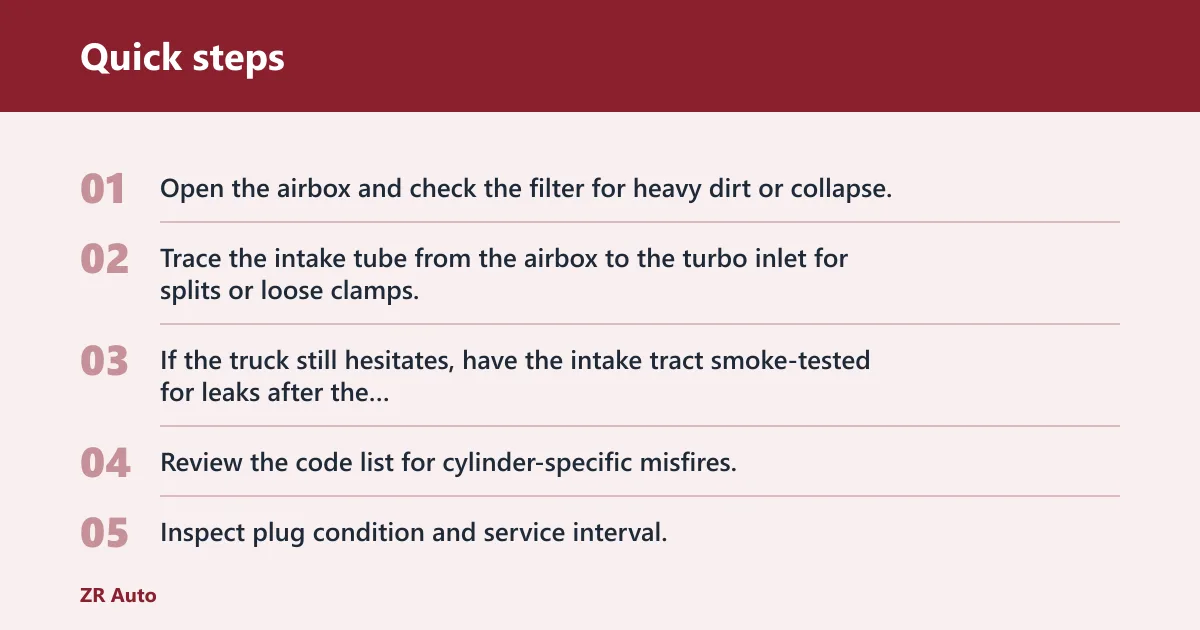
- Open the airbox and check the filter for heavy dirt or collapse.
- Trace the intake tube from the airbox to the turbo inlet for splits or loose clamps.
- If the truck still hesitates, have the intake tract smoke-tested for leaks after the airflow sensor.
Can a boost leak make my Ford F-150 feel sluggish? Yes. Charge-air plumbing leaks, cracked couplers, or a weak bypass valve can create underboost and a flat feeling on throttle. If you want a deeper step-by-step, see boost leak testing.
Inspect spark plugs and ignition coils
- Review the code list for cylinder-specific misfires.
- Inspect plug condition and service interval, then replace worn plugs as a set if they are due.
- Swap or test coils under load if the scan points to one cylinder or a repeat misfire at 45-50 MPH.
Could spark plugs or ignition coils cause EcoBoost power loss? Yes. Worn or defective spark plugs can prevent a good spark and cause power loss, and weak ignition coils can misfire under load. For more detail on a cylinder-by-cylinder approach, see F-150 misfire diagnosis and spark plug intervals.
Move to fuel delivery if air and ignition check out
- Ask for fuel-pressure testing at idle and under load.
- Have the fuel filter checked for restriction and the regulator verified.
- If pressure is correct, have the injectors checked for dirt or imbalance.
Dirty injectors are a known cause of loss of power, and a plugged fuel filter can make the air/fuel ratio too lean. That can feel a lot like an ignition fault.
Check turbo control if the code points there
- Inspect wastegate linkage, bypass valve operation, and all charge-air plumbing.
- Use a smoke test to find leaks the eye cannot see.
- Confirm whether the code is underboost or overboost before assuming turbo failure.
A boost code does not always mean the turbocharger is bad. The problem can be a leak, a stuck wastegate, or a bypass valve issue.
When should you stop driving?
Stop driving if the check-engine light flashes, the engine rattles loudly on startup and keeps rattling, or the truck loses power enough to make merging or passing unsafe. Severe timing noise can lead to internal damage, and a severe misfire can damage the catalyst quickly. If the light flashes, treat it as a serious misfire condition rather than a nuisance warning.[Ford owner guidance; OBD-II code references]
Suppose the truck falls flat on a highway on-ramp and the check-engine light begins flashing. That is a tow situation, not a keep-driving-and-see case. For more on why that matters, see flashing check-engine light safety guidance.
Common mistakes
Replacing the turbo before checking for a boost leak wastes money. Ignoring misfire codes because the truck still runs delays the real fix. Assuming every cold rattle is a timing-chain failure can send you down the wrong path.
Another common mistake is driving through severe loss of power or loud timing noise. That is when the fault can spread.
What repairs are common on Ford EcoBoost engines with these symptoms?
Common repairs include spark plugs, ignition coils, intake hoses, charge-air plumbing, cam phaser service, timing-chain components, and fuel-system repairs. The right fix depends on whether the symptom appears cold, under boost, or at steady cruise. That is why code reading and a symptom pattern come first. If the pattern points toward variable cam timing, the next read is often closer to EcoBoost cam phaser symptoms.
Frequently asked questions
Why is my Ford F-150 EcoBoost rattling on cold start?
A brief cold-start rattle usually points to cam phasers, timing-chain tensioners, or guides that depend on oil pressure. Check the oil level first, then scan for timing-related codes. If the noise is loud, persistent, or paired with a flashing light, stop driving and have it inspected.
Is EcoBoost rattle always a timing chain problem?
No. On these engines, a cold rattle can come from cam phasers, oil-pressure control, chain tensioners, or guides, and the noise pattern matters more than the sound alone. A brief startup rattle is different from a constant knock, so the diagnosis should begin with oil level and codes.
Can low oil cause an EcoBoost to rattle or feel weak?
Yes. Low oil can reduce pressure to timing-related components and let the engine rattle on startup. It can also make the truck feel weak until pressure stabilizes. Check the dipstick on level ground and add oil only as needed to reach the correct range before driving further. Ford owner materials and maintenance schedules support checking level regularly rather than guessing at a fixed top-off amount.[Ford Owner’s Manual; Motorcraft maintenance schedule]
What should I check first when my F-150 hesitates under load?
Start with an OBD-II scan, then inspect spark plugs, ignition coils, and the intake tract. Under-load hesitation is where weak coils often show up, and boost leaks or dirty plugs can mimic fuel problems. If the code points to one cylinder, that narrows the path quickly.
Could spark plugs or ignition coils cause EcoBoost power loss?
Yes. Worn plugs can weaken spark, and weak coils can misfire under load. A bad coil will often store a diagnostic trouble code, and coil problems are easiest to catch at about 45-50 MPH under throttle. That makes scan data and road-load testing useful.
Can a boost leak make my Ford F-150 feel sluggish?
Yes. A leak in the charge-air plumbing, a wastegate problem, or a bypass valve fault can create underboost and slow throttle response. Check clamps, hoses, and intercooler piping first. If that does not reveal the fault, a smoke test is the next step.
What codes or symptoms point to EcoBoost misfire or underboost?
Misfire codes often point to a specific cylinder, while underboost codes point to a boost-control problem rather than a dead turbo. If the truck hesitates under load, shudders at 45-50 MPH, or feels flat on throttle, scan the codes before replacing anything.
When is an EcoBoost rattle serious enough to stop driving?
Stop driving if the rattle is loud and continuous, the check-engine light flashes, or the truck loses power enough to make traffic merging unsafe. Those are signs that the fault may be damaging the engine or catalyst. Shut it down and arrange a tow.
Sources
- Ford owner materials for oil level checks, oil grade, and service guidance
- Motorcraft maintenance schedules for oil and filter intervals and related service items
- NHTSA recall and technical service information related to cam phaser and timing concerns on applicable Ford EcoBoost vehicles
- OBD-II code reference definitions for misfire, underboost, lean fuel-trim, and variable-cam timing faults