VW Passat B8 Ownership Costs and Known Issues
Budget roughly £800-£1,500 a year for routine upkeep on a healthy Passat B8, and avoid neglected 2.0 TDI DSG cars unless the service history is complete. Miss the weak spots, and repair bills can jump into four figures for EGR, AdBlue, DSG, suspension, or timing-belt work. This guide maps common faults to likely repair costs, usage patterns, and the engine-and-gearbox combinations worth buying.
Fuel, servicing, and tax costs across the Passat B8 range
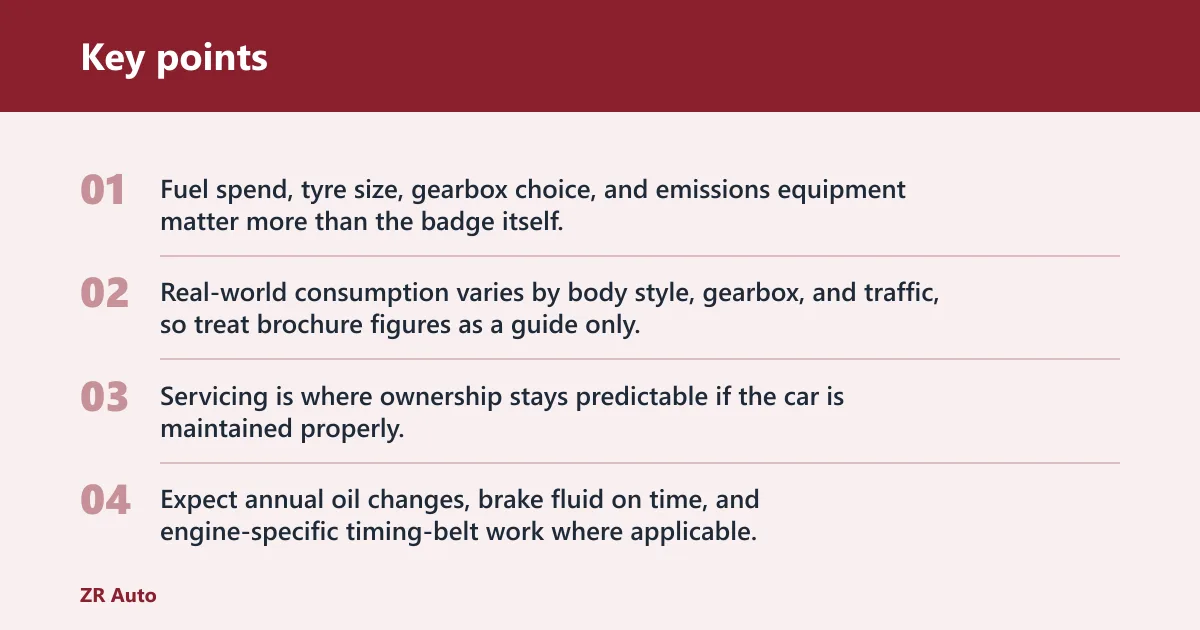
The Passat B8 is a 2014-2023 MQB-based saloon or estate in the family-car segment, so its running costs sit in the middle of the mainstream rather than at the bottom. Fuel spend, tyre size, gearbox choice, and emissions equipment matter more than the badge itself.
For fuel economy, the spread is wide. A 2.0 TDI suits long motorway miles and usually returns the best diesel economy, while 1.4 TSI and 1.5 TSI petrols give up some efficiency for easier short-trip use. Real-world consumption varies by body style, gearbox, and traffic, so treat brochure figures as a guide only.
Servicing is where ownership stays predictable if the car is maintained properly. Expect annual oil changes, brake fluid on time, and engine-specific timing-belt work where applicable. Tyres and brakes are typical family-car costs, but the Passat’s heavier estate versions and larger wheel sizes can push them up.
Insurance and road tax also matter. Insurance group depends on engine, trim, gearbox, and driver profile, while VED is driven by the model year and emissions rating. Later diesel models with AdBlue can be clean on paper, but emissions hardware adds another fault source to the cost stack.
Which Passat B8 engines are cheapest to own?
The cheapest Passat B8 to own is usually the one that matches your mileage pattern. A high-mileage driver typically gets the best value from a 2.0 TDI, while mixed-use and shorter-trip owners are usually better served by a 1.4 TSI or 1.5 TSI. The wrong match turns cheap fuel into expensive repairs.
2.0 TDI for high-mileage use
The EA288 2.0 TDI is the strongest fit for motorway-heavy use, provided the car has solid service history and the emissions equipment is healthy. It suits long runs because the DPF can regenerate properly and the engine spends less time in the soot-loading, stop-start conditions that trigger faults.
1.4 TSI and 1.5 TSI for mixed or urban use
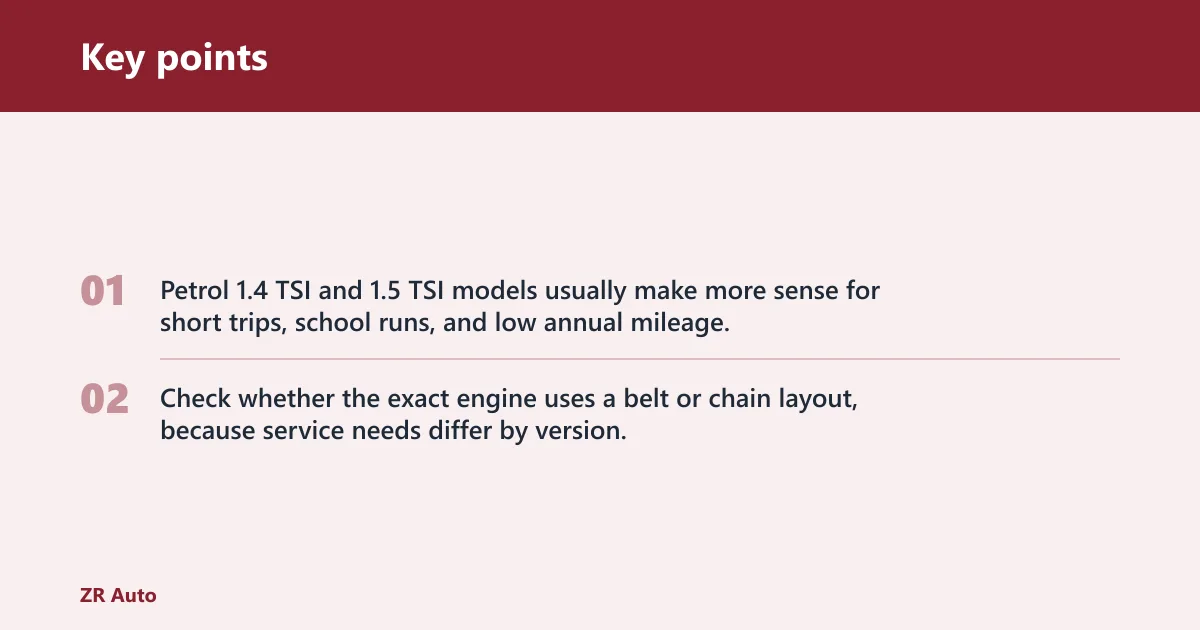
Petrol 1.4 TSI and 1.5 TSI models usually make more sense for short trips, school runs, and low annual mileage. They avoid diesel aftertreatment problems, but fuel economy is lower than a TDI at motorway pace. Check whether the exact engine uses a belt or chain layout, because service needs differ by version.
How mileage and trip length change the answer
Short trips are the key divider. A diesel that never reaches full operating temperature can load its DPF and EGR system, while a petrol that spends its life at low speed avoids that diesel burden. If your driving is mixed, the best choice depends on annual mileage and how often you do uninterrupted 20-30 minute drives.
Passat B8 engine and gearbox risk table
| Engine and gearbox | Most likely failure points | Typical symptom | Service-history item to verify | Buying decision |
|---|---|---|---|---|
| 2.0 TDI manual | DPF loading, EGR soot buildup, timing belt wear, AdBlue on later cars | Warning lamp, rough idle, limp mode, higher idle fan use, poor cold running | Timing-belt and water-pump proof, oil changes on time, evidence of long runs, AdBlue checks if fitted | Green if history is complete and use suits it |
| 2.0 TDI DSG | All diesel emissions items plus DSG service and mechatronics risk | Shuddering take-off, delayed shifts, harsh changes, gearbox warning light | DSG oil service every 40,000 miles where applicable, timing belt, AdBlue, DPF and EGR records | Yellow unless the paperwork is strong and symptoms are absent |
| 1.4 TSI manual | General ignition and cooling wear, belt or chain service depending on variant | Cold-start rattle on some variants, rough running, misfire warning, coolant loss | Correct timing service for that exact engine code, coolant history, regular oil changes | Green for mixed use if maintained properly |
| 1.5 TSI DSG | Gearbox servicing, low-speed shift quality, software-related hesitation on some cars | Jerky creep, hesitation pulling away, odd low-speed shift behavior | DSG service record, software updates if documented, clean cold and hot test drive | Yellow until it drives cleanly and the history is clear |
What are the most common Passat B8 problems?
The most common Passat B8 problems are diesel emissions faults, worn suspension parts, and occasional electrical or infotainment glitches. On diesel cars, the cost picture changes fast if the DPF, EGR, or AdBlue system starts to fail, because one warning light often leads to several diagnostic hours and a larger repair bill.
DPF and EGR faults on diesel cars
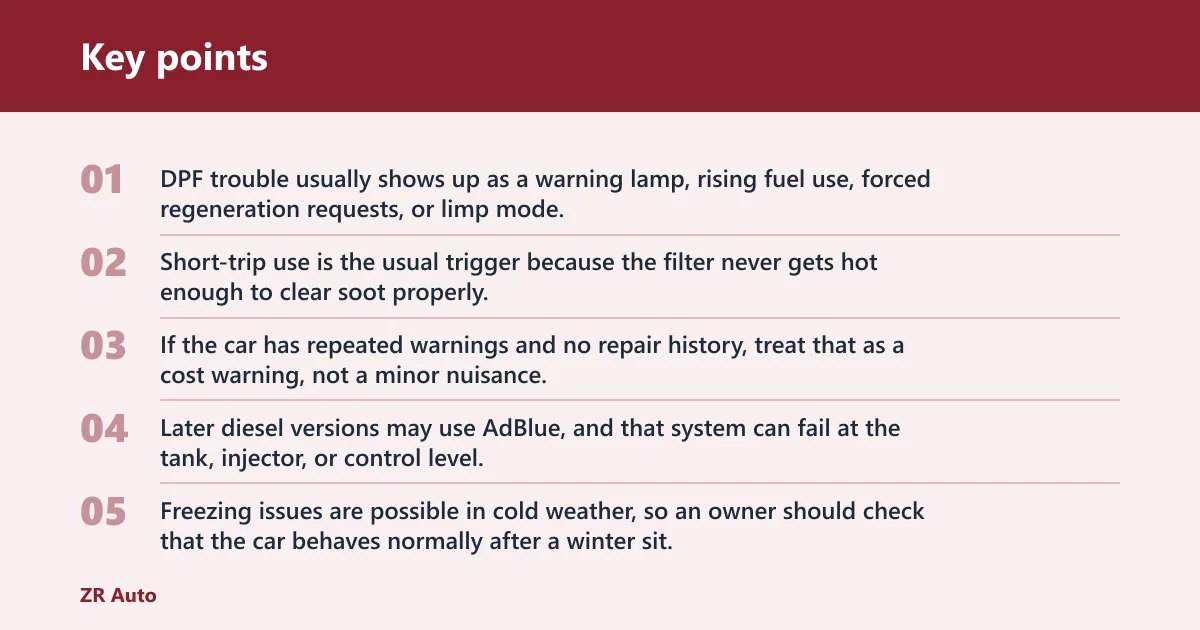
DPF trouble usually shows up as a warning lamp, rising fuel use, forced regeneration requests, or limp mode. Short-trip use is the usual trigger because the filter never gets hot enough to clear soot properly. EGR faults can cause rough idle, hesitation, and smoke-free power loss, which often points to soot buildup rather than a dramatic failure.
Repair cost depends on what is wrong. A forced regeneration or EGR clean can be much less than replacement, but if the filter is damaged or the valve is stuck, costs can rise sharply and may reach four figures. If the car has repeated warnings and no repair history, treat that as a cost warning, not a minor nuisance.
AdBlue warnings and emissions-system faults
Later diesel versions may use AdBlue, and that system can fail at the tank, injector, or control level. A top-up warning is normal, but a persistent warning light, non-start countdown, or repeated level sensor fault points to diagnosis, not just fluid. Freezing issues are possible in cold weather, so an owner should check that the car behaves normally after a winter sit.
Say your 2.0 TDI shows an AdBlue warning after a top-up and the message returns within a day. That usually means the fault is not low fluid, but a sensor, injector, or tank issue that needs scan-tool diagnosis. Buying such a car without a discount is risky.
Suspension, steering, and tyre-wear clues
Control arms, bushes, and shock absorbers wear with age, especially on heavier estate cars and cars that run large wheels. Clunks over sharp edges, a floaty ride, or inner-edge tyre wear point to suspension or alignment problems. These are rarely catastrophic, but they matter because they often sit alongside neglected maintenance.
Picture a Passat B8 that tracks straight but makes a knock over broken tarmac and has uneven front-tyre wear. That pattern usually points to worn bushes or dampers rather than a wheel balance issue, and it is worth pricing in before you buy.
Are DSG gearboxes on the Passat B8 reliable?
DSG gearboxes can be a good fit on the Passat B8, but only when serviced on schedule and driven with no symptoms. The 6-speed wet-clutch versions and the 7-speed variants both add convenience, yet they also add cost, and neglected service history is the clearest reason to walk away from a used car.
6-speed wet-clutch servicing and symptoms
Wet-clutch DSG units need regular oil and filter changes, commonly around every 40,000 miles on many Volkswagen applications. Skip that work and the gearbox can start to shift harshly, hesitate on take-off, or feel indecisive at low speed. A service stamp alone is not enough; the invoice should show the correct gearbox service.
7-speed variants and mechatronics concerns
The 7-speed DSG variants can be smooth when healthy, but mechatronics faults are a known risk across the line. Warning signs include jerky creep in traffic, delayed engagement from Park or Reverse, or a gearbox fault message. If the car already hesitates on the test drive, do not assume a software reset will fix it.
Service-history checks that matter
Check for dated DSG services, evidence of correct fluid use, and any gearbox software updates. If the seller cannot produce proof, budget for the service immediately after purchase or discount the price accordingly. A cheap DSG car with no paperwork is usually expensive later.
What should you check before buying one?
Before buying a Passat B8, verify timing-belt evidence, emissions-system history, and the condition of the electronics. A clean-looking car with missing service proof can hide a large maintenance bill, especially on diesel models with DPF, EGR, AdBlue, and DSG all in the same ownership stack.
-
Confirm timing service proof. Ask for the exact date and mileage of the timing-belt replacement and, where applicable, the water pump. If the interval is due or unknown, price the work into the deal because missing proof weakens the car’s value immediately.
-
Scan diesel emissions history. Look for DPF regeneration records, EGR cleaning or replacement, and any AdBlue repair invoices. A repeated warning light or limp-mode history is a red flag because those faults often return if the underlying usage pattern has not changed.
-
Test the electronics properly. Check the infotainment screen, parking sensors, climate control, and battery health. Screen glitches, dead sensors, and odd module faults are common enough to matter, but the bigger issue is whether they are isolated or part of a wider electrical problem.
-
Drive it cold and hot. Start the car from cold, then repeat the key checks after a longer drive. Listen for suspension knocks, feel for DSG hesitation, and watch for warning lights that appear only once the car reaches temperature.
How much can repairs add up to?
Repairs can turn a cheap Passat B8 into an expensive one very quickly. Routine wear items are manageable, but DSG servicing, timing-belt work, DPF issues, EGR faults, and AdBlue failures can each push costs into the hundreds or more. The difference between a good car and a bad one is often paperwork, not purchase price.
A missing timing-belt record is a negotiation point, not a detail. If the seller cannot prove the interval, the buyer should assume the service is due. The same logic applies to DSG servicing and diesel emissions hardware.
For a rough ownership map, a healthy car with clean history may stay near the £800-£1,500 yearly upkeep band noted above. Add one major fault, and the year can jump sharply. Add two, and the cheaper car is no longer the cheaper car.
What different faults do to the buy-or-walk-away call
If a 2.0 TDI needs only a scheduled belt and service, it can still be a sensible buy. If it also has repeated DPF warnings, EGR symptoms, or a DSG that shudders, walk away unless the price is low enough to cover several major repairs. A petrol with no emissions-system baggage is usually easier to budget for.
Which model years should you avoid?
Avoiding a whole year range is less useful than avoiding specific cars with poor history. The highest-risk Passat B8 examples are the ones with unresolved DSG faults, missing timing-belt proof, repeated diesel-emissions warnings, or obvious electrical issues. Later diesel cars add AdBlue complexity, so missing records matter even more there.
Some early or heavily used examples can still be good buys if they have full evidence of correct servicing. The problem is not the year badge alone; it is the combination of engine, gearbox, and maintenance record.
Frequently asked questions
How much does it cost to own a VW Passat B8?
For a healthy car, budget roughly £800-£1,500 a year for routine upkeep, before any major repair. Fuel, tyres, brakes, insurance, road tax, and scheduled servicing make up most of the spend, while diesel emissions faults and DSG work can push the total much higher if the car has been neglected.
What are the most common problems with the VW Passat B8?
The common problems are DPF loading, EGR soot buildup, AdBlue faults on later diesels, DSG service neglect, and age-related suspension wear. Infotainment glitches, parking sensor faults, and battery or module issues also appear often enough to check carefully, especially on cars with patchy service records.
Is the VW Passat B8 expensive to maintain?
It is not cheap in the way a small hatchback can be, but it is not unusually expensive for a large family car. A well-maintained petrol version is easier on the wallet than a neglected diesel, while a diesel with full history can stay reasonable if the usage pattern fits the engine.
Which VW Passat B8 engines are the most reliable?
Reliability depends on use and maintenance more than on a single winner. A maintained 2.0 TDI suits high-mileage motorway work, while a 1.4 TSI or 1.5 TSI is usually the safer choice for shorter trips and mixed use. The best engine is the one with the right service evidence.
What should I check before buying a used VW Passat B8?
Check timing-belt proof, DSG servicing where fitted, diesel-emissions history, tyre wear, suspension noise, and electronics function. A proper test drive should include cold start, low-speed traffic, and a faster road section so you can catch rough idle, gearbox hesitation, or warning lights that only appear under load.