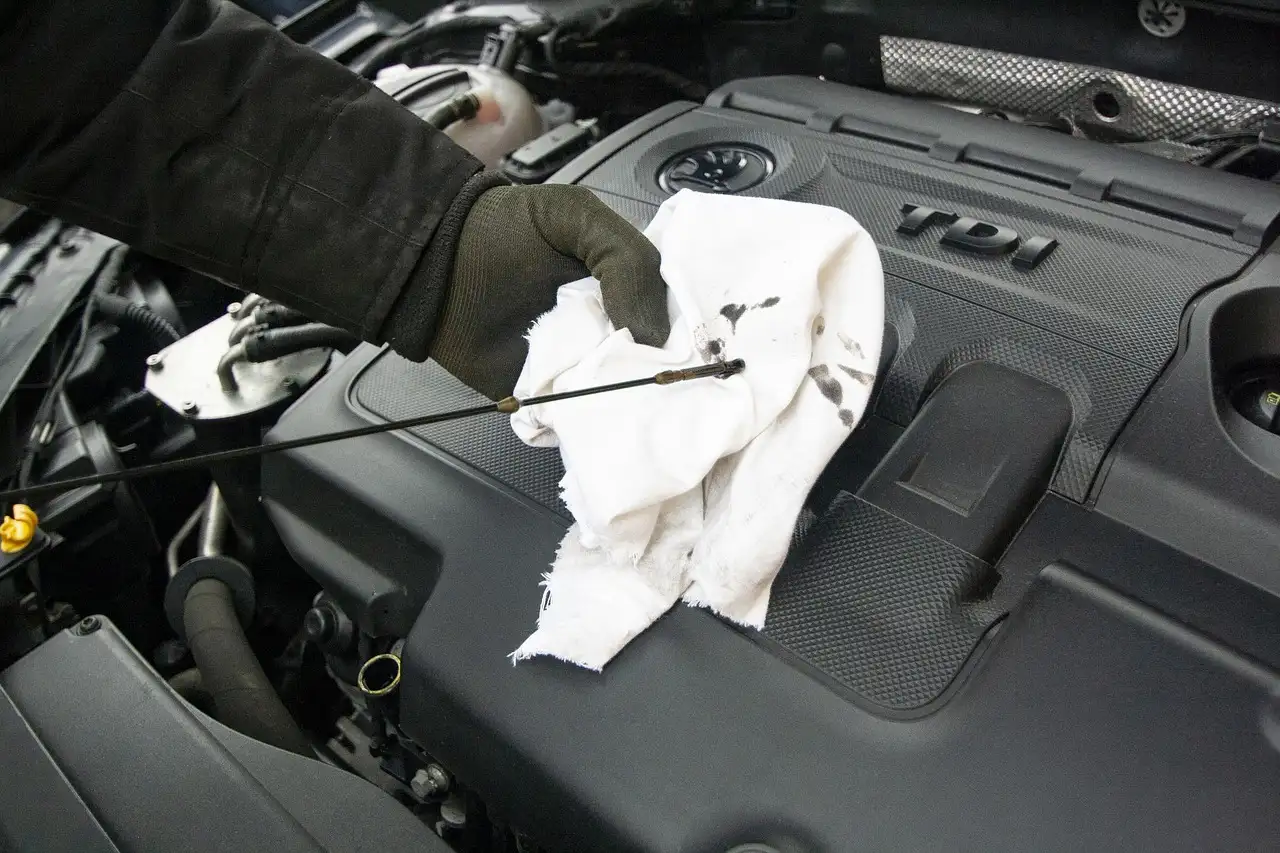
VW Passat B7 Reliability: Common Problems
The VW Passat B7 is a mixed-risk used buy: a well-kept 2.0 TDI with a manual gearbox is the safer pick, while DSG cars and neglected diesels bring the most repair exposure. Miss faults and you can end up paying for EGR, DPF, water-pump, suspension, and gearbox repairs. This guide breaks down the main engine, transmission, and chassis problems into buy, negotiate, or avoid calls.
Passat B7 fault triage table
Use this table first. It turns common B7 faults into a buying decision, so you can sort a car quickly before you spend time on a full inspection.
| Fault | Likely symptom | Inspection method | Repair severity | Buying decision |
|---|---|---|---|---|
| Dual-mass flywheel wear | Squawking, rumbling, or growling on pull-away and gear changes | Cold start, then test in first and second gear with light throttle | High | Negotiate if mild; avoid if noisy and worsening |
| DSG gearbox issues | Harsh shifts, hesitation, shudder, warning lights | Check service evidence, then road test in stop-start traffic and on an incline | High | Negotiate only with proof of recent service or warranty; otherwise avoid |
| EA189 diesel emissions fix side effects | Rougher running, drivability complaints, extra EGR-related work | Confirm recall completed, ask about follow-on repairs, scan for stored faults | Medium to high | Buy only with clean history and no current warning lights |
| EGR and DPF issues | Poor low-speed running, limp mode, warning lamps | Check short-trip history, idle quality, and exhaust warning messages | High | Negotiate if isolated; avoid if repeat faults appear |
| Suspension wear | Knocks, uneven tyre wear, wandering steering | Inspect bushes, top mounts, and tyre edges on a lift or lock-to-lock check | Medium | Negotiate if limited to one axle |
| Electrical faults and sensors | Warning lights, intermittent sensor messages | Cycle every switch, check instrument panel, and read fault memory | Medium | Negotiate unless the fault is persistent or undocumented |
| Early B6 2.0 TDI oil pump drive wear | Loss of oil pressure if the hex shaft wears out | Only applies to early B6 cars; ask when the drive was inspected | High | Avoid if inspection proof is missing on the affected early cars |
Is the VW Passat B7 reliable?
The Passat B7 is generally a reasonable used buy if the maintenance record is strong and the powertrain choice is sensible. It was built from 2010 to 2014 and is a major facelift rather than a clean-sheet new car, so condition and upkeep matter more than trim level or badges.
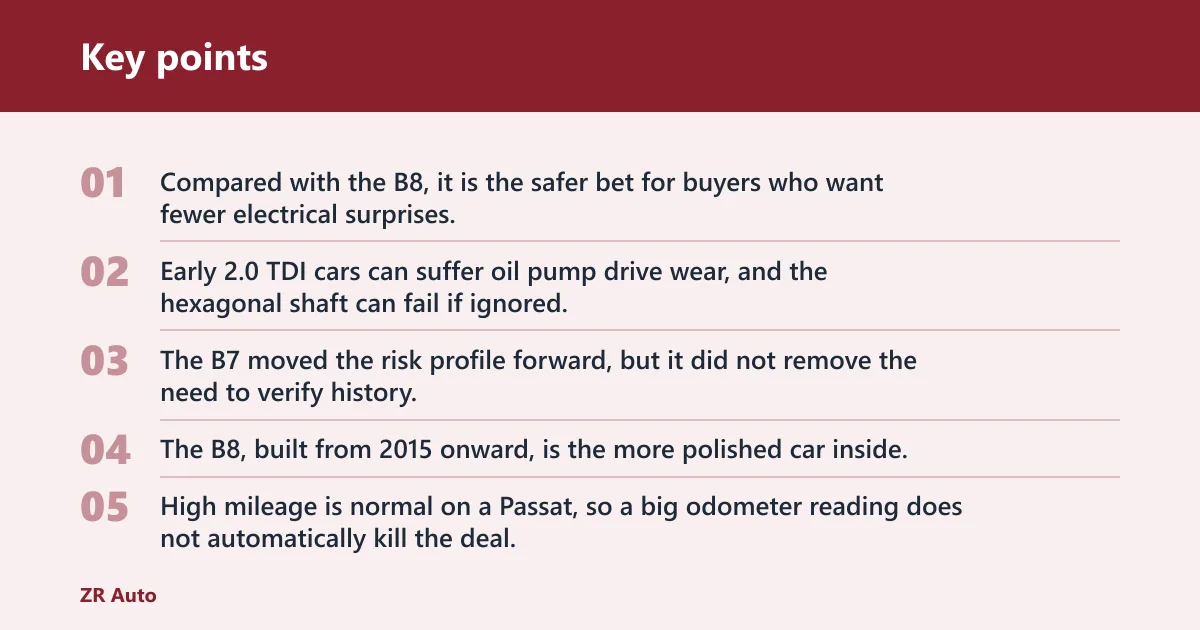
Compared with the B6, the B7 is usually the cleaner used choice because it avoids the earliest B6 2.0 TDI oil pump drive issue. Compared with the B8, it is the safer bet for buyers who want fewer electrical surprises. The B8 is more spacious and quieter, but its owner survey result placed it 19th of 20, with electrical faults, warning lights, and sensors cited most often.
How the B7 compares with the B6 and B8
The B6, built from 2005 to 2010, is still a budget used-buy option, but it needs closer condition checking than equipment shopping. Early 2.0 TDI cars can suffer oil pump drive wear, and the hexagonal shaft can fail if ignored. The B7 moved the risk profile forward, but it did not remove the need to verify history. (Wikipedia)
The B8, built from 2015 onward, is the more polished car inside. It is also the one to watch more closely for electrical faults and warning messages. For a used buyer, that means the B7 often lands in the sweet spot if you want a practical estate or saloon without stepping into the B8’s newer-electronics risk.
Why history matters more than mileage alone
High mileage is normal on a Passat, so a big odometer reading does not automatically kill the deal. A full service history, proof of recall work, clean starting behaviour, and evidence of transmission servicing matter more than the number on the dash.
Say the chosen B7 2.0 TDI shows about 220,000 km but has documented oil, filter, brake, and gearbox service, plus a clean cold start and no warning lights. That can be a better risk than a 140,000 km car with missing invoices, repeated EGR faults, and a hesitant DSG launch.
When a high-mileage car is still worth buying
A high-mileage B7 can still make sense if it has a manual gearbox, no current fault codes, even tyre wear, and evidence that the diesel recall work was completed. A car that has covered long motorway distances often ages better than one used only for short urban trips.
The warning signs are different. Short-trip diesel use, repeated warning lamps, and poor service records all push the car toward a negotiate or avoid decision, even if the bodywork looks tidy.
Which B7 engines are safest to buy?
The safest B7 engines are the better-kept diesels and the simpler petrol cars, but the exact choice depends on how the car was used. Common B7 engines include the 1.6 TDI and 2.0 TDI diesels, plus the 1.4 TSI and 1.8 TSI petrol engines. For most buyers, maintenance history is more important than badge prestige.
1.6 TDI and 2.0 TDI diesel risk
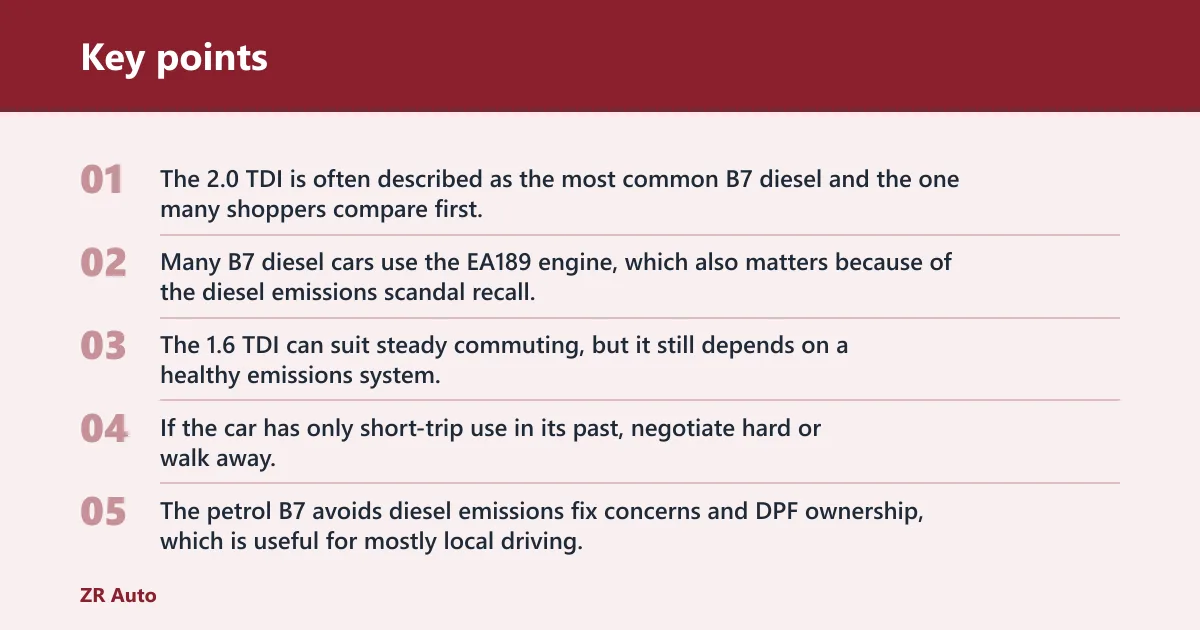
The 2.0 TDI is often described as the most common B7 diesel and the one many shoppers compare first. Many B7 diesel cars use the EA189 engine, which also matters because of the diesel emissions scandal recall. That means you must check both routine service history and recall completion.
The 1.6 TDI can suit steady commuting, but it still depends on a healthy emissions system. On any diesel B7, a tired dual-mass flywheel, EGR faults, or DPF issues can quickly turn a bargain into a repair project. If the car has only short-trip use in its past, negotiate hard or walk away.
1.4 TSI and 1.8 TSI petrol risk
The petrol B7 avoids diesel emissions fix concerns and DPF ownership, which is useful for mostly local driving. The trade-off is that you still need a clean service record and a smooth road test, especially on turbocharged petrol cars that have been missed on oil changes.
For used buyers who want fewer diesel-specific costs, a petrol B7 can be a sensible option. It is still not a blind buy. Listen for rough idle, check for warning lights, and insist on evidence of regular maintenance.
Best engine and gearbox combinations
| Combination | Risk level | Why | Decision |
|---|---|---|---|
| 2.0 TDI manual | Lower | Good long-distance choice if service history is strong and the flywheel is quiet | Buy |
| 1.6 TDI manual | Lower to medium | Fine if used gently and the emissions system is healthy | Buy |
| 1.4 TSI manual | Medium | Petrol avoids diesel aftertreatment issues, but history still matters | Buy |
| 1.8 TSI manual | Medium | Can be a good choice if serviced properly and road-tested cleanly | Buy |
| Any engine with DSG | Higher | Automatic repair risk is greater on used examples without proof of care | Negotiate or avoid |
What are the most common problems on a VW Passat B7?
The most common B7 faults are not random; they cluster around diesel aftertreatment, drivetrain wear, and electrical niggles. That is why a used buyer should split the search into petrol and diesel risk patterns instead of treating every B7 the same way.
Dual-mass flywheel wear
The dual-mass flywheel is a common wear item on the B7, especially on diesel cars. A worn unit can squawk, rumble, and growl on take-off and gear changes. Those sounds matter because they often show up first during pull-away or while changing gears under light load.
Picture a manual 2.0 TDI that is quiet at idle but emits a dull rumble as you ease away in first gear. If the noise fades once the clutch is fully engaged, the flywheel is a suspect. That is a negotiate call at minimum, and an avoid call if the noise is obvious, heavy, or getting worse.
DSG automatic gearbox risk
The DSG automatic is not forbidden, but it is a higher-risk choice on a used Passat. A good one can be pleasant to live with, yet used examples can carry expensive transmission repair exposure. Warranty cover or clear proof of recent servicing is worth having before you commit.
On the test drive, pay attention to launch feel, low-speed shunting, and shift timing in traffic. Any hesitation, jolting, or warning light pushes the car toward negotiate or avoid. If the seller cannot prove the gearbox has been maintained, treat the car carefully.
EGR, DPF, and emissions-related faults
Diesel B7s can suffer from EGR and DPF issues, especially if the car spent much of its life on short trips. Symptoms include limp mode, warning lamps, poor low-speed running, and repeated fault codes. These are not cosmetic faults; they usually point to real ownership cost.
Do not assume one fault will stay isolated. A blocked EGR or stressed DPF often brings follow-on costs, including repeat scans, forced regenerations, and related repairs. That is why a diesel with unresolved warning lights should usually be avoided rather than gambled on.
Electrical faults, warning lights, and sensors
The B7 is not the B8, but it can still suffer from warning lights and sensor faults. Check that every dashboard light behaves normally at ignition, then goes out as expected. If a message appears, do not dismiss it as a minor glitch.
Look for parking sensor issues, window faults, central locking oddities, and intermittent dash messages. One minor electrical fault may be manageable. A cluster of them suggests a car that will need repeated fault-finding, which makes the budget harder to control.
What does the diesel emissions fix change?
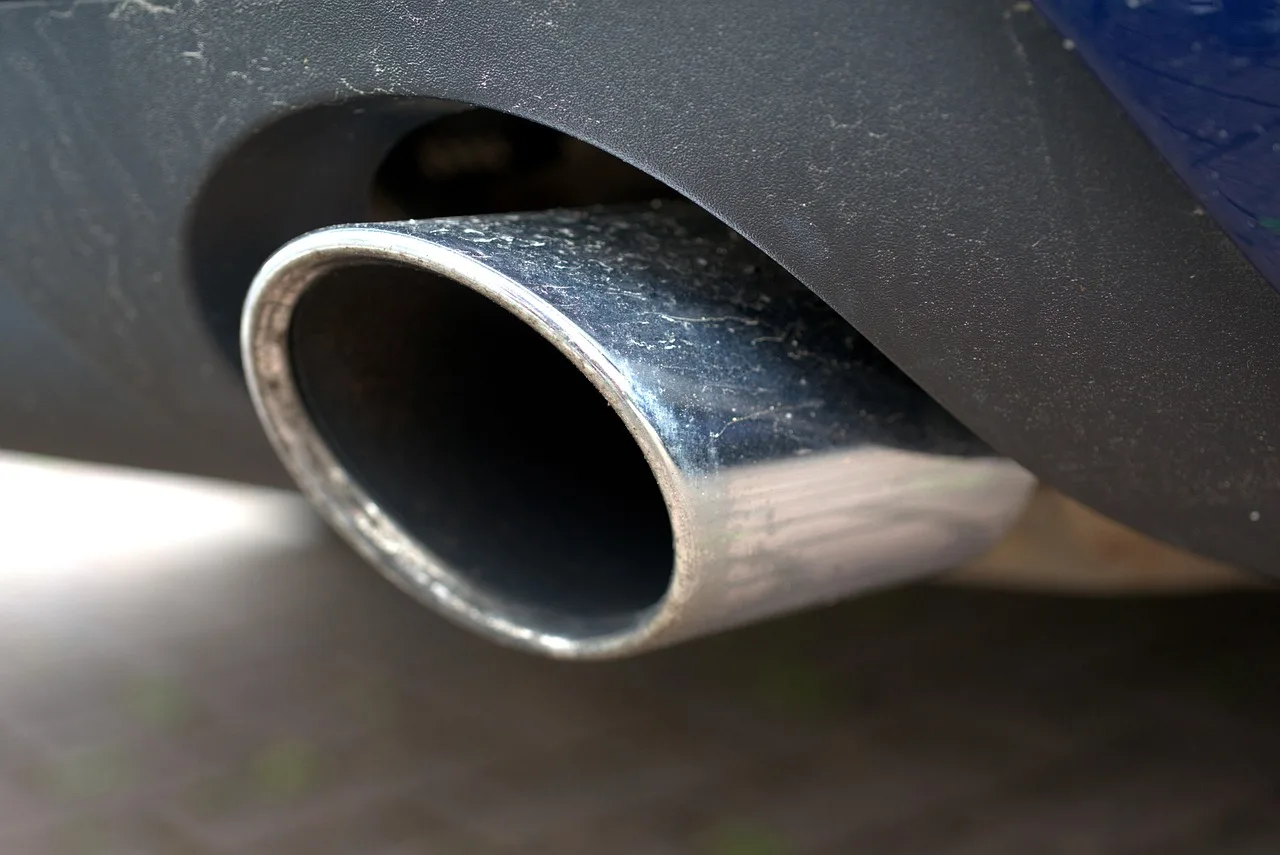
The B7 diesel emissions fix matters because many 2.0 TDI cars use the EA189 engine. The recall is not a simple software-only job in every case. It involves a software update and a small hardware change, and some owners report drivability complaints afterward. That means the update can affect both how the car feels and what it may need next.
EA189 cars and the recall
EA189 is the diesel engine fitted to many B7 2.0 TDI cars. If the car has had the emissions update, ask for paperwork that confirms it. If the recall has not been completed, treat that as a buyer issue that needs resolving before money changes hands.
The B8 moved to EA288, so the emissions-fix discussion is generally centered on B7 diesels. A car with missing recall proof is not automatically a bad buy, but it is a negotiating point and a sign that paperwork may be incomplete elsewhere too.
Drivability complaints to watch
After the fix, some drivers report rougher running, flatter response, or a less clean idle. That does not mean every updated car is bad. It does mean you should road-test the car from cold and under light throttle, then again once warm, before deciding.
A common first-timer mistake is to focus only on the recall sticker and ignore how the car drives after the update. If the owner also mentions EGR-related follow-on work, that is a warning sign. The fix itself may be acceptable, but the ownership trail around it can still be expensive.
Inspection points after the update
-
Confirm the recall paperwork.
Ask for written proof that the emissions update was completed. The paperwork should match the car’s engine details and date the work. Missing proof is a negotiation issue, not a small paperwork gap.
-
Scan for stored faults.
Read the fault memory before buying if possible. Look especially for EGR, DPF, boost, and sensor-related codes. A car with cleared faults but no explanation deserves caution.
-
Road-test from cold.
Start the car after it has sat for several hours. Listen for uneven idle, smoke, and hesitation on initial pull-away. The first few minutes often reveal the problems that a warm engine hides.
What should you check before buying a used VW Passat B7?
Start with documents, then move to the mechanical checks that matter most on this car. Service history, recall proof, and a clean road test are worth more than trim level or optional equipment. If the paperwork and symptoms do not line up, the car should move from buy to negotiate, or to avoid.
Service history and recall proof
Ask for a stamped or itemised service record, plus proof of any diesel emissions recall on EA189 cars. Check whether gearbox servicing has been done, especially on DSG examples. If the seller cannot produce evidence, assume the maintenance standard may be lower than the advert suggests.
Cold-start and road-test checks
-
Start the engine cold.
Listen for rattle, uneven idle, warning lights, and excessive smoke. A cold start tells you more than a warmed-up handover.
-
Test pull-away feel.
Use first and second gear, then pay attention to rumbling, squawking, or shuddering. Those symptoms point toward dual-mass flywheel wear or transmission trouble.
-
Check stop-start traffic.
On a DSG car, crawl in traffic and then climb a gentle incline. Jerking, hesitation, or delayed engagement is a warning sign.
-
Watch the dashboard.
Confirm that no warning lights remain after the initial self-check. Any engine, emissions, gearbox, or sensor lamp should move the car toward negotiate or avoid.
Paperwork, tyres, brakes, and warning lights
Tyres should wear evenly across the tread, and brake discs should not be deeply ridged or heavily corroded. Uneven wear can point to suspension problems, while poor brake condition often signals deferred maintenance elsewhere.
Also check that every electrical item works: windows, mirrors, parking sensors, and climate controls. Small faults are easy to ignore during a viewing, but they can reveal a pattern of poor care.
How bad is the oil pump drive problem on an early Passat B6?
The early B6 2.0 TDI oil pump drive issue is serious, but it belongs to the B6, not the B7. It affects cars built up to roughly mid-2006, and specialists recommend inspecting the oil pump drive at around 150,000 km. If the hex shaft wears badly, the result can be loss of oil pressure.
Practical inspection workflow
-
Confirm the build period.
Check whether the B6 you are looking at falls into the early range. If it is an affected car and there is no evidence of drive inspection or repair, treat that as a serious warning.
-
Ask for service evidence.
Look for records that mention oil pump drive attention, engine work, or related preventative repairs. Missing proof matters because the failure can be sudden and severe.
-
Judge the risk threshold.
If the affected early B6 has high mileage and no documented inspection around 150,000 km, avoid it unless the price and repair plan make the risk acceptable. For many buyers, that means walking away.
Frequently asked questions
Which VW Passat B7 engines are the most reliable?
The safer choices are the better-maintained 2.0 TDI manual, the 1.6 TDI manual, and the petrol 1.4 TSI or 1.8 TSI if serviced properly. The key is history. A neglected low-mileage car is a worse bet than a higher-mileage one with documented care.
Should I avoid a DSG automatic VW Passat B7?
Not automatically, but you should treat it as a higher-risk purchase. Buy one only if the gearbox history is clear, the road test is smooth, and there are no warning lights. Without that, the repair exposure is enough to justify a negotiate or avoid decision.
What does the diesel emissions fix do to a VW Passat B7?
On many EA189 diesel cars, it brings a software update and a small hardware change. Some owners report drivability complaints afterward, and there can be EGR-related follow-on costs. The fix is worth confirming, but it should be checked alongside how the car actually drives.
Are high-mileage VW Passats okay to buy?
Yes, if the car has strong maintenance records, clean road-test behaviour, and proof of recall and gearbox servicing where relevant. High mileage is normal for a Passat. Missing service proof, warning lights, or rough drivability matter far more than the number on the odometer.