Is the Volvo S60 Reliable as a Used Car?
Used Volvo S60 reliability is mixed: a 2019+ car is usually the safer bet, while 2011–2018 models can bring costly cooling, turbo, transmission, and infotainment repairs. Ignore that split, and a bargain S60 can turn into repair bills that quickly erase any savings. This article tells you which years to favor, which faults are nuisance-level versus expensive, and what to inspect before you buy.
What reliability means for S60 shoppers
The short answer is yes, with limits. A current-generation S60 can be a sensible used buy if the service record is complete and the electronics behave normally. It is comfortable, safe, and well-appointed, but reliability depends heavily on model year, software history, battery health, and how the previous owner maintained the car.
What reliability means here
For an S60 shopper, “reliable” should mean two different things. Some issues are nuisance faults: a frozen screen, a slow menu, or a warning light that clears after a software update. Others are real purchase risks: a bad charging system, repeated module faults, or a neglected cooling or transmission problem that can lead to expensive repair work.
The current U.S. used-shopping window is the 2019 to 2025 generation, and that matters because the later model years have fewer early software and module bugs than the first years of the redesign. Volvo is phasing out its sedan and station wagon offerings, the S60 is no longer sold new in the U.S., and Volvo ended production of the S60 sedan in Ridgeville, South Carolina. The 2025 model year became the last version sold to American buyers.
Which buyers should keep looking?
If you want the cheapest possible luxury sedan and do not want to check software history or battery condition, keep looking. If you want a sedan that feels refined and secure, and you are willing to inspect electronics carefully, a later S60 can make sense. Buyers who plan to own past 100,000 miles should be stricter about records and pre-purchase testing.
Why discontinued status matters
The S60’s discontinued U.S. status changes the buying decision because depreciation usually speeds up once a model leaves the market. That can make the asking price look tempting, but it also means buyers should expect more concern about future resale, software support, and long-term parts availability than they would with a current showroom model.
Parts support and resale
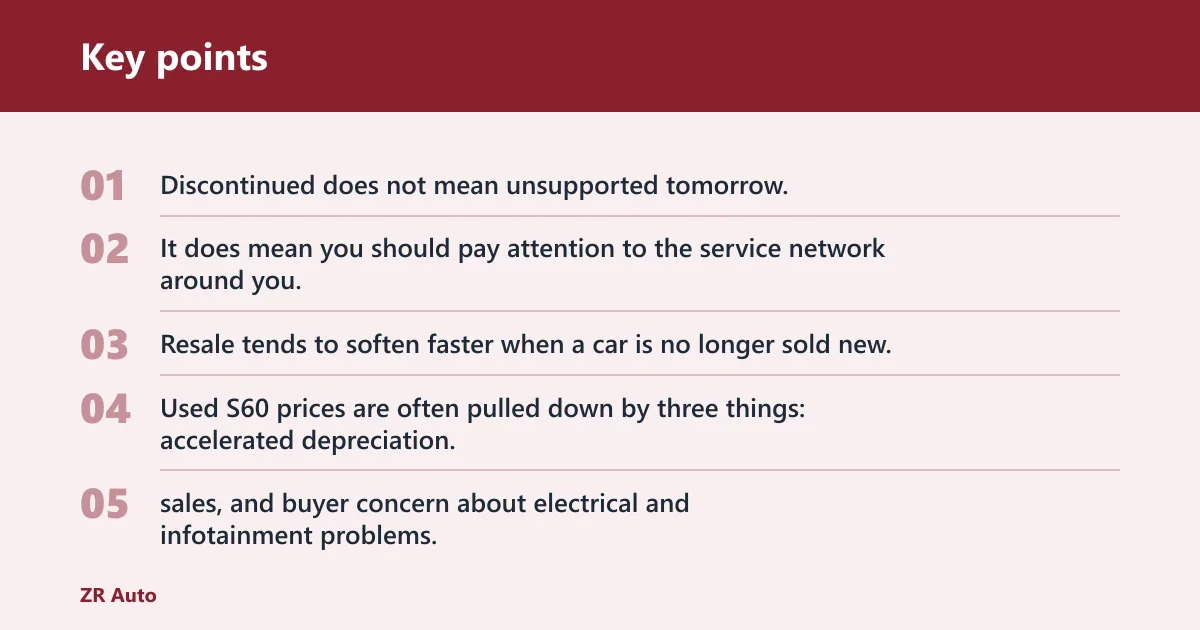
Discontinued does not mean unsupported tomorrow. It does mean you should pay attention to the service network around you, because a luxury sedan with electronic issues can cost more to sort if the dealer or independent shop needs to chase modules and software updates. Resale tends to soften faster when a car is no longer sold new.
Why price drops faster
Used S60 prices are often pulled down by three things: accelerated depreciation, the end of U.S. sales, and buyer concern about electrical and infotainment problems. Those concerns are not always catastrophic, but they do affect the market. A clean car with records can be worth more than a cheaper example with vague history.
What to watch in the service record
Look for documented maintenance intervals, software updates, tire and brake history, and any record of battery replacement or charging-system checks. Missing records matter more on a premium sedan with complex electronics. A thin file is not proof of trouble, but it should lower your offer.
Reliability data from major sources
Major sources paint the S60 as average-to-good rather than a standout or a problem child. RepairPal puts annual repair costs at $750, the S60 averages 0.5 shop visits per year, and only about 8% of repairs are severe. An independent reliability index scores it 72/100, and that rating is described as “Good.”
RepairPal cost and failure outlook
RepairPal’s numbers suggest the S60 is not a budget trap, but it also is not class-leading. The 0.5 shop visits per year figure points to moderate visit frequency, while the 8% severe-repair share suggests most repairs are not catastrophic. That still leaves room for expensive outliers on neglected cars.
Independent index scores by model year
The 72/100 overall reliability score gives the S60 a respectable middle-of-the-pack result. The best year in the cited data is the 2025 S60 at 76/100. That fits the usual used-car pattern: later model years have fewer first-run bugs, especially once software and module problems have had time to be corrected.
Consumer Reports and owner survey trends
Consumer Reports uses owner-survey data, so its results can move by model year and powertrain. The S60’s results are mixed rather than uniformly strong, which is why you should not judge every used example the same way. Against comparable German luxury sedans, the S60 sits in the middle of the pack rather than at the front.
Volvo S60 reliability scorecard
This scorecard turns common complaints into buying risk. The point is not to fear every fault. It is to separate a screen glitch from a repair that can strand the car or drain your budget.
| Model year | Known complaint type | Inspection test | Likely severity | Negotiation leverage |
|---|---|---|---|---|
| 2019 | Early-current-generation software bugs, infotainment lag | Cold start, then check screen response, backup camera, and warning lights | Moderate | Medium |
| 2020 | Electrical glitches, intermittent module warnings | Cycle all drive modes, lights, climate controls, and steering-wheel buttons | Moderate | Medium |
| 2021 | Sensus freezing or slow response | Pair a phone, open maps, and test audio plus touchscreen delay | Low to moderate | Low to medium |
| 2022 | 12V battery health, charging-system complaints | Check start behavior after sitting, scan for low-voltage warnings | Moderate to high | High if symptoms repeat |
| 2023 | Residual software and sensor glitches | Verify all updates, test ADAS alerts, and confirm stable infotainment reboot behavior | Low to moderate | Medium |
| 2024 | Fewer complaint patterns, but electronics still matter | Long test drive with repeated restarts and stop-and-go traffic | Low to moderate | Medium |
| 2025 | Best-in-lineup reliability score, mostly residual risk checks | Confirm software version, phone integration, and smooth cold-start behavior | Lower | Lower unless history is weak |
Which model years are best?
The best used S60 years are the late current-generation cars, especially 2023 to 2025, with 2025 standing out in the cited reliability data. The weaker years are the early current-generation models, where buyers should be more alert for infotainment complaints, low-voltage issues, and incomplete software maintenance.
Stronger late-run years
Late-run cars usually benefit from more mature software and fewer early-production bugs. For the S60, that matters because many complaints are electronics-related rather than mechanical. A later car with full maintenance records is usually the better value than an earlier one that is only cheaper on paper.
Weaker early years
The 2019 and 2020 model years deserve extra scrutiny. That does not make them bad buys, but it does mean the buyer should assume a higher chance of nuisance electronics issues. If a seller cannot show update history or repair invoices, the price should reflect that risk.
High-mileage buying sweet spot
A common first-timer mistake is to judge a used S60 by its odometer reading instead of checking maintenance records and repair history. A 75,000-mile car with documented service and a healthy battery can be a better buy than a lower-mileage car with repeated warning lights and missing records. Mileage matters, but maintenance history matters more.
Say your target S60 has 82,000 miles, a clean body, and a screen that hesitates when you change menus. That is not the same as a car with 82,000 miles and repeated charging warnings. The first problem is usually a nuisance; the second can point to real cost.
What usually goes wrong?
The most common complaints center on electrical systems and infotainment. On the used market, that usually means slow response, frozen screens, warning lights, or a battery and charging system that need attention. Those are not all equal. Some are annoying. Some are expensive.
Sensus freezing and slow response
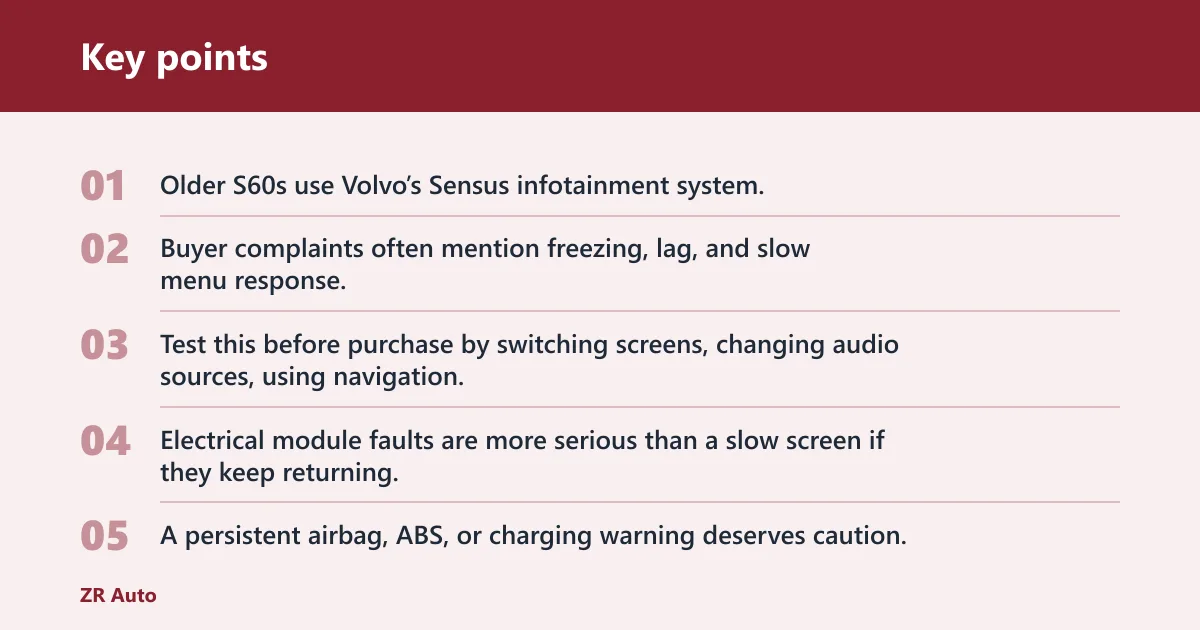
Older S60s use Volvo’s Sensus infotainment system. Buyer complaints often mention freezing, lag, and slow menu response, along with issues in the screen and dashboard electronics. Test this before purchase by switching screens, changing audio sources, using navigation, and restarting the car to see whether the system comes back cleanly.
Electrical modules and warning lights
Electrical module faults are more serious than a slow screen if they keep returning. A persistent airbag, ABS, or charging warning deserves caution, because it may point to deeper wiring or module trouble. A one-time glitch is easier to forgive than a repeating fault with no documented fix.
Battery, charging, and 12V issues
Low-voltage issues can create a chain reaction of warning lights and odd behavior. On a used S60, check how it starts after sitting, whether stop-start works correctly, and whether the battery age is documented. Weak 12V health can mimic bigger problems, but it still costs money to sort out.
Suppose a 2021 S60 starts normally but the infotainment reboots twice on a 20-minute drive. That is a different risk from a car that also shows charging warnings after a short stop. The first may be a software annoyance; the second could mean you need to budget for diagnosis and repair.
Suspension, brakes, and wear items
As with any used luxury sedan, brakes, tires, control-arm bushings, and dampers can wear with mileage. These are not unique S60 failures, but they matter because they change ownership cost fast. A car with fresh service here is easier to justify than one that needs tires, brakes, and electronics attention at once.
How does it compare with rivals?
The S60 is not the class leader for reliability, but it also does not sit at the bottom. Against rivals, it often looks decent on comfort and value, with electronics remaining the main risk area. The exact ranking depends on the year, trim, and maintenance record.
Volvo XC60 benchmark
The Volvo XC60 is a useful benchmark because it is a sibling model with a better cited reliability score than the S60. That does not mean the S60 is bad. It means shoppers comparing Volvo options may find the XC60 a safer bet on paper, especially if they are willing to give up sedan handling for an SUV.
BMW 3 Series comparison
Compared with the BMW 3 Series, the S60 often looks similar in the sense that both can be rewarding but not cheap to ignore. The BMW may offer a stronger driving reputation, while the Volvo can feel less stressful in ownership if the buyer values comfort and safety more than sportier tuning.
Audi A4 comparison
Compared with the Audi A4, the S60 is usually in the same general reliability conversation: a premium sedan where electronics and software matter a lot. If both cars have incomplete records, either can become costly. A clean S60 with a documented service file is often easier to defend than a mystery Audi.
What should you check before buying?
Before you buy, treat the S60 like a software-dependent sedan, not just a body and engine. Your inspection should cover the road test, infotainment, electrical behavior, service history, and the wear that shows up on higher-mileage cars. Do not skip any of those steps.
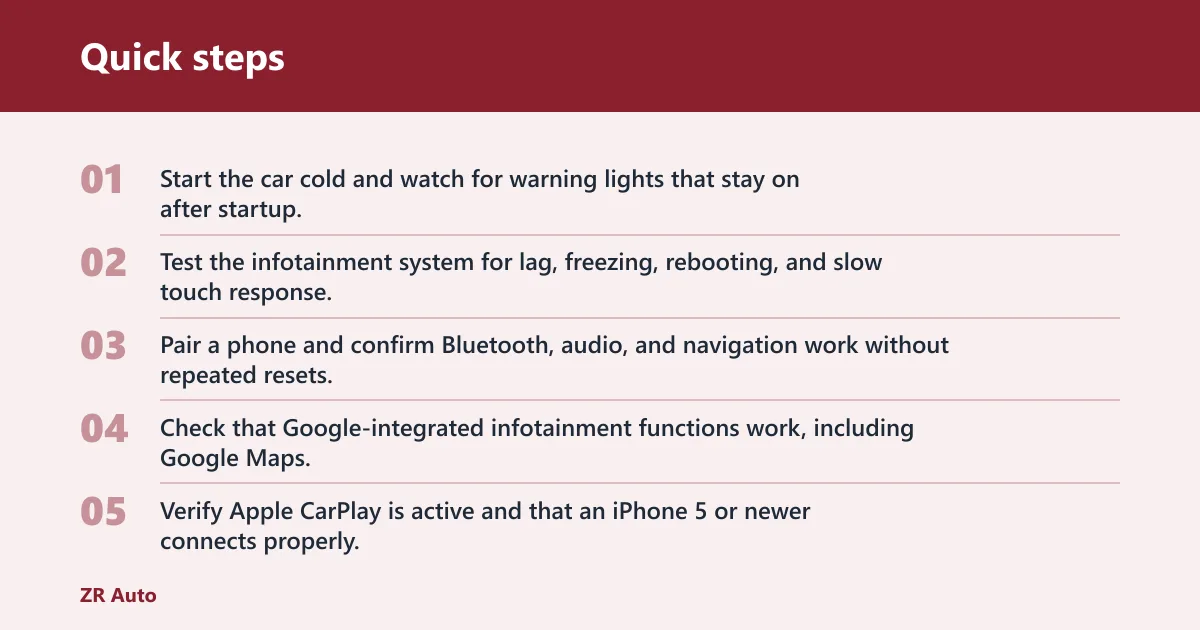
Buyer checklist
- Start the car cold and watch for warning lights that stay on after startup.
- Test the infotainment system for lag, freezing, rebooting, and slow touch response.
- Pair a phone and confirm Bluetooth, audio, and navigation work without repeated resets.
- Check that Google-integrated infotainment functions work, including Google Maps, Google Assistant, and Google Play.
- Verify Apple CarPlay is active and that an iPhone 5 or newer connects properly.
- Ask for service records showing maintenance, software updates, and any battery or charging work.
- Inspect tires, brakes, and suspension wear if the car has 60,000 miles or more.
- Look for evidence of repeated electrical diagnosis, not just one-off code clears.
Infotainment and phone pairing
The S60’s interface matters because many complaints begin there. Newer versions use Google-integrated infotainment with Google Maps, Google Assistant, and Google Play. Apple CarPlay is standard equipment, and iPhone compatibility generally starts with version 5 and later. If these features glitch during the test drive, take that seriously.
Electrical checks and software status
Ask whether the software is current and whether the battery has been replaced recently. Check mirror controls, seat memory, climate functions, parking sensors, and dash warnings. These small systems are often the first place a weak electrical car shows its age. Cheap repairs can still stack up fast.
Service history and recalls
Full service history is one of the best filters you have. A well-kept S60 with receipts is much safer than one with a vague story. If a seller cannot explain past warning lights, battery work, or infotainment fixes, treat that as a price concession or a reason to keep shopping.
Frequently asked questions
Is the Volvo S60 a good car?
Yes, if you want a comfortable, safe, upscale midsize sedan and you choose a later model with records. The S60 is not class-leading for reliability, but it is generally reliable rather than terrible. The key is to buy the right year and inspect the electronics carefully.
Are Volvo S60 reliable in real-world use?
Real-world reliability is mixed and model-dependent. RepairPal’s annual cost estimate is $750, with 0.5 shop visits per year and about 8% severe repairs, which is respectable. That said, owner surveys and used-market complaints still point to electrical and infotainment problems as the main watch items.
Why are Volvo S60 so cheap used?
The S60 often drops faster because it is discontinued in the U.S., buyers worry about electronics, and depreciation is strong on luxury sedans. A lower asking price does not always mean a bargain. It may simply reflect market concern about software history, battery condition, and future resale value.
What are the most common Volvo S60 reliability problems?
The most common complaints center on electrical systems and infotainment, especially Sensus freezing, slow response, warning lights, and low-voltage behavior. Suspension, brakes, and wear items also matter on higher-mileage cars. The biggest difference is whether the fault is a nuisance or a sign of deeper electrical trouble.
Which Volvo S60 model year is the best year to buy?
For used buyers, the late current-generation years are the safer zone. Earlier 2019 and 2020 cars can still be good buys, but they need closer inspection.
Does the Volvo S60 have infotainment or electrical issues?
Yes. Those are the most common complaint areas. Older cars can show Sensus freezing or slow response, and any S60 can develop electrical warnings if the battery or charging system is weak. A single glitch is not a deal-breaker, but repeat faults should lower your offer.