Ford F-150 Common Problems, Best Years, What to Avoid
For a used Ford F-150, start with 2011-2014 V8 trucks or 2015-2017 5.0-liter models, and be far more careful with 2004-2008 5.4L, 2018-2020 10-speed, and any EcoBoost lacking repair records. Miss the known trouble spots and you can inherit cam phaser, timing chain, transmission, or rust repairs that quickly run into four figures. This guide maps the best years, the common Ford F-150 problems, and the symptoms or repair proof that should decide buy, inspect, or walk away.
Quick verdict
Shortest safe-buy
For most used shoppers, the cleanest starting points are late 12th-generation trucks with the V8 and solid records, plus selected early aluminum-body trucks with the 5.0-liter and no drivability faults. CarWhere identifies 2008, 2009 and 2010 as the best F-150 years, while RealTruck names 1998, 2008, 2009, 2014, 2017, 2020, 2021 and 2022 as best years and calls 2020 the best model year F-150 Ford has ever produced.
That does not make every truck from those years a safe buy. It means you should start there, then screen for engine choice, transmission behavior, and proof that known issues were fixed.
Caution years that can still make sense
Some years fit the “buy only with proof of repair” bucket, not the “skip all of them” bucket. That group includes many 2009-2014 trucks with the fuel-pump fuse #27 fix completed, and many 2015-2016 trucks if throttle-body replacement is documented and the truck no longer stalls or drops into limp mode.
Likewise, a 2017-up truck with the 10R80 can still be worth pursuing if it shifts cleanly, has current software history, and shows no rough shifting, flare, or gear hunting on a cold and warm drive.
High-downside years and powertrains
The biggest downside sits with 2004-2008 trucks carrying the 5.4L Triton, plus 2018-2020 trucks showing 10-speed behavior problems. CarWhere says 2011, 2013, 2016, 2018, 2021, 2022 and 2023 are years to avoid. RealTruck also flags 2004, 2005, 2006, 2010, 2011 and 2013 among the worst years.
The reason to be selective is simple: some F-150 faults stay in nuisance territory, while others can trigger engine or transmission bills big enough to erase any bargain price.
What Ford F-150 years should you avoid when buying used?
The years to avoid are the ones with the highest repair downside after complaint severity, drivetrain pattern, and symptom check are combined: 2004-2006 with the 5.4L Triton, many 2011 and 2013 trucks, and 2018-2020 trucks with unresolved 10-speed issues. Some trucks can still work if repair proof is unusually strong.
Complaint severity matters more than a flat bad-years
Complaint totals help, but they need context. The same source lists 2011 with 2,137 complaints and 1,755 severe complaints. It lists 2013 with 2,796 complaints and 2,231 severe complaints. It lists 2018 with 1,835 complaints and 1,296 severe complaints.
Those totals matter because they point to years where complaints were numerous and more likely to involve expensive or safety-related failures. That tells you more than treating a frozen door latch and a failing transmission as equal.
Why some avoid-years depend on engine or transmission choice
Not every bad year is bad for the same reason. A 2005 truck with a 5.4L carries a different risk than a 2018 truck with the 10R80. The older truck raises concern about cam phasers, timing components, and spark plug removal trouble. The newer truck raises concern about rough shifting, hunting between gears, and possible transmission failure before 60,000 miles.
That is why the buy decision should follow the powertrain first, then the year.
When an avoid year can still make sense
A common first-timer mistake is walking away from every truck on a bad-year list, even when the exact known failure has already been corrected. A 2012 truck that once had the crank-no-start issue but now has the fuse relocation kit and clean starting behavior is very different from one that still intermittently cranks without firing.
That said, 2004-2006 5.4L trucks and any 10-speed truck with repeat shift complaints still deserve the hardest line. The downside is large, and better alternatives usually exist.
Which Ford F-150 years are the best to buy used?
The best used F-150 years are the ones with lower drivetrain risk, easier parts support, and a strong record of reaching high mileage without a signature failure pattern. Good targets include many 2008-2010 trucks, selected 2011-2014 V8 trucks, and 2015-2017 5.0-liter trucks with documented service and clean shift quality.
Best value years for lower repair exposure
Those years can offer solid value because they avoid some of the newest-truck pricing while still giving broad parts availability and simpler used-market screening.
Still, 2008 needs care. The same source says steering shaft U-joint corrosion and binding affected the 2008 F-150, seen at 30,000 to 80,000 miles. That is manageable if the truck steers smoothly and repair history is clear.
Best years for towing-minded shoppers
For shoppers who tow, the safer move is usually a truck with a stable transmission record and no current shift flare, shudder, or gear hunting. The 6R80 era is often easier to screen than the 10-speed era because the failure pattern is less tied to software behavior and adaptation complaints.
If the truck has spent its life towing, insist on service records and pay close attention to hot-shift quality after at least 15 minutes of driving.
Best years for newer tech with lower drivetrain risk
If newer cabin tech matters, many 2015-2017 5.0-liter trucks hit the best balance. The key is avoiding examples with unresolved throttle-body faults, Sync instability, or any transmission behavior that suggests more than an ordinary calibration quirk.
A newer truck with clean records is often the better buy than an older cheap truck that already shows one expensive symptom.
F-150 triage table
Ford f-150 common problems decision table
| Model year range | Likely failure system | Quick driveway symptom | Test-drive red flag | Buying verdict |
|---|---|---|---|---|
| 2004-2006, especially 5.4L | 5.4L Triton timing and cam phaser system; spark plug removal risk | Cold-start rattle, uneven idle, misfire history, check-engine light | Persistent ticking, weak pull, misfire under load, rough restart hot or cold | Avoid unless repair history is unusually complete |
| 2008-2009 | Spark plug failure risk; steering shaft U-joint corrosion on 2008 | Misfire records, broken-plug service notes, stiff or notchy steering | Steering bind at low speed; hesitation or misfire under throttle | Buy only with proof of repair and smooth steering |
| 2009-2014 | Fuel-pump fuse #27 starting issue | Crank-no-start history, fuse repair note, relay relocation evidence | No issue during drive, but hot restart delay is a warning | Pursue if the relocation kit is installed; otherwise buy only with proof of repair |
| 2011-2014, some EcoBoost trucks | Timing chain and related drivability concerns on neglected examples | Rattle at start-up, rough idle, inconsistent service records | Lag followed by surge, fault lights, rough acceleration | Buy only with strong maintenance history |
| 2015-2016 | Throttle body fault; Sync module instability | Sudden reduced-power complaint, stalling history, infotainment hard resets | Random limp mode, unstable idle, screen rebooting while driving | Pursue only if throttle-body replacement or diagnosis is documented |
| 2015-2017 | Door-handle latch issue in cold conditions | Sticky handle, incomplete latch return, winter-use history | Door warning persists or latch does not close cleanly after a stop | Pursue if latch campaign or repair is documented |
| 2017-2020 with 10R80 | 10-speed automatic rough shifting and gear hunting | Shift adaptation reset talk, repeat dealer visits, transmission software notes | Harsh 1-3 shifts, flare, hesitation, hunting at steady throttle | Buy only with clean driving behavior and update history; avoid symptomatic trucks |
| 2021-2023 | Newer-truck electronic and transmission complaint exposure | Open recall items, repeated infotainment resets, warning messages | Any harsh shift or repeated system faults on a newer truck | Pursue only after recall completion and fault-free scan |
Budget-risk ranking
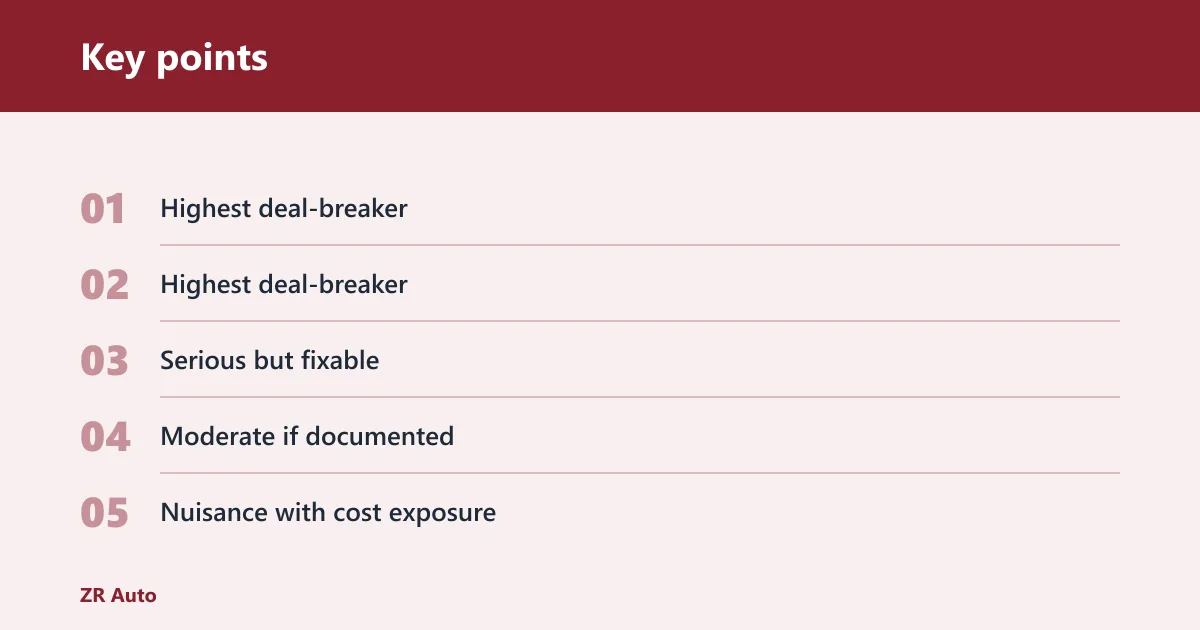
- Highest deal-breaker: 5.4L cam phaser or timing noise, major misfire, or broken-spark-plug service uncertainty. These can turn a cheap truck into an engine-out or major top-end decision.
- Highest deal-breaker: 10R80 harsh shifting, flare, neutral-feel hesitation, or gear hunting that repeats on a warm drive. Software may help some trucks, but a bad one is easy to overpay for.
- Serious but fixable: 2009-2014 fuse #27 crank-no-start issue. If the relocation kit is already in place and the truck restarts cleanly, the risk drops a lot.
- Moderate if documented: 2015-2016 throttle body faults. Sudden stalling or limp mode matters, but a fully replaced throttle body changes the verdict more than vague “it was cleaned once.”
- Nuisance with cost exposure: Sync hard resets and module faults. Annoying by themselves, expensive when a module is needed, but they are not in the same class as an engine or transmission failure.
- Use-case specific: Door-latch and steering binding issues. Safety matters, especially in winter or parking-lot use, but these are easier to screen than deep drivetrain faults.
How do common Ford F-150 problems change by generation?
F-150 trouble patterns shift by generation.
2004-2008: 11th-generation trouble spots and 5.4L exposure
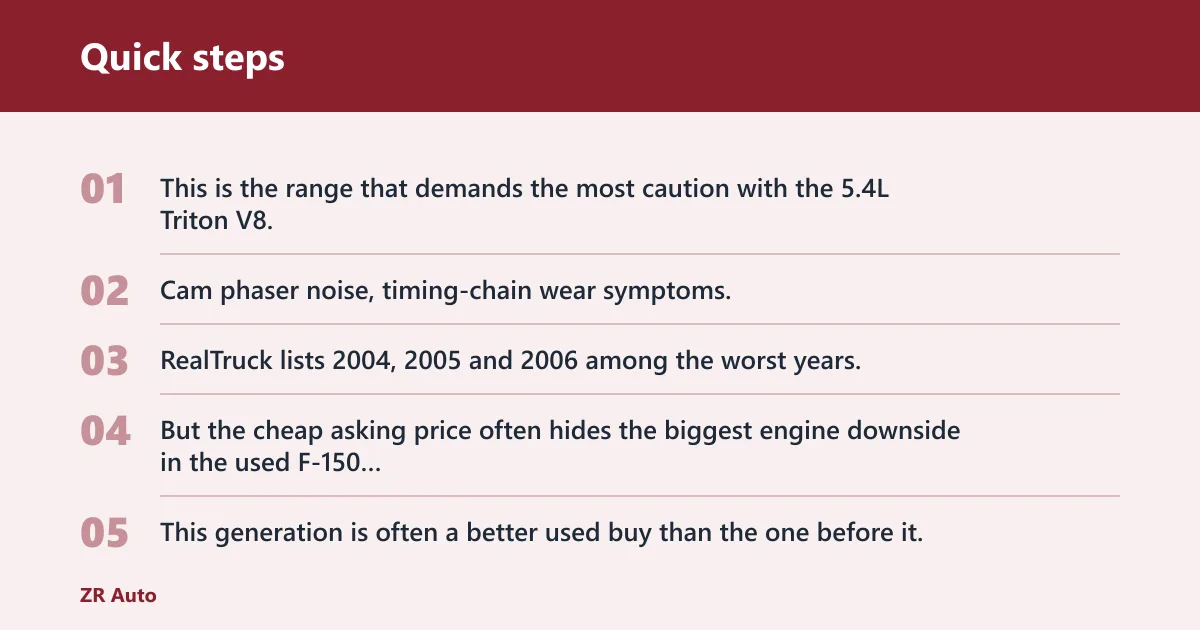
This is the range that demands the most caution with the 5.4L Triton V8. Cam phaser noise, timing-chain wear symptoms, and spark plug service risk can stack up on the same truck.
Are these trucks always bad? No. But the cheap asking price often hides the biggest engine downside in the used F-150 market.
2009-2014: 12th-generation starting issues and transmission context
This generation is often a better used buy than the one before it, especially if records are strong. That usually shows up as a crank-no-start complaint, and the repair path many shoppers want to see is the fuse relocation kit.
Transmission context matters here too. Many trucks from this era use the 6R80, a transmission that many shoppers prefer to screen over the later 10-speed because the behavior is easier to judge on a short drive.
2015-2020: aluminum-body era, throttle body faults, and 10-speed screening
The lighter aluminum-body trucks can be smart buys, but the first task is separating manageable faults from skip-now symptoms. On some 2015 and 2016 trucks, throttle body faults can cause stalling, reduced power, and erratic idle. Full replacement is the proof that changes the buying verdict, not a vague note about cleaning.
Starting in 2017, the 10R80 10-speed automatic enters the picture. Introduced in 2017, it brought newer-truck efficiency and performance, along with a stream of rough-shift and gear-hunting complaints that continued into later years, especially when update history is unclear.
2021-up: newer-truck caution points
Newer trucks are not immune to risk. On these trucks, open recalls, unresolved software updates, and repeat drivability complaints matter more than age alone.
For a newer F-150, incomplete campaign work is a bigger warning than cosmetic wear.
Which engines and transmissions carry the most risk?
Lower-risk choices are generally later V8 trucks with clean records and transmissions that shift consistently cold and hot, without flare, hunting, harsh engagement, or repeat adaptation resets.
5.4L Triton V8: cam phasers, spark plugs, and expensive downside
The 5.4L risk is not one single fault. It is the way several expensive problems can overlap. Cam phaser wear can bring a rattle or knocking sound at start-up or idle. Timing-chain wear can add poor running, fault lights, and weak acceleration. Spark plug removal is its own risk because damaged or stuck plugs can turn routine service into a much bigger job.
The same source says spark plug failure and engine damage affected 2008 to 2009 trucks, with the issue appearing at 80,774 to 140,000 miles. That is late enough to catch the second or third owner off guard.
Transmission eras compared
4R70W and 4R75W family: Older, simpler automatics that many shoppers understand well. Age and maintenance matter more than year prestige here.
5R55 family: More caution is warranted on age and shift quality. A clean drive matters more than any seller claim.
6R80 era: Often the sweet spot for shoppers who want a modern-feeling truck without stepping into the heaviest 10-speed uncertainty.
10R80 era: Introduced in 2017. Watch for rough shifting, gear hunting, delayed engagement, or failure patterns appearing unusually early, even before 60,000 miles.
Manageable drivability issue or buy-killing fault?
Suppose a 2019 truck gives one slightly firm 2-3 shift in the first mile on a 45-degree morning, then drives normally for 20 minutes with no flare, no hunting, and no warning lights. That is very different from a truck that bangs through several shifts warm, hesitates before moving, and has already been “reset” more than once.
The repeatability of the fault is the clue. A single odd shift may be calibration. A pattern is risk.
Are 2015 and 2016 F-150s bad buys?
They belong in the “screen carefully” group because throttle body faults can cause stalling or reduced power, and some trucks also show Sync issues or latch complaints. A documented throttle-body replacement changes the verdict a lot more than seller reassurance does.
Throttle body symptoms you can catch quickly
Focus on idle stability and throttle response in the first five minutes. A truck that stumbles, idles unevenly, flashes a wrench light, or suddenly drops into reduced-power behavior deserves caution. The problem matters because intermittent faults are easy for a seller to dismiss as “just a battery reset.”
What repair proof changes the verdict
The best evidence is an invoice showing the throttle body was replaced, followed by normal operation. Generic notes about cleaning, clearing codes, or “it has not done it lately” should not carry the same weight.
Also check whether Sync reboots, freezes, or loses functions. Hard-reset behavior may point to module trouble, which is a cost risk even if the truck drives well.
What else to check on early aluminum-body trucks
REREV says the 2015 to 2017 F-150 had door-handle latch problems. In cold climates, that is more than an annoyance. Check latch return, warning messages, and whether the seller has records for latch repairs or campaign work.
Which symptoms should make you walk away fast?
Sync glitches alone may be manageable; drivetrain symptoms usually are not.
Crank-no-start and fuel-pump fuse clues
On 2009-2014 trucks, a crank-no-start complaint is never something to shrug off. The same source says these trucks were known for a burnt fuse #27 starting issue. Ask directly whether the fuse relocation kit was installed. If nobody knows, treat the truck as unrepaired until proven otherwise.
Harsh shifts, flare, or gear hunting on 10-speed trucks
On a short drive, use light throttle, then moderate throttle, then hold a steady speed. If the truck cannot decide on a gear, hesitates before engaging, or upshifts with a slam after warming up, that is a hard warning. Shoppers on a budget should be especially strict here.
Cold-start rattle, phaser noise, and misfire signs on 5.4L trucks
Picture a 2006 truck that starts after sitting overnight and rattles sharply for a few seconds, then settles into a shaky idle with a faint tick. Even if it drives around the block, that combination is enough to stop the deal until a specialist inspection says otherwise.
Sync failures and electrical faults
Infotainment faults are lower on the danger scale, but they still matter. If Sync repeatedly hard-resets, drops controls, or throws module-related behavior, budget for more than a simple reboot. The truck may still be buyable, but only if the driveline is clean and the price reflects the annoyance and module cost exposure.
What should you check before buying a used F-150?
Before buying a used F-150, check cold-start noise, idle quality, shift behavior, warning lights, no-start history, recall completion, and repair invoices for the exact known issue tied to that year. Then match the truck’s use history to its weak points, especially towing, short-trip driving, and winter exposure.
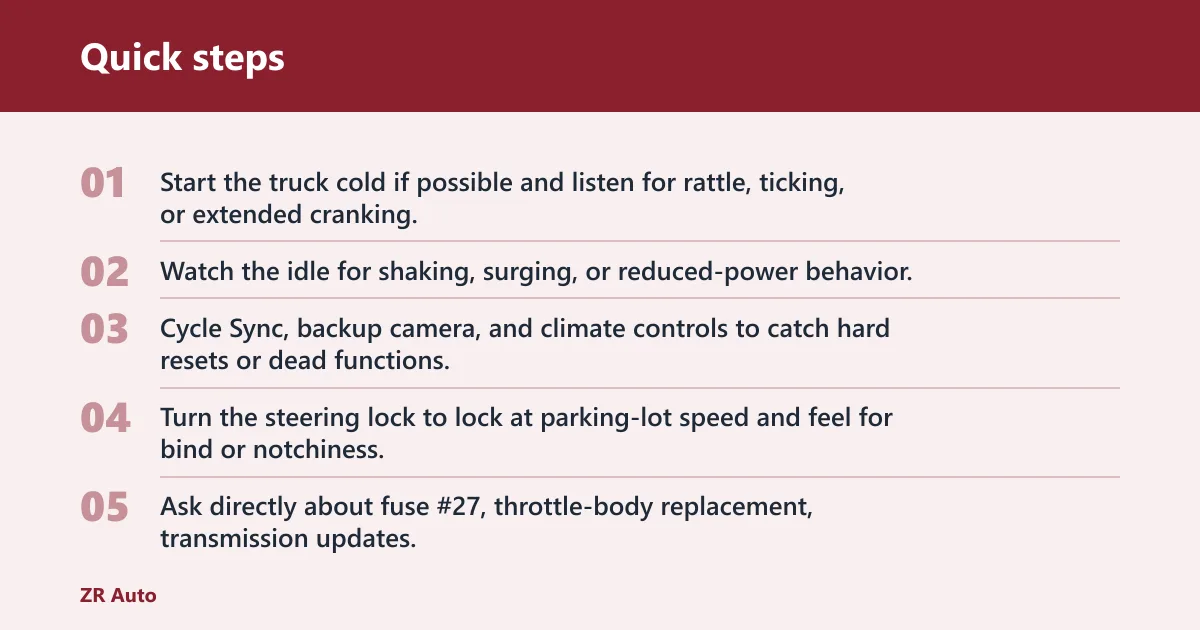
Driveway checks in the first five minutes
- Start the truck cold if possible and listen for rattle, ticking, or extended cranking.
- Watch the idle for shaking, surging, or reduced-power behavior.
- Cycle Sync, backup camera, and climate controls to catch hard resets or dead functions.
- Turn the steering lock to lock at parking-lot speed and feel for bind or notchiness.
- Ask directly about fuse #27, throttle-body replacement, transmission updates, and timing work.
Short test-drive checks that expose faults
Run the truck at city speed and highway speed. Try gentle acceleration, then a firmer pull. The red flags are flare between gears, hunting at steady throttle, shudder, delayed reverse engagement, or a sudden drop into limp mode.
For engine screening, look for hesitation under load, rough hot restart, or a check-engine light that appears only after the truck warms up.
Records, recalls, software updates, and repair invoices
Use recall and complaint data as a screening tool, not a verdict by itself. A year with heavy severe complaints deserves more skepticism. A truck from that year with complete campaign work, repeat dealer paperwork, and invoices for the exact known issue deserves a closer look.
For 2017-up trucks, transmission software history matters. For 2015-2016 trucks, throttle-body paperwork matters. For 5.4L trucks, timing and spark-plug service history matters most.
How use case changes risk
Short-trip use can be harder on a truck with marginal idle or throttle-body behavior because the engine may spend much of its life cold. Heavy towing raises the bar for transmission screening because heat and load expose shift problems faster. Cold-climate use makes latch issues, starting faults, and steering corrosion more important than they would be in a mild climate.
Frequently asked questions
Are 2004 to 2006 Ford F-150s reliable?
They can be serviceable, but they are not the easiest used-buy choice. The main concern is the 5.4L Triton, where cam phaser noise, timing trouble, and spark plug service risk can overlap. If a truck shows cold-start rattle or weak records, the safe answer is usually to keep shopping.
Is a 2015 or 2016 Ford F-150 a bad buy?
No, but it is a year pair that needs direct screening. Throttle-body faults can cause stalling or reduced-power operation, so documented replacement matters. Also check Sync behavior and door-latch operation. A clean-driving truck with invoices is very different from one with vague “it was fixed” claims.
Which Ford F-150 years have the worst transmission problems?
Older trucks can still have age-related wear, but the 10-speed era has the clearest pattern where a short drive can expose a high-dollar risk.
What should I check before buying a used Ford F-150?
Check cold-start noise, idle quality, shift behavior, warning lights, restart behavior, recall completion, and invoices for known fixes. On 2015-2016 trucks, ask about throttle-body replacement. On 2017-up trucks, look for transmission update history and a clean warm-drive shift pattern.