Dodge Durango Used Buyer’s Guide: Best Years, Engines
For most used buyers, the sweet spot is a 2014–2020 Dodge Durango with the 3.6L V6 or 5.7L Hemi, depending on towing needs; avoid early first-gen trucks and verify the timing-chain and AWD service history. Pick the wrong year or engine, and you can be stuck with costly suspension, transmission, or cooling repairs. This guide matches Durango model years, trims, engines, towing, safety tech, inspection points, and ownership costs to the way you plan to use it.
What a used Durango
The Durango is a three-row SUV with rear- or all-wheel drive on non-SRT models, and that layout is its main selling point. It is also older than many rivals in this class, which matters because the platform dates back to the 2011 model year and was last given a major update in 2021.
That age cuts both ways. You get a packaging and powertrain setup that many shoppers still like for towing, but you also get a cabin, safety reputation, and fuel economy profile that trail newer rivals such as the Explorer, Pilot, Telluride, and Wagoneer.
Why it fits the three-row market
The Durango sits closer to a towing-first, truck-leaning family SUV than a polished minivan alternative. It can work as a daily driver, but its strongest case is for buyers who want a three-row SUV that can pull more than most mainstream crossovers, especially with V-8 power.
That makes it a different buy from a Pilot or Telluride, which usually prioritize efficiency and cabin packaging. It also sits below a Wagoneer in size and luxury, while the Explorer competes more directly on mixed family use rather than brute towing focus.
Why the platform age matters
Age matters here because used shoppers are not buying a clean-sheet 2020s design. They are buying a long-running architecture with incremental changes, so condition and service history matter more than shiny trim names. The newest body update helps, but it does not erase the model’s dated reputation for safety and efficiency.
That is why year group, engine, and equipment level should drive the decision. A well-kept Durango can make sense. A neglected one can become expensive fast.
📊 The current-generation Durango debuted for the 2011 model year. Source: Motortrend.
Durango model years and risk
The safest used Durango buys are later examples with clear service records, especially 2014 and newer trucks that have already absorbed their early-life depreciation. The 2021 update-era models bring the most polish, but they still carry the same basic Durango tradeoffs: heavy fuel use with V-8s, older underpinnings, and a feature set that depends heavily on trim.
For older trucks, the deal only works if the price reflects age, mileage, and maintenance. That is especially true for suspension wear, cooling-system work, electronics, and four-wheel-drive service history.
2011 to 2020: early generation buying cautions
These years belong to the long-running current generation before the 2021 update. They can be good value, but you need to be careful about age-related wear, missing safety features on lower trims, and deferred maintenance on high-mileage examples. V-8 models are usually more desirable than base commuter-spec trucks, which can help resale but also raise running costs.
A common first-timer mistake is treating a low sticker price as the whole story. On a 100,000-mile Durango, worn tires, brake work, and neglected fluids can erase the apparent savings quickly.
2021 and newer: update-era gains and limits
The 2021 refresh improved the Durango’s appeal, and it is the best place to shop if your budget allows. You still get the same basic towing-first format, but later examples usually bring newer infotainment, more available driver-assistance content, and the most current safety and trim mix in the lineup.
Even so, the 2025 Durango still carries a four-star overall NHTSA rating, and the last-year model earned a Marginal small front overlap rating from IIHS. That is not a reason to skip every updated Durango, but it is a reason to buy on condition, features, and price rather than assuming the newest shape fixes every concern.
High-mileage issues to watch by year group
On older and higher-mileage Durangos, focus on timing-chain noise, transmission behavior, cooling-system leaks, worn front-end parts, and AWD service records. Electronics can also matter because the feature list varies widely by trim, and repairs on convenience systems can get pricey after warranty.
Listen for clunks over broken pavement, watch for delayed shifts, and verify that all dash warning lights clear normally. If the truck has a tow package or heavier-duty use history, check for brake wear, uneven tire wear, and rear suspension sag.
Durango engine and trim guide
The Durango’s engine lineup is straightforward, and that helps used shoppers. The eight-speed automatic is the common transmission across the range, so your decision usually comes down to whether you want lower running costs, better towing, or straight-line speed.
For buyers comparing trims, the rule is simple: V-6 models suit commuting and family duty, while V-8 models earn their keep when towing or performance matters. The Hellcat is an enthusiast special, not a practical default.
3.6-liter V-6: best for lower running costs
The base 3.6-liter V-6 is rated at 295 hp and 260 lb-ft. It returns about 19/26 mpg in RWD form and about 18/25 mpg in AWD form, and the AWD version is claimed to reach 60 mph in about 7.8 seconds. For shoppers who want the lowest fuel bill in the lineup, this is the starting point.
It is the right fit if you want a Durango for school runs, commuting, and occasional light towing. It is also the best choice if you like the Durango format but do not need V-8 torque every day.
5.7-liter V-8: best balance for towing
The 5.7-liter V-8 makes about 360 hp and 390 lb-ft, with an estimated 14/22 mpg rating and a claimed 6.4-second AWD 0-60 mph time. This is the engine that most clearly matches the Durango’s towing-first character without jumping all the way into performance-trim pricing or fuel use.
If you plan to tow regularly, this is the most balanced used-buying answer. It gives you more reserve torque, stronger passing power, and better fit for trailers than the V-6, while still avoiding the extreme fuel and tire costs of the top engines.
6.4-liter and Hellcat: performance-first choices
The 6.4-liter V-8 produces 475 hp and 470 lb-ft, returns 13/19 mpg, and is quoted at 4.6 seconds to 60 mph. The supercharged 6.2-liter V-8 in the SRT Hellcat makes about 710 hp and 645 lb-ft, returns around 12/17 mpg, and can reach 60 mph in about 3.4 seconds.
These are not sensible picks for buyers trying to minimize ownership cost. They make sense only if you want the fastest Durango and are willing to accept higher fuel use, insurance pressure, and tire and brake spending. The Hellcat is especially niche because it is a power-first specialty model.
Durango buying matrix
This matrix turns the Durango into a use-case decision instead of a trim-name exercise. The best pick changes based on towing, fuel use, safety features, and the age band you are willing to buy. That is the only way to compare these trucks fairly.
| Model-year group | Engine and drive layout | Towing priority | Fuel economy tradeoff | Safety-tech availability | Buyer fit |
|---|---|---|---|---|---|
| 2011–2013 | 3.6L V-6 or 5.7L V-8; RWD or AWD | Good with V-8, basic with V-6 | High fuel use for the size; V-8s are costly at the pump | Limited by trim; less common driver-assistance content | Budget buyer only, if service history is strong |
| 2014–2020 | 3.6L V-6 or 5.7L V-8; RWD or AWD | Strong with 5.7L; acceptable with 3.6L for light duty | V-6 is the sensible choice for daily use | Blind-spot monitoring available; other aids depend on trim | Best all-around used range for most shoppers |
| 2021–2025 | 3.6L V-6, 5.7L V-8, 6.4L V-8, or 6.2L supercharged V-8; RWD or AWD on non-SRT models | Best tow setup is a V-8 model; strongest with 5.7L or above | Update-era pricing is higher, and V-8 fuel bills remain steep | Blind-spot monitoring included; AEB, lane departure warning, adaptive cruise control, and parking sensors are optional | Buyer who wants the newest body style and can pay more |
Which Durango should you buy?
The right Durango depends on use, not badge count. For a commuter, the V-6 in a later, well-kept truck makes the most sense. For towing, the 5.7-liter V-8 is the cleanest answer. For performance, the 6.4-liter and Hellcat trims are the only honest fit.
If you want value, shop the 2014–2020 range first. That window usually gives you the best mix of price, powertrain choice, and feature availability without paying the premium attached to the newest update-era trucks.
Best choice for daily commuting
A 3.6-liter V-6 Durango with the equipment you actually need is the best daily-driver buy. It offers the lowest fuel use in the lineup, and the RWD version is rated at 19/26 mpg, which helps if you drive more miles than you tow.
Choose this path if your towing is rare and your priority is keeping monthly costs in check. You still get the Durango’s three-row layout and available AWD without paying V-8 fuel penalties every week.
Best choice for towing
The 5.7-liter V-8 is the best towing engine for most used shoppers because it gives the Durango its strongest blend of torque, capability, and price. V-8 Durangos are where this SUV’s towing-first mission makes the most sense, especially when paired with the right axle and tow package.
That is also where the Durango separates itself from many rivals. A Pilot or Telluride may be easier to live with every day, but the Durango’s V-8 setup is the more convincing answer when trailers are part of the job.
Best choice for performance buyers
If acceleration matters more than operating cost, skip the V-6 and go straight to the 6.4-liter or Hellcat trims. The 6.4-liter’s 4.6-second 0-60 mph claim already puts it well beyond normal family SUV territory, and the Hellcat’s 3.4-second number is in another category entirely.
These trucks are for buyers who understand that insurance, tires, and brakes will rise with output. They are also easy to overbuy, so condition and maintenance records matter even more here.
Best choice for value shoppers
That range tends to offer the least painful depreciation while still keeping the useful parts of the Durango formula intact.
A low-mileage example with maintenance records is worth more than a cheap, neglected truck with shiny photos. On this model, deferred service can outrun the purchase savings fast.
What does a used Durango cost to own?
Ownership cost depends heavily on engine choice, trim, mileage, and whether you buy AWD. Fuel is only one piece. Tires, brakes, and insurance can add a lot, especially on V-8 and performance trims, so a cheap purchase price can still mean a costly year.
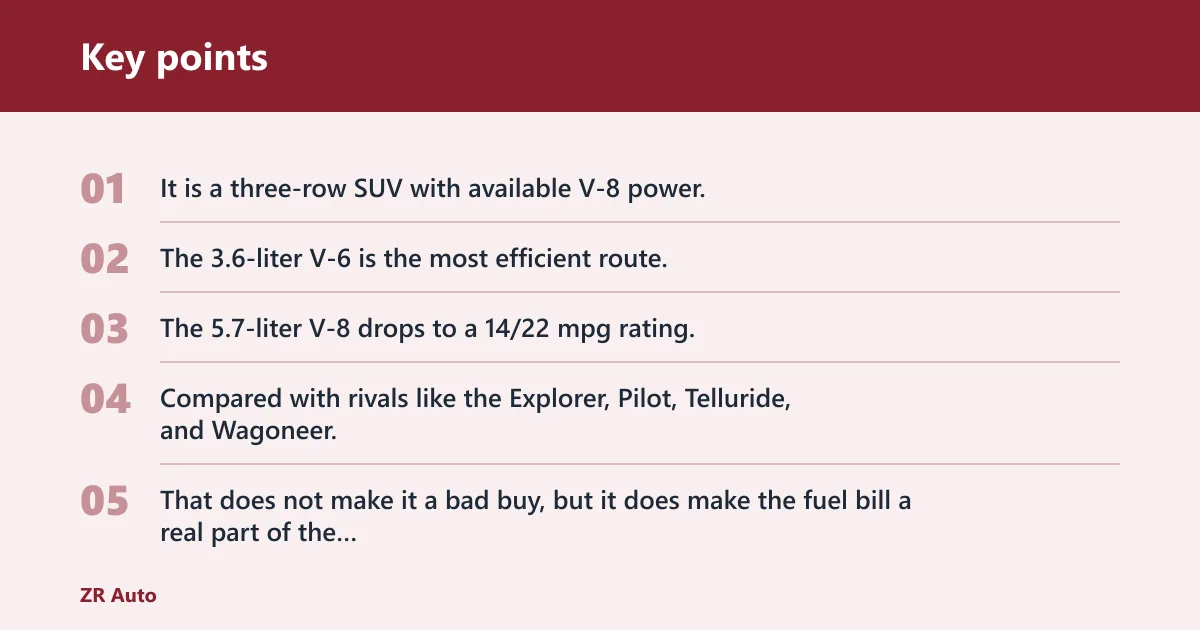
The Durango is not a low-cost crossover. It is a three-row SUV with available V-8 power, and the running costs usually match that mission.
Fuel use by engine
The 3.6-liter V-6 is the most efficient route, but even it is not class-leading by modern three-row standards. The 5.7-liter V-8 drops to a 14/22 mpg rating, while the 6.4-liter and Hellcat move further toward performance use than commuting economy.
Compared with rivals like the Explorer, Pilot, Telluride, and Wagoneer, the Durango’s fuel economy usually lands on the wrong side of the comparison. That does not make it a bad buy, but it does make the fuel bill a real part of the decision.
Tires, brakes, and insurance
Expect tires and brakes to cost more on V-8 Durangos than on V-6 versions because the heavier powertrains and stronger braking demands tend to shorten wear intervals. Insurance often follows the same pattern, especially on high-output trims and Hellcat variants.
Say your daily commute is 18 miles each way, with one winter road trip and no trailer use. A V-6 Durango can keep fuel spend lower, while a V-8 version may cost more every month even before maintenance enters the picture.
How trim choice changes yearly cost
Lower trims usually keep insurance and tire costs closer to the middle of the pack, while performance trims push both up. A tow-focused V-8 with modest equipment can make more financial sense than a high-output special edition if you need capability more than bragging rights.
If you want a rough rule, the more the Durango looks like a performance SUV, the more it behaves like one in your budget.
What to inspect before you buy
A used Durango should get a close mechanical check, not just a walk-around. Scan-tool checks, tire wear, brake condition, cooling-system condition, and proof of regular maintenance matter because the truck’s age and output can hide expensive problems behind a clean appearance.
Do not skip the paperwork. Service records, recall completion, and evidence of AWD or transmission care are especially useful on older examples and on trucks that have towed regularly.
Test-drive clues
Listen for front-end clunks, feel for transmission hesitation, and note any vibration under throttle or braking. A soft brake pedal, steering wander, or uneven tire wear can point to neglected suspension or alignment work.
During the drive, verify that the eight-speed automatic shifts cleanly in city traffic and at highway speeds. If the truck feels busy, delayed, or harsh, budget for diagnosis before you assume it is normal.
Scan-tool and warning-light checks
Use a scan tool to check for stored and pending codes, even if the dash is clear. That matters because intermittent electronic faults can show up long before a warning lamp stays on, especially on higher-mileage trucks with more available driver-assistance equipment.
Confirm the function of blind-spot monitoring, backup sensors if equipped, and any optional lane departure warning, adaptive cruise control, or automatic emergency braking features. If those systems are part of the sale price, they should work now.
Paperwork, recalls, and service records
Ask for service records that show oil changes, coolant service, brake work, and any AWD maintenance. If the seller cannot produce records, treat the price as if you will need to do some of that work immediately.
Also verify recall completion and check whether the truck has had major work on the transmission, cooling system, or front suspension. Those items are expensive enough to change the whole deal.
Checklist for the lot
- Check tire age, tread depth, and even wear across all four corners.
- Look for fluid leaks under the engine, transmission, and rear axle.
- Start cold and listen for timing-chain rattle, exhaust leaks, or rough idle.
- Confirm clean shifts from the eight-speed automatic in normal and hard acceleration.
- Test brakes for pulsing, noise, and straight-line stopping.
- Scan for warning lights and stored codes.
- Verify every key driver-assistance feature that the trim should have.
- Review service records for oil, cooling, brake, and AWD work.
Frequently asked questions
Is the Dodge Durango a good vehicle to buy used?
Yes, if you want a three-row SUV with real towing ability and you shop carefully. The best buys are later, well-maintained examples, ideally with the 3.6-liter V-6 for lower running costs or the 5.7-liter V-8 for towing. Avoid buying on price alone, because neglected trucks can get expensive fast.
What year Dodge Durango is the best to buy used?
Those years give you the best mix of powertrain choice, equipment, and depreciation without pushing you into the oldest examples or the most expensive specialty trims.
Do Dodge Durangos hold their value?
They tend to hold value better in V-8 and towing-focused trims than in plain commuter setups. Demand is stronger for models that match the Durango’s towing mission, while base commuter-spec trucks usually depreciate harder. Condition, mileage, and service history still matter more than trim name alone.
Does Dodge still make the Durango?
Yes. The 2025 Durango is still listed as a three-row SUV, with a starting price range of $40,990 to $56,265. That does not make it the newest design in the class, but it does mean Dodge still sells the model today.
What Dodge Durango engine is best to buy used?
The 3.6-liter V-6 is best if you want the lowest operating cost, while the 5.7-liter V-8 is the best all-around pick for towing. The 6.4-liter and supercharged 6.2-liter are for performance buyers only. Most used shoppers should choose between the V-6 and the 5.7-liter V-8.
What is the best Dodge Durango for towing?
A Durango with the 5.7-liter V-8 is the best towing buy for most shoppers because it gives the strongest balance of capability and cost. If towing is frequent and heavy, V-8 models make more sense than the V-6, and they fit the Durango’s truck-like mission better than the lower-output versions.