Lincoln MKX Buyer’s Guide: What to Know
For most used shoppers, the safest Lincoln MKX picks are 2013–2015 models with the 3.7L V6, documented maintenance, and under about 100,000 miles. Skip the wrong year or a neglected example, and you may face costly transmission, cooling, and electronics repairs. This guide breaks down the best MKX years, engines, trims, mileage bands, recalls, and the examples worth avoiding.
What is the Lincoln MKX?
The Lincoln MKX is a mid-size luxury SUV produced from 2007 to 2018, then renamed Lincoln Nautilus for 2019. It was built for comfort over sporty handling, with a quiet cabin and a softer ride than many rivals. For used shoppers, the real question is not what it is, but which year and powertrain are worth the risk.
MKX vs. MKS: the quick difference
The MKX was the SUV, while the MKS was Lincoln’s sedan. That sounds obvious, but shoppers cross-shop them because both sit in the same used-luxury price range and can show similar wear patterns: electronics faults, suspension age, and costly repair history. The SUV also gives you a clearer split between first- and second-generation buying advice.
Does Lincoln still make the MKX?
No. Lincoln ended the MKX name after the 2018 model year, and the 2019 model became the Lincoln Nautilus. If you are shopping used, you are looking at 2007–2018 MKX models only. That matters because the name change also marks the shift in body style, features, and the engine lineup.
MKX years and generations
The MKX has two generations: 2007–2015 and 2016–2018. The first generation shared a platform with the Ford Edge and used V6 powertrains, while the second generation brought a major redesign, turbocharged engines, and advanced safety features. That split should shape how you judge mileage, price, and risk.
First generation: 2007–2015
The first-generation MKX is the older, simpler choice. It is still a luxury SUV, but it lacks the newer safety tech and turbo power of the later redesign. For used shoppers, the better examples are usually the later years in the run, especially when service records show regular maintenance and no major electrical or airbag history.
Second generation: 2016–2018
The second-generation MKX brings the cleaner redesign and more modern features, along with turbocharged engines and advanced safety features. These years often appeal to shoppers who want newer tech and fresher styling. The tradeoff is that repair exposure can shift toward turbo-related concerns, sensor issues, and more expensive parts.
2019 rename to Nautilus
Lincoln renamed the MKX as the Nautilus for 2019. That does not make the MKX disappear from the market, but it does help explain why some shoppers see separate listings for similar Lincoln crossovers across model years. If you want an MKX badge, stop at 2018.
MKX buyer score table
The Buyer Score below is a practical composite, weighted more toward reliability than value. Mileage, engine choice, recall status, and complaint patterns all matter. A clean record can move a car from “negotiate” to “buy,” while known issue clusters or incomplete recalls should push it into “avoid.”
| Model year | Typical mileage band | Engine fit | Recall status to verify | Likely repair-risk cluster | Buyer Score | Verdict |
|---|---|---|---|---|---|---|
| 2007 | 130,000+ miles | 3.7L V6 | Check all open recalls; airbag work is especially important | Airbags, electronics, age-related suspension wear | 3/10 | Avoid |
| 2008–2010 | 110,000–150,000 miles | 3.7L V6 | Verify completion before purchase | Electronics, brakes, cooling, interior wear | 4/10 | Negotiate only |
| 2011–2012 | 90,000–140,000 miles | 3.7L V6 | Check VIN for campaign completion | Powertrain wear, infotainment faults, brake service | 5/10 | Negotiate |
| 2013–2015 | 70,000–110,000 miles | 3.7L V6 | Look for completed recalls and documentation | Normal age wear, electronics, suspension bushings | 8/10 | Buy |
| 2016 | 60,000–100,000 miles | 2.7L V6 EcoBoost | Confirm all safety campaigns are closed | Turbo-system concerns, sensors, software updates | 6/10 | Negotiate |
| 2017–2018 | 40,000–90,000 miles | 2.7L V6 EcoBoost | Verify recall completion before signing | Turbo-related repairs, infotainment, advanced safety systems | 7/10 | Buy if clean |
Which MKX years are best to buy?
The strongest used MKX choices are often 2013–2015, with 2017–2018 also worth attention if the price is reasonable and the service history looks clean. The earlier years can still work, but they more often carry age and complaint baggage. A low-mileage example is not enough on its own; condition matters more.
Best year groups by risk tolerance
If you want newer tech and are willing to inspect more carefully, look at 2017–2018. If your budget is tight, older MKX models can still make sense, but only with a lower price and a stronger inspection result.
Years to target if you want lower repair risk
Target 2013, 2014, or 2015 when the maintenance file is complete and the mileage is reasonable for the asking price. These years tend to sit in the sweet spot between age, equipment, and expected repair exposure. They also fit shoppers who want a comfortable luxury SUV without paying a premium for the newest badge.
Years to skip unless price is low
Skip 2007 first. It also shows airbags as the top issue for that model year. Early examples can still be tempting because of low sticker prices, but the savings disappear quickly if you face unresolved recalls or repeated repair visits.
What engines should you choose?
The 3.7L V6 is the safer baseline choice, while the 2.7L V6 EcoBoost typically offers stronger performance with more complexity. One page lists the 3.7L V6 as a used MKX engine option, and another lists the 2.7L V6 EcoBoost. Your best choice depends on whether you value simpler ownership or extra power.
3.7L V6: base choice and tradeoffs
The 3.7L V6 is the naturally aspirated baseline powertrain for many used MKX shoppers. It is the easier fit if you want predictable maintenance and fewer turbo-specific parts. The tradeoff is straightforward: less punch than the EcoBoost, but usually a cleaner path for long-term ownership and lower repair anxiety.
2.7L V6 EcoBoost: power and risk tradeoffs
The 2.7L V6 EcoBoost is the stronger performance-focused option. It suits shoppers who want quicker response and do not mind a more complex engine bay. Turbocharged systems can add repair cost if maintenance is thin, so this engine makes the most sense when service records are complete and the price reflects the added risk.
Which engine fits which buyer?
If you want the simplest used MKX purchase, choose the 3.7L V6. If you want newer-model performance and are comfortable checking maintenance closely, the 2.7L V6 EcoBoost can work. A common first-timer mistake is choosing the newer engine on mileage alone, then ignoring whether the service history supports it.
Common MKX problems to inspect
Used MKX complaints cluster around electronics, brakes, engine-related repairs, powertrain concerns, and airbags. NHTSA complaint data helps identify problem patterns, but it does not replace an inspection. The useful approach is to match the symptom to the likely cluster before you buy, then decide whether the issue is a walk-away item or a negotiation point.
Electronics and infotainment faults
First- and second-generation MKX models can show infotainment glitches, dead screens, or warning lights that return after resets. On a road test, check that the display boots normally, the audio system works on every source, and the climate controls respond. Repeated electrical faults are usually a negotiation point only if they are isolated and documented.
Brake and suspension wear
Brake noise, steering wander, and clunks over small bumps usually point to normal wear, but the repair bill can still be meaningful on a luxury SUV. These issues are more acceptable on a higher-mileage MKX than a major drivetrain fault. If the seller cannot explain recent brake work, assume the next owner may have to pay soon.
Engine, transmission, and cooling issues
Engine, transmission, and cooling complaints are the ones that most often change a deal from “buy” to “avoid.” Look for rough idle, delayed shifts, temperature warnings, coolant loss, or any sign of prior overheating. Say your test drive includes a warm idle at a stoplight and the temperature gauge stays steady, but a coolant odor appears after parking; that is a stronger warning than a simple worn tire.
Airbag and safety-system warnings
Airbag and safety-system problems deserve special attention because they can turn into both a safety and recall issue. Any airbag warning light should lower the offer or end the deal.
How much should you pay?
Price should follow year, mileage, engine, and recall status. A cleaner 2013–2015 MKX can justify a meaningful premium over an older, higher-mileage example, especially if the records are strong. A second-generation model may also be worth more, but only if its turbo engine and safety systems are working normally.
Price bands by year and mileage
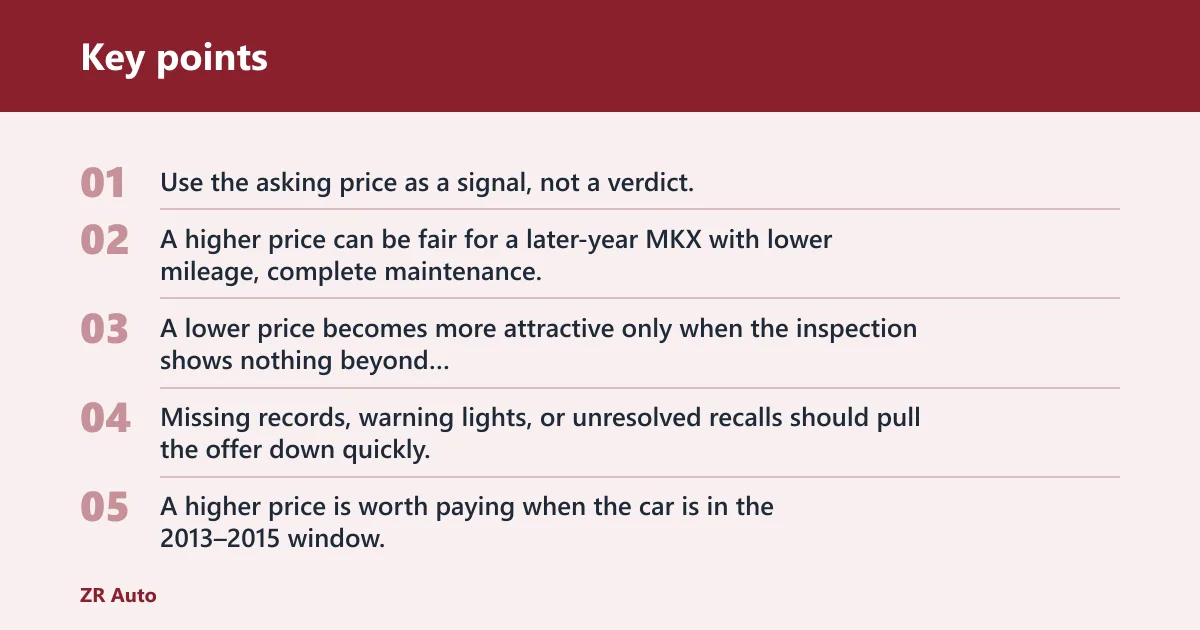
Use the asking price as a signal, not a verdict. A higher price can be fair for a later-year MKX with lower mileage, complete maintenance, and closed recalls. A lower price becomes more attractive only when the inspection shows nothing beyond normal wear. Missing records, warning lights, or unresolved recalls should pull the offer down quickly.
When a higher price is worth it
The same logic applies to a clean 2017–2018 example with verified recall completion. You are paying for reduced surprise risk, not for mileage alone.
What should trigger a lower offer?
Lower the offer if the MKX has incomplete service history, mismatched tires, a fresh coolant smell, dashboard warnings, or recall work that is still open. Picture a 2014 MKX with 112,000 miles and no proof of transmission service; that should not be priced like a clean, documented example with the same mileage. Use the deficiency list to shape your offer, not a guessing game.
Buying checklist
Before you commit, treat the MKX like a condition-sensitive luxury SUV. A pre-purchase inspection and recall check are not optional. The best examples are usually the ones with paper trails, not the ones that merely look clean on the lot.
- Confirm the exact model year and generation.
- Check whether all recalls are completed.
- Review service records for oil changes, coolant work, and transmission service.
- Scan for warning lights, especially airbag, engine, and stability-system alerts.
- Test electronics, infotainment, climate control, and seat functions.
- Inspect tires, brakes, and suspension noise on a bumpy road.
- Have a qualified technician perform a pre-purchase inspection.
That sequence matters because the MKX can look appealing while hiding expensive faults. A complete inspection is especially useful on second-generation turbo models and on early first-generation vehicles with older safety and electronics hardware. If the seller resists a pre-purchase inspection, that is useful information too.
Frequently asked questions
What does MKX mean on a Lincoln?
On a Lincoln, MKX is the model name used for the brand’s mid-size luxury crossover from 2007 through 2018. For shoppers, the badge mainly matters because it separates the older SUV from the later Nautilus. The name itself does not change the buying logic: year, engine, and condition still drive the decision.
Is the Lincoln MKX reliable?
The MKX can be a reasonable used luxury SUV, but reliability varies by year and example. Later first-generation models and clean second-generation trucks are the safer bets. Complaint and recall checks matter because the worst problems are usually clustered by year, system, and maintenance history rather than spread evenly.
How much does a Lincoln MKX cost?
Price depends on year, mileage, engine, and condition. Later years with lower mileage and clean records usually justify a premium, while older or neglected examples should be discounted. The smartest price comparison is not against another badge; it is against the cost of fixing the specific faults you find.
Which Lincoln MKX years are best to buy used?
For many shoppers, 2013–2015 are among the safer used MKX years because they tend to balance age, price, and repair risk better than earlier models. Clean 2017–2018 examples also deserve a look if the maintenance file is strong.
What are the common problems on a used Lincoln MKX?
Common problem areas include electronics, brakes, engine-related repairs, powertrain concerns, and airbags. The exact risk depends on year and engine.
Which Lincoln MKX engine is best to buy used?
The 3.7L V6 is the safer baseline choice for most shoppers because it is naturally aspirated and usually easier to live with. The 2.7L V6 EcoBoost is better if you want stronger performance and are comfortable with a more complex turbo setup. The right answer depends on your risk tolerance, not just horsepower.
Lincoln mks vs mkx
The MKS was Lincoln’s sedan, while the MKX was the SUV. If you want a higher seating position, cargo utility, and a softer ride, the MKX is the more relevant comparison. If you are choosing between them on the used market, compare condition and repair history first; the body style comes second.