Why Does My Dodge Charger Battery Keep Dying Overnight?
A Dodge Charger that dies overnight may have a weak battery, a charging issue, or a parasitic draw that exceeds about 50 milliamps when parked. Leave it alone and you risk repeated no-starts, a stranded car, and wasted parts. This guide walks you from quick checks to battery, alternator, and parked-current testing so you can isolate the cause fast.
This guide is part of our Dodge Charger used guide: best years, problems, costs series.
What you’ll need
- Digital multimeter
- Battery load tester or carbon pile tester
- Battery terminal brush or wire brush
- Basic hand tools for fuse access
- Battery maintainer sized for the Charger’s battery
Overnight drain triage table
| Symptom pattern | Likely cause | Quick check | Next diagnostic step |
|---|---|---|---|
| Battery dies after sitting, but starts fine after a jump | Parasitic draw or battery not holding charge | Check for interior, trunk, and glovebox lights staying on | Measure parked draw and isolate fuses |
| Slow cranking, clicking, dim lights, repeated jump-starts | Weak battery or poor connection | Inspect terminals for looseness and corrosion | Load-test the battery |
| Battery warning light or dim headlights while driving | Charging-system fault | Measure charging voltage with engine running | Test alternator and drive belt condition |
| Battery drains after short trips | Alternator not replacing used energy | Compare daily drive length to recharge time | Confirm charging output and reduce short-hop use |
| Only happens in cold weather | Reduced battery capacity | Note whether the problem worsens below freezing | Test battery under load in cold conditions |
Why does my Charger battery die overnight?

The quickest way to separate the cause is to ask what changed between parking and the next morning. If the battery is old, it may no longer hold enough charge; if charging voltage is low, the alternator may not be replenishing it; if the car sits overnight and the battery is dead, a parked-current draw is likely.
A 12-volt lead-acid car battery typically lasts about 3-4 years before weakening enough to cause repeated failures. A fully charged battery is described as about 12.8 volts at rest, but voltage alone does not prove the battery is healthy under load. Sulfation can also make an aging battery fail even when it still reads near full voltage. (Wikihow)
Common warning signs are slow cranking, clicking, dim lights, electrical glitches, and repeated jump-starts. A healthy battery should start the vehicle repeatedly before it begins to fail. If those signs show up after an overnight park, do the battery test before you buy parts.
Start with the battery
- Check the battery date code and case for swelling, leaks, or cracked posts.
- Measure resting voltage after the Charger has sat off for several hours.
- Load-test the battery instead of trusting voltage alone.
Picture a Charger that cranks slowly after one cold night but starts fine after a jump. If the battery is four years old and fails a load test, replacement comes before deeper electrical diagnosis. If it passes, keep moving; the issue is likely elsewhere.
Could the terminals be the problem?
Yes. Loose or corroded battery terminals can make the car act like the battery is dead, even when the battery itself is usable. A bad connection can block current flow, create slow cranking, and mimic a deeper electrical fault. This is one of the cheapest checks to do first.
Inspect cable tightness and corrosion
- Turn the ignition off and remove the key fob from the vehicle.
- Check both battery terminals for movement, white or green corrosion, and damaged clamps.
- Clean the posts and clamps, then tighten them firmly before retesting.
Say your Charger starts after a jump, but the positive terminal can be twisted by hand. Tightening that connection may solve the symptom without replacing a battery. If corrosion returns quickly, inspect the cable end for hidden damage.
If that didn’t work, test the battery again after cleaning. A bad connection can leave a battery undercharged and make the next reading misleading.
Is the alternator charging it?
The alternator turns engine motion into electrical power and keeps the battery charged while the engine runs. If the battery keeps dying after normal driving, or the battery warning light and dim headlights show up while driving, suspect a charging-system problem. Repeated overnight failures after a full drive point away from storage alone and toward recharge failure.
Check charging voltage with the engine running
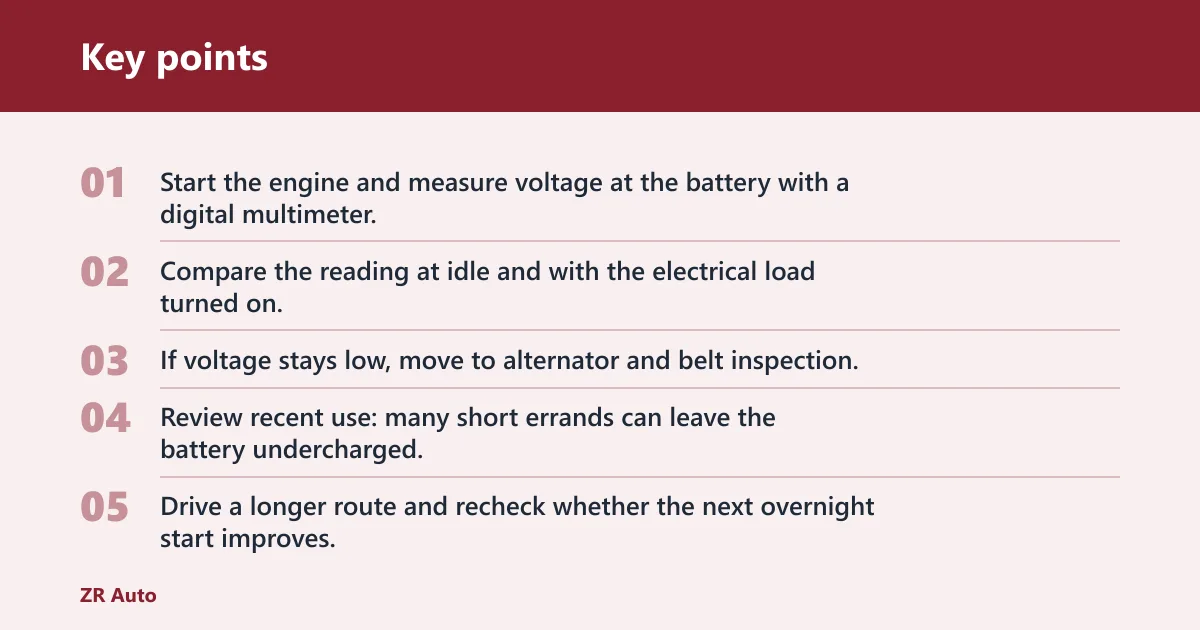
- Start the engine and measure voltage at the battery with a digital multimeter.
- Compare the reading at idle and with the electrical load turned on, such as headlights and rear defrost.
- If voltage stays low, move to alternator and belt inspection.
A simple resting voltage check is not enough here. The battery can read fine at rest and still fail to recharge while driving.
Rule out short-trip charging failure
- Review recent use: many short errands can leave the battery undercharged.
- Drive a longer route and recheck whether the next overnight start improves.
- If the problem persists, continue with charging-system testing.
Short trips can worsen battery problems because the alternator may not have enough running time to replace the energy used during startup. That can create repeat overnight failures even without a hard alternator fault.
How do you check for parasitic draw?
Yes, a parasitic drain can kill your Charger battery while it’s parked. A vehicle can lose charge overnight from an electrical draw after shutdown, and the source is often something simple: an interior light, trunk light, glovebox light, aftermarket stereo, dash camera, phone charger, or alarm.
Look for obvious loads first
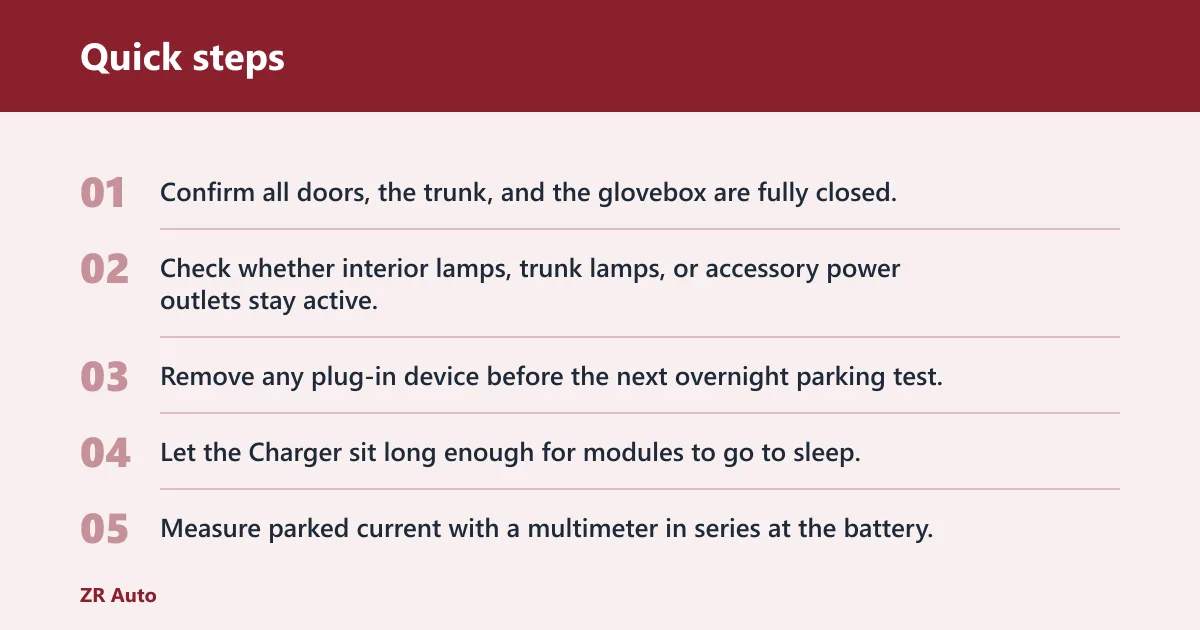
- Confirm all doors, the trunk, and the glovebox are fully closed.
- Check whether interior lamps, trunk lamps, or accessory power outlets stay active.
- Remove any plug-in device before the next overnight parking test.
Isolate the draw with fuses
- Let the Charger sit long enough for modules to go to sleep.
- Measure parked current with a multimeter in series at the battery.
- Pull fuses one at a time and watch for a current drop.
A common first-timer mistake is assuming every parked draw is abnormal. Modern vehicles can have a small normal draw, but a larger abnormal drain needs measurement. Do not guess; isolate the circuit.
Watch Charger-specific suspects
- Check the trunk light and latch position first.
- Check for keyless-entry wakeups that keep the car from sleeping.
- Inspect body control module sleep behavior, aftermarket audio wiring, and dash cam power taps.
A Charger-specific drain often hides in wake-up logic rather than an obvious light left on. If the car refuses to sleep, the battery can be drained by the morning even when everything looks off.
Does cold weather make a Dodge Charger battery die faster?
Yes. Extreme cold can reduce battery capacity by about 20%, and at -22 degrees Fahrenheit capacity can drop to 50%. That means a battery that seems acceptable in mild weather may fail overnight once temperatures fall. Cold also makes cranking demand higher.
If the battery is already aged, winter can push it over the edge. The answer is not a guess about the weather alone; it is a load test in the same conditions where the failure happens.
When should you replace the battery instead of diagnosing the car?
Replace the battery when it fails a load test, is near the 3-4 year life window and showing repeated failure, or has clear physical damage. Do not buy a new battery before checking the terminals, charging voltage, and draw. A weak but still usable battery should be confirmed under load first.
A battery maintainer is useful for vehicles that do not get driven often, but it must be properly rated for the vehicle. It is a storage aid, not a fix for a charging fault or a parasitic drain.
Common mistakes
- Replacing the battery too early instead of load-testing it.
- Skipping terminal inspection when corrosion or looseness is visible.
- Ignoring repeated jump-starts as a warning sign.
- Chasing accessories first and missing the alternator or charging fault.
- Using a maintainer that is not properly rated for the vehicle.
Frequently asked questions
Can an aftermarket stereo or dash cam drain my Charger battery?
Yes. Both can keep drawing power after shutdown if they are wired to a constant feed or a bad trigger source. Remove the device, then retest the overnight drain. If the symptom disappears, inspect the install wiring and the fuse tap before replacing the battery or alternator.
What warning signs come before a battery dies completely?
Slow cranking, clicking, dim lights, electrical glitches, and repeated jump-starts usually show up first. If those symptoms appear after parking overnight, test the battery under load and inspect the charging system. A battery that still starts once does not mean it is healthy.
How do I test for a battery drain before replacing the battery?
Measure parked current after the Charger has gone to sleep, then pull fuses one at a time to find the circuit that drops the draw. Start with lights, accessory outlets, and aftermarket equipment. If current stays high with all obvious loads off, move to module and BCM-related checks.
Could a loose battery terminal cause overnight battery drain?
Yes, but it usually mimics a dead battery rather than creating a true overnight draw. A loose or corroded terminal can block current flow and leave the battery too weak to start the next morning. Tighten and clean the connection before deeper testing.
How do I tell if my Charger battery is old or just not charging?
Aged batteries often fail load testing and are commonly past 3-4 years of service. A charging problem shows up when the battery dies again after driving, especially with the battery warning light or dim headlights on. Check resting voltage, then verify charging voltage with the engine running.
What electrical parts should I check if my Charger dies after sitting overnight?
Start with the trunk light, glovebox light, interior lamps, aftermarket stereo, dash cam, phone charger, and alarm. Then check keyless-entry wakeups and body control module sleep behavior. Those are common parked-drain suspects before you move to more invasive diagnostics.