
Dodge Charger vs Chrysler 300: Which Is Better Used?
Choose the Dodge Charger if five-year depreciation, retained value, and NHTSA safety rating are your top filters. Choose the Chrysler 300 if you want more cabin volume, a calmer ride, and a wider shot at a cleaner used car for less money. Pick the wrong one and you can overpay for worn tires, weak brakes, or the wrong trim for your budget.
| Decision factor | Dodge Charger | Chrysler 300 | Winner |
|---|---|---|---|
| Used-price spread | 2023 examples: $20,327-$59,669 | 2023 examples: $23,706-$50,167 | Chrysler 300 for easier bargain hunting |
| Resale and depreciation | 44.1% five-year depreciation; 8.2/10 retained value | 52.7% five-year depreciation; 7.6/10 retained value | Dodge Charger |
| Safety and long-term outlook | 5/5 NHTSA average; 7.7/10 reliability; 9.2 years remaining life expectancy | 4/5 NHTSA average; 7.5/10 reliability; 7.5 years remaining life expectancy | Dodge Charger |
| Cabin and cargo packaging | Better rear shoulder room and cargo space | Better interior volume | Chrysler 300 for overall cabin volume |
| Base power and fuel use | 292 hp, 23 mpg average, regular unleaded | 292 hp, 23 mpg average, regular unleaded | Tie |
Used pricing differences between the Charger and 300
The Dodge Charger is the safer bet if you care most about resale strength, crash results, and a longer ownership window. The Chrysler 300 is the better used-car hunt if you want a smoother ride, more cabin volume, and a better chance of finding a nicer car for the money.
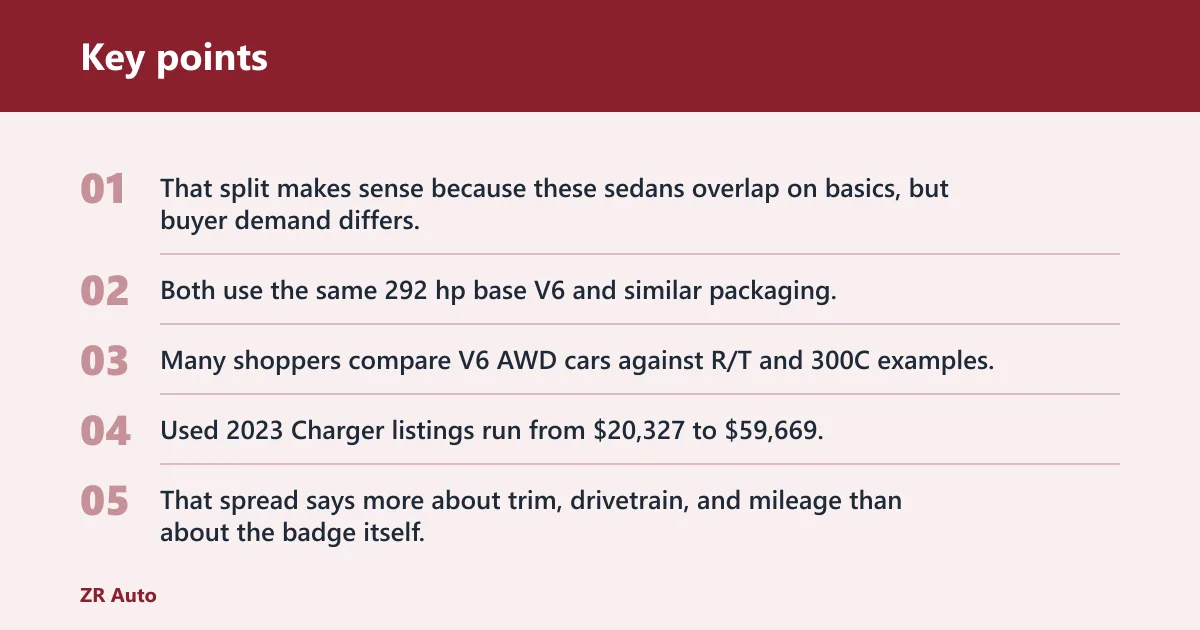
That split makes sense because these sedans overlap on basics, but buyer demand differs. Both use the same 292 hp base V6 and similar packaging, yet the Charger holds value better and scores higher in safety data, while the 300 often lands in a friendlier used-market price band.
Trim matters as much as the badge. Many shoppers compare V6 AWD cars against R/T and 300C examples, so condition and equipment can matter more than the name on the trunk lid.
| Model | 2023 used price range | Base engine | Reliability | Safety | Retained value |
|---|---|---|---|---|---|
| Dodge Charger | $20,327-$59,669 | 292 hp | 7.7/10 | 5/5 stars | 8.2/10 |
| Chrysler 300 | $23,706-$50,167 | 292 hp | 7.5/10 | 4/5 stars | 7.6/10 |
Used price and listing ranges
Used 2023 Charger listings run from $20,327 to $59,669, while the 2023 Chrysler 300 runs from $23,706 to $50,167. That spread says more about trim, drivetrain, and mileage than about the badge itself, because low-mileage performance trims can sit far above ordinary V6 cars.
Live listings tend to spread the Charger wider at both ends. You will usually see more high-dollar cars in the Charger pool, while the 300 often sits in a narrower middle band, which helps if you want a cleaner, less contentious purchase.
Say your budget is around $25,000 and you want the least risky car you can find. A higher-mileage V6 300 with clean records may be easier to justify than a rougher Charger with more visible wear, even though the Charger often wins on value retention over time.
How do they compare on power and fuel economy?
They are tied on the numbers that matter most at the base-engine level. Both models make 292 horsepower, both are rated at 23 mpg on average, and both use regular unleaded, so the real buying choice comes down to trim, condition, and how you plan to drive the car.
Base V6 output and fuel rating
There is no power penalty for choosing the Chrysler 300 base car over the Charger base car. If the V6 is enough for your commute, neither sedan gets a numbers edge here, and that pushes the comparison toward suspension tuning, equipment, and deal quality.
Fuel costs are also a tie on paper. The 23 mpg average and regular-fuel requirement keep either car in the same basic operating bucket, so you should not expect one of these to save much at the pump in base form.
When to move up from the base engine
If you are shopping an R/T or 300C, you are no longer comparing the same kind of buy. Those trims can change insurance, tire costs, brake costs, and fuel use, which matters if you plan to keep the car for several years or drive a lot of miles.
For daily use, the base V6 is the safer bet for predictable running costs. It is also the easiest place to compare examples fairly, because performance versions often hide their value in equipment and condition rather than in the engine alone.
Which one is the better used buy for safety and reliability?
The Dodge Charger has the edge here. It carries a 5/5-star NHTSA average rating, a 7.7/10 reliability score, a 9.2-year remaining life expectancy, and a 19% chance of reaching 200,000 miles, while the Chrysler 300 trails on each of those metrics.
NHTSA ratings side by side
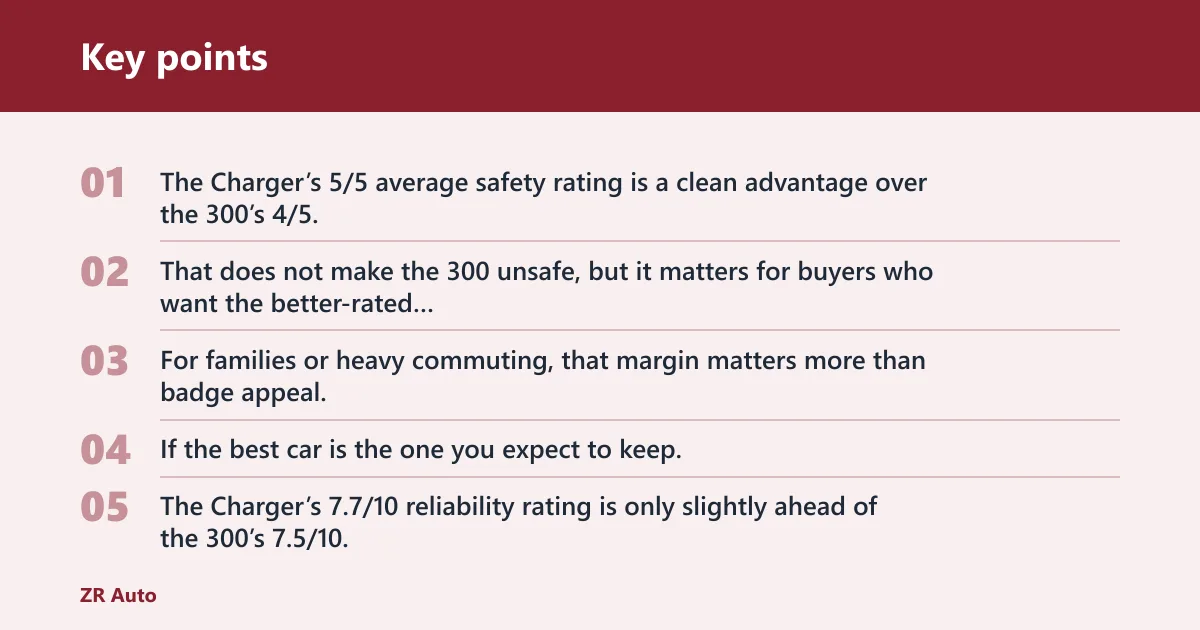
The Charger’s 5/5 average safety rating is a clean advantage over the 300’s 4/5. That does not make the 300 unsafe, but it matters for buyers who want the better-rated used sedan on paper and more confidence in crash results.
For families or heavy commuting, that margin matters more than badge appeal. If the best car is the one you expect to keep, the Charger’s safety data gives it a stronger case.
Reliability scores and life expectancy
The Charger’s 7.7/10 reliability rating is only slightly ahead of the 300’s 7.5/10, but the broader ownership picture matters more. The Charger also carries a 9.2-year remaining life expectancy versus 7.5 years for the 300, which points to a longer usable runway if the example is maintained.
That edge matters more as mileage climbs. A high-mileage sedan with missing records, old tires, and uneven brake wear can erase the gap fast, so the condition of the car still matters more than the badge alone.
200k-mile odds and what they mean
The Charger’s 19% chance of reaching 200,000 miles compares with 6.8% for the Chrysler 300. That is not a promise, but it does support the Charger as the safer long-term bet for buyers who want the car to stay in service for years rather than a short ownership cycle.
Picture a commuter car with 108,000 miles, a recent service file, and clean suspension bushings. That example can still be the better buy than a lower-mile car with accident repair and worn tires, because condition can matter more than the odometer reading alone.
Charger 300 decision matrix

Use this as a buyer filter, not a ranking of the badges themselves. The right answer changes with budget, mileage, winter use, and whether you care more about cargo room or resale strength.
| Budget | Mileage band | Drivetrain | Winter use | Cargo priority | Resale priority | Recommended model/trim direction |
|---|---|---|---|---|---|---|
| Under $25,000 | Higher mileage accepted if records are strong | AWD preferred | Frequent snow or slush | Moderate | High | Dodge Charger V6 AWD |
| $25,000-$35,000 | Middle mileage, clean title only | AWD or RWD depending on climate | Mixed seasons | High | Moderate | Chrysler 300 V6 or well-kept Charger V6 |
| $35,000 and up | Lower mileage preferred | RWD acceptable if weather is mild | Light winter use | Low to moderate | Very high | Dodge Charger R/T if records and tires are strong |
| Value-first bargain | Any band if condition is clearly better | Either, but condition matters more | Seasonal use | High | Low | Chrysler 300 with clean history and easier negotiation |
AWD is the sensible call for buyers who see winter as a real factor, especially if the car will be a year-round commuter. RWD can still work, but the better deal is often the one that also matches your climate and tire budget.
There is also a supply angle. The Chrysler 300 is out of production, which can help bargaining because some sellers know the pool is finite and some shoppers will not chase a specific trim for long. That does not make parts support vanish, but it does make clean examples worth watching closely.
Which one gives you more space?
The Chrysler 300 has the advantage in interior volume, while the Dodge Charger leads in rear shoulder room and cargo space. If you care most about a broad-feeling cabin, the 300 has the better layout; if you care about rear-seat shoulder space and trunk utility, the Charger has the edge.
Interior volume
The 300 feels larger inside because its cabin volume works better for passengers who want an open feel. That matters for long freeway drives, adult rear-seat use, or buyers who dislike a tighter cockpit.
The Charger counters with better rear shoulder room and cargo space, so it can be the better pick if you haul luggage, gear, or multiple passengers who spread out across the back seat.
Family use and road-trip use
For road trips, both can work, but they solve the job differently. The 300 gives you the quieter-feeling, roomier cabin impression; the Charger gives you a little more practical space for bags and broader rear seating.
Suppose you carry two child seats and weekend luggage. The Charger’s cargo advantage can matter more than the 300’s interior-volume lead, especially if you also want the better safety score.
Choose Dodge Charger if… / Choose Chrysler 300 if…
Choose the Dodge Charger if you want the stronger resale story, the better NHTSA score, and the longer projected ownership runway. It is also the better fit if you want V6 AWD for winter use, or if you are shopping an R/T and care about value on the back end.
Choose the Chrysler 300 if you want a calmer ride, more cabin volume, and a wider chance of finding a cleaner used car for less money. It also makes sense if you care more about negotiation room and comfort than about retained value.
For trim value, the Charger’s best used sweet spots are usually V6 AWD for all-weather use and R/T only when the service history is strong, the tires are fresh, and the price still leaves room for maintenance. The 300 is the better value when it is clean, well documented, and priced below comparable Chargers with similar mileage.
Used inspection and value adjustments
High-mileage examples can cost more than the asking price once you account for wear. Tires, brakes, suspension parts, accident history, and missing records should all change how much you pay, because these cars can be cheap on paper and expensive after the first repair visit.
| Item to inspect | What to look for | Typical buying impact |
|---|---|---|
| Tires | Uneven wear, mismatched brands, low tread depth | Deduct if a full set is near replacement |
| Brakes | Shudder, noisy pads, thin rotors, recent service gap | Deduct if pads and rotors are near the end |
| Suspension wear | Clunks, wandering steering, loose feel over bumps | Deduct more on higher-mile cars |
| Accident history | Panel mismatch, uneven gaps, repaint, airbag records | Deduct heavily if structural repairs are likely |
| Service records | Regular oil changes, transmission service, documented repairs | Pay more for clean documentation |
| Visible faults | Warning lights, cracked glass, worn trim, fluid leaks | Use as negotiating room or walk away |
- Check tire age and tread before judging the asking price.
- Inspect brake feel, rotor condition, and service dates.
- Look for uneven panel gaps or mismatched paint.
- Ask for records that prove routine maintenance and repairs.
- Test the suspension over broken pavement and speed bumps.
- Reduce your offer if the car needs immediate wear items.
Frequently asked questions
Is a used Dodge Charger better than a used Chrysler 300?
Usually yes if you care most about resale, crash ratings, and the longer ownership outlook. The Charger also scores higher on reliability and projected life. The Chrysler 300 can still be the better buy if comfort, cabin volume, and a lower-pressured purchase matter more.
Which has better reliability when buying used, Charger or 300?
The Charger has the edge, with a 7.7/10 reliability score versus 7.5/10 for the Chrysler 300. The gap is not huge, so condition still matters most. A cleaner 300 can beat a neglected Charger, but the numbers favor the Charger overall.
Does the Dodge Charger hold value better than the Chrysler 300?
Yes. The Charger’s five-year depreciation rate is 44.1 percent, while the Chrysler 300’s is 52.7 percent. The retained-value gap is 8.7 percentage points, which gives the Charger a clearer advantage if you plan to sell or trade it later.
Which is cheaper to buy used, a Charger or a 300?
It depends on trim and mileage, but the 2023 price bands overlap enough that either can be the cheaper buy. The 300 often gives you more room to bargain on cleaner middle-grade cars.
Which car has more interior room: Charger or Chrysler 300?
The Chrysler 300 has the advantage in interior volume. The Charger counters with better rear shoulder room and cargo space. If you care about a roomy cabin feel, the 300 is the better match; if trunk use and rear-seat width matter more, the Charger has the edge.
Are the Charger and Chrysler 300 mechanically the same?
They are close cousins, not identical twins. Both share Stellantis roots and similar large-sedan packaging, and both can use the same 292 hp base V6. But shoppers should still compare drivetrain, trim, and condition, because V6 AWD, R/T, and 300C versions create very different ownership costs.
Is the Chrysler 300 only a used-car buy now?
For practical shopping, yes. The 300’s end-of-production status means the used market is where most buyers will find one, and that can help bargaining on the right example. It does not make the car a bad choice, but supply is finite, so condition matters even more.
Which used Charger trim is the best value?
The best value for most buyers is the V6 AWD Charger, especially in cold-weather markets. It balances year-round usability, resale strength, and lower operating cost than the performance trims. If you want more power, an R/T only makes sense when the price, tires, brakes, and service history all check out.