Is the VW Tiguan Reliable for a Used SUV?
A used VW Tiguan is a fair reliability bet. Buy 2022+ models with complete maintenance records, and be cautious with neglected early-2018-to-2021 examples unless they are priced well below market. Skipped maintenance can turn into four-figure repairs for water leaks, cooling faults, or DSG service issues. This guide ranks the safer Tiguan years and trims, then lists the test-drive checks that catch expensive problems before you buy.
Is the VW Tiguan reliable?
The Tiguan is generally reliable when it has been maintained on time, but it is not a low-risk used SUV. Its reputation sits above average rather than bulletproof, and that depends heavily on engine choice, gearbox type, and whether the car has had the right fluid and filter work. Neglect changes the picture fast.
What reliability means for a used Tiguan buyer
For a buyer, reliability means how likely the car is to avoid expensive faults during the next ownership period. On the Tiguan, the expensive risks are usually not cosmetic. They are timing chain issues on early petrols, DSG service lapses, cooling-system leaks, and diesel emissions faults from short-trip use.
That is why two Tiguans with the same badge can have very different risk profiles. A well-kept 2.0 TDI used for long motorway runs is a different proposition from an early 1.4 TSI that has seen city driving and patchy servicing.
How maintenance history changes the risk profile
Service records matter more than the odometer alone. A Tiguan with proof of DSG oil and filter changes, regular engine oil work, and coolant-system repairs is far safer than a cheaper example with missing invoices. Skip the paperwork and you are buying the risk, not just the car.
Ask for evidence of oil changes, gearbox servicing, coolant repairs, and any recent work on the EGR or water pump. If the seller cannot show it, price the car as though those jobs are due.
Where the Tiguan sits among compact SUVs
Compared with other compact SUVs, the Tiguan asks for more care than the least troublesome Japanese rivals. It gives you family practicality and tidy driving manners, but weak maintenance raises the repair risk quickly. Buy the right spec and it can be a good used SUV. Buy the wrong one and repair bills can erase the savings.
Tiguan reliability by generation
The first-generation Tiguan and second-generation Tiguan do not carry the same risk. The earlier car has more problem years and more exposure to timing-chain and cooling issues. The later MQB-based car is the better used buy overall, especially if you want newer tech without taking on the oldest engine faults.
First-generation Tiguan (Typ 5N): 2007-2016
The first-generation Tiguan, sold from 2007 to 2016, is the higher-risk used pick. The 2008-2012 period is often the part to be most careful with, especially on early 1.4 TSI petrol models and cars with weak service histories. Timing chain tensioner failures are the headline concern here.
Rear coil spring breakage can also appear on first-generation cars, but that is a smaller repair. The larger worry is buying a cheap early petrol or a diesel that has spent too much time on short journeys.
Second-generation Tiguan (Typ AD1): 2016/2018+
The second-generation Tiguan arrived in 2016 and brought a larger body, better refinement, and newer tech. Used-market examples from 2019 and 2020 are often seen as a sweet spot for many buyers because they sit after the launch-year quirks of 2018 and before older, high-mileage examples become more common.
That does not make every later Tiguan safe. It means the platform is better, the cabin and controls feel more modern, and the most serious early-gen petrol risks are less central. You still need proof of servicing.
Why the second generation is the safer used buy
The MQB-based Tiguan is the safer buy because it avoids the oldest first-generation petrol trouble spots and gives you a newer package without forcing you into the highest-risk years. If you want the best balance of age, equipment, and buyer confidence, look first at 2019-2020 cars with a complete service trail.
Used Tiguan reliability risk matrix
This matrix turns the main Tiguan failure points into buyer actions. Use it to judge whether a car is acceptable, worth negotiating on, or best left alone.
| Issue | Common years/engines affected | Typical symptom | Inspection check | Purchase decision |
|---|---|---|---|---|
| Timing chain tensioner | Early 1.4 TSI petrols, especially 2008-2012 | Startup rattle, rough initial idle, warning lights if severe | Listen closely from cold; ask for proof of chain or tensioner work | Pass if it rattles cold; negotiable only with documented repair |
| DSG mechatronic unit | DSG-equipped cars, any relevant year if neglected | Harsh shifts, hesitation, neutral warnings, limp mode | Road test in traffic and at low speed; check for service history | Pass if shifting is erratic; acceptable only with proof of care |
| DSG oil and filter service lapse | All DSG variants, 6-speed and 7-speed | Sloppy changes, shudder, delayed engagement | Confirm gearbox oil and filter change at the right interval | Negotiable if overdue; otherwise acceptable |
| Water pump and thermostat housing leak | Many TSI petrol engines across generations | Coolant loss, sweet smell, damp area around the housing | Inspect for dried coolant residue and check the level after a cold start | Negotiable if minor; pass if overheating is present |
| 2.0 TDI DPF clogging | Diesel models used mainly for short urban journeys | Warning light, forced regeneration, poor fuel economy | Ask about commute pattern and check for repeated warning lights | Negotiable for motorway use; pass for city-only use |
| 2.0 TDI EGR valve fault | Diesel models, especially stop-start use | Rough running, warning lamp, loss of power | Scan for stored faults if possible; test for hesitation under load | Negotiable if price reflects risk |
| Panoramic sunroof drain blockage | Cars with panoramic roof | Wet headliner, damp carpets, electrical oddities | Check drains, carpet edges, and the roof aperture after rain or washdown | Pass if there is water ingress |
| Rear coil spring breakage | First-generation cars | Knock from rear, sitting low on one corner | Inspect rear ride height and look for broken spring ends | Negotiable because repair cost is lower |
Which used Tiguan years are best to buy?
The safest used Tiguan years are generally 2016-2017 and 2019-2020, with the caveat that service history still rules. Those years avoid the worst first-generation petrol risks and sit in a better part of the second-generation run. For buyers who want the most balanced pick, 2019-2020 is usually the better target.
Safer petrol choices
Choose a petrol Tiguan with evidence of careful servicing and no cold-start rattle. Later second-generation petrols are better bets than early 1.4 TSI cars, which are the ones most associated with timing chain trouble. A quiet cold start matters more than a long options list.
Safer diesel choices
The 2.0 TDI is the diesel to consider if your driving is mainly motorway or A-road use. It suits long runs better than short urban journeys, because short trips raise the risk of DPF clogging and EGR trouble. If your weekly use is mostly school runs and local traffic, petrol is the safer route.
Why 2019-2020 stand out
These years are a practical sweet spot because they combine the second-generation body, better refinement, and fewer launch-year quirks than 2018. They are not immune to DSG or cooling-system issues, but they usually make a better starting point than the oldest or least-documented cars.
Which VW Tiguan years should you avoid?
Avoiding the worst years is about reducing the chance of a large repair on top of a bargain purchase. Launch-year second-generation cars also deserve extra care if they lack documentation or show warning signs.
2008-2012 first-gen problem years
These years are commonly flagged for timing chain tensioner concerns and other age-related faults. The issue is not that every car fails; it is that the repair exposure is high enough to wipe out the value advantage of a cheap example. A startup rattle is a hard warning sign.
Engine and gearbox combinations to approach carefully
Be careful with early 1.4 TSI petrols, any Tiguan with DSG service gaps, and diesel cars used mainly in town. The DSG gearbox itself can be fine if serviced on time, but skipped oil and filter changes raise the risk of mechatronic failure. The 6-speed and 7-speed versions both need correct care.
Mileage and service-history red flags
High mileage is not automatically a problem if the car has complete records. The real warning is missing evidence of routine work, overdue gearbox servicing, repeated coolant top-ups, or signs that the car has been run with low oil. A cheap Tiguan with no paperwork is often the most expensive one to own.
Say your 2010 1.4 TSI starts with a brief metallic rattle every morning, then settles down after two seconds. That is the kind of symptom that should make you walk away unless the seller can show a documented timing-chain repair.
What are the most common Tiguan problems?
The most common Tiguan problems are the ones that create expensive ownership pain, not just nuisance faults. Timing chain wear, DSG issues, coolant leaks, and sunroof drain problems lead the list. Diesel cars add DPF and EGR trouble when the usage pattern does not suit them.
Timing chain and startup rattle issues
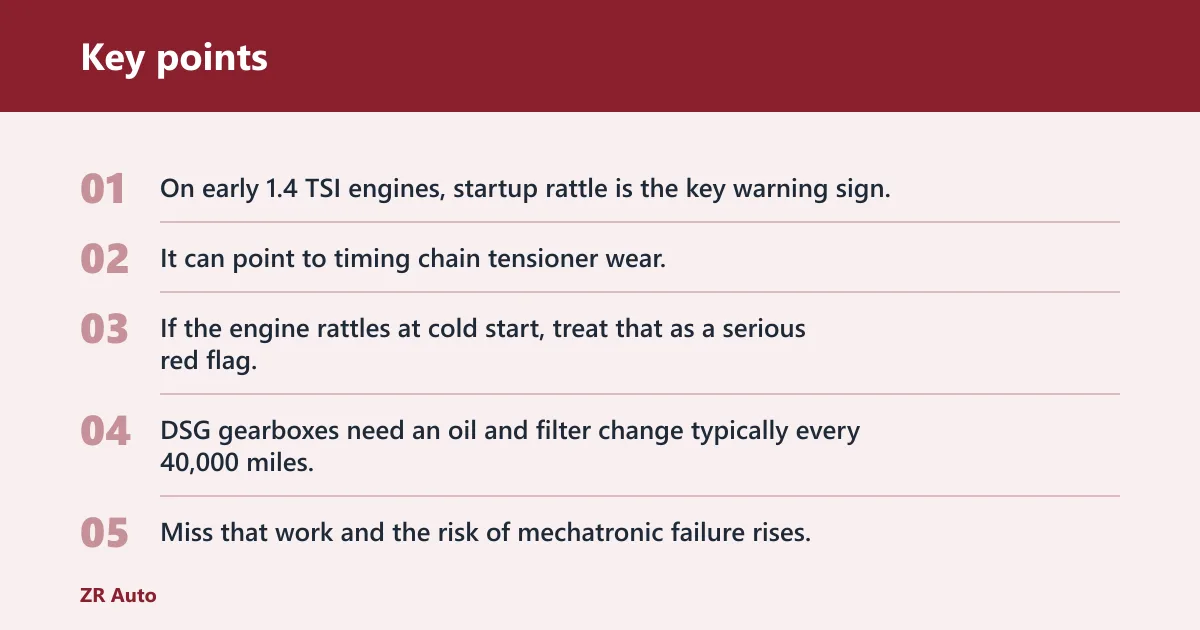
On early 1.4 TSI engines, startup rattle is the key warning sign. It can point to timing chain tensioner wear, which is a high-severity repair and one of the costliest Tiguan faults. If the engine rattles at cold start, treat that as a serious red flag.
DSG service lapses and mechatronic faults
DSG gearboxes need an oil and filter change typically every 40,000 miles. Miss that work and the risk of mechatronic failure rises. Cost can reach £1500-3500, so a smooth test drive is not enough; you need paperwork that proves the maintenance has been done.
Suppose a 7-speed DSG shifts cleanly on a short loop but lurches when creeping in traffic. That is not a “normal VW trait” to ignore. It is the kind of behavior that should trigger either a deep discount or a pass.
Water pump, thermostat housing, and coolant leaks
Water pump and thermostat housing leaks are common across TSI engines. The plastic parts can crack or seep, then coolant loss follows, and overheating becomes the next problem if the leak is ignored. Look for pink or white residue around the housing and ask whether the cooling system has already been repaired.
Panoramic sunroof drain tube blockages
If the car has a panoramic sunroof, check the drain tubes. Blocked drains can send water into the cabin, then electrical faults start to appear. Damp carpets, a musty smell, or fogging after rain are strong reasons to walk away or demand a proper fix before purchase.
How to inspect a used Tiguan before you buy
A good inspection is about catching the high-cost faults before the sale. Focus on cold-start behavior, gearbox operation, cooling-system evidence, and signs of water ingress. If the seller will not allow a proper road test, that is a warning in itself.
Cold-start checks on petrol engines
- Start the car from fully cold and listen for timing-chain rattle.
- Watch the idle for hunting, misfire, or uneven running.
- Check for warning lights after the engine settles.
- Look around the water pump and thermostat housing for dried coolant residue.
Road-test checks for DSG and diesel models
- Test slow-speed creeping in traffic or a car park.
- Check for hesitation, shudder, or abrupt shifts.
- On diesel models, ask about the normal driving pattern.
- Watch for DPF warnings, loss of power, or EGR-related hesitation.
Paperwork and service-record checks
- Confirm regular oil changes with dated invoices.
- Look for DSG oil and filter service evidence at the correct interval.
- Check for cooling-system repairs if the car has had coolant loss.
- Verify any rear spring, EGR, or water pump work before you haggle on price.
Frequently asked questions
Is the vw tiguan a good car?
Yes, the VW Tiguan can be a good used SUV if you choose the right engine and keep to examples with strong service history. It is practical and drives well, but it is not a buy-anything-badged-as-a-VW proposition. The wrong year or a neglected DSG can make it expensive fast.
Is the volkswagen tiguan a good car?
The Volkswagen Tiguan is a good car for buyers who want family space and a refined drive, provided they accept that some versions carry real repair risk. Later second-generation cars with clear records are the safer bet. Early petrols and diesel cars used only for short trips need more caution.
Is tiguan reliable?
The Tiguan is reliable enough to buy, but only if you separate engines, gearboxes, and usage pattern. A maintained petrol or a motorway-used diesel can be a sensible ownership choice. An early 1.4 TSI with cold-start rattle, missing records, or overdue servicing is the wrong side of the line.
Which used VW Tiguan years are best to buy?
Those years sit in the second generation and avoid some of the oldest first-gen engine risks. Even then, condition and records matter more than the badge on the tailgate.
What are the most common problems with the Volkswagen Tiguan?
The common problems are timing chain wear, DSG issues, coolant leaks from the water pump or thermostat housing, DPF clogging on short-trip diesel use, EGR faults, and blocked panoramic sunroof drains. Most of these can be spotted early if you inspect cold-start behavior, test the gearbox carefully, and check for leaks or damp carpets.