Volvo XC90 vs XC60: Which Used Volvo SUV Is Better?
The XC60 is the better used Volvo SUV for most buyers because it costs less to buy, park, and run. Choose the XC90 only if you need a third row or regularly carry seven. Pick the wrong one and you pay for unused space in fuel, tires, brakes, and repairs. This guide compares cabin space, seating, cargo, fuel economy, towing, and ownership costs so you can choose the right one.
| Factor | Volvo XC90 | XC60 | Winner |
|---|---|---|---|
| Purchase price | 1,999,900 Kč | 1,517,900 Kč | XC60 |
| Running cost | 8.3 l/100 km combined | 7.5 l/100 km combined | XC60 |
| Space | 7 seats; 302 / 680 l cargo volume | 5 seats; 468 to 483 l cargo volume | Volvo XC90 |
| Parking ease | 4953 mm long; 2984 mm wheelbase | 4708 mm long; 2865 mm wheelbase | XC60 |
| Family fit | Best for six or seven people | Best for four or five people | Tie |
Volvo XC90 vs XC60: what changes most?
The main difference is simple: the XC60 is the cheaper, easier-to-live-with used buy, while the XC90 is the better pick when seating and cargo flexibility matter more than running costs. Both use B5 AWD Geartronic hardware in the comparison data, so the decision turns on cabin layout, size, and ownership budget. Volvo’s published model pages and brochures should always be checked by model year and market, because equipment, dimensions, and trims vary by generation and software version (Volvo Cars model pages and brochures).
Price gap and market position
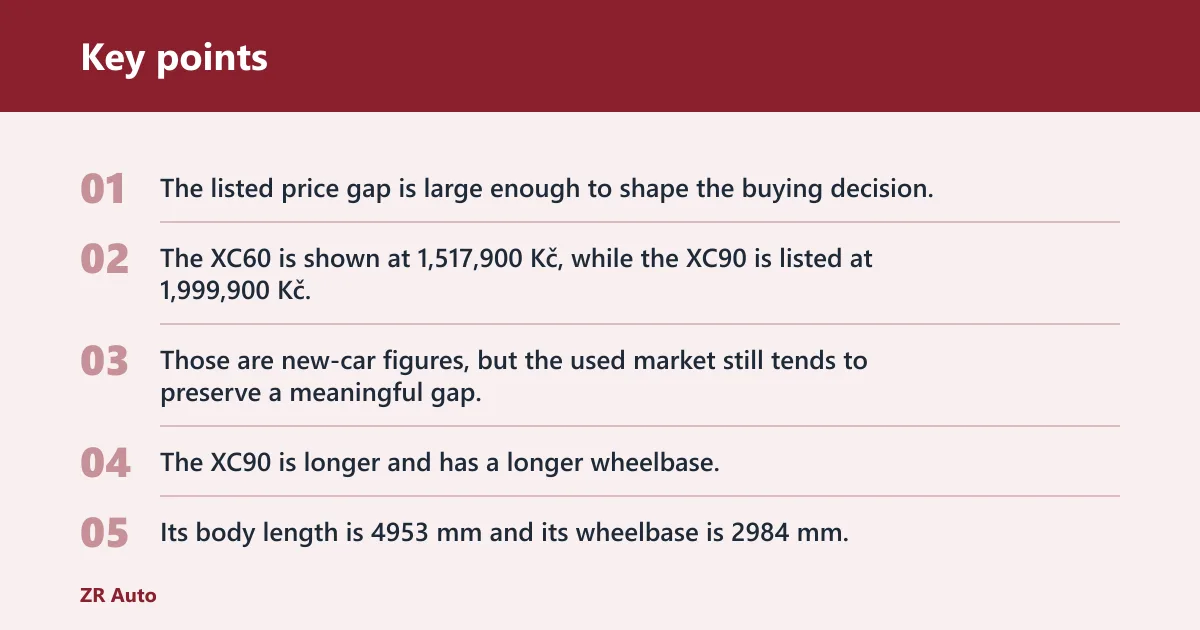
The listed price gap is large enough to shape the buying decision. The XC60 is shown at 1,517,900 Kč, while the XC90 is listed at 1,999,900 Kč. Those are new-car figures, but the used market still tends to preserve a meaningful gap, which is why market listings and transaction data are more useful than MSRP alone when comparing used value (used listings and market data, plus model pricing pages).
Body size, wheelbase, and cargo space
The XC90 is longer and has a longer wheelbase, so it brings more cabin and loading flexibility. Its body length is 4953 mm and its wheelbase is 2984 mm. The XC60 measures 4708 mm long with a 2865 mm wheelbase. Volvo’s published dimensions and luggage figures vary by body style, powertrain, market, and whether the third row is folded, so the exact cargo number should always be checked against the applicable brochure or owner documentation for the specific model year (Volvo Cars model pages and brochures).
The XC90 cargo figure is listed as 302 / 680 liters, which reflects its seven-seat layout and the trade-off of rear-passenger packaging. That is the key point: the XC90 carries more people, while the XC60 often gives you more straightforward boot use for a five-person household.
Powertrain and transmission facts
In the comparison data, both models use a B5 AWD Geartronic setup. That means petrol, four-cylinder, direct injection, 8-speed automatic, 4×4, and 184 kW. Volvo’s naming and equipment can vary by model year and market, so “B5 AWD” is best treated as a family of configurations rather than a single universal specification (Volvo Cars model pages, brochures, and technical data).
The XC60 is listed at 6.9 seconds for acceleration, and the XC90 at 7.7 seconds. The faster figure does not make the XC60 a sportier choice in every sense, but it does support the idea that the lighter SUV is the easier daily drive when you are not filling the cabin.
Which used Volvo costs less to own?
The XC60 is cheaper to buy and usually cheaper to run, so it is the lower-risk used purchase for most households. It asks less cash up front, uses less fuel in the comparison data, and it should also be kinder on tires and brakes simply because there is less mass to move and stop. For used shopping, the better evidence comes from live market listings and price guides rather than only new-car pricing (used listings and market data sources).
Purchase price and depreciation
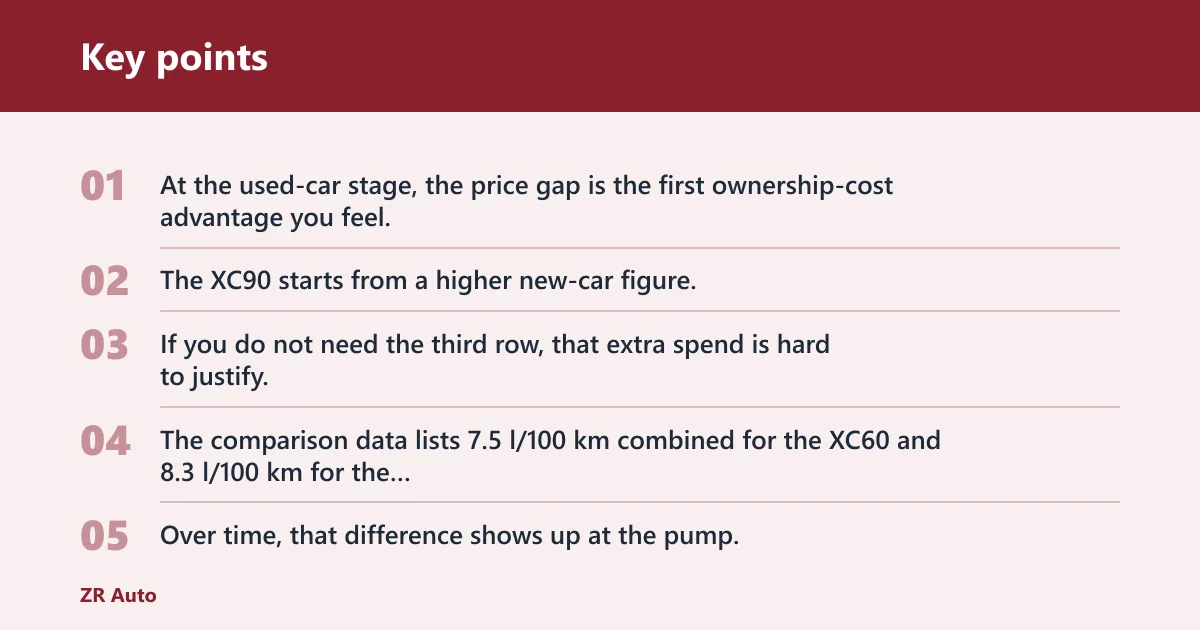
At the used-car stage, the price gap is the first ownership-cost advantage you feel. The XC90 starts from a higher new-car figure, so the used market typically still asks more money to get into one, even before you account for condition, mileage, and trim. If you do not need the third row, that extra spend is hard to justify.
Fuel, tires, and insurance exposure
The comparison data lists 7.5 l/100 km combined for the XC60 and 8.3 l/100 km for the XC90. Over time, that difference shows up at the pump. Tires also tend to cost more on the larger SUV, and insurance can be higher when the vehicle carries a higher purchase value and more expensive bodywork.
Say your weekday routine is school drop-off, a narrow garage, and a short commute. The XC60 fits that pattern better because it is easier to place in tight spaces and less likely to waste fuel on solo trips.
When the XC90’s running costs start to matter
The XC90 becomes expensive to ignore when you are buying a seven-seater but driving it like a five-seat commuter. In that case, you pay for the extra seats all year and use them only a few times. The cost case for the XC90 improves only when those seats are genuinely in use.
How much bigger is the XC90 than the XC60?
The XC90 is noticeably bigger, and the difference is large enough to change where you park and how you load it. It is 245 mm longer than the XC60, and its wheelbase is 119 mm longer. That added length helps with seating and cargo flexibility, but it also makes the SUV harder to place in tight city spaces.
Length and wheelbase difference
The wheelbase figures are 2865 mm and 2984 mm. That extra footprint is useful on the road, but it can create a real nuisance in older garages, compact parking bays, and tight turning areas.
Parking, garages, and city use
The XC60 is the easier urban SUV. It asks for less room at the kerb, gives you more margin in underground parking, and is less stressful when a lane is narrow or the space between pillars is tight. The XC90 still works in a city, but it asks more from the driver every day.
Picture a family with a short driveway, a school run, and one underground parking spot with concrete pillars on both sides. The XC90 may still fit, but the XC60 is the safer choice if door clearance matters as much as seat count.
What the extra size means for loading and passengers
The XC90’s extra length pays off when you need to carry more people without turning the rear row into an emergency-only seat. The XC60 is better when you want a regular five-seat SUV with a usable boot and less daily bulk. Both are practical, but they solve different problems.
Which Volvo SUV is better for a family of 5?
For a family of five, the XC60 is usually the better used Volvo SUV because it gives you five proper seats without the overhead of a third row you may never use. If you are cross-shopping other used Volvos too, the sibling better used Volvo SUV page can help you compare the XC90 against the same ownership priorities. The XC90 only becomes the better family pick if you regularly carry a sixth or seventh passenger, or if you need the extra seating as part of normal life.
Five-seat comfort and rear space
The XC60 is listed with 5 seats, and that layout fits a typical family of five directly. There is no third row to manage, so the second row and boot are easier to use on a daily basis. The XC90’s seven-seat layout is more flexible, but that flexibility comes with size and cost penalties.
Child seats, boot access, and daily loading
Both cars suit child seats, but the XC60 tends to be the less awkward choice for loading bags, school kit, and pushchairs because you are not working around a folded third row. The XC90 helps when you need occasional extra seats, yet that same third row can reduce cargo space when it is in use.
When the XC60 is the better fit
The XC60 is the better fit if your household is five people or fewer, your parking space is tight, and you value lower fuel use over maximum seating. It also makes more sense if the car spends most of its time on ordinary errands rather than on seven-seat weekend duty.
Volvo SUV decision matrix
| Criterion | Volvo XC90 score | XC60 score | What the score means |
|---|---|---|---|
| Purchase price | 2/5 | 5/5 | The XC60 is the cheaper used buy. |
| Running cost | 2/5 | 4/5 | The XC60 uses less fuel and is easier on consumables. |
| Space | 5/5 | 3/5 | The XC90 has the stronger people-carrying case. |
| Parking ease | 2/5 | 5/5 | The XC60 is simpler in tight spaces. |
| Family fit | 5/5 for six to seven people | 5/5 for four to five people | Depends on household size. |
Recommendation by household size
- 2 to 5 people: choose the XC60 unless you genuinely need the extra row of seats.
- 6 to 7 people: choose the XC90 if you need those seats often enough to justify the cost.
- Urban driver with tight parking: choose the XC60.
- Long-trip family with frequent luggage and extra passengers: choose the XC90.
Choose XC90 only if checklist
- You need 7 seats often, not once or twice a year.
- Your parking space and garage can handle a 4953 mm SUV.
- You accept 8.3 l/100 km combined instead of 7.5 l/100 km.
- You will use the extra wheelbase and cargo flexibility enough to justify the higher purchase price.
Which used Volvo SUV is better for towing and long trips?
The XC90 is the better pick for towing and long trips when those trips involve more passengers or more luggage. Volvo’s towing capacity varies by model year, engine, driveline, and market, so buyers should verify the exact figure in the official brochure or owner’s manual for the specific car they are considering. The XC90’s longer wheelbase and seven-seat layout make it the more relaxed tool for big-family travel, even though the XC60 can still handle long-distance driving well and is easier to live with the rest of the year (Volvo Cars towing specifications and owner documentation).
For a couple, a small family, or a driver who tows only occasionally, the XC60 makes more sense because it keeps ownership cost down without giving up AWD, automatic transmission, or premium comfort. For a larger household or anyone who treats the SUV like a travel shuttle, the XC90 earns its keep.
Choose Volvo XC90 if… / Choose XC60 if…
Choose Volvo XC90 if…
Choose the XC90 if you need seven seats regularly, carry six or seven people more than occasionally, or want the extra wheelbase for family travel. It is also the better choice if your priority is passenger space over purchase price, fuel spend, and easy parking.
Choose XC60 if…
Choose the XC60 if you want the cheaper used Volvo SUV, live with tight parking, or only need five seats. It is the better all-round ownership buy for most households because it keeps the price, fuel use, and day-to-day hassle lower.
Choose the XC90 only if the extra row will be used often enough to justify the price gap. Choose the XC60 if you want the smarter used deal and do not need a seven-seat cabin.
Which used Volvo SUV is better used?
The XC60 is better used for most buyers because it offers the stronger value balance: lower entry price, lower fuel use, and easier parking. The XC90 is better only when its extra space is part of your real routine. If not, you are buying capacity you will mostly leave empty.
Which used Volvo SUV is cheaper to buy and run?
The XC60 is cheaper to buy and run. For used shopping, those figures are most useful when paired with live market listings and data sources, because real-world used pricing depends on model year, trim, mileage, condition, and local supply.
Is the XC90 worth the extra size over the XC60?
Yes, but only if you use the size. The XC90 is worth it for frequent seven-seat use, larger family loading, or regular long trips with more passengers. If you do not need those things, the extra length mainly adds cost and parking stress rather than value.
Which used Volvo has the better infotainment and features?
Neither model has a clear advantage in core infotainment because both can be equipped with Volvo’s Google built-in system, but the exact hardware and feature set vary by model year, market, trim, and software generation. Official Volvo material shows Google Maps, Google Assistant, Google Play, connected-car functions, and the Volvo Cars app for remote lock and unlock, remote cabin preconditioning, and status checking, but the screen size, instrument layout, and audio package are not identical across all years or trims (Volvo Cars model pages, brochures, and owner manuals). A used buyer should verify the exact infotainment version on the specific VIN rather than assume the newest interface or the same equipment across all XC60 and XC90 examples.
Feature differences that matter in the used market
Used examples may differ on screen size, navigation subscription status, smartphone integration, over-the-air update support, and connected services. The safest way to compare them is to confirm the model year, software generation, and installed options from the seller’s photos, service records, and Volvo documentation for that chassis.
Does the XC90 have 7 seats and the XC60 only 5?
Yes. The XC90 is listed with 7 seats, and the XC60 is listed with 5 seats. That is one of the cleanest distinctions in this comparison, and it is the reason the XC90 wins on passenger capacity while the XC60 wins on everyday convenience.
XC60 (U) vs XC90 (L): which used Volvo architecture should you buy?
The XC60 uses Volvo’s smaller mid-size SUV packaging, while the XC90 is the larger three-row SUV. In practice, that means the XC60 is the better fit for most used buyers who want a premium five-seat SUV, and the XC90 is the better fit for buyers who want a genuine three-row family hauler. The XC60’s “U” size class is easier to live with in city parking and commuting, while the XC90’s “L” class gives you the extra cabin length, third row, and cargo flexibility that larger families need.
Where the XC60 is the stronger used buy
Choose the XC60 if you want the best balance of price, dimensions, and ownership cost. It is the safer default because most households do not need the XC90’s extra volume every day.
Where the XC90 is the stronger used buy
Choose the XC90 if you regularly move six or seven people, travel with bulky luggage, or want a larger SUV that feels less compromised when all seats are in play. The added size only makes sense when you actually need it.
Which Volvo plug-in hybrid should you consider in each used range?
Both models have plug-in hybrid options in many markets, and those used examples can be excellent if your routine includes regular charging and short daily driving. The XC60 Recharge is usually the better plug-in hybrid value for buyers who want electric-only commuting in a smaller, easier-to-park SUV. The XC90 Recharge makes sense for buyers who need the larger body and still want the efficiency of charging at home or work (Volvo Cars model pages and brochures for each market).
Who should seek a used PHEV XC60 or XC90?
A used PHEV makes the most sense if you can charge regularly, drive short trips often, and want lower fuel use without giving up petrol flexibility. Buyers who do mostly motorway miles, cannot charge at home, or want the simplest long-term ownership experience often get better value from a non-PHEV version.
When battery and charging complexity changes the value equation
The value case changes when the battery system, onboard charger, or charging cable setup adds repair risk that is not offset by regular charging use. Used PHEVs should be judged on battery-health evidence, charging behavior, and warranty status, because the efficiency benefit is strongest only when the vehicle is plugged in often enough to justify the extra complexity. If charging is uncertain, the simpler petrol AWD model may be the better used buy.
FAQ
The short answer is that the XC60 is the better used Volvo for most buyers, while the XC90 is worth paying more for only when you genuinely need its extra seats and space.
Is the XC60 or XC90 cheaper to own?
The XC60 is cheaper to own because it is cheaper to buy and uses less fuel in the comparison data.
Which one is better for city parking?
The XC60 is better for city parking because it is shorter, lighter to place, and less stressful in tight spaces.
Which one is better for a big family?
The XC90 is better for a big family because it can seat seven and has the larger cabin and luggage flexibility.
Should I buy the XC90 if I only occasionally need seven seats?
Usually no. If you only need seven seats occasionally, the XC60 is normally the better value and easier everyday buy.