How Much Does a Ford Escape Cost to Own?
A Ford Escape’s real ownership cost is usually the monthly payment plus several hundred dollars for insurance, fuel, maintenance, and depreciation, so the sticker price is only part of the budget. Miss those costs, and an “affordable” SUV can strain your budget fast. This guide breaks down new, used, gas, hybrid, and plug-in hybrid costs by month and by year.
Ownership cost table
| Scenario | Purchase price range | Monthly payment | Annual fuel cost | Annual insurance | Annual routine maintenance | 5-year total cost |
|---|---|---|---|---|---|---|
| New gas Escape | $30,000-$35,000 | $577/month on $29,250 financed at 6.9% for 60 months | $1,556 | $1,600 | $600 | $34,278 |
| New hybrid Escape | $34,000-$39,000 | $647/month on $32,850 financed at 6.9% for 60 months | $1,077 | $1,650 | $550 | $32,385 |
| Used gas Escape | $18,000-$25,000 | $381/month on $19,350 financed at 6.9% for 60 months | $1,500 | $1,450 | $850 | $32,000 |
| Used hybrid Escape | $22,000-$30,000 | $434/month on $22,050 financed at 6.9% for 60 months | $1,105 | $1,500 | $800 | $31,526 |
Assumptions for the table: about 12,000 miles per year, regular gas at about $3.50 per gallon, 10% down, about 6.9% APR, and 60-month financing. The 5-year total cost includes depreciation, fuel, insurance, and routine maintenance. It does not include taxes, registration, dealer fees, or unexpected repairs, which vary by state and shopping location.
How much does a Ford Escape cost to own?
A Ford Escape usually costs less to own than many larger SUVs, but the exact total depends on trim, powertrain, mileage, insurance, financing, and resale value. A buyer who picks a gas model, drives less, and keeps insurance low will pay far less than a high-mileage driver in a hybrid or plug-in hybrid with expensive coverage.
What monthly owners actually pay
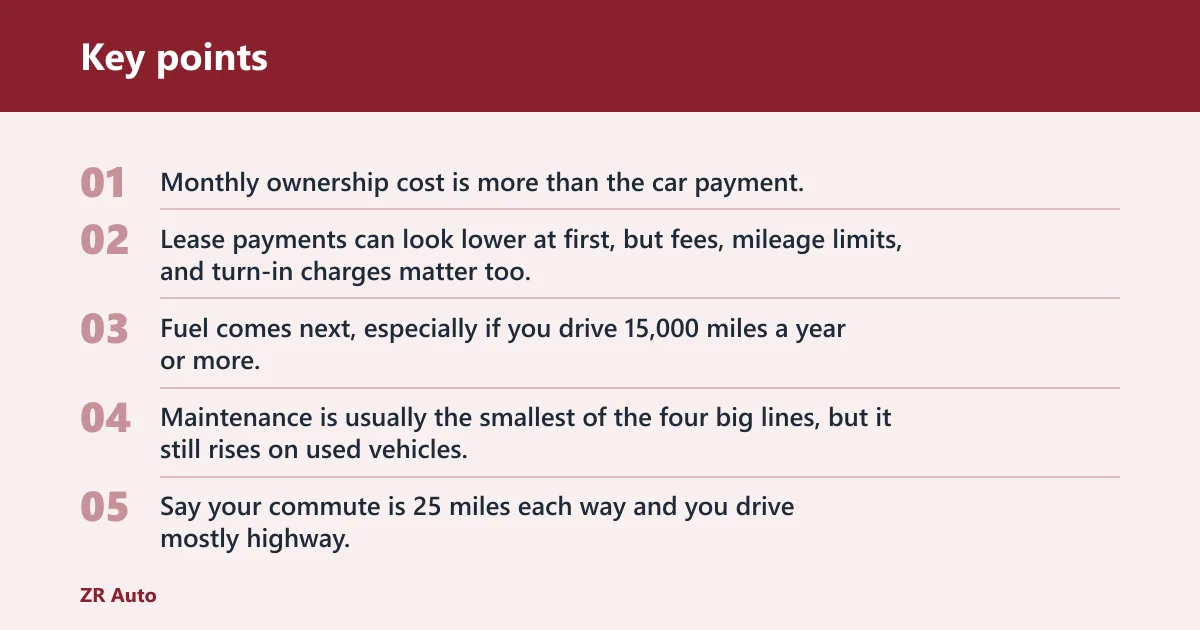
Monthly ownership cost is more than the car payment. Add fuel, insurance, maintenance, and the drop in value over time, and a typical Escape lands in the low- to mid-$500s per month on a 5-year view in the scenarios above. Lease payments can look lower at first, but fees, mileage limits, and turn-in charges matter too.
What changes the number most
Depreciation usually changes the total most. Fuel comes next, especially if you drive 15,000 miles a year or more. Insurance can swing widely by driver profile, age, ZIP code, credit-based pricing rules where allowed, and coverage level. Maintenance is usually the smallest of the four big lines, but it still rises on used vehicles.
Why two shoppers can see very different totals
Say your commute is 25 miles each way and you drive mostly highway. A hybrid can save real fuel money, but a higher purchase price and insurance can cut into that gain. Suppose another shopper buys used and pays cash. That shopper may skip finance charges and see a much lower monthly figure even if the Escape is older.
How much is a new Ford Escape?
A new Ford Escape usually starts in the low $30,000 range and rises with trim, all-wheel drive, and option packages. Gas models stay cheapest up front. The hybrid costs more to buy, while the plug-in hybrid sits higher still because it adds a larger battery and charging hardware.
Gas models
Gas-only Escape trims are the entry point. They are the easiest to budget for if you want the lowest sticker price and a simpler ownership profile. Fuel economy varies by engine, drivetrain, and wheel size, so confirm the EPA estimate for the exact trim on the manufacturer’s listing before you compare financing offers from banks, credit unions, and the dealer.
Hybrid models
The Ford Escape Hybrid costs more up front, but it uses less fuel in daily driving and can reduce annual fuel expense enough to matter over several years. The battery and hybrid system are covered under separate warranty terms, which helps limit repair exposure during the early ownership period.
Plug-in hybrid model
The Ford Escape Plug-In Hybrid usually costs the most of the three powertrain choices. It adds an EV range of about 37 miles and requires charging to get the best result. Incentive eligibility depends on the current rules and the buyer’s situation, so check federal and local programs before you count on a credit.
How much does it cost to lease a Ford Escape?
A Ford Escape lease can look cheaper per month than a purchase, but the real cost depends on the money factor, residual value, drive-off fees, mileage allowance, and what happens at turn-in. For some shoppers, leasing is a lower monthly commitment. For others, the mileage cap and no-equity outcome make buying the better budget move.
Sample lease math
Here is a simple example. If a $33,000 Escape leases for 36 months with a $20,000 residual, $600 in fees rolled into the lease, and a money factor of 0.0025, the base payment is about $494 before tax. That comes from roughly $364 in depreciation plus about $130 in finance charge each month.
-
Check the cap cost.
Start with the negotiated price, then add any acquisition fee the lease rolls in. That number drives the payment more than the sticker price does. -
Confirm the residual.
Ask for the quoted end-of-lease value and the allowed mileage, usually 10,000 to 15,000 miles a year. Higher mileage usually lowers the residual and raises the monthly payment. -
Ask about due-at-signing costs.
Include the first payment, acquisition fee, security deposit if required, and local taxes. A low monthly quote can hide a large drive-off amount. -
Match the lease to your mileage.
If you drive well above the allowance, the excess-mileage charge can wipe out the monthly savings. For a high-mileage driver, buying often makes more sense.
Follow the lease contract and the vehicle manual, never exceed the vehicle’s rated limits, keep items out of airbag zones and the driver’s view, and check local laws before signing. The same rule applies to roof racks, child seats, and towing. Those limits can change the real cost if you need extra equipment or special insurance coverage.
Lease vs buy tradeoffs
Lease payments usually stay lower than loan payments on the same model, but you give up ownership and often pay more for wear, excess mileage, or early termination. Buying builds equity if you keep the Escape past the loan term or sell it at a decent resale value. Leasing is most attractive when low monthly cash flow matters more than long-term value.
Fees and mileage limits to check
Read the lease for acquisition fees, disposition fees, excess-mileage penalties, and wear standards. Those items can add hundreds or thousands of dollars over the term. If you expect to keep a vehicle for many years, a purchase may be simpler to budget because there is no return inspection at the end.
How much are used Ford Escapes worth?
Used Ford Escapes usually cost much less than new ones because the first owner absorbs the steepest depreciation. That is why a three- to five-year-old Escape can look like the best budget choice. Price still depends on trim, mileage, condition, service history, and whether it is a gas, hybrid, or plug-in hybrid model.
Why some model years cost less to own
Older Escapes often have a lower purchase price, so depreciation is spread across fewer dollars even if repair risk rises a bit. That can make a well-kept used model cheaper to own than a new one. The tradeoff is that tires, brakes, and battery-age concerns may arrive sooner.
Trim retention differences
Higher trims often lose value faster in percentage terms, even though they may still cost more in the used market. Hybrids and well-equipped trims can hold a stronger resale position than base gas models in some cases, but condition matters more than badge level once the vehicle is several years old.
How resale value changes five-year cost
Depreciation is the gap between what you pay and what you can sell for later. A new Escape that loses $15,500 in value costs more to own than a used Escape that loses $13,000 over the same five-year window, even if the monthly payment is lower on the used vehicle.
Fuel, insurance, and maintenance costs
Fuel, insurance, and maintenance are the three ongoing expenses most shoppers underestimate. MPG matters because it changes yearly fuel spend directly. Insurance depends on the driver and location. Maintenance depends on age, mileage, and whether the vehicle still has warranty coverage for major systems.
Annual fuel spend from MPG and mileage
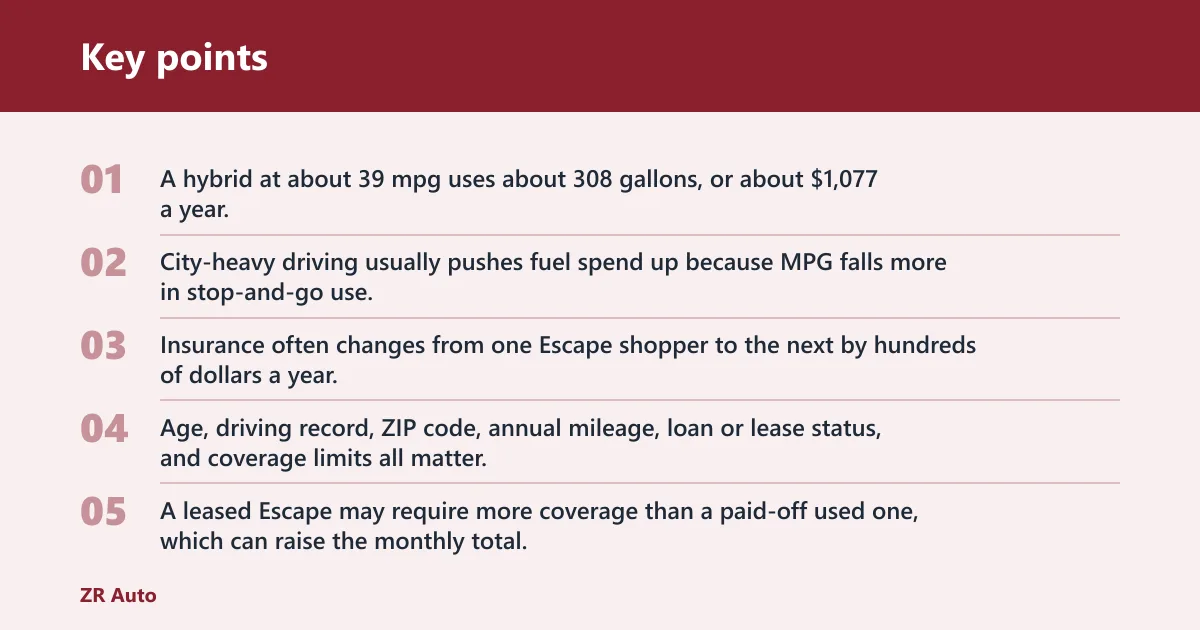
At about 12,000 miles a year and about $3.50 per gallon, a gas Escape at about 27 mpg uses about 444 gallons, or roughly $1,556 a year. A hybrid at about 39 mpg uses about 308 gallons, or about $1,077 a year. City-heavy driving usually pushes fuel spend up because MPG falls more in stop-and-go use.
Insurance factors that move the premium
Insurance often changes from one Escape shopper to the next by hundreds of dollars a year. Age, driving record, ZIP code, annual mileage, loan or lease status, and coverage limits all matter. A leased Escape may require more coverage than a paid-off used one, which can raise the monthly total.
Routine service and wear items
Routine service usually includes oil changes, tire rotations, inspections, brake service, filters, and fluids at the intervals listed in the owner’s manual. Warranty coverage helps with defects, but it does not cover normal wear items. Never treat maintenance as optional, because deferred service can turn a cheaper used SUV into a costly one.
Ford’s warranty coverage commonly includes bumper-to-bumper protection, powertrain coverage, corrosion coverage, and separate coverage for hybrid components. Exact terms vary by model year, so check the manual for your vehicle. A plug-in hybrid also adds charging equipment and home-electricity considerations that a gas Escape does not have.
Is a Ford Escape cheap to own?
A Ford Escape can be cheap to own compared with many compact and midsize SUVs, but “cheap” depends on how you buy it. A new gas Escape often has the highest total cost because depreciation hits hard. A used hybrid can be one of the better value plays if the price, mileage, and condition are right.
Compared with buying new
Buying new gives you full warranty coverage and the cleanest maintenance record, but it usually costs the most over five years because of depreciation. If you keep the vehicle a long time, that penalty softens. If you trade often, the new-car cost gap stays visible in every monthly payment.
Compared with buying used
Used Escapes are often cheaper to own because someone else paid the first big depreciation hit. That does not erase repair risk, though. A careful pre-purchase inspection and service-record check matter more on a used SUV than on a new one, especially if the price seems unusually low.
Gas vs hybrid ownership math
The hybrid usually saves fuel, which helps offset its higher purchase price. In the table above, the new hybrid’s yearly fuel bill is about $479 less than the new gas model’s. That fuel advantage can matter more for long commutes, while the gas model may still win if the deal price is far lower.
Frequently asked questions
How much does a Ford Escape cost per year to maintain?
Routine maintenance in this guide runs about $550 to $850 a year depending on whether the Escape is new, used, gas, or hybrid. That does not include unexpected repairs. Oil changes, tire rotations, brake work, and filters are the normal items to budget first.
Is a Ford Escape cheap to own compared with rivals?
The Escape is often competitive on ownership cost, especially if you buy used or choose the hybrid for high-mileage driving. It is not always the cheapest SUV to own, though. Insurance, depreciation, and local market pricing can shift the answer more than the badge on the grille does.