Dodge Grand Caravan vs Chrysler Pacifica: Which Is Better Used?
For most used buyers, the Dodge Grand Caravan is the better pick when price and repair simplicity matter most; choose a used Chrysler Pacifica only when the extra cost buys newer condition, better safety tech, or a stronger fit for your family. Choose the wrong one and you can spend more up front, then face bigger depreciation or repair surprises later. This guide compares value, reliability, space, safety, and ownership risk so you can choose with fewer regrets.
| Decision factor | Dodge Grand Caravan | Chrysler Pacifica | Winner |
|---|---|---|---|
| Used buy-in | Usually a lower-price choice in the 2017-2020 used market, especially at higher mileage and in SXT-type trims. | Usually costs more, even when mileage is similar, because newer years, more safety gear, and stronger trim content hold value. | Dodge Grand Caravan |
| Repair risk | A simpler package, with a 3.6L Pentastar V6 and 6-speed automatic that are commonly seen and familiar to many repair shops. | More equipment, more systems, and on gas models a 3.6L V6 with a 9-speed automatic that can add complexity. | Dodge Grand Caravan |
| Family tech | Basic family equipment is common, but advanced safety and convenience content is thinner on many used examples. | Usually offers the better safety and convenience set, including more frequent availability of blind-spot monitoring and automatic emergency braking. | Chrysler Pacifica |
| Cargo and seating flexibility | Stow ‘n Go second and third rows make quick cargo conversion easy. Used examples in this range are generally 7-passenger vans. | Gas Pacificas commonly have Stow ‘n Go for the second and third rows; the hybrid is the main exception. Third-row comfort is better in many trims. | Chrysler Pacifica |
| Long-trip comfort | Comfort is fine, but road-noise isolation, seat feel, and feature content are usually more basic. | Usually the better highway van, with newer chassis tuning and more available comfort gear. | Chrysler Pacifica |
Used-buy decision table
| Buyer scenario | Dodge Grand Caravan | Chrysler Pacifica | Buy / no-buy |
|---|---|---|---|
| Lowest purchase price | 5 | 2 | Buy Grand Caravan |
| Lowest repair risk | 4 | 3 | Buy Grand Caravan if history is clean |
| Best family tech | 2 | 5 | Buy Pacifica |
| Best cargo flexibility | 4 | 5 | Buy Pacifica for mixed people-and-cargo use |
| Best long-trip comfort | 3 | 5 | Buy Pacifica |
Lowest purchase price
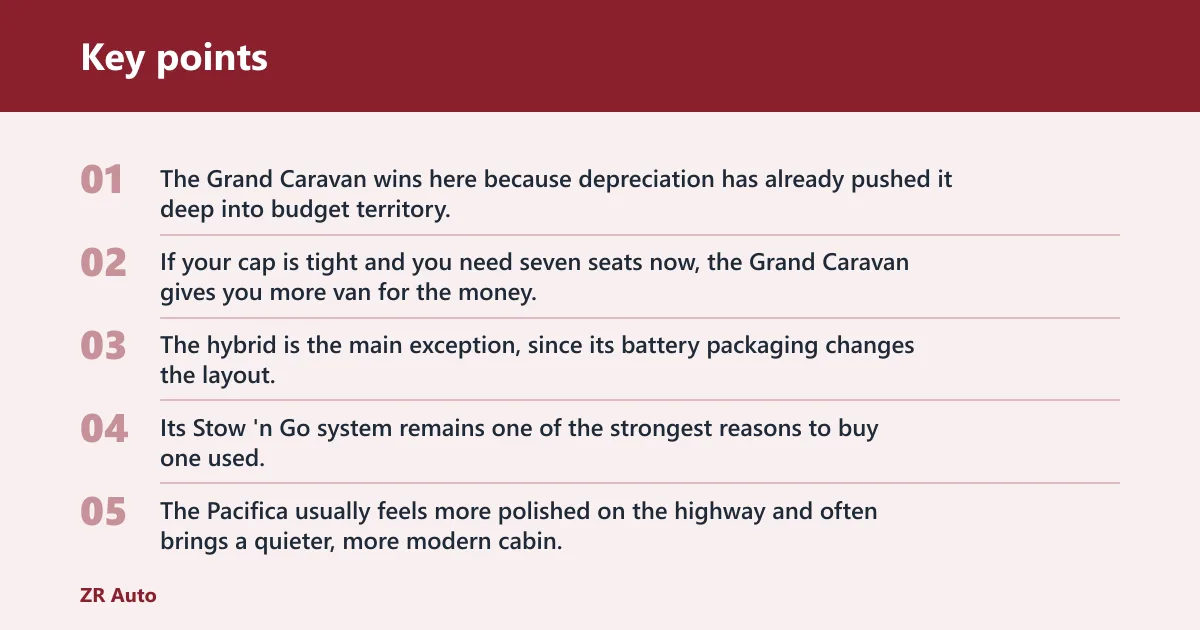
The Grand Caravan wins here because depreciation has already pushed it deep into budget territory. A clean 2017-2020 example with ordinary miles often lands below a comparably equipped Pacifica, and trim still matters: SE and SXT examples often price lower than a Pacifica with safety options and newer interior tech.
That matters more than badge loyalty. If your cap is tight and you need seven seats now, the Grand Caravan gives you more van for the money.
Lowest repair risk
The Grand Caravan gets the edge because its older, simpler formula usually means easier diagnosis and cheaper parts access. The Pacifica can still be a good buy, but its added equipment and the gas-model 9-speed automatic raise the number of things that can go wrong, and repair bills can climb faster when coverage is thin.
This does not make the Pacifica unreliable by default. It means the cost of neglect is usually higher.
Best family tech
The Pacifica wins because used examples are more likely to bring the safety and convenience features that matter in daily family use. Look for rearview camera, blind-spot monitoring, and automatic emergency braking, since those features are far more common on higher-trim or newer Pacifica examples than on the Grand Caravan.
Airbags are standard on both, but the Pacifica’s broader tech spread makes it the better pick when the goal is active safety and easier commuting.
Best cargo flexibility
The Pacifica takes this by a narrow margin because gas models commonly have Stow ‘n Go in both the second and third rows, which keeps the floor usable without removing seats. The hybrid is the main exception, since its battery packaging changes the layout.
The Grand Caravan is still very good here. Its Stow ‘n Go system remains one of the strongest reasons to buy one used.
Best long-trip comfort
The Pacifica usually feels more polished on the highway and often brings a quieter, more modern cabin. It is the better choice if you spend real time on interstates, want better infotainment and driver aids, or care about the van feeling newer for longer.
The Grand Caravan is serviceable, but it rarely feels as complete on a long drive.
How much should you pay used?
The Grand Caravan usually wins on price, but the gap depends heavily on mileage and trim. In the 2017-2020 used range, lower-mile Grand Caravan examples and higher-mile Pacifica examples can overlap, yet the Pacifica typically stays above the Dodge in equivalent condition. If a Pacifica is only a little more expensive and brings much better condition or equipment, the extra spend can still be rational.
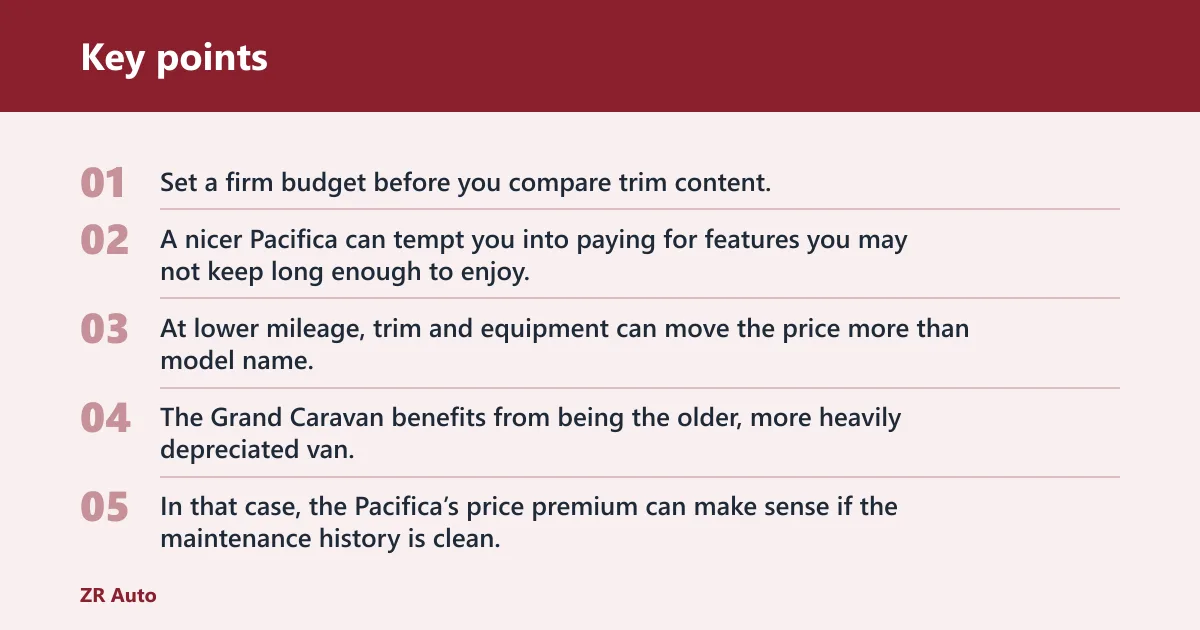
Set a firm budget before you compare trim content. A nicer Pacifica can tempt you into paying for features you may not keep long enough to enjoy.
Mileage bands and trim-dependent pricing
At lower mileage, trim and equipment can move the price more than model name. A well-kept Pacifica with blind-spot monitoring, a rearview camera, and better interior trim can command a clear premium over a similarly aged Grand Caravan; higher-mile base examples of either van can move much closer together.
Use mileage bands, not just year. A 70,000-mile Pacifica with full records can be a better buy than a 120,000-mile Grand Caravan with missing service history, even if the Dodge is cheaper.
Where depreciation helps the Grand Caravan
The Grand Caravan benefits from being the older, more heavily depreciated van. That helps budget buyers who care most about getting a functional family hauler for the least money and who plan to keep it only while repair costs stay predictable.
It also means you can often shop for a better-condition example inside the same budget. That is the useful part of depreciation.
When a Pacifica price is still defensible
The Pacifica is worth the extra money when the seller can prove better condition, newer safety equipment, or a better long-term fit. A Pacifica with complete records, newer tires and brakes, and the safety features you actually want can be the smarter buy than a cheaper Grand Caravan that needs catch-up maintenance.
Say your family drives mostly highway miles, wants blind-spot monitoring, and needs a quieter cabin for school runs and road trips. In that case, the Pacifica’s price premium can make sense if the maintenance history is clean.
Is a used Dodge Grand Caravan or Chrysler Pacifica more reliable?
The Grand Caravan is usually the safer reliability bet when the service record is thin, because its simpler setup tends to be less expensive to bring back to baseline. The Pacifica can be the better machine when it has full records and recent maintenance, but it also has more systems that can add repair exposure if anything was skipped.
Reliability here is less about a badge and more about condition. A well-documented Pacifica can outlast a neglected Grand Caravan, but the Dodge is more forgiving when the history is incomplete.
Maintenance history that matters most
Check for brake wear, suspension wear, cooling system service, and transmission service before you think about trim or color. Those are the items that most often separate a clean used minivan from a money pit, and they matter more when mileage is high.
-
Verify service records. Look for oil changes, coolant service, brake work, and transmission service with dates and mileage. Missing records do not automatically kill a deal, but they raise the risk on both vans, especially the Pacifica.
-
Inspect the brakes and suspension. Listen for clunks over bumps, feel for vibration under braking, and check tire wear patterns. Those clues can point to worn struts, bushings, or brake hardware that will need attention soon.
-
Ask about cooling-system work. Overheating repairs can get expensive quickly, so look for evidence of past coolant service and no signs of leaks. Follow the vehicle manual, never work under a vehicle held only by a jack, never exceed the vehicle’s rated roof/hitch/tow limit, keep items out of airbag zones and the driver’s view, and check local laws.
-
Confirm transmission service. The Grand Caravan uses a 6-speed automatic, while gas Pacifica models use a 9-speed automatic. Ask for fluid-service proof if the seller has it, because transmission neglect is one of the fastest ways to turn a good van into a bad buy.
Grand Caravan common trouble spots
The biggest used-buy issue is usually not one dramatic defect. It is accumulated wear on the brakes, suspension, cooling system, and transmission service history after years of family duty. The 3.6L Pentastar V6 is widely used, but the rest of the van still needs proof of care.
A common first-timer mistake is buying the cheapest Grand Caravan on the lot and assuming the low price leaves room for repairs. If the van needs tires, brakes, and fluid work immediately, the supposed deal can disappear fast.
Pacifica repair exposure and buyer risk
The Pacifica’s higher-tech content is useful, but it also raises the repair stakes when the van has incomplete records. Gas models bring the 3.6L V6 plus a 9-speed automatic, and the hybrid adds another layer of complexity; that is why clean history matters even more here.
Used Pacifica shoppers should be more selective about year, trim, and maintenance proof. The van can justify its price, but only when the condition supports the premium.
Cargo and seating flexibility
Both vans are family-friendly, but the way they handle seats and cargo is different. The Grand Caravan is the simpler hauler, while the Pacifica is the more polished multi-use van when you want better cabin flexibility and newer family packaging.
Stow ‘n Go differences by model and powertrain
The Grand Caravan’s Stow ‘n Go system is a major selling point because it makes the second and third rows disappear into the floor. That keeps cargo loading simple and avoids the hassle of removing seats.
Gas Pacificas commonly keep that advantage, too. The hybrid is the exception, so you should confirm the powertrain before assuming the same floor layout.
Third-row usability and car-seat friendliness
The Pacifica usually gives you the better day-to-day family cabin. It tends to feel roomier and more refined in the back, which helps on long drives and with car seats.
The Grand Caravan remains practical and easy to live with, but the interior is older in design. If your priority is maximum convenience on a tighter budget, it still gets the job done.
Which van works better for hauling?
For pure hauling, either can do the job, but the Grand Caravan is the better cheap workhorse. For a mix of people, cargo, and better cabin comfort, the Pacifica is stronger because it blends Stow ‘n Go utility with a newer interior and more available tech.
Picture a family that needs to haul groceries, sports gear, and two child seats during the week, then fold the van flat for weekend hardware-store runs. If the budget allows, the Pacifica is the nicer version of that life. If not, the Grand Caravan is still a smart tool.
Safety and family tech
The Pacifica usually brings the better safety and driver-assistance package, especially in trims that include blind-spot monitoring and automatic emergency braking. The Grand Caravan can still be equipped for family use, but its used-market content is more basic and less consistent from one example to the next.
For buyers focused on current family tech, the Pacifica earns the nod. For buyers focused on lower risk and lower price, the Grand Caravan stays ahead overall.
Airbags, rearview camera, blind-spot monitoring, and AEB
Both vans use airbags and can be family-appropriate, but the Pacifica more often adds the active-safety tools shoppers now expect. A rearview camera is useful on any minivan; blind-spot monitoring and automatic emergency braking are the features that can separate a convenience buy from a safer daily driver.
Keep items out of airbag zones and the driver’s view. Follow the vehicle manual, never work under a vehicle held only by a jack, never exceed the vehicle’s rated roof/hitch/tow limit, and check local laws before adding child seats, roof cargo, or towing gear.
Which years or trims usually bring the better equipment?
On the used market, newer and better-trimmed Pacificas are more likely to bring the safety gear shoppers want. The Grand Caravan can be a good value, but you should not expect the same depth of driver assistance unless the specific van has the options you need.
If safety tech is a must-have, shop the Pacifica first. If price matters more than electronic aids, the Grand Caravan stays the better value.
Fuel economy and running costs
The Pacifica usually wins on engine efficiency and long-trip refinement, but the real fuel-cost gap depends on year, drivetrain, and how the van is driven. The Grand Caravan’s older 3.6L Pentastar V6 and 6-speed automatic are familiar, but they are not a clear efficiency advantage over the Pacifica’s gas powertrain.
Running cost is broader than fuel. Insurance, repair access, and parts pricing all matter, and the Grand Caravan often has the simpler ownership picture.
Fuel economy and real-world fuel cost
Higher MPG matters most for high-mile families. If you drive a lot of highway miles, the Pacifica’s newer design and available efficiency options can pay back some of its purchase premium, but only over time and only if the van stays in good repair.
For lower-mile buyers, fuel savings are often too small to erase a much larger purchase-price gap. That is why the cheaper van can still be the smarter spend.
Ownership costs: repairs, parts, insurance, and coverage
The Grand Caravan usually benefits from broad repair familiarity and common parts availability. That tends to help with labor access and part pricing, which is useful for a budget shopper who wants fewer surprises.
The Pacifica can cost more to insure and repair, especially when its added equipment needs specialized diagnosis. Extended coverage may make sense on a clean Pacifica if the purchase price is already high and the vehicle still has enough life left to justify the policy.
Choose Dodge Grand Caravan if… / Choose Chrysler Pacifica if…
Choose the Dodge Grand Caravan if you want the lowest buy-in, a simpler used purchase, and a van that is easier to justify when the budget is tight. Choose the Chrysler Pacifica if the extra money buys a cleaner example, better safety tech, newer-feeling comfort, or a van you plan to keep long enough to benefit from the upgrade.
- Choose Dodge Grand Caravan if: you are budget-first, you want the lowest repair exposure, you are shopping a higher-mile van with ordinary family use, or you care most about Stow ‘n Go and low purchase price.
- Choose Chrysler Pacifica if: you want blind-spot monitoring or automatic emergency braking, you value a quieter highway drive, you need the better cabin for long trips, or you find a clean example with full service records at a fair premium.
- Avoid both if: the van has missing maintenance history, obvious accident damage, worn tires and brakes, or transmission behavior that feels delayed, harsh, or inconsistent.
- Prefer the Pacifica over the Grand Caravan if: the price gap is modest and the Pacifica clearly has newer condition, better safety gear, and a stronger long-term fit for your family.
Frequently asked questions
Which has lower ownership costs used: Grand Caravan or Pacifica?
The Grand Caravan usually has the lower ownership cost because the buy-in is smaller and repairs are often easier to price and source. The Pacifica can cost more to buy, insure, and repair, although a clean example may offset some of that with better fuel economy and stronger equipment.
Which minivan has more cargo space: Grand Caravan or Pacifica?
Both are strong cargo vans, but the answer depends on how you use the seats. The Grand Caravan’s Stow ‘n Go system is a major strength, while gas Pacificas commonly offer Stow ‘n Go for both rear rows as well; the Pacifica hybrid is the main exception. Confirm the exact powertrain before you count on fold-flat storage.
Which is better for families on a budget: Grand Caravan or Pacifica?
The Grand Caravan is better for families on a budget because it is cheaper to buy and usually simpler to keep on the road. If your budget stretches far enough to buy a much cleaner Pacifica with better safety equipment, then that premium can be justified, but that is a narrower case.
What are the biggest used problems with a Dodge Grand Caravan?
The biggest used issues are usually wear-related: brakes, suspension parts, cooling-system care, and evidence of transmission service. The 3.6L Pentastar V6 is common, but the van’s value depends on whether the rest of the vehicle was maintained with the same consistency.
What should I check before buying a used Chrysler Pacifica?
Check service records first, then look closely at brakes, tires, cooling-system history, and transmission behavior. Also confirm whether the van is a gas model or a hybrid, since gas Pacificas commonly have Stow ‘n Go for both rear rows, while the hybrid is the main exception.
Is the Pacifica worth the extra money over a Grand Caravan?
Yes, but only when the Pacifica’s premium buys something concrete: newer condition, better safety equipment, stronger service history, or a layout that fits your family better. If the Pacifica is simply more expensive without those benefits, the Grand Caravan is the smarter used purchase.
Which minivan is easier to maintain and repair used?
The Grand Caravan is usually easier to maintain and repair because it is the simpler vehicle and often cheaper to source parts for. The Pacifica is still serviceable, but its higher-tech content and, on gas models, the 9-speed automatic can make the ownership process more expensive when problems appear.