Lincoln Navigator vs Ford Expedition: Which Is Better Used?
The Ford Expedition is the better used buy for most shoppers. Pick a used Lincoln Navigator only if you want the higher-grade cabin and are willing to pay several thousand dollars more than a comparable Ford Expedition, along with potentially greater repair exposure. Skip that premium and you may pay luxury money for the same 3.5-liter EcoBoost issues without getting enough back. This guide compares price, towing, interior quality, and common repair issues so you can decide which one fits your budget.
| Decision factor | Lincoln Navigator | Ford Expedition | Winner |
|---|---|---|---|
| Used price premium | Usually commands a higher asking price, and Black Label examples sit at the top of the market. | Usually costs less for similar age and mileage. | Ford Expedition |
| Feature value | 48-inch curved pillar-to-pillar screen, 28-speaker Revel Ultima audio, and Black Label luxury content. | Less luxury equipment for the money, but the core family-suv hardware is shared. | Lincoln Navigator |
| Repair-cost exposure | Shared Ford parts help, but Lincoln-specific equipment adds more expensive failure points. | More of the value proposition is basic shared hardware, which usually limits complexity. | Ford Expedition |
| Best buy for long ownership | Makes sense only when you will keep the truck long enough to use the extra cabin content. | Better fit when budget and operating cost matter more than luxury features. | Ford Expedition |
Core trade-off
The Navigator is the luxury-content upgrade over the Expedition, not a different kind of vehicle. Both ride on shared Ford/Lincoln architecture, so the money question is simple: are the Lincoln-only features worth paying for when the Expedition gives you most of the size and utility for less?
That answer changes fast with trim. A loaded Navigator can cost a lot to buy and keep, while a well-chosen Expedition can deliver the same basic family-hauling shell with fewer luxury parts to worry about.
Price premium
Used Navigators usually sit above comparable Expeditions, and that gap matters more than badge value. The premium makes sense only when the truck is clean, the option content is actually useful to you, and the asking price still leaves room for maintenance and tires.
Say two similar-mileage examples are parked side by side. If the Navigator asks thousands more and the equipment you care about is only nice to have, the Expedition is the smarter financial move.
Shared architecture
These SUVs are platform siblings, so some underbody and powertrain costs overlap. That helps both models on parts availability, but it does not erase the extra complexity that comes with Lincoln-specific cabin hardware, screens, audio, and trim details.
That is why a Navigator can look like a simple luxury step up while still asking for more in repair exposure. Shared bones do not mean shared ownership cost.
Feature value
The Navigator earns its premium through cabin equipment. The 48-inch curved pillar-to-pillar screen, 28-speaker Revel Ultima audio, rear captain’s chairs with heating, ventilation, and massage, and the digital scent dispenser are all the kind of features that make sense only if you will use them often.
If you will mostly drive in silence, haul kids, and keep the rear seats folded, much of that content turns into expensive decoration. The Expedition then becomes the cleaner buy.
Navigator repair-cost matrix
The Navigator’s repair exposure is usually higher because luxury features add more things that can fail, even when the basic platform is shared. The best way to think about it is not “reliable or unreliable,” but how much extra complexity you are buying on top of the common Ford hardware.
| Buy scenario | Lincoln Navigator | Ford Expedition | Better fit |
|---|---|---|---|
| Budget-sensitive shopper | Harder to justify unless the price gap is unusually small. | Usually the better value because entry pricing is lower. | Ford Expedition |
| Loaded-luxury shopper | Strong case if Black Label equipment is a real priority. | Less compelling when luxury gear is the point of the purchase. | Lincoln Navigator |
| Long ownership | Higher exposure to expensive electronics and cabin hardware over time. | Lower exposure because the model stays closer to the shared-platform value formula. | Ford Expedition |
Expected repair exposure
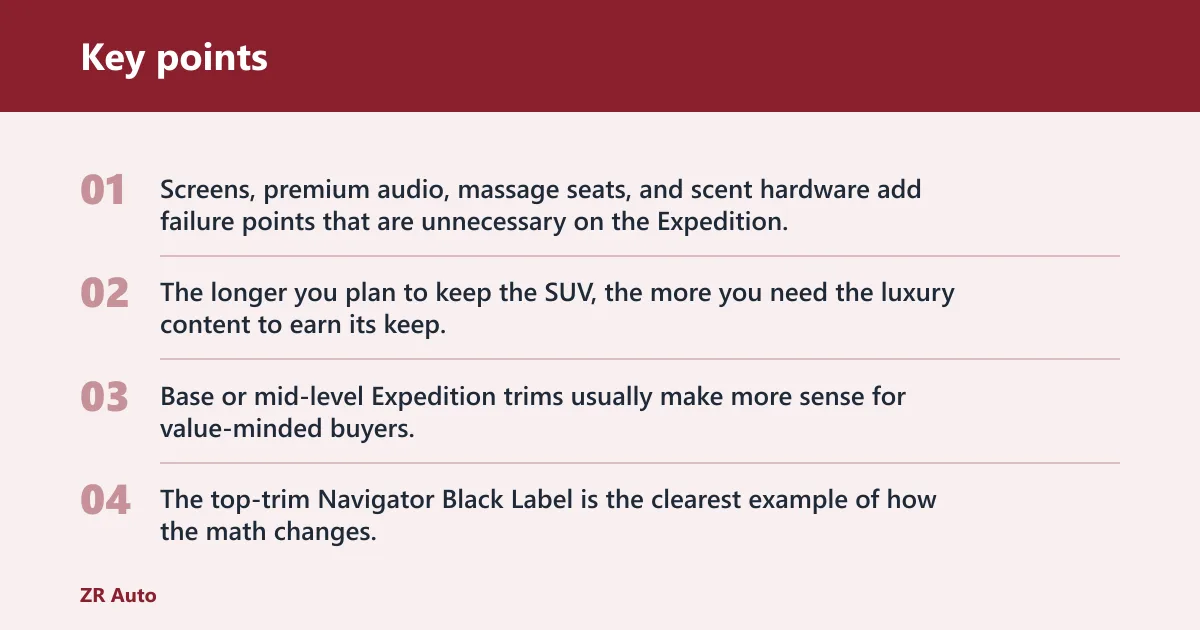
Shared Ford parts help both models avoid some truly exotic costs, but the Navigator still carries more risk from Lincoln-only equipment. Screens, premium audio, massage seats, and scent hardware add failure points that are unnecessary on the Expedition.
That does not mean the Navigator is fragile. It means the bill can get larger when luxury features, rather than the truck basics, are what needs attention.
Feature value versus ownership length
The longer you plan to keep the SUV, the more you need the luxury content to earn its keep. A short ownership cycle can make a well-priced Navigator look attractive, especially if depreciation has already taken a bigger bite out of the sticker.
For a longer hold, the Expedition often wins because it asks less up front and leaves more budget for repairs, fuel, and wear items.
Best-buy trim scenarios
Base or mid-level Expedition trims usually make more sense for value-minded buyers. On the Navigator side, the best cases are clean higher trims with equipment you will actually use, especially when the price gap versus an equivalent Expedition is kept under control.
The top-trim Navigator Black Label is the clearest example of how the math changes. MotorTrend listed the 2025 test vehicle as a Black Label model at an as-tested price of $120,490, which tells you how expensive the fully loaded end of the range can get. (Motortrend)
Is the Lincoln Navigator worth the premium?
The Navigator is worth the premium only when you want the luxury equipment and the asking price is low enough to make that equipment feel earned. If the truck is mainly a family hauler, the Expedition usually makes more sense because it delivers the same basic size with less cost and less feature-driven risk.
When luxury features justify the extra cost
The case for the Navigator gets stronger when the cabin matters as much as the cargo room. The 48-inch curved pillar-to-pillar screen, 28-speaker Revel Ultima system, rear captain’s chairs with heating, ventilation, and massage, genuine wood in Black Label trim, and the digital scent dispenser all create a clear step up in content.
If those features are part of the reason you want the SUV, then the premium is real value rather than dead weight.
When depreciation helps you
Used luxury SUVs often lose value faster than their mainstream siblings, and that can work in your favor. A clean Navigator that has already taken a large depreciation hit can become tempting if the price gap to an Expedition narrows and the condition is strong.
But the discount has to be meaningful. If the Navigator still costs much more while also carrying more feature complexity, the Expedition remains the safer buy.
Suppose a shopper finds two similar-mileage examples. If the Navigator is only a little more expensive, the luxury upgrade may be worth it; if it is $10,000 or more higher and the extra equipment does not matter, the Expedition keeps more money in reserve for ownership.
How much does the Expedition save?
The Expedition usually saves money at purchase, and that lower entry price is the main reason it wins for most used buyers. It also tends to keep the ownership bill simpler because you are paying for fewer Lincoln-only features that can turn into expensive repairs later.
Shared-platform value
The Expedition and Navigator share their basic architecture, which means the Expedition gives up less utility than its price difference suggests. You still get the same full-size SUV shape, the same family-hauling usefulness, and the same broad parts-sibling relationship.
That makes it the logical default when your priority is value rather than luxury content.
Where the Expedition gives up the least
The Expedition gives up the least in areas that matter to most used buyers: seating, cargo utility, and general road-trip capability. The trade-off is mostly in cabin polish and premium amenities, not in the core job the truck is expected to do.
If your use case is school runs, vacations, and towing a trailer a few times a year, the Expedition is the easier recommendation.
Which is better for towing and family hauling?
For towing and family hauling, the right answer depends more on trim and equipment than on badge alone. Both are large three-row SUVs, but the Expedition is usually the better value if you want the truck to work hard, while the Navigator makes sense if the family cabin is the priority and you will use the luxury gear often.
Cabin space and trailer use
The shared platform means the basic packaging is close enough that either one can serve as a big family tow rig. The Navigator adds more comfort for passengers, but comfort does not automatically make towing smarter or cheaper.
For tow duty, check the exact towing package, axle ratio, hitch equipment, and load ratings on the specific listing. Follow the vehicle manual, never work under a vehicle held only by a jack, never exceed the vehicle’s rated roof, hitch, or tow limit, keep items out of airbag zones and the driver’s view, and check local laws.
What to verify in the listing
-
Check the trim first.
Match the exact trim and equipment list before comparing prices. A loaded Navigator and a basic Expedition do not compete on the same terms. -
Inspect electronics closely.
Make sure the display, audio, seat functions, and rear climate controls work as expected. Luxury convenience features can be expensive to sort out later. -
Confirm towing hardware.
Ask for the factory tow package details and verify the vehicle’s rated limits in the manual. Do not assume the badge alone tells you what the truck can pull.
Common first-timer mistake: choosing the nicer cabin and forgetting that a bigger tow workload can punish neglected maintenance faster. A clean Expedition with the right equipment is often the better working truck.
Interior quality and tech differences
The Navigator clearly wins on cabin presentation, but the gap is not as clean as the badge suggests. MotorTrend said the materials let the Navigator down versus rivals, and also noted genuine wood in Black Label trim while criticizing lower-door and dash plastics. That mixed result matters if you are shopping used, because the premium is supposed to buy a consistently better interior.
48-inch curved pillar-to-pillar display
The Navigator’s 48-inch curved pillar-to-pillar screen is one of its biggest used-buy talking points. It gives the cabin a modern look and keeps key information in easy view, which may matter if you want the truck to feel current for several years.
But big screens age differently from stitched trim. Before you pay extra, check that the display boots cleanly, responds normally, and does not hide dead pixels or odd behavior.
28-speaker Revel Ultima audio
The 28-speaker Revel Ultima system is the kind of hardware that can justify the Navigator for buyers who care about long drives and better sound. It is a real feature, not a marketing line, and it is part of what separates the Lincoln from the Ford.
If you do not listen to music much, though, that advantage shrinks fast. The Expedition’s simpler cabin becomes easier to value.
Real wood, plastics, and perceived cabin quality
MotorTrend’s comparison makes the core point well: genuine wood helps, but lower-door and dash plastics can still weaken the luxury feel. That is why some used Navigators feel premium in the right places and ordinary in others.
The Expedition is less likely to disappoint on false promises because it starts from a value-first brief. You are buying function first, polish second.
Choose Lincoln Navigator if… / Choose Ford Expedition if…
Choose the Lincoln Navigator if you want the better cabin, plan to keep the SUV long enough to use the premium features, and find a price gap that stays reasonable for the mileage and condition. Choose the Ford Expedition if you want the better used buy, lower repair exposure, and the strongest value for towing, family hauling, and everyday use.
Choose lincoln navigator if…
- You want the 48-inch curved pillar-to-pillar screen, 28-speaker Revel Ultima audio, and Black Label cabin content.
- The asking price is only modestly above a comparable Expedition, not dramatically higher.
- You will keep the SUV long enough for the luxury equipment to matter in daily use.
- You are comfortable with a higher chance of costly electronics or trim-related repairs.
Choose ford expedition if…
- You care most about price, condition, and lower ownership risk.
- You want the shared platform benefits without paying for Lincoln-only features.
- You need a family hauler or tow rig and do not need the top-end luxury cabin.
- You would rather reserve money for maintenance, tires, and repairs than for cabin gadgets.
Frequently asked questions
Is a used Lincoln Navigator or Ford Expedition better?
The Ford Expedition is better for most used buyers because it usually costs less and brings lower feature-driven risk. The Lincoln Navigator is the better choice only when the cabin upgrade matters enough to justify a larger purchase price and more expensive equipment.
Which is more reliable used, Lincoln Navigator or Ford Expedition?
The Ford Expedition is usually the safer reliability bet in used shopping because it has fewer luxury systems to fail. The Navigator shares much of the same platform, but its extra screens, audio, seat functions, and trim hardware create more things to inspect and maintain.
Which used SUV has lower maintenance costs, Navigator or Expedition?
The Ford Expedition generally has lower maintenance exposure because it is the simpler value-oriented sibling. The Navigator can cost more to keep in shape, especially when its premium cabin equipment, electronic features, and luxury trim details need attention.
Is the Lincoln Navigator just a fancier Ford Expedition?
That is the right shorthand, with an important caveat: it is fancier, but not all of that extra polish is equally durable or equally valuable to a used buyer. The Navigator adds real luxury content, while the Expedition keeps the shared-platform basics at a lower price.
What are the biggest differences between the Navigator and Expedition?
The biggest differences are cabin content, perceived materials quality, and price. The Navigator adds the 48-inch curved pillar-to-pillar screen, 28-speaker Revel Ultima audio, Black Label features, and more upscale trim, while the Expedition stays closer to the value end of the same underlying truck formula.
How much more should I pay for a used Lincoln Navigator over an Expedition?
A reasonable target is roughly $8,000 to $15,000 more for similar years and mileage, and only if the condition and option content support it. If the gap is wider than that, the Expedition is usually the smarter purchase unless you specifically want the Navigator’s luxury features.