Lincoln Aviator Problems, Best Years, and Costs
For used buyers, the safer Lincoln Aviator picks are generally 2021 and newer, with 2023 often seen as a stronger recent target. Start there first, then move to 2022 or a late 2021 only if service records are complete and the truck passes a hard inspection. Skip a bad year and you can inherit expensive air-suspension, electronics, or powertrain repairs that erase the SUV’s price advantage. This guide sorts the trouble years, the stronger years, and the real maintenance and repair costs to budget before you buy.
Lincoln Aviator years to avoid
The clearest avoid list is the 2003-2005 Aviator, plus the 2020-2021 return of the nameplate. The early truck has a long record of body, paint, transmission, and engine complaints, while the newer version opened with weak reliability and expensive electronic and drivability issues. The 2023 model is the safer recent pick, but it still needs records and a hard inspection.
2003-2005: highest-risk early years
These are the years to skip first. The 2003-2005 Aviator years are tied to rear liftgate panel cracking, clear coat deterioration on the 2005 model, transmission problems, and cylinder leakage that can lead to misfires. The 2004 model is said to have over 165 reported complaints, and the 2003-2005 group carries 76 technical service bulletins tied to body and paint issues.
2020-2021: newer does not mean trouble-free
The 2020-2021 Aviator also belongs on the avoid list. Consumer Reports reportedly rated the 2020 Aviator poorly on reliability, and the recent truck has drawn complaints about electronics, climate control, steering, and powertrain behavior. That means the bargain price on a used example can be misleading if the vehicle still needs software work or expensive repairs.
2023: the safer recent pick
The 2023 Aviator is the better recent-year target because it shows significant improvements over the launch years. That does not make it a no-risk buy. It does mean you should start your search there before moving to 2022 or to a late 2021 vehicle only if the records are unusually complete and the inspection is clean.
Aviator ownership risk table
This table gives you the quick sort. Use it to decide which year bands deserve a deep inspection and which ones deserve a hard pass. The repair-risk level is a buyer judgment, not a factory rating, and the cost bands reflect the sourced ten-year pressure noted for the early generation.
| Model year or range | Likely problem areas | Expected repair-risk level | Estimated 10-year cost band | Buy or not-buy |
|---|---|---|---|---|
| 2003 | Stuck shifter rods, erratic gear changes, transmission slip, engine misfires, rear liftgate cracking | High | About $12,000 or more in repair-heavy ownership | Not-buy |
| 2004 | Transmission issues, cylinder leakage, misfires, poor performance, body and paint complaints | High | About $12,000 or more in repair-heavy ownership | Not-buy |
| 2005 | Clear coat deterioration, bubbling, transmission rough shifting, engine shutdown risk | High | About $12,000 or more in repair-heavy ownership | Not-buy |
| 2020 | Electronics, climate control, steering, powertrain complaints; weak reliability context | High | Above-average and condition-dependent | Avoid unless fully documented |
| 2021 | Same early-run risk profile as 2020; verify updates, recalls, and repeat repairs | Moderate to high | Above-average and condition-dependent | Cautious only |
| 2023 | Still inspect electronics, drivability, and service history, but fewer early-run concerns | Moderate | Typical luxury-SUV upkeep plus condition-based repairs | Best recent buy |
What goes wrong in the early Aviator?
The early Aviator’s problem set is broad enough to affect both daily use and resale value. Transmission symptoms, engine failure signs, liftgate cracking, and paint deterioration all show up in the same generation, which is why a cheap purchase price can be a trap.
Transmission symptoms and failure patterns
Look for slipping, rough shifting, gear selector breakage, and complete failure risk. The 2003 model is described as having stuck shifter rods and erratic gear changes, which suggests a more serious issue than a simple fluid-service problem. If the truck hesitates between gears, bangs into gear, or feels confused at low speed, treat that as a warning that a major repair may be near.
Suppose a 2004 Aviator moves cleanly for the first few miles, then starts hunting between gears on a mild uphill merge. That kind of behavior matters more than a warning light alone, because it points to a drivability fault that can become a safety issue under load or while passing.
Engine misfire, leakage, and shutdown warning signs
The early truck is also described as having cylinder leakage that caused misfires. That can show up as poor performance, rough idle, flashing or steady misfire behavior, or unexpected shutdowns while driving. A seller who calls it “just a tune-up” may be minimizing a deeper internal problem.
For a buyer, the key question is whether the issue was corrected or merely cleared. A repeated misfire code, coolant loss, or power loss at speed is not a cosmetic annoyance. It is a sign to stop the deal until the repair history makes sense.
Rear liftgate cracking and paint issues
The rear liftgate panel cracking issue is one of the most useful inspection points before purchase. Check the panel edges, seams, and the area around the glass and trim. On the 2005 model, clear coat deterioration and bubbling were reported between 69,000 and 90,000 miles, and that kind of paint failure hurts resale value fast.
These are not minor age marks. Paint failure on a luxury SUV pulls down trade-in value, hints at cost-cutting repairs, and can hide prior body work. A bubbling hood or roof should push you toward a different truck unless the price is discounted enough to cover refinishing.
What the 76 technical service bulletins tell you
Seventy-six technical service bulletins across the 2003-2005 years tell you the platform needed repeated fixes. That does not mean every truck is broken, but it does mean the safest purchase is one with a thick file of completed repairs, not a thin folder and a vague story. If the seller cannot show the fixes, assume you will pay for them.
What goes wrong in the recent Aviator?
The 2020-2021 Aviator is newer, but the early ownership experience was still rough enough to keep it off the short list. Consumer Reports rated the 2020 Aviator 2/5, and the complaint pattern reaches beyond one annoying feature. Buyers reported issues tied to electronics, climate control, steering, and powertrain behavior.
Reliability context for 2020-2021
The main trap here is assuming “newer” means “safe.” It does not. A low-mileage 2020 or 2021 can still carry first-run software bugs, expensive module faults, and repeat shop visits that make the total cost much higher than a slightly older but better-sorted SUV.
That is why service history matters so much. If the vehicle has already had repeated dealer visits for the same complaint, the next owner may be the one who funds the final repair cycle.
Transmission and drivability complaints
Even in the newer truck, transmission behavior remains a watch item. Rough shifting, hesitation, or a delay when pulling away from a stop is not something to ignore on a luxury SUV this price class. If the gear changes feel clumsy during a normal road test, the issue may be electronic, hydraulic, or both.
Infotainment and electronic faults
Infotainment complaints matter here because they often point to broader electrical instability. A touchscreen freeze can be annoying; a climate-control failure, steering fault, or powertrain fault is much more serious. When multiple systems fail together, the repair bill can climb quickly.
What improved by 2023
The safer takeaway is not that every problem disappeared. It appears the first-year pain points were reduced enough to make 2023 the first recent model year worth serious attention.
Which Aviator years are the best buys?
The best buys are the least troubled years with the cleanest records. For used shoppers, that usually means 2023 first, then later examples only if the service file is strong and the inspection is clean. The early 2003-2005 trucks are only worth considering as history projects, not as low-risk family transport.
Best used-year ranges by risk level
Start with 2023 if you want the best mix of modern features and lower early-run risk. If you are shopping the 2020-2021 range, buy only when the vehicle has complete recall work, repeat repair documentation, and a passing inspection. Skip the 2003-2005 years unless you are prepared for body, paint, and mechanical work.
When a lower-mileage recent model makes sense
A low-mileage 2021 can make sense when the price is discounted, the warranty history is documented, and the vehicle has no repeat complaints tied to the same system. That is a narrow lane. The more complex the equipment, the more important it becomes to see repair invoices instead of relying on mileage alone.
When an early truck is only a parts-and-history buy
If you are tempted by a 2003-2005 Aviator, treat it as a parts-and-history buy rather than a no-drama family hauler. That means you need service records, bodywork proof, and a budget for repairs that can exceed the purchase discount. Without that, the numbers stop working.
Aviator inspection and service checklist
A pre-purchase inspection matters here more than on many crossovers because the known faults touch the drivetrain, the body, and the electronics. Ask for the records first, then verify the symptoms on the road and at the body panels. If the seller resists any of that, walk away.
Records to ask
- Complete repair invoices, not only a maintenance summary.
- Recall completion proof.
- Any transmission work, including fluid service or rebuild history.
- Engine repair history tied to misfires, leakage, or shutdown complaints.
- Body and paint repair records for liftgate, roof, or panel work.
Recall and TSB checks
Check open recalls before you negotiate. Then ask whether the dealer or independent shop has addressed the known bulletin items. A stack of completed work matters because a seller who already fixed the known weak points is passing you less risk.
Test-drive symptoms to verify
During the drive, watch for rough shifts, gear hesitation, warning messages, and any sudden loss of power. Turn the climate system on and off. Test steering feel at parking speed and on a straight road. If several systems act odd in the same drive, assume the truck needs a deeper diagnosis.
A common first-timer mistake is to accept a smooth idle in the parking lot and ignore a rough shift under load. That misses the problem. A luxury SUV can idle fine and still have a transmission or engine issue that shows up only when it is warm and moving.
Body, paint, and liftgate inspection points
On the early Aviator, inspect the rear liftgate panel closely for cracking. Then inspect the paint for bubbling, especially on the 2005 model and especially near the mileage band where the issue was reported. Look at panel alignment and mismatched paint texture, which can hint at prior repair work.
What do ownership costs look like?
The first cost mistake is focusing only on the sticker price. On a used Aviator, the bigger question is how fast repairs, depreciation, fuel, insurance, tires, and brakes eat into the savings. The early 2003-2005 years are the hardest hit because repair costs can exceed $12,000 over ten years.
Repair cost pressure versus depreciation
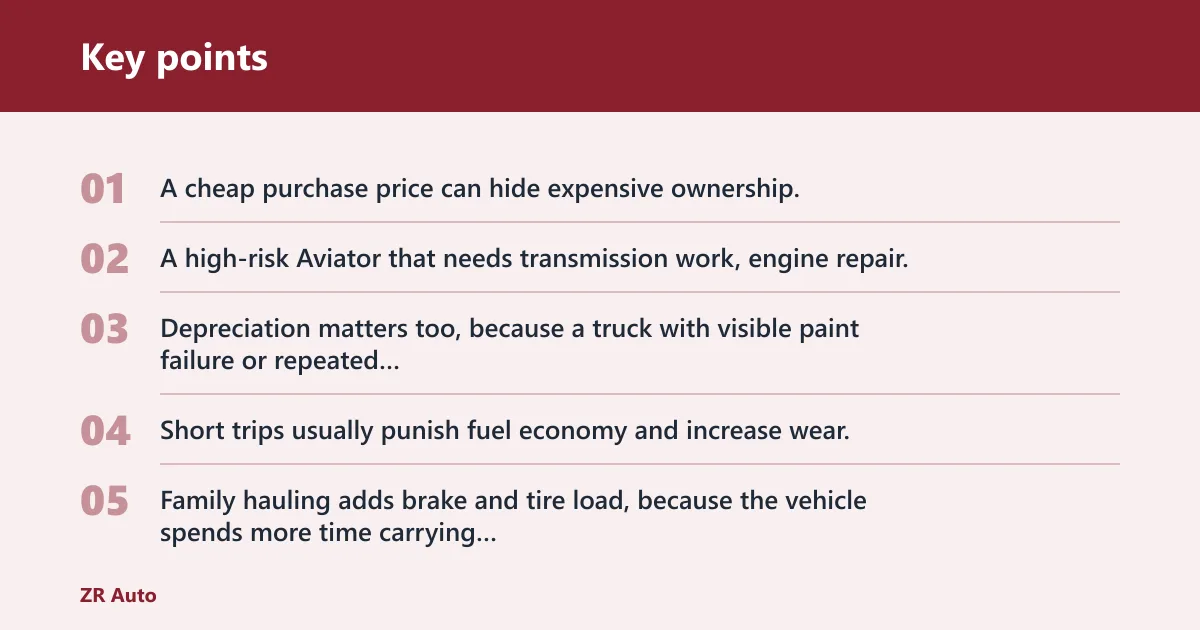
A cheap purchase price can hide expensive ownership. A high-risk Aviator that needs transmission work, engine repair, and body refinishing can end up costing more than a better year bought for more money. Depreciation matters too, because a truck with visible paint failure or repeated mechanical issues loses resale value faster.
Fuel, insurance, tires, and brakes by usage pattern
Short trips usually punish fuel economy and increase wear, especially if the truck never fully warms up. Family hauling adds brake and tire load, because the vehicle spends more time carrying people and cargo. Towing raises the stakes further, since drivetrain strain can make weak transmission behavior show up sooner.
Long commutes are different. They can be easier on brakes than stop-and-go use, but they still expose a marginal transmission or electronics issue over time. If you commute daily and depend on the truck, a weak year makes little sense even at a discount.
Usage pattern guidance
If you need a family hauler, aim for 2023 and newer with clear records. If your driving is mostly short trips, avoid the early 2000s trucks because repeated cold starts and short runs make small faults become larger ones. If you plan to tow, keep the search to the cleanest recent years only.
For long commutes, the best bet is the newer model with the strongest paper trail. That is where a clean service file matters more than a low odometer reading.
Aviator versus similar luxury SUVs
Compared with other luxury midsize SUVs, the Aviator’s risk profile is less about one obvious flaw and more about how year and condition change the outcome. The early 2003-2005 years look worse than many peers because of body, paint, transmission, and engine exposure. The 2020-2021 run is better than that, but still not a casual buy.
How repair risk compares at a high level
If you are cross-shopping, compare not only price and mileage but also how much the platform has already proven itself in the years you are considering. A cheaper Aviator can lose to a pricier rival if the rival has fewer repeat issues and better documented upkeep.
What to compare before you buy
Compare service history, recall status, known bulletin work, and the cost of the specific repairs you may need. Then compare the truck on a test drive, not on paper. If one SUV needs a long list of deferred fixes and the other does not, the lower asking price is not the better deal.
Frequently asked questions
Which Lincoln Aviator years should I avoid?
The early truck has transmission, engine, paint, and liftgate problems, while the newer return of the nameplate opened with weak reliability and broader electronic and drivability complaints. A clean service file can reduce risk, but it does not erase it.
What are the most reliable Lincoln Aviator years?
The 2023 Aviator is the safest recent pick in this guide because it shows significant improvements over the launch years. It still deserves a full inspection, but it starts from a better place than the 2020-2021 trucks. For older models, condition matters more than age, and the early 2000s still rank as high risk.
How much does it cost to maintain a Lincoln Aviator?
Maintenance cost varies by year, mileage, and use pattern, but repair risk is the key issue on the weak years. Fuel, brakes, tires, and insurance then add on top of that, especially for family hauling or towing.
What problems are common in the 2003-2005 Lincoln Aviator?
Common problems include transmission slipping and rough shifting, stuck shifter rods, erratic gear changes, cylinder leakage with misfires, rear liftgate panel cracking, and clear coat deterioration and bubbling on the 2005 model. These issues are serious because they affect drivability, body condition, and resale value at the same time.
What problems are common in the 2020-2021 Lincoln Aviator?
The 2020-2021 Aviator has complaints tied to electronics, climate control, steering, and powertrain behavior. Consumer Reports gave the 2020 model a reliability score of 2/5. That is why a cheap used example is not automatically a bargain; repeated repairs can erase any savings.
Is the 2023 Lincoln Aviator more reliable?
Yes, the 2023 Aviator is the better recent choice because it shows significant improvements over the launch years. That said, “better” is not the same as “problem-free.” You still need recall checks, service records, and a proper pre-purchase inspection before you commit to any used Aviator.