
What Are the Most Common Problems with the Volvo XC60 Hybrid?
The most common Volvo XC60 hybrid problems are charging faults, 12-volt battery drain, software glitches, coolant or thermal-management issues, and engine or transmission warnings; any repeated high-voltage fault, charging failure, or limp-mode message should be treated as a hard stop. Ignore them, and you can end up with a car that will not charge, will not start, or needs dealer-level repairs. This guide breaks the failures down by system and shows which symptoms are normal, which need diagnostics, and which should kill the deal.
Volvo XC60 hybrid risk checklist
The XC60 plug-in hybrid makes the most sense if you can charge at home regularly. That is where the T8/Recharge powertrain earns its keep. Skip charging, and the value case changes fast. It can also hide battery, control, or charging-system faults that only show up after repeated use.
For used buyers, the key is separating three things: harmless software behavior, a fixable service issue, and a fault that points to a costly hybrid-system repair. Full service history, dealer software updates, recall completion, and maintenance records matter here more than on a simple gasoline XC60.
What are the most common problems with the Volvo XC60 hybrid?
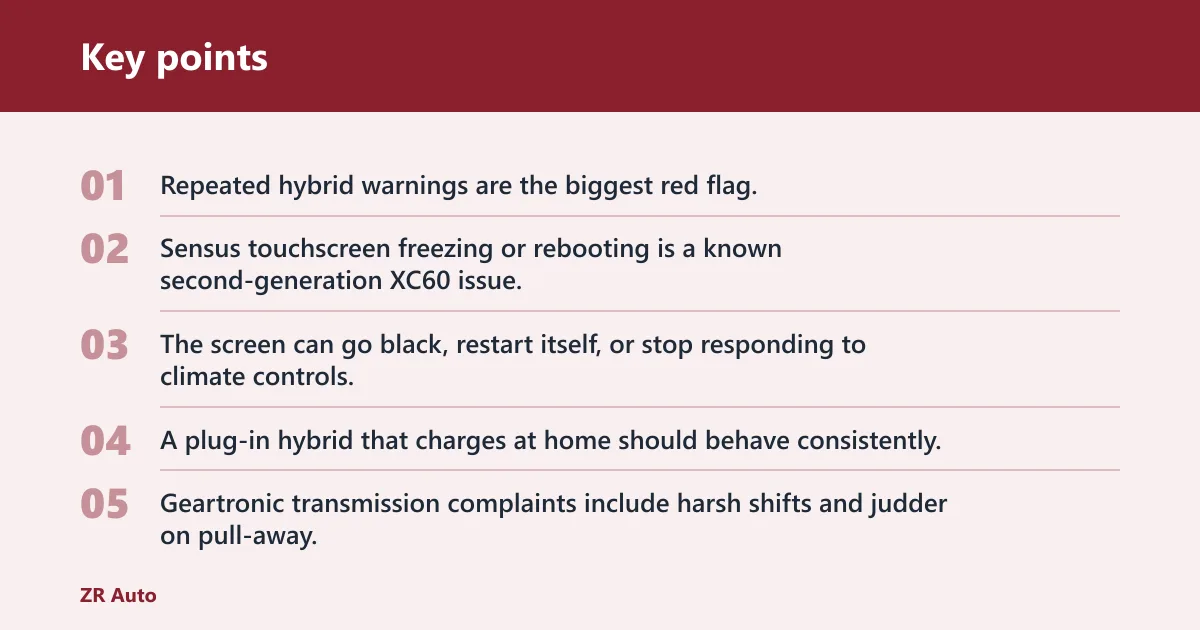
The most common XC60 hybrid complaints cluster around the infotainment screen, charging behavior, hybrid control electronics, and the automatic gearbox. On plug-in models, the warning signs usually start as messages, odd screen behavior, or uneven charging before they become a no-drive fault. Repeated hybrid warnings are the biggest red flag.
Infotainment and software faults
Sensus touchscreen freezing or rebooting is a known second-generation XC60 issue. The screen can go black, restart itself, or stop responding to climate controls. That matters because heat, fan speed, seat settings, and other core functions are tied into the screen, so a “small” screen fault can become an everyday annoyance.
Battery and charging issues
High-voltage battery issues usually show up as weak electric range, failed charging sessions, or repeated state-of-charge warnings. A plug-in hybrid that charges at home should behave consistently. If it does not, the problem may be the cable, charge port, onboard charging hardware, software calibration, or the battery system itself.
Transmission and driveline complaints
Geartronic transmission complaints include harsh shifts and judder on pull-away. Flipcar notes that this can appear from around 80,000 miles. A thin fluid-service record makes that more concerning. If the gearbox is already hesitant or jerky, repair cost risk is real, especially on a hybrid with more complex driveline control.
What should you check on a used XC60 Recharge?
Start with records, then move to charging and dashboard behavior. The best used XC60 hybrid is one with complete maintenance documentation, dealer software updates, and no unresolved warnings. A good-looking car with missing history is harder to trust, because hybrid faults often leave little physical evidence until the warning lights appear.
-
Verify the service file. Ask for full service history, recall completion, and evidence of dealer software updates. That matters especially on a plug-in hybrid, where control-unit calibration and software fixes can change how the charging and hybrid systems behave.
-
Check charging history. Confirm whether the car has been charged at home regularly. The XC60 plug-in hybrid is “quick and cheap to run” if you can charge at home, but skipped charging changes the ownership case and can hide degraded electric-use behavior.
-
Inspect the warning display. Turn the car on and look for hybrid, charging, drivetrain, or 12-volt messages. Stored fault codes matter even if the dash looks clear, because intermittent faults can clear themselves and return under load or after a charging attempt.
-
Test electric operation. Check that the car starts, moves, and transitions as expected in electric mode. Watch the state-of-charge display for obvious inconsistencies, and confirm that the vehicle accepts a charge from the cable and port without repeated interruption.
If an XC60 Recharge drives normally but the battery never rises above a low state of charge after a full overnight plug-in, that can point to a charging-system fault, a software issue, or battery-management trouble. That is not a minor quirk. It points toward a charging-system fault, a software issue, or battery management trouble that needs diagnosis before purchase.
Suppose the seller says the infotainment “just needs a reset,” yet the climate controls stop responding during the test drive. That is a bigger concern than a brief screen reboot, because the screen is part of the car’s core control layer, not a separate accessory.
What problems should I check on a used Volvo XC60 Recharge?
Check for faults that affect charging, hybrid operation, and core controls. A used XC60 Recharge can be a strong premium SUV, but it should not show repeated warning lights, failed charging sessions, or unexplained loss of electric range. Those symptoms can indicate a problem that will not stay cheap.
Pay close attention to whether the battery charges cleanly, whether the infotainment behaves for several minutes, and whether the gearbox pulls away smoothly. If those three systems are clean, the car is much easier to justify.
Are XC60 hybrid infotainment faults a big deal?
Yes, because the screen is tied to more than audio menus. Sensus freezing, rebooting, or going black is often fixable with software, but repeated failures can interrupt climate control and other basic functions. A one-off glitch is less serious than a reboot loop or a screen that repeatedly loses response on the test drive.
Sensus freezing, rebooting, and black screens
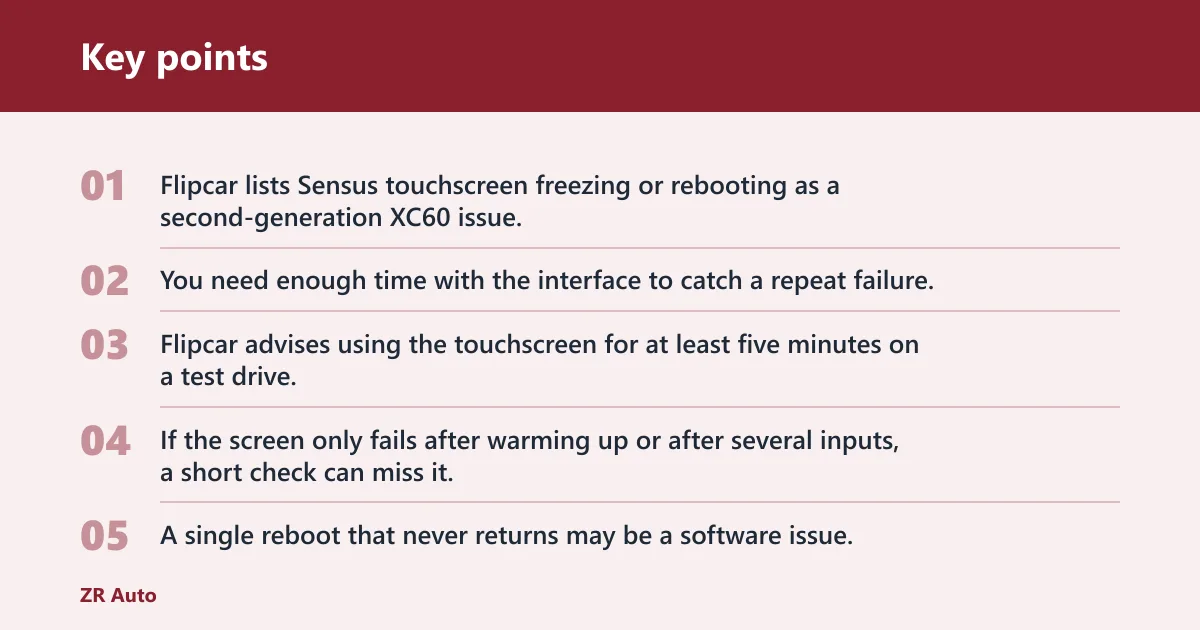
The same source lists Sensus touchscreen freezing or rebooting as a second-generation XC60 issue. It also notes that the screen can go black, restart itself, or stop responding to climate controls. That is why a quick glance is not enough. You need enough time with the interface to catch a repeat failure.
How long to test the screen
Flipcar advises using the touchscreen for at least five minutes on a test drive. That gives enough time to open menus, adjust climate settings, and check for delays or restarts. If the screen only fails after warming up or after several inputs, a short check can miss it.
When a reset is enough
A single reboot that never returns may be a software issue. A screen that blacks out repeatedly, locks up climate controls, or loses response after an update is more serious. If there is no proof of recent dealer software updates, assume the problem may come back.
A common first-timer mistake is treating any touchscreen issue as cosmetic. On the XC60 hybrid, that screen is part of the car’s control system. A black screen can mean no climate adjustment, no clear status readout, and no easy way to judge whether other warning messages are hidden underneath.
How do battery and charging problems usually appear?
Battery and charging faults usually show up as uneven electric range, failed charging attempts, or repeated hybrid messages rather than a sudden total failure. The important question is whether the car behaves predictably when plugged in and whether the state of charge changes as expected. If it does not, the fault needs proper diagnostics.
Low range or odd state of charge
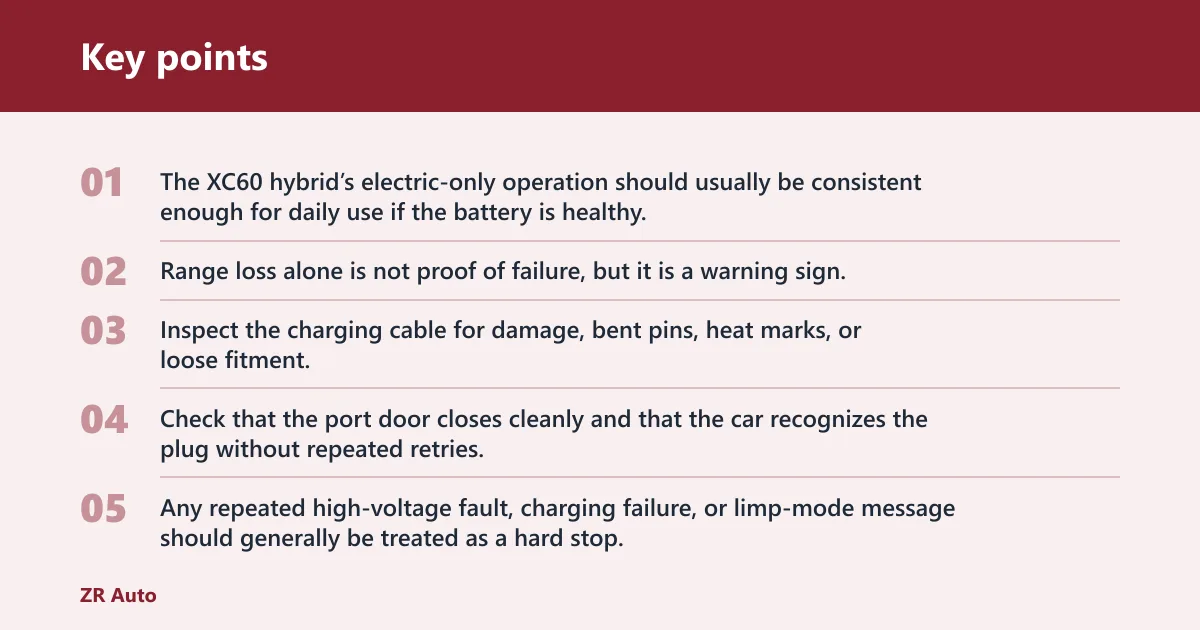
The XC60 hybrid’s electric-only operation should usually be consistent enough for daily use if the battery is healthy. A low or erratic state of charge after charging can point to battery degradation, software calibration problems, or a charging-system issue. Range loss alone is not proof of failure, but it is a warning sign.
Charging cable and port checks
Inspect the charging cable for damage, bent pins, heat marks, or loose fitment. Check that the port door closes cleanly and that the car recognizes the plug without repeated retries. If the car is finicky with one cable but not another, the issue may be external; if it fails with known-good equipment, the concern is higher.
When hybrid faults need dealer diagnostics
Any repeated high-voltage fault, charging failure, or limp-mode message should generally be treated as a hard stop. The hybrid system is complex and costly to fix out of warranty. Even a car that still drives can be hiding a fault code that only a proper scan tool will reveal.
| Symptom | Likely cause | Quick driveway check | Buy/no-buy severity |
|---|---|---|---|
| Screen freezes once | Sensus software glitch | Use the touchscreen for at least five minutes and check if it recovers after a restart | Buy if isolated and documented; diagnose if repeated |
| Screen goes black | Display or control-module fault | Check whether climate controls still respond and whether the screen wakes normally | Diagnostic needed; no-buy if repeat issue |
| Climate controls stop responding | Sensus integration fault | Change temperature, fan speed, and defrost settings from the screen | Diagnostic needed |
| Charging session fails | Cable, port, charger, or onboard charging fault | Try a known-good cable and confirm the car accepts charge consistently | Diagnostic needed; no-buy if repeat fault |
| Electric range is far lower than expected | Battery state, software, or usage pattern issue | Check state of charge after a full charge and see whether the number changes predictably | Buy with caution if explainable; diagnose if severe |
| Hybrid warning message | Control electronics or battery-management fault | Look for stored codes or repeat alerts after a restart | No-buy until scanned |
| Limp mode | Serious hybrid or drivetrain fault | Check whether power is limited and whether warnings return immediately | No-buy |
| Harsh shift | Geartronic or adaptation issue | Test gentle and hard acceleration from a stop | Diagnostic needed |
| Judder on pull-away | Transmission or driveline wear | Pull away slowly on level ground and on a slight incline | No-buy if persistent |
| AWD service message | AWD system fault | Check for warning text on the dash during the drive | Diagnostic needed; no-buy if unresolved |
Geartronic transmission and drivetrain faults
Transmission complaints are important because they can turn an otherwise decent XC60 hybrid into an expensive ownership risk. Harsh shifts and pull-away judder are the main symptoms to watch for. If the car already feels unsettled at low speed, the problem is unlikely to be a harmless software quirk.
Harsh shifts and pull-away judder
The same source says the automatic gearbox can show harsh shifts or judder from around 80,000 miles. That does not guarantee failure, but it does move the car into a higher-risk group, especially if the service record is thin or the car has seen lots of stop-start use without proper maintenance.
Fluid service history and repair cost risk
Gearbox fluid history matters because transmission wear often grows quietly. If the fluid has not been changed on schedule, the cost can rise quickly from routine maintenance to repair work. On a hybrid, the bill can climb further because drivetrain control and hybrid electronics are tied together.
When drivetrain symptoms should kill the deal
If the car shudders on pull-away, slips between gears, or throws an AWD service message, walk away unless the seller can prove a clean, recent repair and scan. Flipcar advises checking AWD cars for an AWD service message. A clean test drive is not enough if the dash has a stored warning.
Is the Volvo XC60 T8 reliable for long-term ownership?
The XC60 T8 can be a solid long-term premium SUV if it is maintained properly and charged at home regularly. That said, its plug-in hybrid hardware adds risk outside warranty, and repair costs can rise fast if the battery, charging, or control systems misbehave. Ownership is most attractive when the car is used as intended.
If you do not charge at home, the plug-in hybrid advantage fades quickly. At that point you are carrying hybrid complexity without getting full benefit from it. That is why a conventional gasoline or diesel XC60 can sometimes be the simpler buy, depending on use case.
Are XC60 hybrid problems worse than diesel XC60 problems?
They are different rather than directly better or worse. The diesel XC60 has its own risks, including DPF issues on short trips, EGR faults on some 2.0 Drive-E diesel engines, and recall items on some diesel models. The hybrid’s risk pattern is more centered on charging, software, and high-voltage systems.
For a shopper, the key difference is this: diesel issues often show up through emissions and exhaust behavior, while hybrid issues show up through charging behavior, screen faults, warning messages, and drivetrain control. That means the inspection method should be different too.
Frequently asked questions
What warning lights or symptoms mean a Volvo XC60 hybrid needs attention?
Any hybrid warning, repeated charging failure, limp mode, or transmission-related message needs attention. A black screen that also kills climate controls is another warning sign. If the car starts but behaves inconsistently, or if fault codes return after a reset, treat it as a serious issue until proven otherwise.
Does the XC60 plug-in hybrid have expensive battery or charging issues?
It can. The hybrid system is complex and costly to fix out of warranty, so repeated charging failures or battery-related warnings should be treated carefully. A single cable problem is one thing. A car that repeatedly refuses to charge, shows a low state of charge after a full plug-in, or enters limp mode is a different level of risk.
What should I inspect on a Volvo XC60 hybrid test drive?
Check the touchscreen for at least five minutes, test climate controls through the screen, confirm the car charges properly, and drive it gently and firmly to watch for harsh shifts or pull-away judder. Also look for warning lights, stored messages, and any AWD service message on the dash.
Which model years of the Volvo XC60 hybrid are safest to buy?
The safest used XC60 hybrid is usually the one with the best records, not simply the newest badge. Look for complete service history, documented dealer software updates, and completed recalls. A cleaner maintenance file matters more than a small model-year difference when you are buying a plug-in hybrid out of warranty.
How much do common XC60 hybrid repairs usually cost?
Costs vary widely, but the important point is that out-of-warranty hybrid repairs can become expensive fast. Screen and software faults may be cheaper than battery or charging hardware problems, while gearbox or hybrid-control repairs can escalate quickly. Any estimate should depend on fault codes, parts availability, and whether the problem is electrical or mechanical.