Is the Dodge Grand Caravan Reliable as a Used Minivan?
A used Dodge Grand Caravan is worth buying only at the low end of the market, after you verify transmission, cooling, and electrical repairs, and only if you avoid neglected high-mileage vans; as a rule, budget about $1,500 to $3,000 for near-term fixes. Skip the history check, and a cheap van can turn into a transmission or cooling bill that erases the savings. This guide covers year-by-year reliability, common failures, and the inspection points that separate a value buy from a money pit.
Mixed reliability figures and high risk of major repair
The Grand Caravan is a mixed used buy. It can work well when the price is low, the service history is complete, and the major systems already had repairs, but neglected examples get expensive fast. Reliability changes with model year, mileage, and maintenance history.
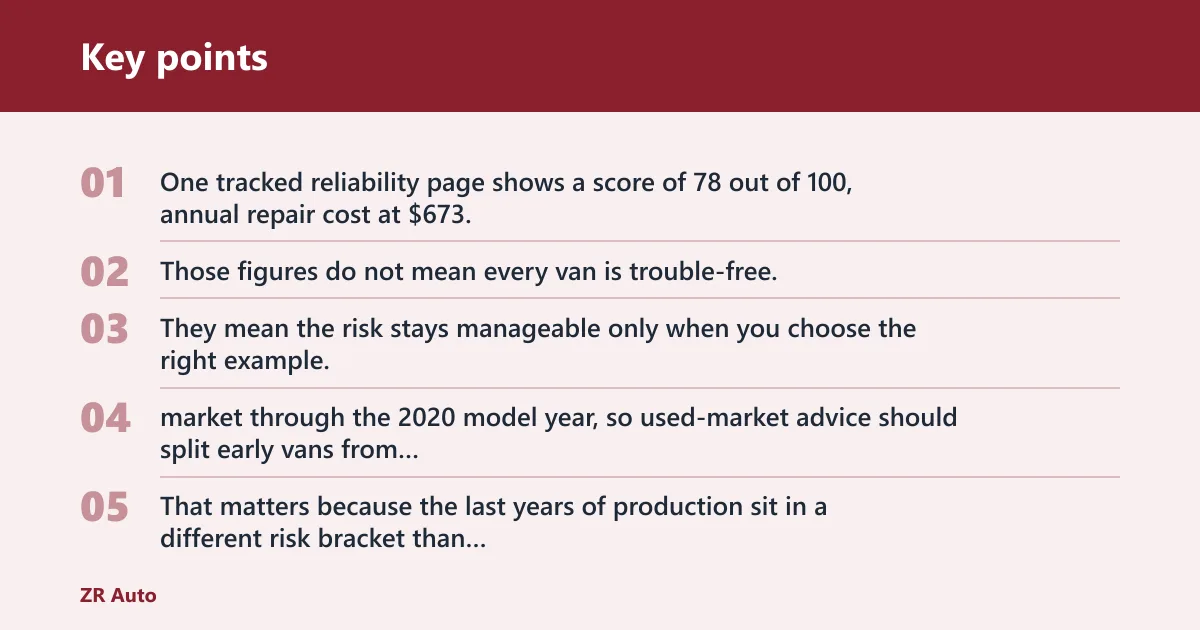
One tracked reliability page shows a score of 78 out of 100, annual repair cost at $673, repair frequency at 0.3 per year, and estimated major repair risk at 11 percent. Those figures do not mean every van is trouble-free. They mean the risk stays manageable only when you choose the right example.
Where value turns into risk
The Grand Caravan stayed in the U.S. market through the 2020 model year, so used-market advice should split early vans from late ones. That matters because the last years of production sit in a different risk bracket than older high-mileage vans, even if they wear the same nameplate. (Wikipedia)
A well-kept van with repair records can still work as family transport. A neglected one with missing records, rough shifting, and door faults is cheap for a reason.
How maintenance history changes the answer
Maintenance history and past repairs have a direct effect on reliability. A van with documented fluid changes, completed recalls, and repaired door or electrical faults is easier to trust than one with no paper trail. The difference shows up in downtime as much as repair bills.
Say your budget is tight and the van already has a clean transmission service record, a working A/C system, and doors that open from the fob every time. That example can make sense. Add a history of overheating or repeated electrical complaints, and the same price stops looking like a bargain.
Grand Caravan reliability by year
Model-year variation matters more here than badge loyalty. Late-model Grand Caravans generally carry better ownership odds than older, higher-mileage vans with incomplete records, but even late examples still need a careful check for recalls, transmissions, and door electronics.
Years with the best ownership odds
Among tracked models, 2020 is listed as the best year, with one recall and 15 owner complaints. That is still not the same as “problem-free,” but it is a better starting point than years with far more complaints and recall activity.
Used buyers should treat the best-year label as a relative ranking, not a guarantee. A clean 2020 with records can be a better buy than a cheap older van with no history.
Years to approach with extra caution
2019 is listed with five recalls and 247 complaints, and 2018 with four recalls and 258 complaints. Those are not automatic no-buys, but they do justify a harder inspection and a lower purchase price because the odds of hidden repair cost are higher.
Older guidance also points to transmission wear or shifting hesitation, plus electrical issues affecting windows, locks, and dashboard indicators. That means early and midlife vans deserve extra scrutiny before you commit.
Grand Caravan buyer-risk matrix
Use mileage and service history together. A lower-mileage van with complete records can be a sensible value play, while a higher-mileage van with no proof of care can turn into a repair sink. The point is not to chase a perfect van. The point is to buy the risk level you can actually support.
| Mileage and history scenario | Likely reliability | Top failure risks | Buy or skip |
|---|---|---|---|
| Under 100,000 miles; full records; recalls completed | Better-than-average for the model if road test is clean | Minor electrical faults, early door wear, routine brake and fluid items | Buy if price leaves room for inspection and first repairs |
| 100,000 to 140,000 miles; partial records; some repair receipts missing | Mixed; usable only if major systems pass inspection | Transmission wear, sliding door faults, cooling leaks, intermittent electronics | Conditional buy only with a discount and pre-purchase inspection |
| Over 140,000 miles; no records; unknown recall status | Poor to uncertain | Refusal to shift, overheating, door latch failure, repeated electrical glitches | Skip unless price is extremely low and repairs are already documented |
| Any mileage; records show major repairs already done and frequent maintenance | Depends on current condition, often better than the odometer suggests | Residual wear in transmission, doors, and cooling parts, but lower surprise risk | Buy if inspection confirms the repairs were real and recent |
A common first-timer mistake is to assume a lower-mileage Grand Caravan is more reliable without checking its sliding doors, transmission history, and maintenance records. A 128,000-mile van with a thick folder of receipts can be safer than a 92,000-mile van with no records and warning lights taped over.
What problems show up most often?
The biggest trouble spots are the transmission, sliding doors and door locks, electrical systems, and cooling parts. Some are nuisance faults. Others can strand the van or make it poor family transport. You need to separate inconvenience from deal-breaker risk before you buy.
Transmission behavior
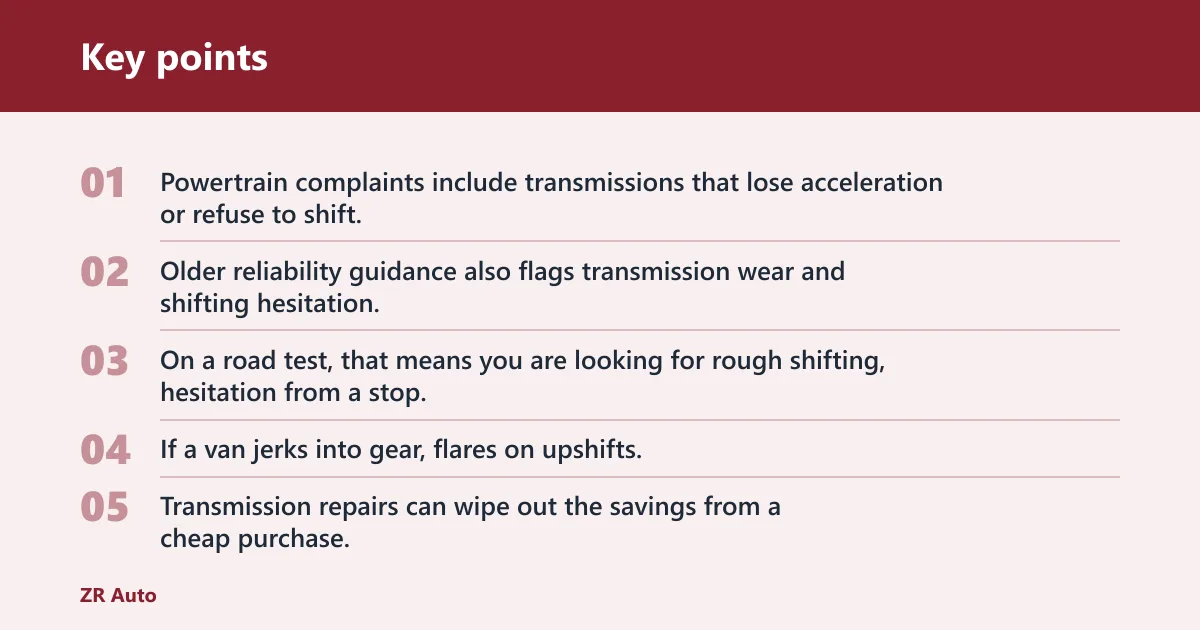
Powertrain complaints include transmissions that lose acceleration or refuse to shift. Older reliability guidance also flags transmission wear and shifting hesitation. On a road test, that means you are looking for rough shifting, hesitation from a stop, slipping under load, or a gear change that simply does not happen when it should.
Those are not small issues. If a van jerks into gear, flares on upshifts, or hesitates when pulling onto a faster road, treat it as a major warning sign. Transmission repairs can wipe out the savings from a cheap purchase.
Sliding doors and door locks
The most common complaint is sliding door locks that jam shut. Power door mechanism failures are also common, along with dead locks by fob, button, or handle. For a family van, that is more than an annoyance. It affects child-seat access, curbside loading, and daily convenience.
Picture a side door that opens with the fob in the seller’s driveway but jams shut after a few cycles. That kind of intermittent failure is expensive because it can hide during a quick visit and return later as a repeated repair.
Electrical glitches
Older examples also saw electrical issues affecting windows, locks, dashboard indicators, radio, display, and climate control. These faults often start small, then spread into convenience problems that are hard to ignore on a family vehicle.
If the display flickers, the blower acts erratically, or a window switch works only sometimes, expect diagnosis time and labor charges. Electrical faults are often less dramatic than a failed transmission, but they still drain a tight used-car budget.
Cooling-system trouble
Cooling-system checks matter because overheating can turn a bargain into a very expensive van. Inspect the radiator, hoses, and coolant condition, and verify that the engine stays stable under load. Also check A/C performance, because weak cooling can point to deeper system issues.
Overheating signs, coolant smell, crusty hose ends, or weak cabin cooling are reasons to pause. A van that runs hot in a short road test should not get a pass because the price is low.
What should you check before buying?
Start with the systems that can cost the most: transmission, sliding doors, cooling, and the electrical accessories that families use every day. Then verify that service records, recalls, and dealer campaigns are all handled. If any of those checks fail, lower the offer or walk away.
Road-test signs of transmission wear
Drive the van long enough to warm it up, then pay attention to shift quality at light throttle and under moderate acceleration. You want smooth gear changes, prompt response, and no slipping. A hesitation, flare, or refusal to shift is a red flag, not a quirk.
Also test reverse, low-speed parking maneuvers, and highway merging. Problems often show up when the transmission is asked to move between gears quickly.
Door, lock, and latch checks
Open and close both sliding doors several times using the handle, button, and fob. Make sure the doors unlatch cleanly, close fully, and do not bind. Confirm that child locks, power locks, and the latch indicators all work as expected.
Try the doors on a slight incline if possible. That can expose weak motors or a sticky latch that looks fine on flat ground.
Cooling and A/C inspection
Watch the temperature gauge and check that the engine does not overheat in stop-and-go driving. Inspect the radiator and hoses for seepage or swelling. Then confirm that the A/C cools quickly at idle and while driving.
If the cabin never gets properly cold, the van may need more than a simple recharge. Weak cooling can point to leaks, fan issues, or compressor trouble.
Records, recalls, and dealer campaigns
Ask for service records that show oil changes, transmission work, cooling repairs, and door fixes. Then check recall completion separately from dealer campaigns. A recall is a safety action tied to a defect; a campaign can cover a repair or update that may not be framed the same way. Both matter, and both should be verified before purchase.
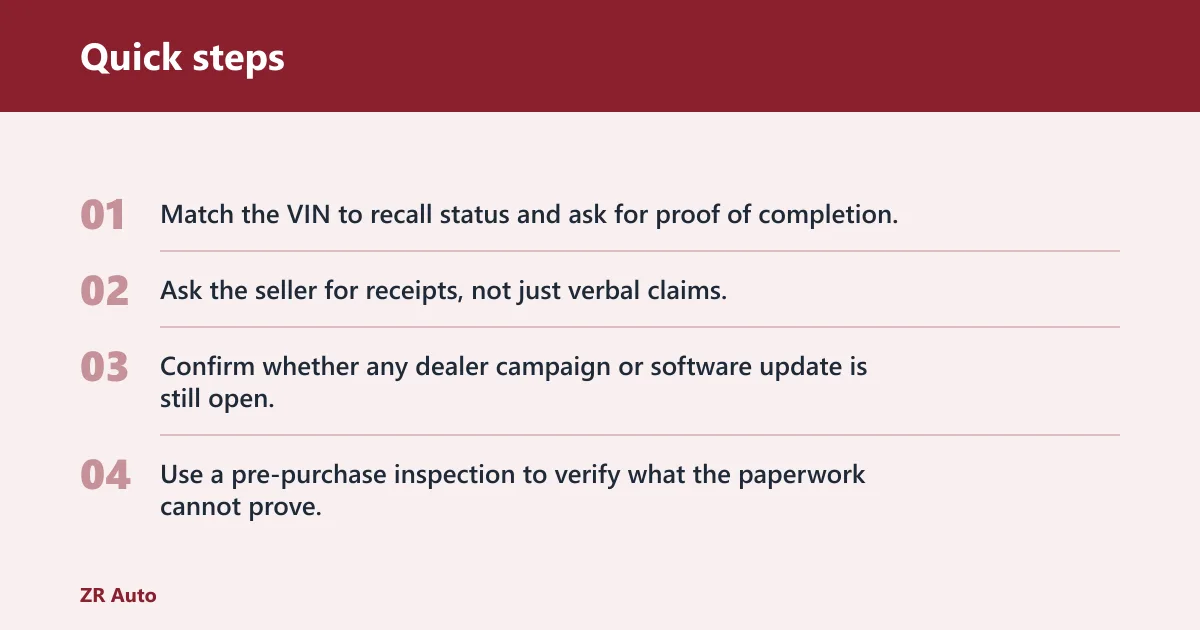
- Match the VIN to recall status and ask for proof of completion.
- Ask the seller for receipts, not just verbal claims.
- Confirm whether any dealer campaign or software update is still open.
- Use a pre-purchase inspection to verify what the paperwork cannot prove.
How much does ownership really cost?
Annual repair cost is estimated at about $673, with repair frequency around 0.3 per year and major repair risk around 11 percent. That is not catastrophic, but it is not cheap either. On a tight budget, you need to treat the van as a purchase plus a repair reserve, not just a sale price.
Repair frequency versus budget risk
If you plan on a low monthly payment but have no reserve for a transmission or cooling repair, the Grand Caravan can become a bad financial fit fast. The lower the purchase price, the more important the reserve becomes. That is why the $1,500 to $3,000 near-term repair buffer matters.
On a family budget, a van with one major repair can cost more than a newer minivan with a better history and fewer surprises. The cheaper purchase price does not always win.
How it compares with newer minivans
Compared with newer minivans, the Grand Caravan can look affordable upfront, but the ownership risk is older and less predictable. Newer vans often cost more to buy, yet they may reduce downtime and surprise repairs. If you need dependable daily family transport, that trade-off matters.
For shoppers who can afford a newer minivan, the Grand Caravan usually makes sense only when the price gap is large and the inspection is clean.
What about safety and family use?
NHTSA safety ratings should be part of the decision because this is a family transport vehicle, not just a cheap people mover. Ratings vary by model year, so you should check the exact year you are considering rather than assuming every Grand Caravan performs the same.
Using NHTSA ratings in a used-buy decision
Crashworthiness matters more when the van is carrying children, school gear, and long highway miles. Use the rating as one filter, then weigh it against the mechanical condition. A good safety score cannot make up for a van that overheats or refuses to shift.
Door operation and child-seat convenience
Power sliding doors are a family-use feature only if they work consistently. A jammed latch or failed door motor can turn school runs and curbside loading into daily frustration. That is why door checks belong beside the mechanical inspection, not after it.
When the van still fits family duty
If the van has strong records, clean road-test behavior, working doors, and no cooling concerns, it can still do family duty. That is the right way to think about a used Grand Caravan: condition first, price second, and model reputation last.
Frequently asked questions
Is the Dodge Grand Caravan reliable as a used minivan?
It can be reliable enough for used-buy duty if you choose the right year, verify records, and keep a repair reserve. The model’s weak points are real, especially transmissions, doors, and electronics, so the cheapest example is not always the best buy. Condition matters more than badge reputation.
Which Dodge Grand Caravan years are the most reliable?
Among tracked models, 2020 is listed as the best year, with one recall and 15 owner complaints. That does not make it perfect, but it is the strongest data point in the group here. Earlier years with more complaints and recalls deserve a tougher inspection and a lower offer.
What are the most common Dodge Grand Caravan problems?
The most common complaint is sliding door locks that jam shut. Transmission issues are also a major weak point, including loss of acceleration, rough shifting, hesitation, slipping, or refusal to shift. Electrical glitches in windows, locks, dashboard indicators, radio, display, and climate control are also common.
Are Dodge Grand Caravan transmissions a weak point?
Yes. Transmission behavior is one of the main buyer risks, especially if the van hesitates, slips, or shifts harshly on the road test. Older guidance also flags transmission wear and shifting hesitation. If you feel any of those symptoms, treat the van as a higher-risk purchase.
How much does it cost to repair a Dodge Grand Caravan?
One source estimates annual repair cost at $673, with repair frequency at 0.3 per year and major repair risk at 11 percent. That average can hide a very expensive outlier, though. A single transmission or cooling repair can exceed the normal yearly budget quickly.
Should I buy a Grand Caravan with a full maintenance history?
Yes, if the records are real and the van passes inspection. Maintenance history and previous repairs strongly affect reliability, especially on older vans. A complete paper trail reduces surprise risk, helps confirm recall completion, and makes it easier to judge whether the asking price is fair.
Is a higher-mileage Grand Caravan worth buying?
Only if the records are strong and the inspection is clean. A high-mileage van with no history is a skip, because transmission wear, door faults, and electrical issues become harder to predict. A well-documented higher-mileage example can still work, but only at the right price.
What should I check on a used Dodge Grand Caravan before buying?
Road-test the transmission, open and close the sliding doors repeatedly, inspect the radiator and hoses, verify A/C performance, and test windows, locks, gauges, radio, display, and climate controls. Then review service records, confirm recall completion, and ask whether any dealer campaigns are still open.