Do Dodge Grand Caravans Have Transmission Problems?
The Dodge Grand Caravan can have transmission problems, and a 62TE that slips, shudders, or bangs on a warm test drive is generally a no-go unless repair proof is solid. Ignore those signs and you can inherit a $2,500-plus repair or a van that fails under load. Use this guide as a buyer’s decision tree for normal wear, likely 62TE trouble, and rejection-level symptoms before you buy.
Understanding the 62TE transmission and what to look
Yes. The main concern is the 62TE 6-speed automatic, not every van in the lineup and not every mile of ownership. Some behavior is normal wear, especially light flare or a brief hesitation when cold. Harsh shifting, delayed engagement, slipping, shuddering, limp mode, and no-drive symptoms are the signs that matter most.
Why the 62TE matters
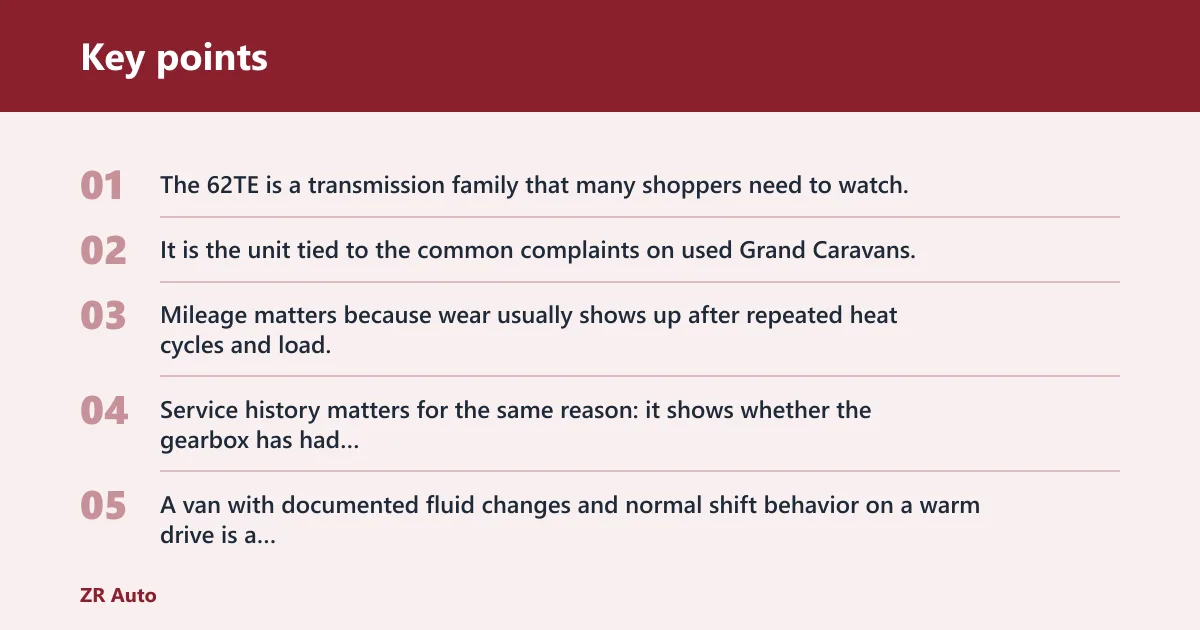
The 62TE is a transmission family that many shoppers need to watch. It is the unit tied to the common complaints on used Grand Caravans, and it can move from annoying to expensive fast if fluid service is poor or the van has already seen heavy use. Mileage matters because wear usually shows up after repeated heat cycles and load.
Service history matters for the same reason: it shows whether the gearbox has had regular fluid changes or has been left to run hot and dirty. A van with documented fluid changes and normal shift behavior on a warm drive is a different buy from one with uncertain maintenance and a transmission that bangs into gear after every stop. The gearbox is the decision point, not a background detail.
When the answer changes from yes to no
The answer shifts from “yes, this model can have transmission problems” to “not a dealbreaker” only when the van shows clean shift behavior, no stored faults, and believable service records. That does not mean the transmission is guaranteed healthy. It means you have not found evidence of a likely 62TE problem yet.
Suppose you test a 2014 Grand Caravan on a warm afternoon, and reverse engages after a brief pause but does not slam. That can still be normal wear if everything else checks out. If the same van hesitates, then shudders on takeoff, then flashes a warning light, treat it as a real fault path.
Which model years are riskiest?
The riskiest used Grand Caravans are the ones with both age and documented transmission concern. The 2009 Grand Caravan is the clear high-risk example. Later vans can still be worth considering, but they need better inspection discipline because the risk shifts from older electrical problems to 62TE wear and age-related issues.
2009 Grand Caravan risk profile
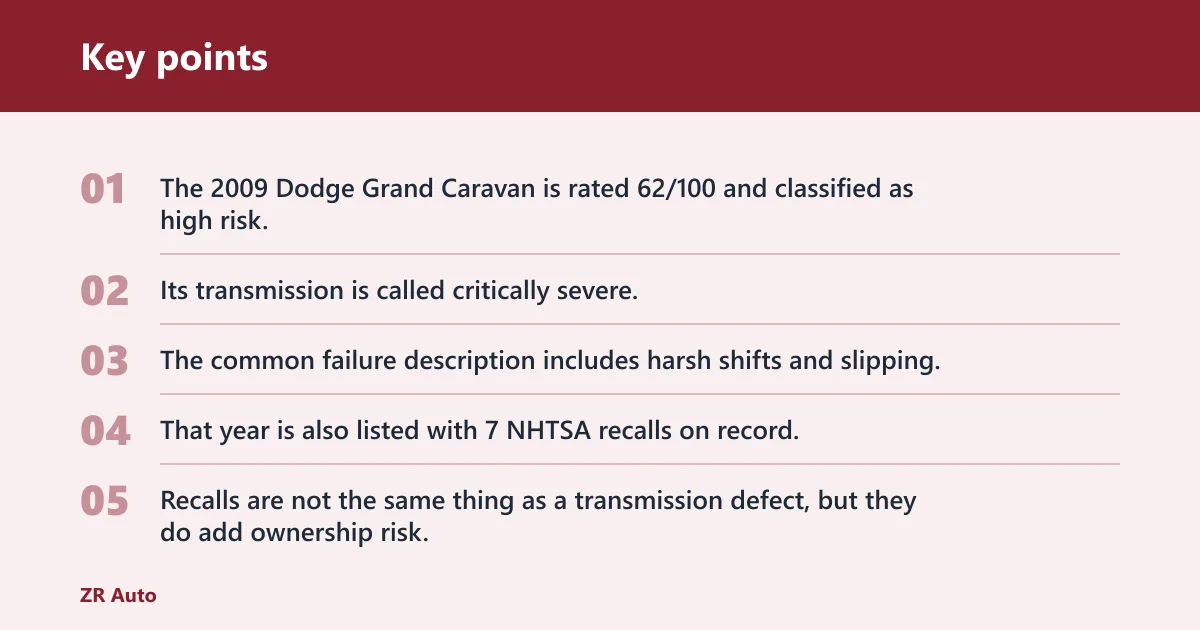
The 2009 Dodge Grand Caravan is rated 62/100 and classified as high risk. Its transmission is called critically severe, and the risk window is about 60,000 to 120,000 miles. The common failure description includes harsh shifts and slipping, which is exactly the kind of behavior that should push a buyer toward caution.
That year is also listed with 7 NHTSA recalls on record. Recalls are not the same thing as a transmission defect, but they do add ownership risk. On a 2009, a transmission complaint plus age plus recall history is a lot to carry unless the price and records are unusually strong.
2013 Grand Caravan questions shoppers should ask
A 2013 Grand Caravan sits in the middle of the used-market conversation. It is not automatically a reject, but it deserves direct questions about shift quality, service records, and any past transmission work. If the seller cannot explain fluid changes or prior symptoms, inspect more carefully and price the risk in.
Ask whether the van ever had delayed reverse engagement, shudder under light throttle, or limp mode. Those are not minor nuisances on a family hauler. They are clues that the 62TE may be moving from wear into repair territory.
2014-2020 and the 2019 Grand Caravan
The 2014-2020 group still deserves attention because transmission pump failure appears in the problem list for that range. The 2019 Dodge Grand Caravan is rated 72/100 and categorized as moderate risk, but its most likely first failure area is the transmission, and that risk is described as major severity. It is still a concern, even if it is better positioned than the 2009.
The 2019 Grand Caravan is also described as a value-packed minivan with Stow ‘n Go seating. That matters to buyers because the package is useful, but the utility does not cancel out a weak gearbox. A good cargo layout is not a repair plan.
How to read year-to-year risk without guessing
Read the model year as a clue, not a verdict. Older vans tend to stack more age-related risk, while later vans can still have transmission concerns without the same electrical baggage. If a seller says “it’s fine because it still drives,” ignore that shortcut and look for evidence: shift quality, repair history, scan results, and fluid condition.
A common mistake is to assume a Dodge Grand Caravan’s transmission is fine just because the fluid level looks normal. A 2019 with 90,000 miles and a documented service trail can be a different gamble from a 2009 with 85,000 miles and no records. The van’s maintenance history and symptom pattern matter more than the odometer alone.
Grand Caravan transmission risk checklist
| Symptom | Likely severity | Buyer action |
|---|---|---|
| Harsh shifts | Moderate if brief and cold; higher if repeated warm | Negotiate only if service records are strong and the issue is mild |
| Delayed engagement | Moderate to serious | Inspect before buying; ask for transmission history and scan codes |
| Slipping | Serious | Price in major repair risk or walk away if the seller cannot prove a fix |
| Shuddering | Serious | Get a mechanic inspection before any deposit |
| Limp mode | Critical | Reject unless documented repair proof and current fault codes are absent |
| Complete failure | Critical | Reject |
Harsh shifts and delayed engagement
Harsh shifts can still fall in the “watch it” category if they happen cold and fade with warm fluid. Delayed engagement is more serious because it points to a pressure or control problem. If reverse takes several seconds to bite, or drive feels like it hesitates before moving, do not treat that as normal minivan behavior.
Slipping, shuddering, and limp mode
Slipping means the engine speed rises without the expected push. Shuddering often shows up under light throttle, especially at cruising speed or during gentle acceleration. Limp mode is a red flag because the transmission control system is protecting itself. At that point, the van is warning you that the fault is no longer subtle.
Complete failure and no-drive symptoms
Complete failure means the van will not move correctly in one or more ranges, or it may not move at all. No-drive symptoms are walk-away territory for most shoppers. If a seller says it is “just a sensor” but the van will not back out or accelerate normally, assume the repair path is bigger until proven otherwise.
What else should you inspect?
Transmission risk is only part of the used Grand Caravan picture. Earlier years can have TIPM trouble that causes no-start or accessory issues. Power sliding doors fail often enough to matter. Later vans also need rust checks, especially if they lived on salted roads. Recalls and service records should be part of the buying decision too.
TIPM and earlier electrical trouble
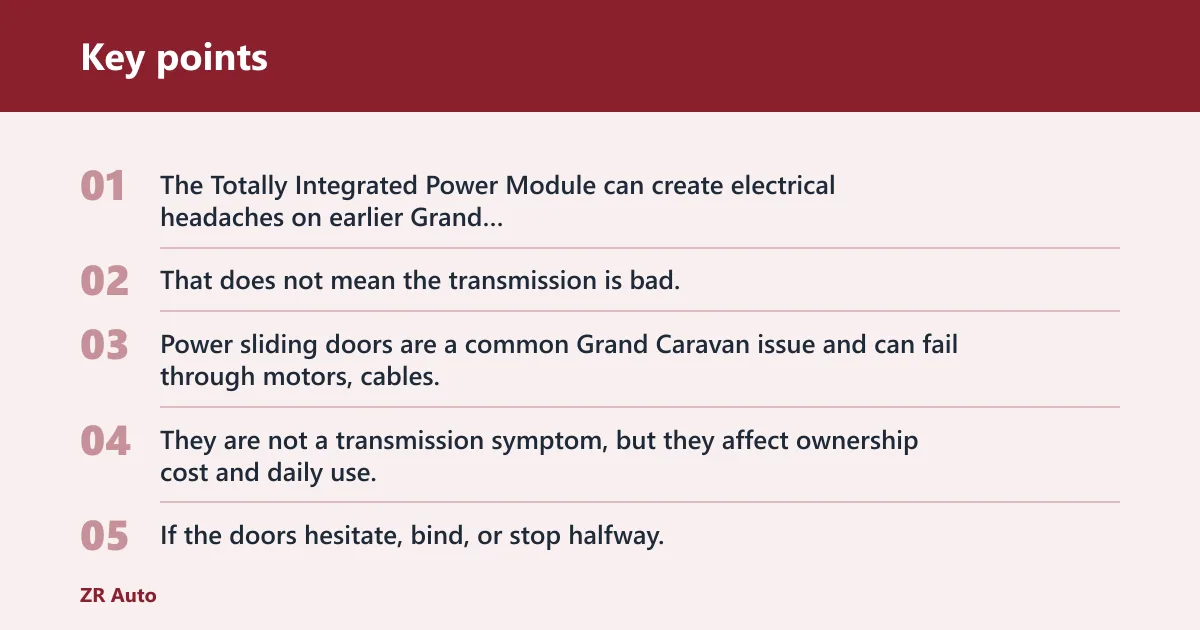
The Totally Integrated Power Module can create electrical headaches on earlier Grand Caravans, including no-start behavior and accessory problems. That does not mean the transmission is bad, but it does mean you should not confuse a dead battery-like symptom with a gearbox problem. Diagnose the system, not the noise.
Power sliding doors and door hardware
Power sliding doors are a common Grand Caravan issue and can fail through motors, cables, or sensors. They are not a transmission symptom, but they affect ownership cost and daily use. If the doors hesitate, bind, or stop halfway, factor that into your offer instead of assuming it is cosmetic.
Rust, corrosion, and road-salt damage
Later-model vans still need a close look underneath and around the body. Check the rear wheel wells, liftgate, and rocker panels for corrosion, especially if the van spent time on salted roads. Rust does not cause a 62TE to slip, but it can turn a decent van into a bad long-term buy.
NHTSA recalls and service records
Recall history is part of the ownership risk, not a substitute for a mechanical inspection. The 2009 Grand Caravan has 7 NHTSA recalls on record, and competitor data also ties some years to air bag and seat-related issues. That means you should check recall completion, but still judge the transmission on symptoms and repair evidence.
Should you buy one?
Buy only when the transmission behavior is clean, the records are credible, and the price reflects the model-year risk. Keep shopping if the van slips, shudders, or drops into limp mode. A pre-purchase inspection is enough only when the symptoms are mild, the scan is clean, and the seller can document service. If the van has major transmission symptoms, do not let Stow ‘n Go seating talk you into a bad deal.
When to keep shopping
Keep shopping if the van shows slipping, repeated harsh shifts when warm, delayed reverse, or any limp mode event with no clear repair proof. The same applies if the seller cannot explain transmission service or if the price seems to assume the problem does not matter. It does matter.
When to negotiate hard
Negotiate hard when the van has mild, isolated shift roughness but otherwise clean operation and documented maintenance. That is the zone where repair risk exists but does not automatically kill the deal. Use the risk level to lower the price, and be ready to walk if the seller will not move enough.
When a pre-purchase inspection is enough
A mechanic inspection is enough when the van drives normally, the transmission has no warning signs, and the seller can show basic maintenance history. The inspection should still include a scan for codes and a road test under light and moderate throttle. If that check turns up transmission faults, stop treating the van as a routine buy.
What makes it worth a look?
Grand Caravans still appeal because they package utility well. Stow ‘n Go seating gives quick cargo flexibility without pulling seats out. The Pentastar V6 is also a strength for used buyers who want familiar parts support and easy everyday drivability. Those advantages can justify a look, but not a bad transmission.
Stow ‘n Go seating and cargo flexibility
Stow ‘n Go is a real buying advantage because it makes the cabin adaptable in minutes. That matters for families, hauling, and mixed use. Still, cargo flexibility does not offset a van that slips in traffic or bangs into gear every time you pull away from a stoplight.
Pentastar V6 value for used buyers
The 3.6L Pentastar V6 is one of the strengths people look for in this van. It helps make the Grand Caravan attractive as a used value play, especially when the rest of the vehicle is sound. That value only holds if the transmission, doors, and body are acceptable.
Frequently asked questions
Do Dodge Grand Caravans have transmission problems?
Yes. The 62TE automatic is the main concern, and the risk shows up through harsh shifts, delayed engagement, slipping, shuddering, limp mode, and, in worse cases, complete failure. A Grand Caravan with clean shift behavior and maintenance records can still be a fair buy, but symptoms should change your offer or send you away.
Do 2013 Dodge Grand Caravans have transmission problems?
They can. The 2013 model year is best treated as a careful-shopping year, not an automatic reject. Focus on reverse engagement, shift quality when warm, fluid-service history, and whether the van has ever shown slipping or shuddering. Missing records raise the risk fast.
Does the 2019 Dodge Grand Caravan have transmission problems?
Yes, it can. It is worth considering only if the gearbox behaves normally and the price reflects the risk.
Do Dodge Caravans have transmission problems?
Yes, the Caravan nameplate has a history of transmission concern, especially in the Grand Caravan versions with the 62TE. The exact risk changes by year, mileage, and maintenance. Older models can also bring TIPM electrical issues, so you should sort the symptom before assuming the gearbox is the cause.
Are dodge grand caravans reliable?
They are mixed. Some offer strong value, useful space, and Stow ‘n Go seating, but transmission trouble, door problems, electrical issues, and rust can drag down ownership value. A reliable one is the van with clean records and no fault symptoms, not the one with the biggest discount.
What transmission problems are common on Dodge Grand Caravans?
Harsh shifting, delayed engagement, slipping, shuddering, limp mode, and complete failure are the symptoms to watch. The difference between a nuisance and a dealbreaker is severity and consistency. Light cold roughness can be minor; repeated warm slipping or no-drive behavior should be treated as a serious warning.