Volvo XC90 Buyer’s Guide: Best Trims and Engines
For most used shoppers, the smartest Volvo XC90 buys are 2019-2022 T6 or B6 Momentum/Plus models with complete service records; skip 2016 examples unless price leaves room for repairs. Choose poorly, and a cheap-looking XC90 can turn into four-figure suspension, infotainment, AC, or oil-consumption bills in a hurry. This guide matches each XC90 generation, trim, and powertrain to the buyer it suits, then points out the years, options, and inspection items worth your time.
The split is straightforward. First-generation XC90s can still work as lower-cost family haulers if you stay selective on engine and upkeep, while second-generation SPA models bring the cabin, safety tech, and refinement most shoppers want, but with a clear jump in complexity and repair risk.
XC90 generations that matter used
First-generation XC90 (2002-2014): what changed and why it still attracts budget buyers
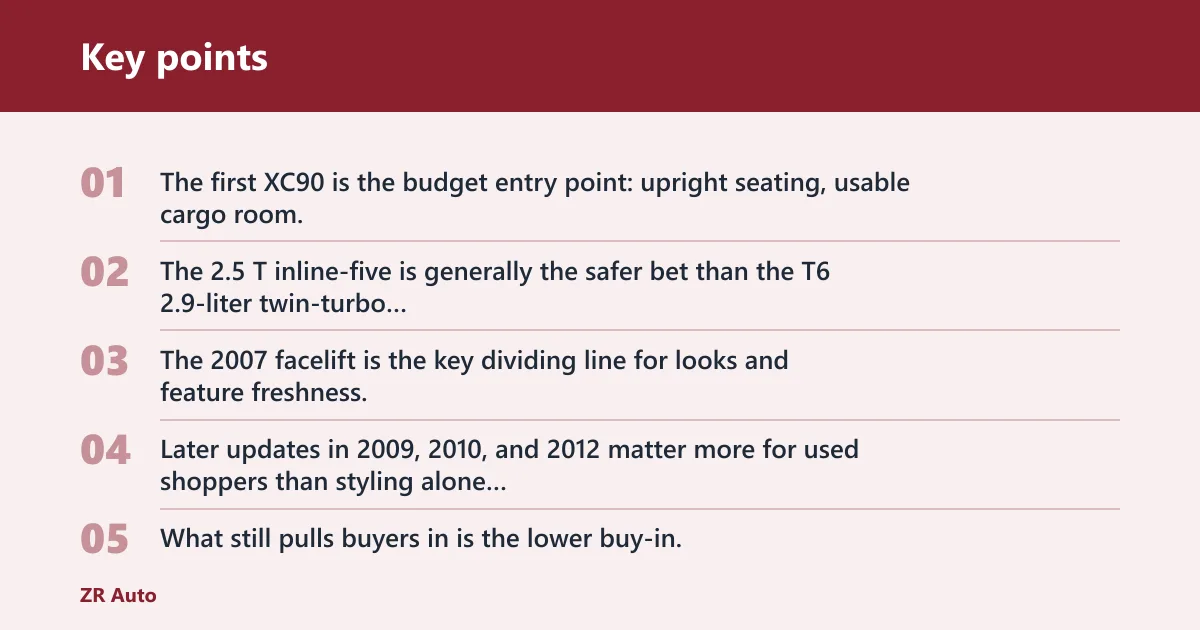
The first XC90 is the budget entry point: upright seating, usable cargo room, and a simpler ownership case than later hybrids if you avoid the wrong engine. Version matters, though. The 2.5 T inline-five is generally the safer bet than the T6 2.9-liter twin-turbo inline-six.
The 2007 facelift is the key dividing line for looks and feature freshness. Later updates in 2009, 2010, and 2012 matter more for used shoppers than styling alone because they help identify newer-build examples that usually feel less dated and, in many cases, less worn after years of family duty.
What still pulls buyers in is the lower buy-in. What limits it is age. At this point, suspension wear, climate-control faults, vacuum leaks, neglected driveline service, and electronics gremlins often matter more than badge appeal.
Second-generation XC90 (2016-present): SPA redesign, Drive-E power, and the ownership-cost jump
The second-generation XC90 is the one most shoppers picture: the SPA-platform redesign that arrived wider, longer, and lower, with a cleaner dash layout, fewer physical controls, tablet-style infotainment, and active-safety systems woven more tightly into daily driving features. It also moved the XC90 into a pricier ownership bracket.
Most of these use Volvo’s 2.0-liter Drive-E four-cylinder architecture with an 8-speed Geartronic transmission. That brings stronger efficiency and tidier packaging than the old SUV, but it also concentrates a lot of work into one small-displacement engine family: turbocharging, and in some versions supercharging or plug-in-hybrid hardware too.
Current versions can help set expectations for the used market. The 2025 XC90 B5 AWD is rated at 247 hp and 266 lb-ft, uses a Miller combustion cycle, and is rated at 23/30 mpg city/highway. The 2025 XC90 Recharge T8 eAWD makes 455 hp and 523 lb-ft, returns 58 mpg-e combined, and can drive up to 32 miles on all-electric power.
The used-market split: lower entry price versus lower complexity
That leaves two very different used-XC90 paths. Older first-gen trucks win on entry price and mechanical familiarity, but age-related repair risk is high. Newer SPA models win on crash tech, cabin quality, and daily refinement, but the wrong early-year or high-spec hybrid can wipe out any bargain quickly.
Say your budget tops out around the price of a tired early SPA example and a clean late first-gen example. The newer body style may look tempting, but the older SUV with a stronger service file can be the lower-risk buy if the newer one already shows laggy screens, suspension noise, and deferred maintenance.
Which Volvo XC90 years are the best to buy?
The best used XC90 years are often late first-gen 2010-2014 models with the right upkeep, plus second-gen 2019-2022 examples that offer newer software, more refined SPA hardware, and strong feature content without reaching the newest-car price bracket. The sweet spot is not one year; it is the right year-group and powertrain.
Best first-gen year groups after the major updates
For the old body style, 2010-2014 is the easiest recommendation. These are newer within the first generation, they benefit from the later update cycle, and they are easier to find with more modern convenience features. Buy on condition and service records first, trim second.
Within this group, the 2.5 T inline-five makes the most sense for shoppers who want the simplest old-XC90 ownership path. It is still an aging luxury SUV, so no version is cheap to neglect, but the T6 2.9 twin-turbo six is the one most budget buyers should approach with much more caution.
Best second-gen year groups for features, safety tech, and lower hassle
For the SPA generation, 2019-2022 is the strongest used target. These years generally thread the needle between early-launch bugs and current-model pricing, while still delivering newer software, standard or widely available driver-assistance features, and the updated XC90 design most used buyers are shopping for.
For many families, a 2019-2022 T6 or later B6 in mid-level trim is the best all-around pick. It gives you good equipment without the highest electronics count, and it avoids both the oldest SPA examples and the cost jump to nearly new inventory.
How the 2025.5 update changes the value case for earlier SPA models
The 2025.5 XC90 update is reported to bring revised front and rear fascia styling, a larger infotainment touchscreen, an improved 360-degree view camera, and frequency selective dampers. Those changes will make pre-update late SPA SUVs feel older faster in dealer lots, which can help used buyers if the older vehicle is priced accordingly.
That matters because the new XC90 still sits in a premium bracket. MotorTrend lists the 2025 XC90 price range at $62,445 to $75,245. As fresher-looking 2025.5 models arrive, a clean 2022-2024 B5 or B6 may become the value play for shoppers who care more about depreciation than the latest screen and camera hardware.
Which Volvo XC90 years should you avoid?
The XC90 years that deserve the most caution are early first-generation T6 models and early second-generation 2016 examples, especially if they are cheap because maintenance has been postponed. A bad XC90 is usually expensive in familiar ways: drivetrain faults, suspension wear, oil use, electronics issues, and overdue cooling or AC work.
First-gen year groups that need extra caution
The biggest first-gen caution flag is the early T6 2.9-liter twin-turbo inline-six. Even when the vehicle looks clean, complexity and age can stack up fast. Budget buyers often underestimate what happens when turbo plumbing, driveline wear, and old luxury-SUV electrical issues hit at once.
Earlier 2002-2006 examples in general need more scrutiny because age is now the main problem. Plastic cooling parts, bushings, mounts, wheel bearings, cracked hoses, and tired interiors are common old-vehicle realities even on lower-mileage examples.
Second-gen configurations where complexity can outrun the bargain price
For the SPA generation, 2016 models are the easiest caution call. They were the launch-year version of a very complex redesign, and low asking prices can hide expensive catch-up work. Early T8 plug-in hybrids deserve even more care because they combine first-year risk with the highest system count.
Cheap second-gen cars can also be false economy if the service file is thin. Missed transmission servicing, stale brake fluid, neglected cooling-system work, and no evidence of software updates all matter more than an extra feature package.
Red flags that matter more than model year alone
Walk away or bid hard lower if you find multiple warning lights, harsh or flaring shifts, front suspension knocking, obvious uneven tire wear, weak air conditioning, camera faults, or a seller who cannot document regular service. Those symptoms can outweigh an otherwise “good” model year.
Picture a 2020 XC90 with glossy paint, nice wheels, and a bargain price. If the center screen reboots, the 360-view camera is cloudy, the steering wheel sits off-center, and the brake pedal shudders after one stop, you are looking at deferred cost, not value.
Buyer-fit matrix table
How to read the fit columns
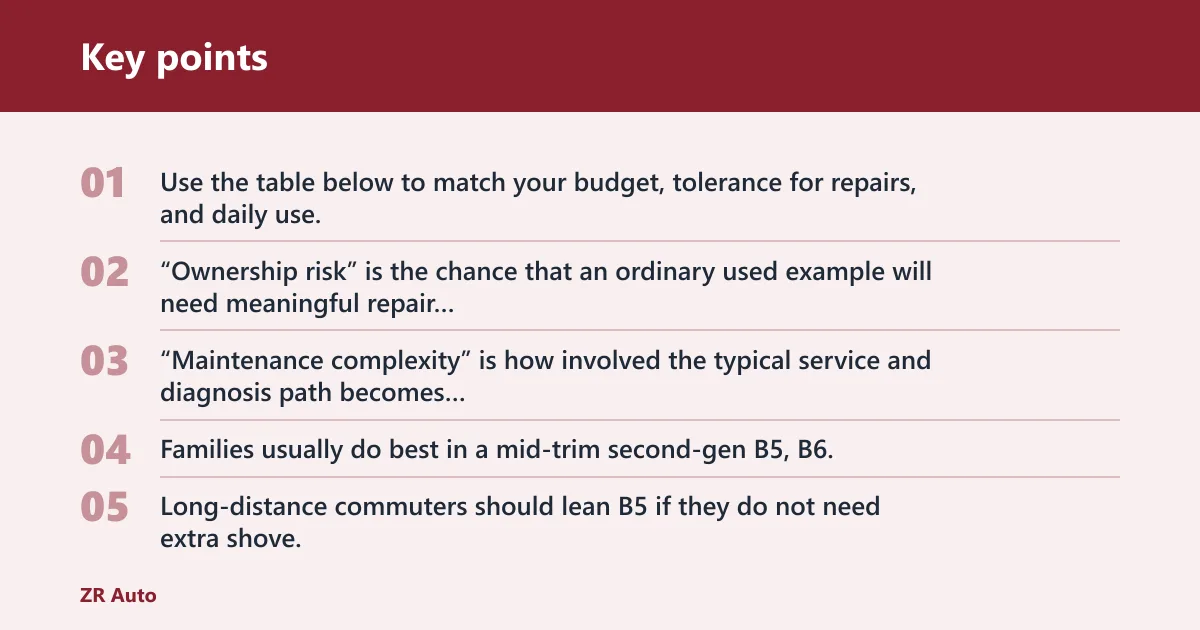
Use the table below to match your budget, tolerance for repairs, and daily use. “Ownership risk” is the chance that an ordinary used example will need meaningful repair money. “Maintenance complexity” is how involved the typical service and diagnosis path becomes once something goes wrong.
| Generation | Engine | Trim | Drivetrain | Likely ownership risk | Expected maintenance complexity | Best use case | What to verify on a test drive |
|---|---|---|---|---|---|---|---|
| 2002-2014 first gen | 2.5 T inline-five | Base or later well-equipped trims | Mostly AWD | Medium to high because of age | Medium | Budget three-row family use, occasional winter duty | Cold-start smoothness, boost delivery, steering clunks, suspension looseness, AC output, tire wear, service records |
| 2002-2014 first gen | T6 2.9-liter twin-turbo inline-six | Higher trims | AWD | High | High | Only for a buyer with repair budget and a very strong history file | Transmission behavior, turbo response, oil leaks, cooling health, driveline vibration, warning lights |
| 2016-present second gen | Drive-E T5/T6 four-cylinder | Momentum or Plus-equivalent | FWD or AWD depending on year | Medium | Medium to high | Family luxury use with better value than nearly new models | 8-speed Geartronic shift quality, screen speed, brake feel, front suspension noise, driver-assist function, camera clarity |
| 2019-present second gen | B5 mild hybrid | Core or Plus | AWD | Medium | Medium | Commuters and families who want lower running costs and lower complexity than a plug-in | Mild-hybrid restart smoothness, transmission calibration, highway wind noise, stop-start operation, ADAS warnings |
| 2020-present second gen | B6 mild hybrid | Plus or Ultra | AWD | Medium | Medium to high | Highway drivers, mountain-state buyers, stronger passing power | Supercharged and turbocharged power delivery, cooling performance, suspension composure, brake wear, infotainment speed |
| 2016-present second gen | T8 AWD plug-in hybrid | Plus, Ultra, or T8-focused luxury spec | eAWD | Medium to high | High | Short-distance commuting with home charging, buyers who will actually use EV miles | Charge-port operation, EV-only drive, battery range consistency, transition to gas power, brake blending, fault messages, software history |
Best matches for families, commuters, winter drivers, and towing buyers
Families usually do best in a mid-trim second-gen B5, B6, or late T6 because the safety and packaging gains are real and the third row is more useful than in smaller two-row rivals. Long-distance commuters should lean B5 if they do not need extra shove. Winter drivers should focus more on tire quality and AWD condition than trim badge. Buyers towing or hauling regularly should avoid choosing solely by low price; power delivery, brake condition, cooling-system health, and rear-suspension condition matter more.
How do the XC90 engines and hybrids compare?
The short version is this: first-gen 2.5 T models are the safer old-school buy, early T6 twin-turbo first-gens are the one to treat carefully, B5 is the lowest-stress modern choice, B6 adds welcome power with more hardware, and T8 is worth it only if you will use its electric range and can accept higher system complexity.
First-gen engines: 2.5 T inline-five versus T6 2.9 twin-turbo inline-six
The 2.5 T inline-five fits the budget buyer who wants the XC90 shape and seating without chasing the most complicated old engine. It is still a used luxury SUV from an earlier era, so preventive maintenance matters, but the ownership case is easier to justify.
The T6 2.9-liter twin-turbo inline-six suits a narrower buyer: someone paying for a documented, carefully kept example rather than chasing the cheapest listing. If the price seems surprisingly low, assume you are buying the next repair cycle too.
Second-gen gas and mild-hybrid choices: B5 and B6 on the 8-speed Geartronic
The B5 is the sensible default.
The B6 pushes the XC90 toward easier passing and better loaded performance. Its 295 hp and 310 lb-ft make more sense if you regularly carry adults, cargo, or mountain grades. The tradeoff is more complexity and a 20/26 mpg city/highway rating.
T8 AWD plug-in hybrid: where the performance and efficiency gains justify the added complexity
The T8 is impressive on paper and can be a smart used buy for a very specific owner. With 455 hp and 523 lb-ft, plus up to 32 miles of all-electric range, it fits the household that can charge regularly and does many short local trips.
It is a weaker fit for the buyer who cannot charge at home, drives mostly long highway stretches, or wants the simplest long-term maintenance path. On a used T8, ask how often it was charged, whether EV range seems consistent with age, and whether software updates were kept current.
What each powertrain means for fuel costs, drivability, and long-term service exposure
B5 is the easiest recommendation for lower running costs. B6 is the better match for buyers who notice performance every day. T8 can cut fuel use in the right routine, but only if the charging habit exists in real life rather than in the brochure.
Used XC90 plug-in hybrid value
The XC90 T8 can make sense used, but only when the price reflects hybrid-specific risk. The supporting guide explains how to judge battery health, software history, charging habits, and the model years most worth considering. That matters because a neglected plug-in hybrid can lose much of its fuel-savings edge if the battery is weak or the electronics have been troublesome.
If you are cross-shopping gas and electrified versions, this Volvo XC90 T8 guide helps you decide whether the extra complexity is justified or whether a conventional XC90 is the safer used choice.
XC90 vs XC60: How to Choose Between Volvo’s Two SUVs
Picking between the used Volvo XC90 and XC60 comes down to one question: do you actually need that third row? The XC60 is the smarter buy for most shoppers because it costs less upfront, cheaper to fuel, insures, and maintains, while still delivering spacious second-row comfort. The XC90 only earns its larger footprint when you regularly seat seven or need maximum cargo volume.
The full comparison breaks down cabin space, seating configurations, cargo capacity, fuel economy, towing capability, and total cost of ownership so you can avoid paying for features you never use. Volvo XC90 vs XC60 walks through a decision matrix and clear buying recommendations for different household sizes and driving needs.
Which XC90 trim is the best used buy?
The best used XC90 trim depends more on ownership fit than status. Core is the value play, Plus is usually the sweet spot, and Ultra is best only if you specifically want the added comfort and camera tech and are comfortable with a higher repair bill when features age.
Core, Plus, and Ultra: feature value versus repair exposure
Core works for shoppers who want the SPA chassis, safety hardware, and lower purchase price without paying extra for every luxury extra. It is usually the smartest route if you are cost-sensitive and plan to keep reserve money for maintenance.
Plus is the trim that most used buyers should start with. It tends to deliver the features families actually use without pushing too far into expensive-to-fix convenience equipment. That makes it the main sweet spot for resale, comfort, and risk.
Ultra suits a buyer who genuinely values the top-end experience and will inspect every electronic feature carefully. The appeal is clear. So is the future repair exposure.
When the T8 trim and powertrain package makes sense used
The T8 version makes sense if your routine can actually use its electric side. A buyer who commutes within the EV range window and can charge nightly may justify the complexity. A buyer who treats it like a normal gas SUV usually cannot.
Trim picks by budget, family use, cold climate, and highway mileage
Budget: Core or a well-kept older Momentum. Family use: Plus. Cold climate: prioritize heated-seat and driver-assist content, but buy on tire quality and AWD condition first. Highway mileage: B5 Plus is the most rational modern XC90 for buyers who want comfort without buying the most elaborate powertrain.
What should you check before buying a used XC90?
Check service records first, then test every expensive system the XC90 depends on: transmission behavior, suspension noise, AC output, screen speed, cameras, braking feel, and all driver-assistance functions. A clean body and polished interior do not offset warning lights, poor software behavior, or signs of skipped maintenance.
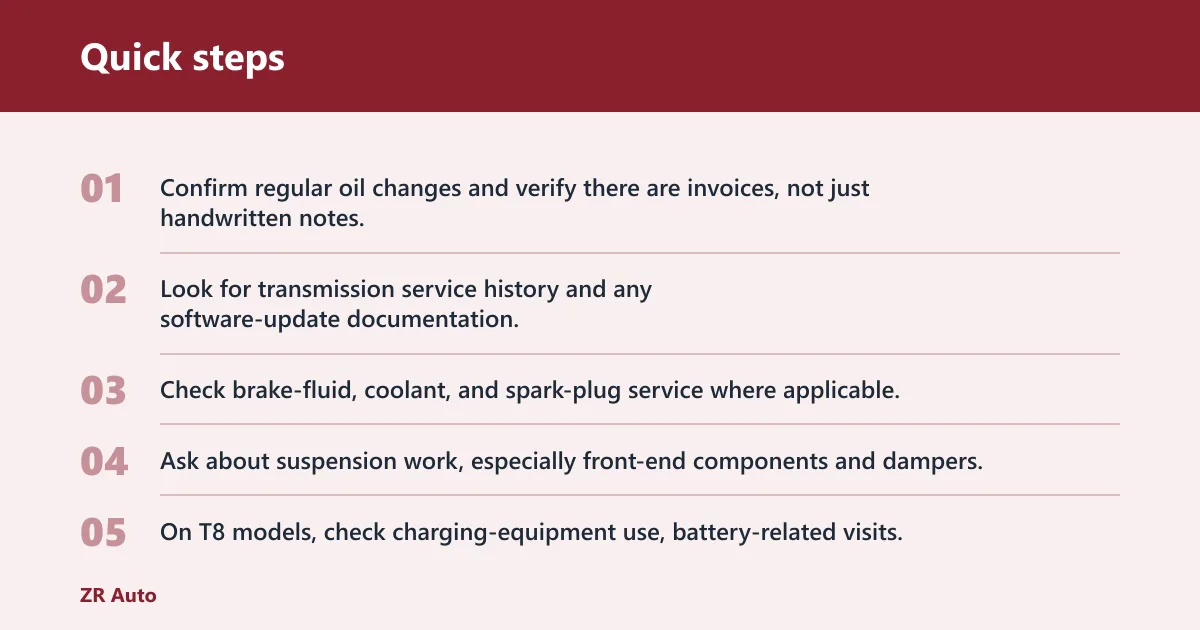
Service-history items that separate a maintained XC90 from a deferred one
- Confirm regular oil changes and verify there are invoices, not just handwritten notes.
- Look for transmission service history and any software-update documentation.
- Check brake-fluid, coolant, and spark-plug service where applicable.
- Ask about suspension work, especially front-end components and dampers.
- On T8 models, check charging-equipment use, battery-related visits, and hybrid-system updates.
- Confirm tire replacement patterns; uneven wear can point to alignment, bushing, or air-suspension issues.
Test-drive checks for transmission, suspension, brakes, steering, and AWD behavior
Start with a cold engine if possible. Listen for rough idle, timing-related noise, or delayed engagement into drive. On the road, the 8-speed Geartronic should shift cleanly without flare, thump, or hesitation. Steering should track straight, and the suspension should feel controlled rather than busy or noisy.
Brake feel matters on every XC90, and doubly so on a T8 where regenerative blending can mask problems on a short drive. Find a rough section of road, a tight parking-lot turn, and a highway merge. Those three situations expose most used-XC90 issues quickly.
Hybrid and electronics checks: battery operation, infotainment speed, cameras, and ADAS warnings
On SPA models, every screen and camera matters because safety and convenience systems are deeply integrated. Check startup time, menu responsiveness, Bluetooth pairing, climate-control response, parking sensors, and 360-degree-view image quality. A blurry or flickering camera system is more than an annoyance.
On T8 models, verify EV drive operation, charging-port function, and the transition between electric and gas power. Ask whether the car spent long periods uncharged. That does not automatically make it a bad buy, but it weakens the case for paying a T8 premium.
Safety-system verification using IIHS and NHTSA context
Safety is a real XC90 strength, but used shoppers should inspect the tech that delivers it. The 2025 XC90 received an IIHS Top Safety Pick+ award and earned five stars overall from NHTSA, with five stars in front crash and four stars in rollover.
That should push you to verify windshield replacement quality, because poor glass or poor calibration can upset camera-based systems. Check for ADAS warning lights, test parking and driver-assistance features where safe, and confirm that the 360-degree camera is clear and aligned.
When the XC90 won’t recognize the key
If an XC90 suddenly stops detecting the key, the fastest fix is usually simple: try a fresh fob battery, then test the spare key to see whether the problem follows the fob or the vehicle. This supporting guide explains how to narrow the fault to the key, the 12V battery, the antenna or reader, or interference before you spend money on unnecessary parts or dealer diagnostics. It matters because key-recognition problems can turn into no-start situations, repeated lockouts, or a tow if you ignore them. For a clear step-by-step breakdown, see Volvo XC90 key recognition.
How does the XC90 compare with key used rivals?
The XC90 makes the most sense for shoppers who want a calm, upscale three-row cabin and strong safety tech. The XC60 is often the smarter buy if you do not need the third row, while the BMW X5 suits buyers who value driving response more than family packaging. Q7, MDX, and Aviator each beat the XC90 in narrower cases.
XC90 versus XC60: when the smaller Volvo is the smarter used buy
If you rarely use a third row, the XC60 is often the sharper used purchase. It is easier to park, usually cheaper to buy, and simpler to justify for couples or small families. The XC90 wins only when you will truly use the extra space.
XC90 versus BMW X5: space and comfort against driving feel and engine choices
The used X5 generally leans more athletic, but that comes with its own complexity depending on engine choice. The XC90 counters with a calmer ride, a more family-focused interior, and a stronger case if second-row room and cargo flexibility matter more than corner-entry speed.
Where the Q7, MDX, and Aviator beat the XC90 and where they do not
The Audi Q7 is a strong alternative if you want a more polished road feel and can accept a tighter third-row experience. The Acura MDX is often the safer reliability-minded luxury play if badge image matters less than lower drama. The Lincoln Aviator can feel richer in straight-line power and American-style comfort, but ownership complexity and depreciation can cut both ways.
Volvo XC90 vs BMW X5: used‑car showdown
When weighing a used Volvo XC90 against a BMW X5, the decision hinges on power versus practicality. The review finds the X5 the better pick for stronger acceleration and sharper handling, while the XC90 wins for three usable rows and a lower upfront cost. It also stresses that a used vehicle’s condition and service history matter as much as the specs. See the detailed XC90 vs X5 comparison for the full verdict.
The article walks through size differences, engine output, operating‑cost estimates, family suitability, towing capacity, winter grip, and daily driving feel, then offers concise “choose Volvo if…” and “choose BMW if…” recommendations, helping buyers match the model to their priorities and budget.
Frequently asked questions
What should I look for when buying a used Volvo XC90?
Prioritize service history, transmission behavior, suspension noise, brake feel, climate-control performance, tire wear, infotainment speed, camera clarity, and any driver-assistance warnings. On T8 models, also verify charging operation, EV-only driving, and whether software updates and hybrid-system maintenance were kept current.
What Volvo XC90 years should I avoid?
Use extra caution with early first-generation T6 models and 2016 second-generation SUVs, especially if the price is low because maintenance has slipped. Any XC90 with multiple warning lights, harsh shifts, weak AC, camera faults, or obvious suspension wear should move down your list quickly.
Is the Volvo XC90 reliable as a used luxury SUV?
The XC90 is not a one-answer reliability vehicle. Late first-gen 2.5 T models and sorted later SPA examples can be reasonable if maintained well, while early T6 first-gens and neglected early SPA or T8 models can become expensive quickly because complexity multiplies repair exposure.
Which XC90 trim is best to buy used?
Plus is usually the best used trim because it adds meaningful comfort and family features without stacking on every expensive extra. Core is the best value choice for budget-minded buyers, while Ultra is best only if you specifically want the added equipment and accept higher feature-related repair risk.
Is the Volvo XC90 T8 worth buying used?
Yes, but only for the right routine. A used T8 makes sense if you can charge at home, do many short trips, and want strong performance with meaningful EV use. It makes less sense for mostly highway driving or buyers who want the simplest long-term ownership path.