Why Is the Ford Escape So Cheap?
The Ford Escape is cheap because it depreciates like a mainstream compact SUV, and some model years price even lower when buyers factor in known reliability and repair risks. Miss that split, and you can overpay for a trim or year that is cheap for a reason. This guide explains which Escape years carry more risk, where value usually sits by trim and drivetrain, and how to spot the better used buys.
Why specific trims and drivetrains get discounted
What pulls Escape prices down
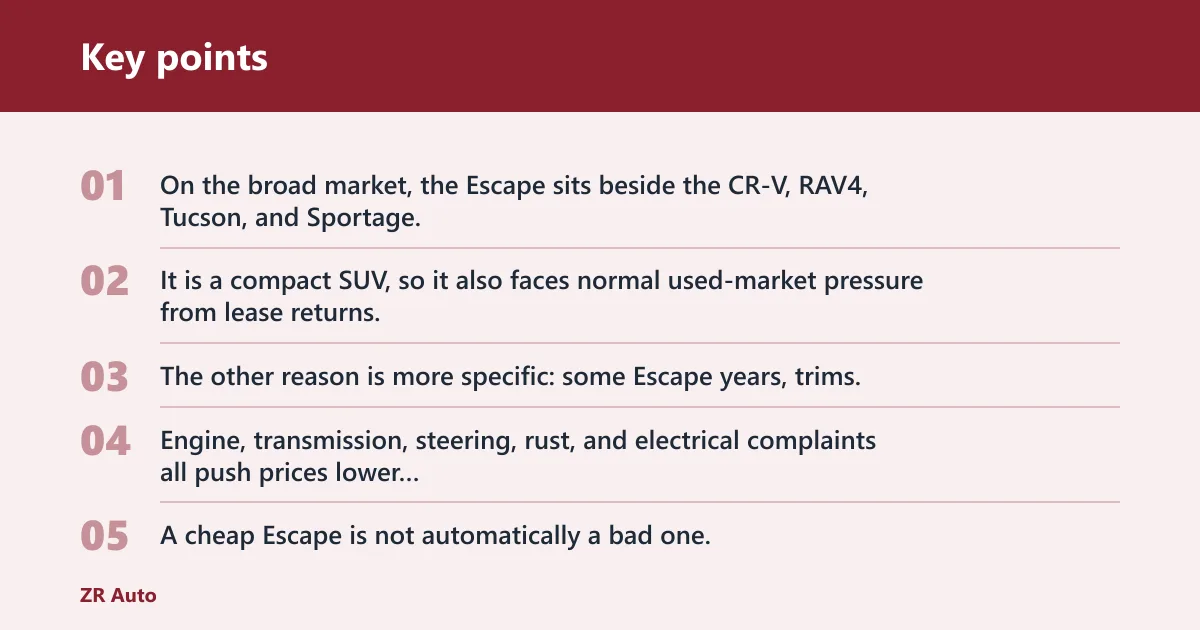
On the broad market, the Escape sits beside the CR-V, RAV4, Tucson, and Sportage. That keeps pricing tight. It is a compact SUV, so it also faces normal used-market pressure from lease returns, fleet supply, and buyers moving to newer tech instead of paying extra for an older mainstream badge.
That is the basic reason. The other reason is more specific: some Escape years, trims, and drivetrains are discounted because shoppers know the risk profile. Engine, transmission, steering, rust, and electrical complaints all push prices lower when they are tied to a certain year or version.
When a low price is normal
A cheap Escape is not automatically a bad one. A base gas model with high miles, ordinary wear, and a clean history often prices low simply because it is a practical compact SUV rather than a premium one. Low resale demand and common supply keep the floor down.
Picture a front-wheel-drive Escape with 120,000 miles, average tires, and a plain cloth interior. That price can be fair if the service history is orderly and the scan for warning lights comes back clean. The discount is then about age and mileage, not a hidden defect.
📊 MotorTrend says the Escape Hybrid returns about 42/36 mpg city/highway. Source: Motortrend.
Ford Escape decision table
| Generation | Year range | Likely reason it is cheap | Red-flag symptoms | Expected ownership risk | Buyer recommendation |
|---|---|---|---|---|---|
| First generation | 2001-2007 | Age, rust exposure, older powertrain wear, high complaint volume in some years | Rust, stalling, transmission harshness, stuck pedal concerns | High if history is thin | Pass unless price is very low and inspection is clean |
| Second generation | 2008-2012 | Complaint-heavy years and aging drivetrains push prices down | Power steering loss, transmission faults, warning lights | High in the worst years | Pass for 2008; inspect later years closely |
| Third generation | 2013-2019 | Mainstream depreciation, trim mix, mileage, and routine wear | Rough shifting, turbo or cooling issues, incomplete service records | Moderate | Consider if records are strong |
| Fourth generation | 2020-present | Newer tech lowers age-based risk, but recall history and trim pricing still shape value | Fuel system concerns, engine issues, infotainment faults | Moderate | Consider, especially with documented recall work |
Which Escape years are cheap for a reason?
Some Escape years are cheap because buyers are pricing in known faults, not because the whole nameplate is weak. The clearest examples are the 2005 and 2008 models, where complaint counts and recalls were high enough to drag down confidence. The 2020-present Escape is newer, but recall history still affects used prices.
2005 Escape
The 2005 Ford Escape had 2,081 NHTSA complaints and 5 recalls. Wheel4world lists rust, engine stalling, and a stuck gas pedal among the issues tied to that year. That is the kind of record that pushes a used price down fast, especially when mileage is high or body corrosion is visible.
If a 2005 Escape looks unusually cheap, ask why. Rust near the rear wheel arches, floor pans, or suspension mounting points is a serious warning sign, and stalling issues can turn a low sticker into an expensive project.
2008 Escape
The 2008 Ford Escape had 2,390 NHTSA complaints and 6 recalls, and it is described as the worst model year. Wheel4world cites power steering failure and transmission problems, which are exactly the kinds of faults that make buyers walk away or demand a much lower price.
That discount is rational. Steering and transmission repairs can erase any savings quickly, so the cheapest 2008 Escape is often the riskiest one on the lot.
2020-present Escape
The 2020-present Escape has newer tech and a cleaner cabin presentation, including a 13.2-inch touchscreen on higher trims after the 2023 refresh. Even so, recalls for fuel system and engine issues keep some buyer caution in place. The market still prices in that uncertainty.
Higher trims can cost more because they add equipment, but they do not erase the need to check recall completion, software updates, and powertrain behavior. Newer does not always mean low-risk.
Why do some Escapes hold their price better?
Escapes hold value better when they have the trim, drivetrain, and history that buyers want most. Higher equipment levels, AWD, lower miles, and clean service records all reduce the discount. A cheaper Escape is often cheaper for one of those reasons, not because the market made a mistake.
Trims that add value
Upper trims cost more because they usually bring more comfort and tech. On the 2020-present truck, that can mean larger displays, better seats, more driver-assist content, and nicer cabin materials. The price gap is real because shoppers pay for those items on the used market too.
AWD versus front-wheel drive
AWD usually costs more than front-wheel drive, especially in snowy states or on trims that pair AWD with extra equipment. A base FWD Escape can look cheaper because it is the simplest version to own and resell. That does not make it bad, only less costly.
Mileage and records matter
A full service file can matter more than a badge on the liftgate. Timing of oil changes, transmission service where applicable, and recall repair completion all affect how much confidence a buyer has. A low-mile Escape with gaps in the record can still be a poor buy.
Suppose two 2018 Escapes are listed at similar prices. One has 78,000 miles and a stack of receipts. The other has 92,000 miles, no records, and a warning lamp photo in the ad. The second one is cheap because it is riskier, not because it is a better deal.
Escape hybrid value drivers
The Escape Hybrid is cheaper or pricier depending on how much the buyer values fuel economy, equipment, and drivetrain layout. MotorTrend lists the 2025 Ford Escape Hybrid price range at $35,085 to $38,405, with about 42/36 mpg city/highway, 192 hp, and about 8.0 seconds to 60 mph. It comes with standard FWD or optional AWD. (Motortrend)
| Version | Main value driver | What moves price | Buyer takeaway |
|---|---|---|---|
| Base gas | Lowest entry price | Trim, mileage, and condition | Best if you want the cheapest purchase price |
| Hybrid | Fuel savings and stronger city economy | AWD availability, trim level, and demand for efficiency | Often worth it if you drive a lot or keep the vehicle longer |
| Plug-in hybrid | Short electric commuting ability | Larger battery, electric motor output, and charging convenience | Best for short daily trips and regular charging access |
Why the hybrid can still look cheap
The Escape Hybrid may look inexpensive relative to rivals because it is still a mainstream compact SUV, not a luxury model. Buyers who want the lowest purchase price often start with gas versions, while hybrid shoppers compare fuel savings against the upfront premium. That can leave used hybrids with softer pricing than expected.
The hybrid is not slow or sparse. Its 192 hp system output and about 8.0-second 0-60 mph time put it in normal everyday territory, while the efficiency figures are the main appeal. If the fuel savings matter to you, that is the reason to pay more.
What the plug-in hybrid changes
The Escape Plug-In Hybrid adds a larger battery and a more powerful electric motor, with up to 37 miles of all-electric driving range. That changes the value equation for buyers who can charge at home or at work, because short trips may use little or no gasoline.
Its used price depends heavily on battery health, charging habits, and whether the buyer actually needs that electric range. A plug-in model that was rarely charged can be a poor fit for someone expecting maximum electric use.
Does the Escape have a cheap interior?
Yes, in value terms. The Escape interior can feel cheap because the cabin uses a lot of hard plastic and the material quality does not aim at near-luxury levels. Cargo space can also trail some rivals in practical packaging, so the cabin may feel less generous than the price suggests.
What that means in daily use
The cabin is not unusable or flimsy by default. It is simply built to a price. If you compare it with a CR-V or RAV4, the Escape often looks like the lower-cost answer on material feel and sometimes on cargo utility, even when the tech load is competitive.
That is why the cheapest Escape is not always the best value. Interior quality matters if you will sit in it every day, carry child seats, or use the rear area for gear. Cheap plastics age in plain view.
Are Escape parts and repairs expensive?
Routine parts are usually not the expensive part of Escape ownership. Oil changes, brakes, filters, and tires are broadly in line with the compact-SUV class. Repair risk is what changes the bill, especially on years with known steering, transmission, engine, rust, or electrical complaints.
What drives repair costs
Older Escape years with high complaint counts can become costly because a bargain price leaves less cushion for steering repairs, transmission work, or rust remediation. A cheap purchase price can hide an expensive second act. That is especially true on 2005 and 2008 models.
- Check recall completion before negotiating.
- Scan for rust under the body, around suspension points, and in the cargo area.
- Test steering feel at low speed and during parking maneuvers.
- Look for delayed shifting, slipping, or harsh gear changes.
- Verify maintenance records and avoid gaps that hide neglect.
A practical filter for buyers
A cheap Escape can be acceptable if the year is known to be better, the drivetrain matches your use, and the service history is clean. Pass on the ones with visible rust, transmission symptoms, steering warnings, or repeated electrical faults. Those are the cars that turn a low price into a long repair list.
One common first-timer mistake is to chase the lowest ad price without checking the year. A 2008 that is $2,000 under the market is not automatically a deal if it has power steering concerns and a rough shift pattern. The lower price often reflects the problem, not a bargain.
Frequently asked questions
Why is the Ford Escape so cheap?
The Escape is cheap because it is a mainstream compact SUV with normal depreciation, but some years and trims are discounted further when buyers price in reliability risk. The lowest prices often combine age, mileage, fleet supply, and known fault history rather than one single cause.
Why are used Ford Escape so cheap?
Used Escapes are often cheap because the market has plenty of them, and shoppers have alternatives with stronger resale demand. Older model years, plain trims, and high-mileage examples bring the biggest discounts. Years with complaint-heavy histories drop further because buyers expect repair exposure.
Why is the Ford Escape hybrid so cheap?
The hybrid can look cheap because it is still a mass-market compact SUV, not a premium EV substitute. Some buyers avoid hybrids on price alone, while others compare it with the gas model and choose the cheaper upfront option. That keeps demand from soaring too high.
Does the Escape’s low price reflect discontinued status?
Not yet in the way shoppers may fear. MotorTrend says production is expected to end sometime in 2025, but that does not mean immediate parts shortages or a sudden price collapse. Ford also says the 2026 Escape is unavailable in CA, MA, OR, NY, WA, and VT.
Which trims make the Ford Escape cheap or expensive?
Base trims usually make the Escape cheapest, especially with front-wheel drive and higher mileage. Higher trims cost more because they add tech, comfort, and sometimes AWD. The used gap is driven by equipment content and demand, not just age or body style.
Is the Ford Escape a good value compared with rivals?
It can be, but only when the year, trim, and drivetrain line up with your budget and risk tolerance. The CR-V and RAV4 often hold value better, while the Escape can undercut them on price. That lower number is useful only if the specific vehicle is sound.