Is a Dodge Charger a Good First Car for a Teen Driver?
No, a Dodge Charger is usually not a good first car for a teen driver, because its size, rear-drive power, and weight can encourage risk and raise repair and insurance costs. Miss that fit question, and you can end up with harder braking, poorer visibility, more severe crash outcomes, and a car that tempts a new driver to go faster than skill allows. This guide covers safety, visibility, power, size, insurance, fuel use, and the Charger trims that are least bad for a new driver.
Charger first-car verdict
The Charger is a poor default choice for a first car, but not every version carries the same risk. A cautious teen with solid habits, parent oversight, and a realistic budget could consider a lower-output trim. A new driver with shaky judgment, frequent peer passengers, or a history of speeding should avoid it.
Who should avoid it?
Teens who are still learning smooth throttle use, lane positioning, and parking should start elsewhere. The Charger’s size makes low-speed mistakes easier to repeat, and its power can turn a simple merge or wet-road launch into a problem if the driver is overconfident. If the goal is to cut risk, this is not the easiest path.
Who could consider it?
A teen who already drives responsibly, has parent-set limits on passengers and curfew, and can afford higher insurance may consider the least aggressive Charger setup. Even then, the bar should be high. The car must fit the driver’s skill, not the driver’s wish list.
Quick go/no-go by trim
| Trim / driver level | Recommendation | Why |
|---|---|---|
| Charger R/T, new driver | Conditional go | Lower output than Scat Pack, but still powerful enough to reward restraint and punish mistakes. |
| Charger R/T, experienced teen | Possible go | Best fit only if the teen already shows mature driving habits and the budget can absorb higher operating costs. |
| Charger Scat Pack, any new driver | No-go | High-output power makes speed creep and traction loss much easier to reach. |
| Any Charger, weak budget or poor discipline | No-go | Insurance, fuel, tires, and ticket risk can swamp the ownership budget fast. |
Why teens want one
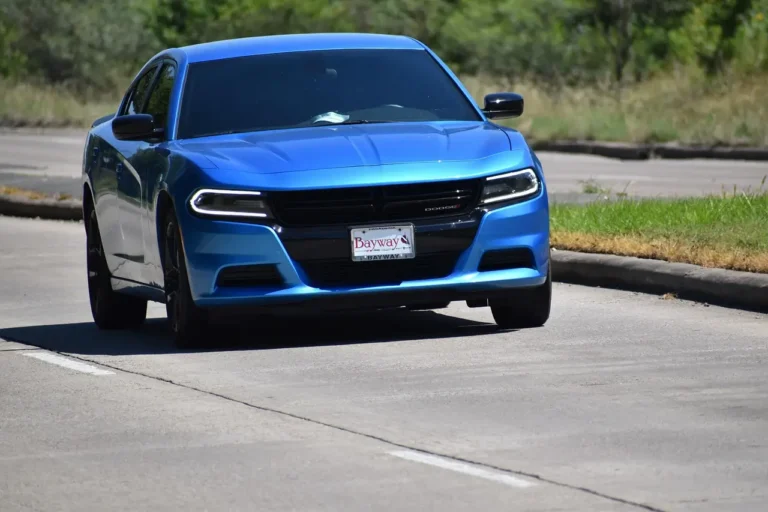
The Charger has the kind of presence many teens notice immediately. It looks serious on the road, and that matters to buyers who want a car that feels different from the average commuter sedan. The problem is that the same appeal can hide the parts that matter most for a first car: mass, power, and operating cost.
Style and street presence
Dodge says the Charger is a muscle car, not a sports car, and that distinction matters. Muscle cars are built around strong straight-line performance and size, while sports cars usually trade space and comfort for sharper handling. A teen who wants a cool badge may not realize that the bigger body and stronger shove can work against beginner skill.
Two-door vs. four-door choice
The Charger comes in two-door and four-door configurations, and both body styles can be a problem or a help. The four-door adds $2,000 MSRP, but it also makes rear-seat access easier for family use. For a teen, four doors do not make the car safe by themselves, yet they can reduce awkward passenger loading and daily frustration.
A common first-timer mistake is thinking a larger car automatically feels “safer” because it looks solid. Suppose a teen pulls into a tight school lot in a 206.6-inch-long, 79.8-inch-wide Charger and needs three tries to park between lines. That is not a safety upgrade; it is a sign that size still matters at low speed.
Is a Dodge Charger a good first car for a teen driver?
Usually no. The Charger’s size, power, and operating costs can work against the habits a new driver is still building. It can be driven safely, but it asks more discipline than a typical first car and gives a teen more chances to make expensive or risky mistakes.
Power and throttle response
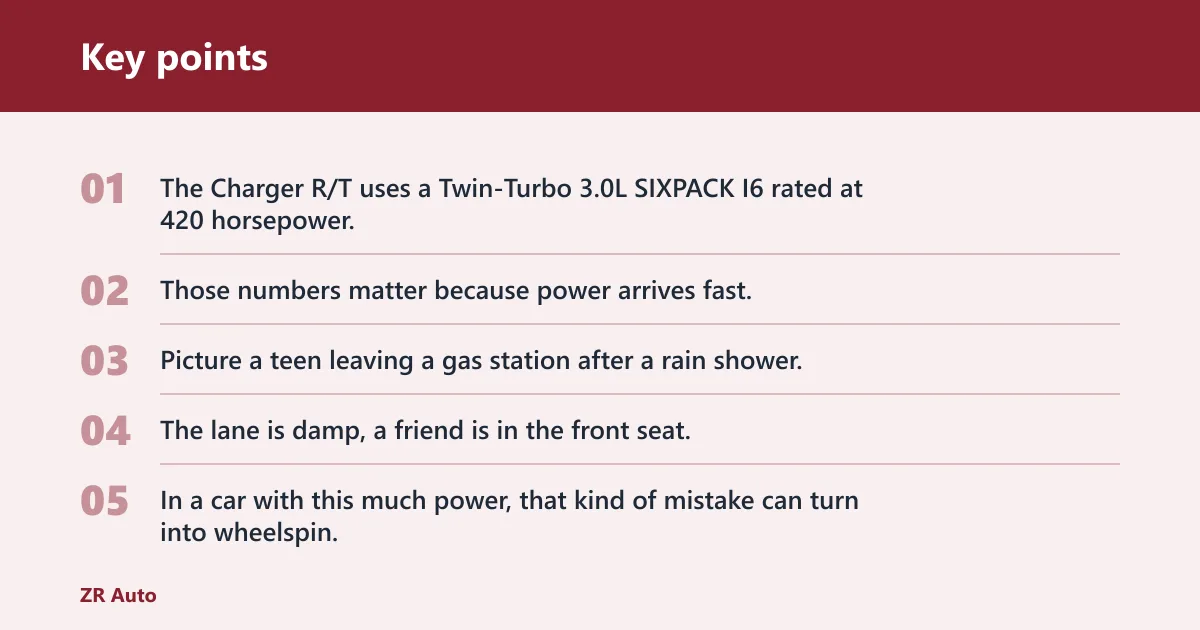
The Charger R/T uses a Twin-Turbo 3.0L SIXPACK I6 rated at 420 horsepower, and the Scat Pack uses the high-output version rated at 550 horsepower. Those numbers matter because power arrives fast, especially when a new driver mashes the pedal in traffic, on a wet road, or while trying to merge too quickly.
Picture a teen leaving a gas station after a rain shower. The lane is damp, a friend is in the front seat, and the driver gives too much throttle while turning. In a car with this much power, that kind of mistake can turn into wheelspin, a messy correction, or a hard lesson in traction.
Size, visibility, and parking
The Charger’s approximate 206.6-inch length and 79.8-inch width make it a full-size handful for a beginner. Longer cars are harder to place in narrow school lots, tighter driveways, and curbside parking. Wider cars can also make lane placement and door clearance feel less forgiving, especially for a driver still learning spatial judgment.
Why behavior matters more than badges
The badge does not decide risk. The driver does. But the Charger makes certain bad habits easier to indulge, especially speed creep, late braking, and showing off with passengers nearby. For a teen driver, that is the key question: does the car make good habits easier, or does it give bad habits more room to grow?
Charger teen-risk scorecard
This is the short version: the Charger scores poorly for teen use unless the buyer chooses the least aggressive trim and sets firm rules. Power and insurance are the biggest concerns, while safety tech helps only on the margin. The car can be managed, but it does not give a new driver much forgiveness.
| Dimension | Teen-risk score | What it means |
|---|---|---|
| Power | High risk | 420 horsepower in the R/T is already a lot for a new driver; 550 horsepower in the Scat Pack is too much for most teens. |
| Size / parking | Medium-high risk | At about 206.6 inches long and 79.8 inches wide, it is harder to place in tight spaces than a smaller first car. |
| Insurance risk | High risk | Insurance is usually above typical first-car pricing, and rates vary by age, trim, and engine. |
| Fuel cost | High risk | It is gas-powered, and performance trims can bring premium-fuel costs that add up fast. |
| Safety tech | Moderate help | Driver-assist features can help with awareness, but they cannot fix bad decisions or erase extra power. |
What trim is safest for a new driver?
The safest realistic Charger choice for many teens is the R/T, and only with strong parent oversight. The Scat Pack is a poor fit for a new driver because its higher output makes everyday mistakes more costly. If the budget can stretch to a Charger, the trim should still stay on the conservative side.
R/T as the upper limit for many teens
The 2026 Charger R/T starts at $49,995, uses the standard-output Twin-Turbo 3.0L SIXPACK I6, and is rated at 420 horsepower. It is available in two-door and four-door forms, and all-wheel drive is standard on 2026 Charger models. That does not make it tame; it just makes it the least aggressive of the current performance trims listed here.
Why the Scat Pack is a poor fit
The 2026 Charger Scat Pack starts at $54,995 and is rated at 550 horsepower. That extra output is exactly what makes it a bad first-car pick for most teens. It raises the odds of over-speeding, harder launches, and overcorrection when conditions are slick or visibility drops.
New vs. used purchase tradeoffs
Used can lower the buy-in, but it raises the need for careful inspection. A used Charger may have been driven hard, modified, curbed, or crashed. Tire wear, brake wear, and accident history matter more here than they do on many ordinary family cars.
- Check the insurance quote before any deposit.
- Compare tire prices for the exact wheel size on the trim you want.
- Inspect for uneven tire wear, bent wheels, and brake vibration.
- Ask for accident history and look for signs of aftermarket mods.
- Make sure the teen can park it cleanly in a tight lot before buying.
What safety features does a Dodge Charger have for new drivers?
The Charger’s safety story has two parts. Passive safety is about the structure and restraint systems that help in a crash. Active driver-assistance tech is about avoiding the crash in the first place. For teens, the second part helps more with day-to-day oversight, but neither part can cancel out careless driving.
Active driver assistance on 2025 models
MotorTrend says all 2025 Charger models get a wide set of active driver assistance tech. That matters for a teen because lane, braking, and awareness aids can support a new driver’s learning curve. They do not replace supervision, and they do not turn a high-powered car into an easy one. (Motortrend)
How the dual displays can help or distract
The Charger uses large dual displays for the instrument cluster and infotainment screens. Those can help a driver read speed, warnings, and navigation without hunting through small menus. They can also create distraction if the teen spends too much time changing settings, searching screens, or adjusting features while moving.
What the car still cannot prevent
Driver-assist tech cannot stop a teen from flooring the accelerator, tailgating, or taking a corner too fast. It also cannot make a big car easy to park in every school lot. The driver still needs judgment, and that is the real weak point in many first-car decisions.
Cost to own as a teen car
Cost is one of the biggest reasons the Charger falls short as a first car. Insurance is usually higher than on typical beginner cars, fuel costs are higher, and maintenance can rise if the car gets driven hard. Even a good deal on the purchase price can become a poor deal once monthly ownership bills start stacking up.
Insurance quotes and age effects
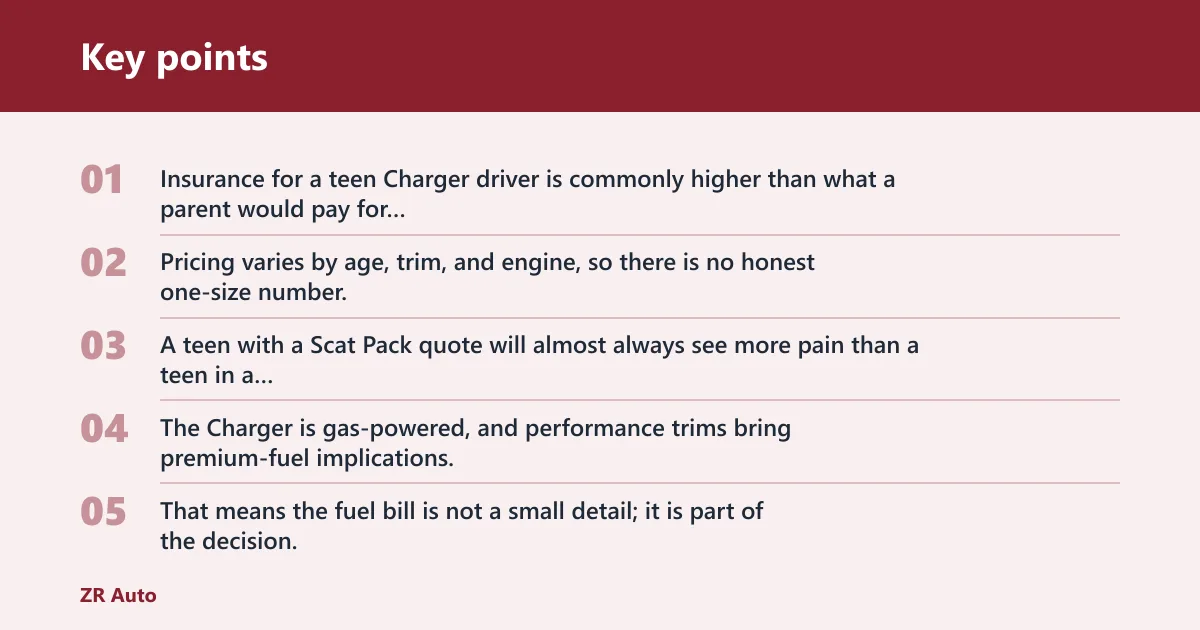
Insurance for a teen Charger driver is commonly higher than what a parent would pay for a smaller sedan. Pricing varies by age, trim, and engine, so there is no honest one-size number. A teen with a Scat Pack quote will almost always see more pain than a teen in a lower-output vehicle, and a newer driver often pays the most.
Fuel and premium gas
The Charger is gas-powered, and performance trims bring premium-fuel implications. That means the fuel bill is not a small detail; it is part of the decision. A teen who drives to school, work, practice, and weekend plans can burn through a tank faster than expected, especially with a heavier right foot.
Tires, maintenance, and tickets
Performance tires can cost more, and hard driving shortens their life. Brake wear can also rise if the car is used aggressively. Then there is the ticket risk, which is easy to ignore on paper and expensive in real life. A Charger can turn a minor habit issue into a monthly budget problem very quickly.
Suppose a parent budgets for insurance and fuel but forgets tires. The teen then needs a new set after one season of spirited driving and a few curb taps in a crowded lot. The car still runs, but the ownership math changes fast.
Frequently asked questions
Is a Dodge Charger too powerful for a new driver?
For most new drivers, yes. Even the R/T’s 420 horsepower is more than enough to punish a bad throttle input or an overconfident merge. The Scat Pack’s 550 horsepower is an even worse match for a beginner who is still learning smooth control, spacing, and wet-weather judgment.
Is a V6 Dodge Charger safer for a first car than a V8?
The current Charger lineup discussed here appears to use Twin-Turbo 3.0L SIXPACK I6 power rather than a V6. In general, lower output is easier for a new driver to manage than higher output, but safety depends on the whole package: speed, size, tires, and the driver’s habits all matter.
How much does insurance cost for a Dodge Charger teen driver?
It is usually expensive compared with typical first cars, and the final price depends on age, trim, engine, location, and driving record. A teen in a high-output trim will often face a harsher quote than one in a lower-output version, so an insurance estimate should come before any purchase decision.
Is the Dodge Charger hard to park and drive for beginners?
It can be. The approximate 206.6-inch length and 79.8-inch width make it harder to slot into tight spaces than a smaller car. Beginners may also struggle more with curb distance, turning radius judgment, and sight-line placement in crowded school or grocery lots.
Should I buy a used Dodge Charger as a first car?
Only if you inspect it carefully and accept the risk of prior abuse. Used Chargers can hide hard launches, uneven tire wear, curb damage, and aftermarket modifications. A parent should check accident history, tire condition, brake feel, and whether the car has been tuned or altered.
What should parents check before giving a teen a Dodge Charger?
Start with the insurance quote, then check tire cost, fuel budget, parking fit, and speeding-ticket risk. The teen should also demonstrate calm driving in wet conditions, smooth braking, and safe passenger behavior. If any of those checks fail, a smaller car is the better first choice.