How Much Does a Dodge Durango Cost to Own Per Year?
A Dodge Durango typically costs about $10,000 to $16,000 a year to own once you include depreciation, fuel, insurance, maintenance, repairs, and fees. That range is a planning estimate, not a guarantee, and the biggest swing factors are model year, mileage, trim, and local pricing. Source note: the total below is built from line-item assumptions rather than a single national average.
Dodge Durango ownership cost
The Dodge Durango is a three-row SUV that has been in production since 1998, so shoppers are comparing a long run of model years, engine choices, and trim levels. Annual cost is usually driven by depreciation, fuel, insurance, maintenance, repairs, and registration, and those buckets move in different directions depending on how old the SUV is and how many miles you drive.
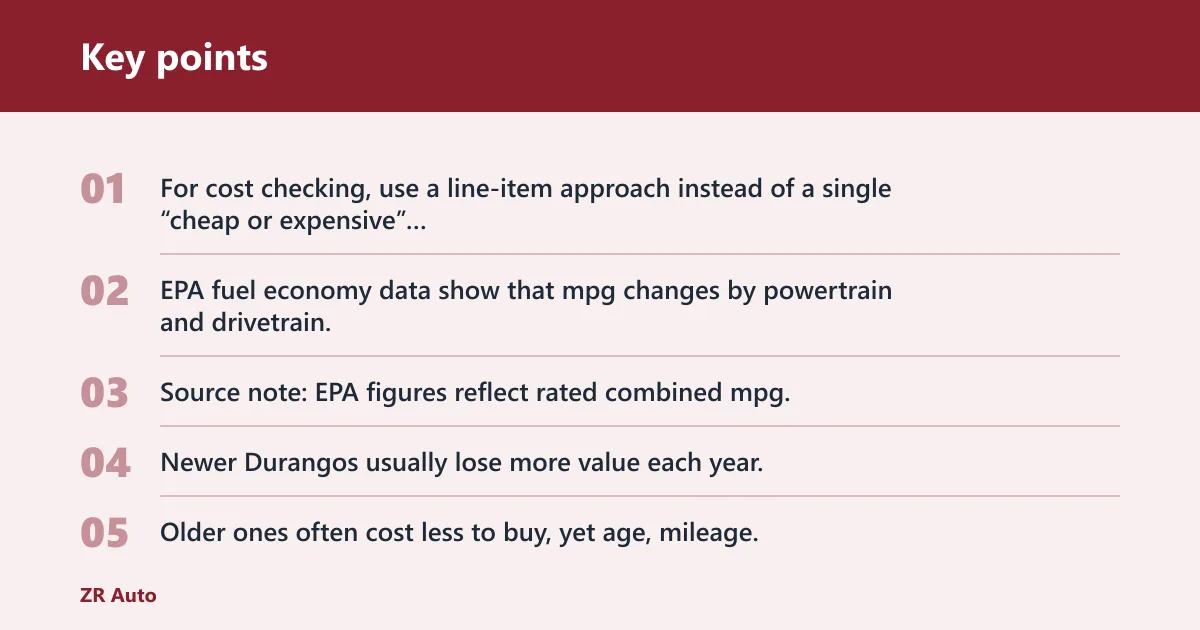
For cost checking, use a line-item approach instead of a single “cheap or expensive” label. EPA fuel economy data show that mpg changes by powertrain and drivetrain; the NHTSA crash-rating database changes by model year and test coverage; and insurance and repair costs vary by ZIP code and vehicle value. Source note: EPA figures reflect rated combined mpg, not real-world hypermiling or worst-case city driving.
Newer Durangos usually lose more value each year, but they may need fewer repairs right away. Older ones often cost less to buy, yet age, mileage, and parts wear can push maintenance and repair bills higher. Local fuel prices, insurance rates, and labor charges can move the total a lot. Source note: depreciation below uses typical used-vehicle value-loss patterns from marketplace pricing rather than a single dealer quote.
What makes up the annual total
For budgeting, separate the Durango’s yearly cost into five buckets: depreciation, fuel, insurance, maintenance, and repairs. Registration and other annual fees should sit in a sixth bucket so they do not get buried inside the rest of the estimate.
That split matters because each line item behaves differently. Depreciation is usually the largest cost on a new vehicle, while fuel depends on mileage and pump prices. Insurance tracks vehicle value and your local market. Maintenance and repairs rise with age, trim complexity, and labor rates. Source note: the worksheet below keeps those buckets separate so you can swap in your own quotes.
Which costs change most by model year?
Model year has the biggest effect on depreciation and repair exposure. A newer Durango usually carries a higher purchase price, so the first few years bring the steepest value loss. An older Durango may look cheaper on paper, but the budget can swing the other way once wear items and age-related repairs start showing up.
Reliability also changes by year. FIXD uses scanner data from thousands of current Durangos, combines that with survey results from owners, and scores reliability on a 1 to 10 scale based on check engine lights during 12,000 miles of driving. That makes it useful for comparing one model year against another before you shop. Source note: FIXD’s score is a vehicle-health signal, not a crash-safety score.
How trim and engine choice affect the budget
Engine choice changes fuel spend first, then can affect insurance and repair risk. A larger or higher-output powertrain usually burns more fuel in mixed driving, and some trims carry a higher sticker price that can raise depreciation and insurance. More performance and more equipment often mean more money tied up in the vehicle.
Lower-mileage owners can soften the fuel hit, while high-mileage drivers feel it much more sharply. If you drive 12,000 miles a year, even a small difference in mpg can move the annual total by hundreds of dollars. The same Durango can fit one budget and miss another by a wide margin. Source note: the sample math below uses 12,000 annual miles to keep the comparison transparent.
How much does a Dodge Durango cost to own per year?
A practical Durango budget is about $10,000 to $16,000 per year once depreciation, fuel, insurance, maintenance, repairs, and fees are all counted. The low end fits an older or better-depreciated SUV with modest insurance and average mileage; the high end fits a newer, pricier, or more fuel-hungry trim. Source note: the range is a scenario band, not a fixed market average.
To reconcile that range with the worksheet below: the $6,400 total in the table is the leanest operating-only example, not the most typical all-in result for a Durango buyer. Once depreciation is set to a more realistic midrange figure for a late-model SUV, the annual total moves into the $10,000-plus zone. Source note: the worksheet is a budgeting starter, while the sample calculation is the checkable ownership estimate.
Low-cost ownership scenario
A lower-cost Durango budget can land around $10,000 to $11,500 a year if a cheaper model year, average miles, and a reasonable insurance quote line up. This scenario usually assumes a purchase that has already taken most of its depreciation hit and does not need major repairs right away. Source note: this is the “best realistic case,” not a stripped-down fantasy number.
Mid-range ownership scenario
A middle-of-the-road ownership budget often falls around $12,000 to $14,000 a year. That is where many shoppers end up once fuel, insurance, routine service, and one or two repair items are added together. It is a realistic planning number for a mid-mileage SUV in a normal market. Source note: this band is meant to match a typical driver, not a garage-kept show vehicle.
High-cost ownership scenario
A higher-cost Durango can run about $15,000 to $16,000 or more per year when depreciation is still steep, fuel prices are high, insurance is expensive, or the SUV needs frequent repairs. Bigger wheels, more powerful engines, and dense urban repair markets can all push the total up. Source note: this band assumes an expensive ownership environment, not just a bad repair month.
Sample annual calculation
Here is one transparent example using 12,000 miles per year, a 19 mpg combined rating, $3.75 per gallon fuel, $1,900 annual insurance, $1,100 maintenance, $1,200 repairs, $500 registration and fees, and $4,000 depreciation. Fuel works out to about 632 gallons a year, or about $2,370. Add the rest and the total lands near $10,770. Source note: EPA fuel economy and depreciation assumptions should be replaced with the exact trim and year you plan to buy.
| Cost bucket | Low annual estimate | Mid annual estimate | High annual estimate | Your number |
|---|---|---|---|---|
| Depreciation | $2,000 | $3,500 | $5,500 | |
| Fuel | $1,400 | $2,100 | $3,200 | |
| Insurance | $1,100 | $1,700 | $2,700 | |
| Maintenance | $700 | $1,100 | $1,700 | |
| Repairs | $900 | $1,500 | $2,400 | |
| Registration and annual fees | $300 | $500 | $800 | |
| Total annual cost | $6,400 | $10,400 | $16,300 |
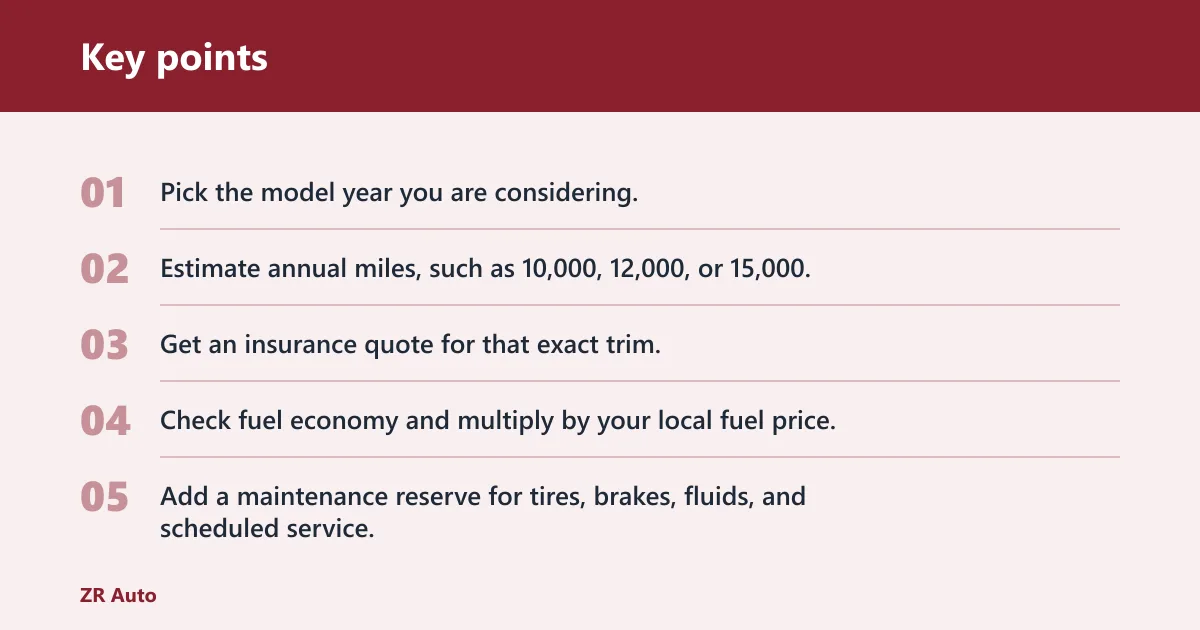
- Pick the model year you are considering.
- Estimate annual miles, such as 10,000, 12,000, or 15,000.
- Get an insurance quote for that exact trim.
- Check fuel economy and multiply by your local fuel price.
- Add a maintenance reserve for tires, brakes, fluids, and scheduled service.
- Add a repair reserve if the vehicle is older or has higher mileage.
- Include registration and any recurring annual fees.
- Total the numbers and compare them with your monthly budget.
Depreciation line item
For a new or late-model Durango, depreciation often deserves the largest share of the worksheet. A good rule is to assign a larger depreciation reserve to newer trims and a smaller one to older vehicles that have already lost more of their value. Five-year value loss is the right frame for this bucket. Source note: for late-model vehicles, use a market-value estimate rather than MSRP alone.
Fuel line item
Fuel should be estimated from your real driving pattern, not the window sticker alone. If you mostly do short city trips, the annual fuel line can climb quickly. If you drive fewer miles or pay lower local fuel prices, the line comes down just as fast. Source note: EPA ratings are a baseline; real-world use can be higher or lower depending on traffic, weather, and load.
Insurance line item
Insurance depends on the vehicle’s value, the trim, your driving record, and your local market. Higher-value Durangos and expensive zip codes tend to produce larger premiums. This is one reason two nearly identical SUVs can have very different annual totals. Source note: insurance estimates should be replaced with an actual quote for the exact VIN or trim.
Maintenance, repairs, and registration line items
CarCostBreakdown says maintenance costs depend on the car’s age and local labor costs. That matters with a Durango because older examples usually need more attention, and labor rates can be very different from one area to the next. Registration and annual fees belong in the budget too, even if they are smaller than fuel or insurance. Source note: maintenance and repair reserves should grow with mileage and age, especially after warranty coverage ends.
Which Durango years cost less to own?
Years with stronger reliability and fewer repair issues usually cost less to own, even if they are not the cheapest to buy. FIXD lists 2017-2020, 2013-2015, 2021, and 2001 among the better Durango years, while 2002-2006, 2016, 2011, and 2008-2009 are on the avoid list. That is a useful starting point, not a guarantee. Source note: the list is a shopping screen, not a substitute for a pre-purchase inspection.
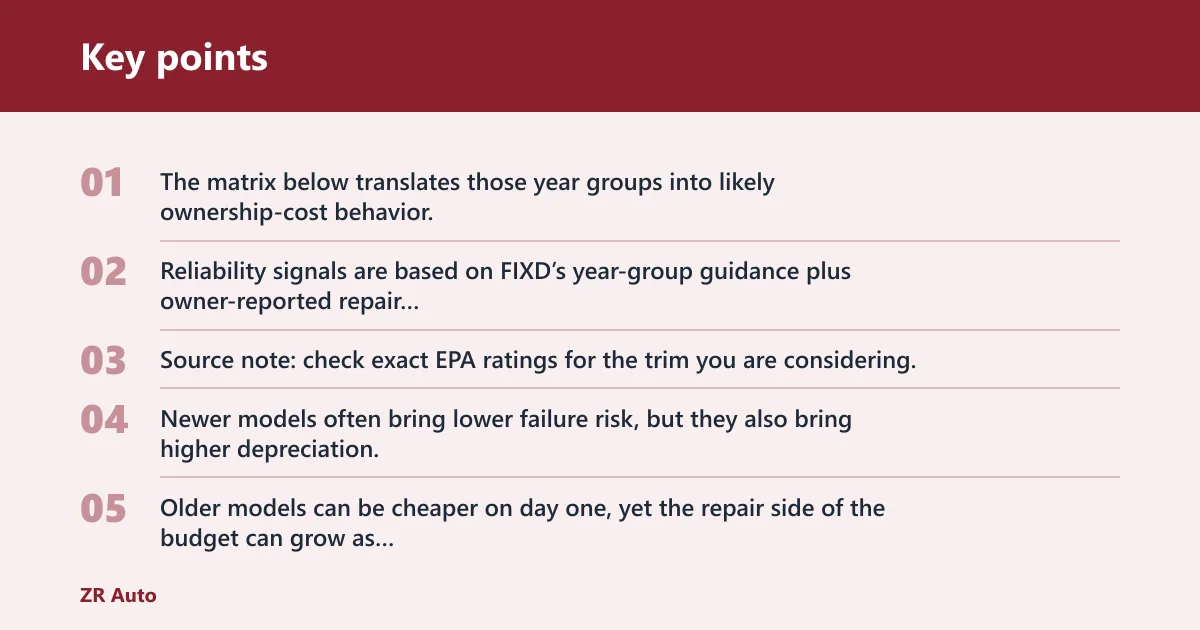
The matrix below translates those year groups into likely ownership-cost behavior. Reliability signals are based on FIXD’s year-group guidance plus owner-reported repair patterns; depreciation reflects how far each group is from new, and fuel economy is shown as a practical band rather than one exact MPG number. Source note: check exact EPA ratings for the trim you are considering.
| Year range | Reliability signals | Likely depreciation profile | Fuel-economy band | Repair-risk level | Who each year fits best |
|---|---|---|---|---|---|
| 2001 | Better Durango year in FIXD’s guidance; older platform means history matters a lot | Very low depreciation left; purchase price usually reflects age and mileage already | Older-SUV economy, often weak by modern standards | High | Buyer focused on low buy-in price and willing to budget for age-related work |
| 2002-2006 | On FIXD’s avoid list | Minimal remaining depreciation, but value can drop further if condition worsens | Older-SUV economy, often weak by modern standards | High | Only shoppers with a large repair reserve and an inspection-ready plan |
| 2008-2009 | On FIXD’s avoid list | Very low depreciation left | Older-SUV economy, often weak by modern standards | High | Budget buyers who can verify service history and tolerate repair risk |
| 2011 | On FIXD’s avoid list | Low-to-moderate depreciation left | Mid-pack for the era | High | Only if condition and service records are excellent |
| 2013-2015 | Better Durango years in FIXD’s guidance | Moderate depreciation left; often a value sweet spot | Mid-pack, depending on engine and drivetrain | Moderate | Shoppers who want a lower purchase price without going very old |
| 2016 | On FIXD’s avoid list | Moderate depreciation left, but pricing should reflect risk | Mid-pack, depending on trim | Moderate to high | Only if the price compensates for the added repair exposure |
| 2017-2020 | Better Durango years in FIXD’s guidance | Moderate depreciation left; newer used market pricing stays firmer | Mid-to-better for the class, depending on engine | Moderate | Most used-shoppers who want a modern cabin and lower age risk |
| 2021 | Better Durango year in FIXD’s guidance | Still has meaningful depreciation left because it is relatively new | Mid-to-better for the class, depending on engine | Moderate | Buyers who want newer tech but can handle depreciation |
Newer models versus older models
Newer models often bring lower failure risk, but they also bring higher depreciation. Older models can be cheaper on day one, yet the repair side of the budget can grow as parts age and wear accumulates. The cheapest purchase price is not always the cheapest year of ownership.
Reliability and repair-cost tradeoffs
The same source says some Durangos have poor value because of low reliability and high repair exposure. That matters because repair risk is not evenly spread across all years. A model year with more check engine lights and more owner-reported problems can turn a bargain into a repeat-service SUV. Source note: use reliability data to size the repair reserve, not to skip an inspection.
A common first-timer mistake is to compare two Durangos only by asking price. Picture an older SUV with a lower sticker and a younger one that costs more upfront. If the older one needs brakes, tires, and a cooling-system repair soon after purchase, the cheaper SUV can cost more within a year.
How safety ratings fit into the choice
NHTSA safety ratings should be part of the comparison because safety is part of the buying decision and can affect demand, insurance, and resale value. A stronger crash-test score does not make a Durango cheaper by itself, but it can help you decide which model year gives you the better overall package for the money. Source note: ratings vary by model year, drivetrain, and test availability.
| Year range | FIXD Reliability score | Owner Reliability score | NHTSA safety rating | Ownership-cost takeaway |
|---|---|---|---|---|
| 2001 | Better than the worst years in FIXD’s guidance | Mixed, depending on mileage and maintenance history | Check the model-year rating before buying | Cheap to buy, but only if inspection results are strong |
| 2002-2006 | Low; on FIXD’s avoid list | Lower confidence because repair history tends to matter more | Check the model-year rating before buying | Higher repair reserve needed |
| 2013-2015 | Stronger than the avoid years | More favorable than the avoid years, but still condition-dependent | Check the model-year rating before buying | Often a better balance of price and risk |
| 2017-2021 | Among the stronger Durango groups in FIXD’s guidance | Generally better for shoppers prioritizing fewer surprise repairs | Check the model-year rating before buying | Higher purchase price, but better cost predictability |
How do reliability and repair scores affect yearly cost?
Reliability scores help you estimate how much repair budget to set aside. FIXD’s 1 to 10 scale is based on check engine lights during 12,000 miles of driving, and its owner survey data add a second layer of real-world feedback. Lower scores usually mean a larger repair reserve. Source note: a weak score should increase your reserve, not stop you from comparing other costs.
FIXD reliability score
Use the FIXD score as a warning light for ownership cost, not as a stand-alone verdict. A low score suggests more trip interruptions, more diagnostic time, and a higher chance of paying for repairs sooner. That can push the annual total well above a similar Durango with a better score.
Owner reliability score
The Owner Reliability score helps round out the picture because it is based on survey data from Durango owners. That matters when you are comparing similar model years that may look fine on paper but differ in how often owners report problems, repairs, or warning lights.
Common repair categories to watch
For a Durango, the categories that most often affect budget planning are engine-related faults, electrical issues, brakes, suspension parts, cooling-system components, and wear items tied to higher mileage. Those items do not hit every SUV the same way, which is why model year and mileage matter so much.
How does the Durango compare with other SUVs?
At a high level, the Durango can cost more to own than some smaller or less powerful SUVs because it is a larger three-row vehicle with more weight, more equipment, and often more expensive tires, brakes, and insurance. It can also cost less than some premium three-row SUVs that carry higher depreciation and repair bills. Source note: compare the exact trim against direct rivals, not the whole segment.
| SUV | Maintenance tendency | Fuel-cost tendency | Insurance tendency | Overall ownership-cost positioning |
|---|---|---|---|---|
| Dodge Durango | Moderate to higher than many non-performance three-row SUVs | Moderate to high, depending on engine | Moderate to high, especially on pricier trims | Middle to upper-middle of the class |
| Chevrolet Traverse | Moderate | Moderate | Moderate | Usually lower than performance-oriented three-row SUVs |
| Toyota Highlander | Usually lower tendency | Lower to moderate | Moderate | Often one of the lower-cost mainstream three-row choices |
| Ford Explorer | Moderate to higher | Moderate to high | Moderate to high | Often close to the Durango, depending on trim |
| Jeep Grand Cherokee L | Moderate to higher | Moderate to high | Moderate to high | Often similar to or above the Durango on total cost |
Maintenance cost at a high level
Compared with many midsize crossovers, a Durango usually sits higher on maintenance spend because of size and engine choices. Compared with some full-size luxury SUVs, it may look better on routine service but still lose ground if the trim is expensive or the repair history is poor.
Fuel economy and insurance differences
Fuel and insurance are where many comparisons separate quickly. If another SUV uses less fuel and costs less to insure, the annual total can fall even if the purchase price is similar. If the Durango carries a stronger engine or higher value trim, those two buckets can move in the opposite direction.
When a different SUV may cost less to own
If your priority is the lowest possible annual bill, a simpler, smaller SUV may be the better fit. If you need three rows and want the Durango’s layout, compare the exact model year, engine, and trim instead of assuming every large SUV will cost about the same. Local prices and your driving habits still change the final number.
Frequently asked questions
How much does it cost to own a Dodge Durango per year?
A Dodge Durango usually costs about $10,000 to $16,000 per year to own. The biggest swing factors are depreciation, fuel, insurance, maintenance, and repairs. Higher mileage, a pricier trim, or local labor costs can push the total toward the top of that range.
What is the biggest cost of owning a Dodge Durango?
Depreciation is usually the biggest cost on a newer Durango. That is especially true in the first five years, when value loss can outpace fuel, insurance, and maintenance combined. On older vehicles, repairs and maintenance can take a larger share of the annual budget.
Which Dodge Durango years have the lowest ownership costs?
The lower-cost years usually combine better reliability with lower repair exposure.
How do insurance, fuel, and repairs affect Durango ownership costs?
Insurance depends on the vehicle’s value and your market, fuel depends on mileage and local prices, and repairs depend heavily on age and reliability. A Durango with average fuel spend can still be expensive if insurance is high or the model year has more known repair exposure.
Is a newer Dodge Durango cheaper to own than an older one?
Not always. Newer Durangos may need fewer repairs early on, but they usually cost more in depreciation and often more in insurance. Older Durangos can be cheaper to buy, yet higher mileage and worn parts can raise maintenance and repair costs fast.
How does the Durango compare to other SUVs on maintenance costs?
The Durango tends to sit above many smaller SUVs on maintenance because of its size and powertrains, but it is not automatically the most expensive choice in the segment. A lower-cost non-luxury SUV may beat it on routine service, fuel, and insurance, especially at higher annual mileage.