Which Dodge Durango Trim Is Best to Buy Used?
For most used shoppers, the GT is the best value because it sits closest to the sweet spot on price, fuel use, and equipment. Choose an R/T if towing matters. Pick an SRT only if performance matters most. Buying the wrong trim can leave you with weak resale value, higher fuel bills, or towing gear you never use. This guide ranks the best used Durango trims by buyer type, value, towing, performance, and ownership risk.
Durango trims, engines, and used market trade-offs
Trim and engine lineup
The used Durango trim spread matters because the model spans family trims and high-output performance trims, and those differences change price, fuel use, and upkeep. The Durango is a three-row SUV with up to seven seats and 85.1 cubic feet of cargo space when the second and third rows are folded, but its packaging comes from a 2011-generation basis, so it does not feel as space-efficient as newer rivals.
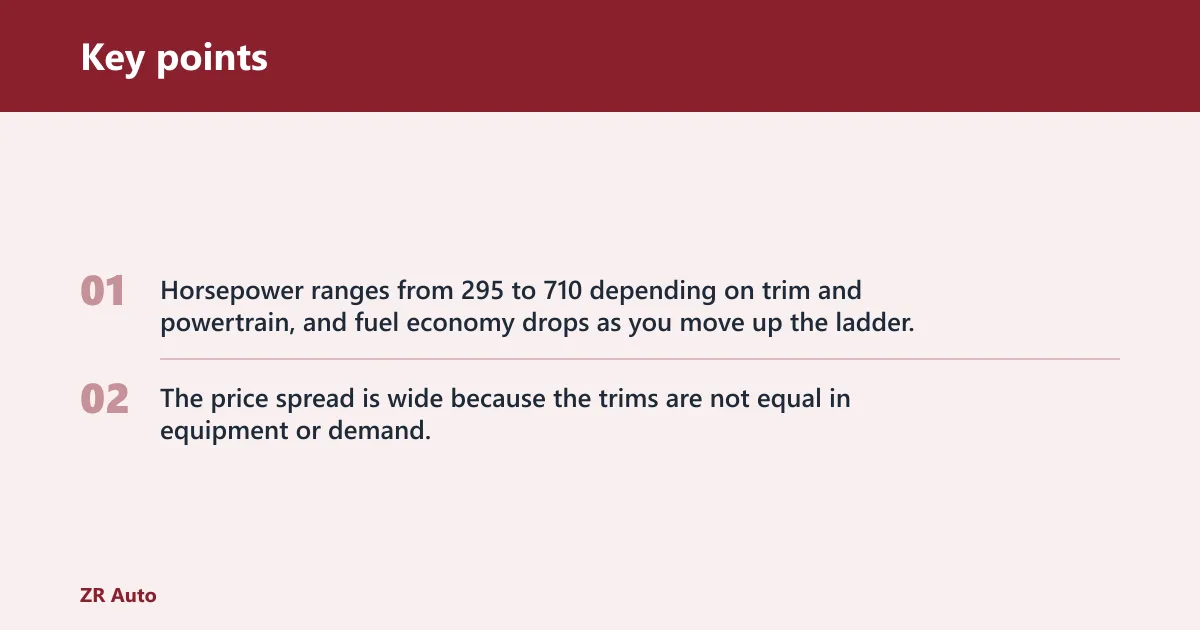
On the used market, common Durango trims to know can include GT with the 3.6L Pentastar V6, GT HEMI and R/T with the 5.7L HEMI V8, SRT with the 6.4L HEMI V8, and SRT Hellcat with the 6.2L supercharged HEMI V8. Horsepower ranges from 295 to 710 depending on trim and powertrain, and fuel economy drops as you move up the ladder.
The price spread is wide because the trims are not equal in equipment or demand. GT models are usually the entry point, GT HEMI and R/T sit in the middle, and SRT and Hellcat examples command the biggest premium on used lots because they are harder to find and far more expensive to run.
Which Dodge Durango trim is the best value used?
For most used buyers, the GT is the best used value because it gives you the Durango shape, three rows, and better fuel economy without stepping into V8 fuel and maintenance costs. If you need stronger towing or want the extra torque of a V8, the R/T is the smarter step-up than the higher-output SRT or Hellcat.
Best value for families
Buy the GT if your main job is school runs, road trips, and weekly errands. The 3.6L Pentastar V6 returns 20 combined mpg, which helps with operating cost, and the Durango still offers available three-zone climate control, Apple CarPlay, Android Auto, and optional wireless charging on the right build.
Best value for towing
The R/T is the better used value for towing because it pairs the 5.7L HEMI V8 with stronger torque and a more muscular feel under load. A properly equipped Durango can tow up to 8,700 pounds, and the Tow N Go package is the setup to seek when towing is a real priority.
Best value for performance
The SRT is the practical ceiling for many enthusiast buyers. It adds serious speed without the Hellcat’s extreme fuel use and ownership cost, but it still belongs in the enthusiast lane, not the family-value lane. The Hellcat is for buyers who want the top number, not the best deal.
Durango trim decision matrix
This table ranks the major used Durango trims on the factors that matter most in the used market. Higher scores mean better value for that category, while lower scores mean more cost, more fuel use, or more maintenance intensity.
| Trim | Purchase price | Expected fuel cost | Towing strength | Feature content | Risk / maintenance intensity | Best fit |
|---|---|---|---|---|---|---|
| GT | 5 | 5 | 3 | 3 | 4 | Budget family use |
| GT HEMI | 3 | 3 | 4 | 4 | 3 | Balanced V8 choice |
| R/T | 3 | 3 | 5 | 4 | 3 | Towing with comfort |
| SRT | 2 | 2 | 4 | 5 | 2 | Performance buyer |
| SRT Hellcat | 1 | 1 | 4 | 5 | 1 | Collector-level enthusiast |
Budget family recommendation: Buy the GT unless a specific used example has the options you want and a clean history. It is the easiest trim to justify because it keeps fuel cost lower and avoids the repair exposure that comes with the bigger V8s.
Towing recommendation: Buy an R/T or a well-equipped GT HEMI, then check for the tow package and axle ratio before you decide. The trim badge matters less than the actual equipment on the sticker.
Performance recommendation: Buy the SRT only if acceleration is the reason for the purchase. If the goal is occasional family hauling with a fast feel, the R/T is the better compromise.
How the engines compare
The 3.6L V6 is the best fuel-economy choice, the 5.7L HEMI is the balanced V8, and the 6.4L and supercharged 6.2L are for shoppers who put speed first. The 3.6L Pentastar V6 returns 20 combined mpg, the 5.7L HEMI V8 returns 16 combined city/highway mpg, and the supercharged 6.2L HEMI V8 gets 12 combined city/highway mpg.
3.6L Pentastar V6
This is the sensible engine for most used buyers. It gives you the lowest fuel cost in the lineup, and at 295 horsepower it provides enough pull for commuting, family duty, and light towing. If you do not need a V8 badge or extra torque, this is the cleanest ownership choice.
5.7L HEMI V8
The 5.7L HEMI is the middle ground. It costs more to fuel than the V6, but it gives the Durango the stronger low-end pull many buyers want for towing and passing. For used shoppers, this is often the sweet spot if you want real V8 character without stepping into SRT-level expense.
6.4L HEMI V8 and Hellcat
The SRT’s 6.4L HEMI and the Hellcat’s supercharged 6.2L HEMI are enthusiast engines first. The 6.4L adds a major jump in output, while the Hellcat is the top-end option at 710 horsepower. Both make the Durango far more expensive to fuel and more expensive to keep in top shape over time.
Does AWD come on every used Durango?
No. AWD is not standard on every used Durango trim, so you need to check the exact powertrain and listing before you buy. Some trims are available in RWD or AWD form, and the right choice depends on snow traction, towing needs, and whether you want the extra driveline weight and cost.
RWD versus AWD tradeoffs
RWD often makes sense if you want a simpler driveline and do not need all-weather traction. AWD helps in rain, snow, and on loose ramps or boat launches, but it can add weight and sometimes slightly reduce fuel economy. For used shoppers, the tradeoff is traction versus running cost.
Which trims get AWD?
Availability changes by model year and trim, so confirm each vehicle separately. In broad terms, GT models are commonly seen with either drivetrain, while V8 trims may also appear in AWD or RWD forms depending on configuration. The safest move is to treat the window sticker or listing equipment as the final word.
-
Check the drivetrain first.
If you live where winter roads matter, prioritize AWD on the exact listing. If you do not need it, do not pay for it just because it sounds more capable.
-
Match the engine to the job.
Choose the V6 for lower running cost, the 5.7L HEMI for towing and stronger midrange pull, and the SRT or Hellcat only if the performance cost is acceptable.
-
Verify the tow hardware.
A proper tow setup matters more than a badge. Look for the package content that supports the weight you plan to pull, especially if you are near the upper limit.
Towing and towing packages
The Durango can tow up to 8,700 pounds when properly equipped, but that figure depends on the right engine and the correct tow hardware. MotorTrend also notes the Durango can tow up to 8,700 pounds with the Tow N Go package, which is the setup most towing-focused shoppers should seek first.
Which used Durango trim has the best towing setup?
The R/T with the right tow package is usually the best overall towing choice because it balances muscle, cost, and drivability. The GT can tow well when properly equipped, but the V8’s extra torque makes the R/T the better match if you pull near the limit with any regularity.
Say your trailer is 6,000 pounds and you use the Durango mainly on weekends. The R/T makes more sense than a Hellcat, because the extra power of the Hellcat does not improve the ownership math nearly as much as a strong but less expensive V8 setup does.
What matters more than trim for towing
Look at the full equipment list, not just the badge. Tow package content, axle gearing, tires, and cooling hardware matter more than a trim name alone. A lower trim with the right equipment can be a better tow buy than a fancier one without it.
Features that change by trim
The Durango’s cabin content changes a lot by trim, and used shoppers should focus on the features they will actually use. The key items to look for are the 10.1-inch touchscreen, Apple CarPlay, Android Auto, three-zone climate control, and available wireless charging.
Interior and infotainment
Higher trims usually bring more convenience content and a better-looking cabin, but the basics matter most on the used market. A large touchscreen and smartphone integration are the big day-to-day wins, while wireless charging is a nice extra rather than a must-have.
Safety and driver assist
The 2026 Durango includes standard blind spot monitoring with rear cross path detection, and optional AEB and lane departure warning are part of the broader driver-assist picture shoppers should look for on used examples. NHTSA gives the Durango an overall rating, which is the baseline reference point buyers should check for the model year they are considering.
Seating and cargo packaging
The Durango seats up to seven people in three rows, but the old platform means the third row and cargo area are not as flexible as in newer designs. Maximum cargo capacity is 85.1 cubic feet with the second and third rows folded, which is useful, but the package still feels older than newer three-row SUVs.
Which used Durango should you avoid?
Avoid the highest-output trims if your goal is low risk, lower fuel cost, and simpler ownership. The SRT and especially the Hellcat bring more speed, but they also bring bigger repair exposure, pricier tires and brakes, and much worse fuel bills. For most buyers, those trims are poor value unless performance is the point.
Higher-risk performance trims
The SRT and Hellcat are best viewed as enthusiast purchases. They are not the trims to buy if you want a cheap three-row family SUV, and they are not the trims to buy if you are already worried about long-term repair cost. Their market demand is strong, but that does not make them the right used buy for everyone.
What to prioritize instead
If you want lower repair risk, focus on the GT or, at most, a clean R/T with documented maintenance and the equipment you actually need. You will give up some straight-line speed, but you will usually get a better ownership balance and a more rational fuel bill.
A common used-shopper mistake is choosing the highest trim just because it looks the most luxurious, even when a lower trim has the features that matter most. A V8 Durango with mismatched tires, missing tow hardware, and a high-mileage history can cost more to own than a newer GT with the options you actually want.
Frequently asked questions
Is a used Durango GT or R/T better?
The GT is better for budget-minded family use, while the R/T is better if towing, passing power, or V8 character matter more. The R/T costs more to buy and fuel, so it only wins if you will actually use the extra capability.
Is the SRT worth buying used?
The SRT is worth buying used only if performance is the main reason you want a Durango. It adds major speed and feature content, but it also brings higher fuel cost and more expensive upkeep. For family use or towing on a budget, the R/T is the better answer.
Which Durango trim has the best fuel economy used?
The GT with the 3.6L Pentastar V6 has the best fuel economy in the lineup at 20 combined mpg. That makes it the smartest choice for buyers who care more about ownership cost than V8 torque or straight-line speed.
Does AWD come on every used Durango trim?
No. AWD is not standard on every Durango trim, and some used examples are RWD. Check the listing and build sheet for the exact vehicle, because drivetrain availability changes by trim and model year.
How much does a used Durango trim affect insurance and fuel costs?
Trim choice can change both costs quite a bit. V6 models usually cost less to fuel and often cost less to insure than high-output V8s, while SRT and Hellcat models tend to carry the highest running costs. The bigger the engine and the higher the output, the more the ownership bill usually rises.