How Long Does a Dodge Grand Caravan Last?
A Dodge Grand Caravan commonly reaches about 150,000 to 200,000 miles, and a well-maintained one can go farther if transmission, cooling, and suspension repairs stay ahead of wear. Skip those systems, and even a cheap high-mileage van can turn into repeat repair bills faster than its resale value drops. This guide breaks down mileage tiers, common failure points, and the repair math that tells you when to keep or replace it. The mileage range is consistent with owner-reported durability patterns and the fact that the Grand Caravan was subject to multiple safety and reliability-related campaigns over its run, including NHTSA recalls and complaint trends that often cluster around powertrain and electrical concerns rather than simple odometer age alone. NHTSA NHTSA
Grand Caravan lifespan: Mileage and what to expect
What lifespan means for a minivan
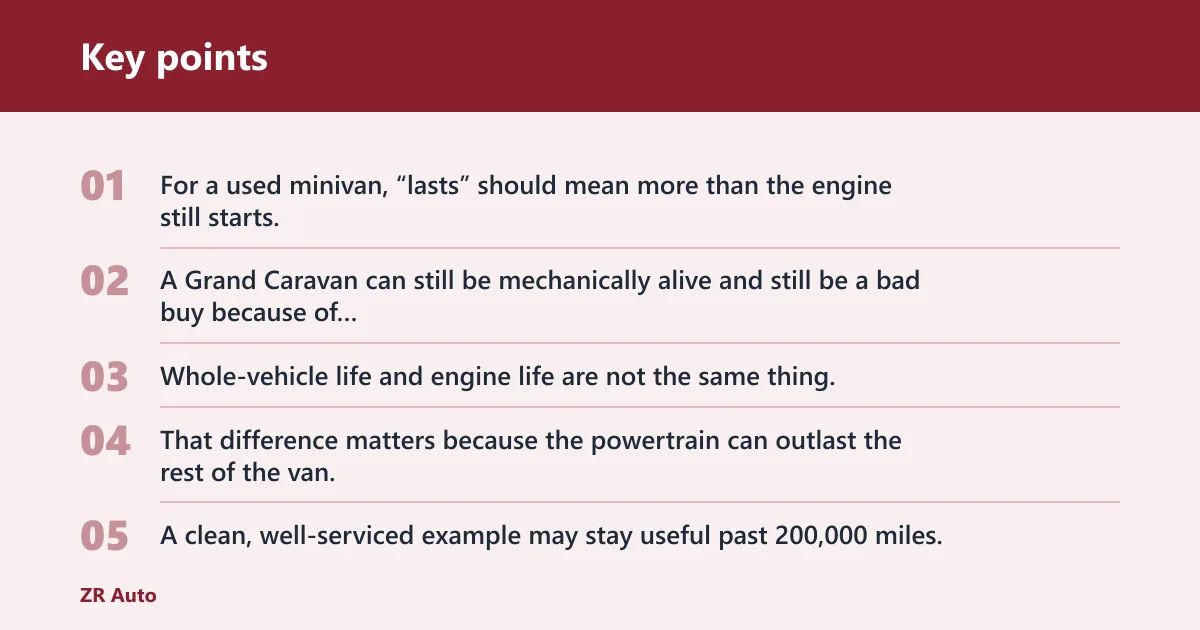
For a used minivan, “lasts” should mean more than the engine still starts. A Grand Caravan can still be mechanically alive and still be a bad buy because of transmission slip, rust, worn rear suspension, or body corrosion that makes the van hard to trust. Whole-vehicle life and engine life are not the same thing.
That difference matters because the powertrain can outlast the rest of the van. A clean, well-serviced example may stay useful past 200,000 miles. A neglected one can feel finished at 120,000 miles if it needs a transmission, front-end work, and cooling repairs at the same time.
A van can feel fine on a short test drive and still have a tired valve body or worn transmission mounts that only show up under load or after heat soak. That diagnostic detail matters more than the odometer when you are deciding whether the van is a keeper.
Typical mileage and year range
With regular maintenance, many Grand Caravans make it past about 150,000 miles, and some reach around 200,000 miles or more. In years, that often means roughly 10 to 15 years of service for average use, sometimes longer for low-mileage family hauling. Severe rust or poor service history can cut that span sharply. Repair surveys and owner complaint patterns also show that durability is heavily affected by maintenance and corrosion exposure rather than mileage alone. RepairPal CarComplaints
The answer also depends on use. A van that spent years on short suburban trips may have more wear than its odometer suggests. A highway-heavy example with fluid changes, brake work, and corrosion control often ages better, even at higher mileage.
Why maintenance history changes the answer
Maintenance history is the main divider between a usable high-mileage van and a money pit. Oil changes protect the engine, transmission fluid service protects the gearbox, and cooling-system care helps prevent heat-related damage. Miss those items, and a higher-mileage van becomes expensive before the body wears out.
A service record also shows whether previous owners dealt with wear early or waited until a failure forced repair. That difference matters more than trim level, badge, or the idea that all vans of the same model age the same way.
What mileage does a Grand Caravan reach?
At 100,000 miles, a Grand Caravan is usually in the early-wear stage. At about 150,000 miles, it enters major service territory where transmission, suspension, and cooling repairs may become more likely. At about 200,000 miles, condition and repair history matter far more than the odometer alone. By 250,000 miles, only unusually solid examples remain rational to keep.
100,000 miles: early wear check
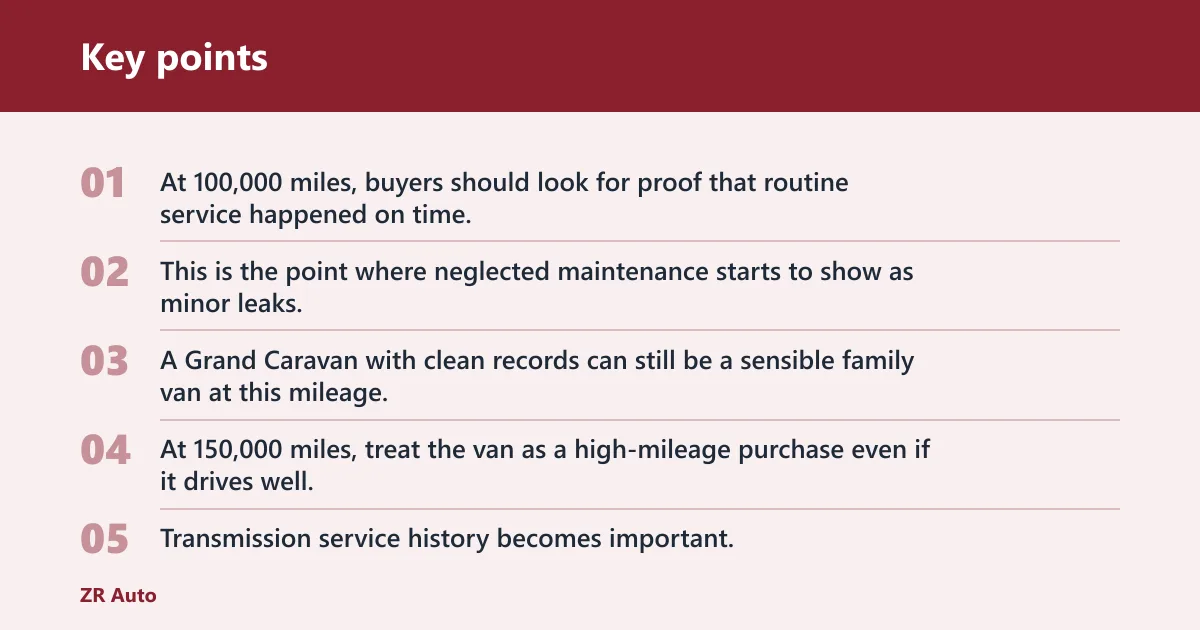
At 100,000 miles, buyers should look for proof that routine service happened on time. This is the point where neglected maintenance starts to show as minor leaks, tired mounts, worn struts, and brake wear. A Grand Caravan with clean records can still be a sensible family van at this mileage.
150,000 miles: major service territory
At 150,000 miles, treat the van as a high-mileage purchase even if it drives well. Transmission service history becomes important, and you should expect some combination of brakes, suspension parts, cooling components, and possibly wheel bearings or tie-rod wear. A clean van can still be worth keeping if the repairs are normal and spaced out.
200,000 miles and beyond: keep-or-skip test
At 200,000 miles, the key question is not whether the van runs. It is whether the next likely repairs are smaller than the value of a replacement van. If the transmission is healthy, the engine has stable compression, and the body is not rusted through, a Grand Caravan can still serve. If major systems stack up, replacement often makes more sense.
Grand Caravan mileage decision table
| Mileage tier | Inspection priorities | Likely wear items | Keep or skip signal |
|---|---|---|---|
| 100,000 miles | Service records, fluid condition, brake pad and rotor wear, strut leaks, rust at pinch welds and subframes | Battery, tires, brakes, sway bar links, control-arm bushings | Keep if records are complete and no major leaks or rust are present |
| 150,000 miles | Transmission shift quality, cooling system condition, suspension looseness, exhaust corrosion, underbody rust | Transmission service items, water pump, thermostat, shocks or struts, wheel bearings | Keep if the transmission is sound and repair bills are still ordinary maintenance |
| 200,000 miles | Compression signs, oil use, transmission slip, rust around suspension mounts, steering play | Engine seals, mounts, transmission repairs, steering parts, larger brake jobs | Keep only if the van is structurally solid and the next repairs are limited |
| 250,000 miles | Frame and underbody corrosion, gearbox history, engine oil consumption, repeated repair pattern | Major drivetrain work, repeated suspension repairs, corrosion-related failures | Buy only as a cheap utility van; keep only if repair costs stay low and body rust is controlled |
Which Grand Caravan years last longest?
Later Grand Caravan years with the 3.6L Pentastar V6 are usually the safer bet, especially when service records are strong and transmission care is documented. Earlier generations can still last, but they often carry more age-related risk, and some model years deserve extra caution because of transmission, electrical, or wear-related issues.
Generation differences that matter
Older Grand Caravans used different V6 engines, including earlier 3.3L, 3.8L, and 4.0L variants depending on generation and trim. Those engines can last well, but age, cooling-system condition, and parts wear matter more now than the original mileage number. The later 3.6L Pentastar V6 is the common reference point for newer vans and is generally the better known of the group.
Better years versus higher-risk years
For longevity, the safer choices are usually the 2011-2016 Grand Caravan years with the 3.6L Pentastar V6 and complete maintenance records. The 2008-2010 years can still be decent buys, but they are more sensitive to age, service gaps, and wear-related repair stacks. Risk rises when a van lacks records, has multiple owners, or shows signs of deferred repair. A lower-mileage van with poor care can be worse than a higher-mileage one with complete service history.
Picture two vans with the same odometer reading. One has oil changes, transmission service, and recent brakes. The other has no records and a slipping transmission. The first van is the more durable buy, even if the second looks cleaner on the lot.
Mid-cycle updates that affect durability
Mid-cycle updates can matter because they often bring revised components, software changes, and small fixes to known weak points. For shoppers, that means later production years within a generation are often easier to live with than the earliest ones. The best approach is still to compare records, not rely on model-year reputation alone.
What usually shortens its life?
Transmission wear, engine neglect, rust, and suspension damage shorten a Grand Caravan’s life faster than mileage alone. Missed oil changes, overdue transmission service, clogged cooling passages, and salted-road corrosion all stack up. A van can still run while becoming too expensive to trust for family hauling or daily use.
Transmission wear and missed service
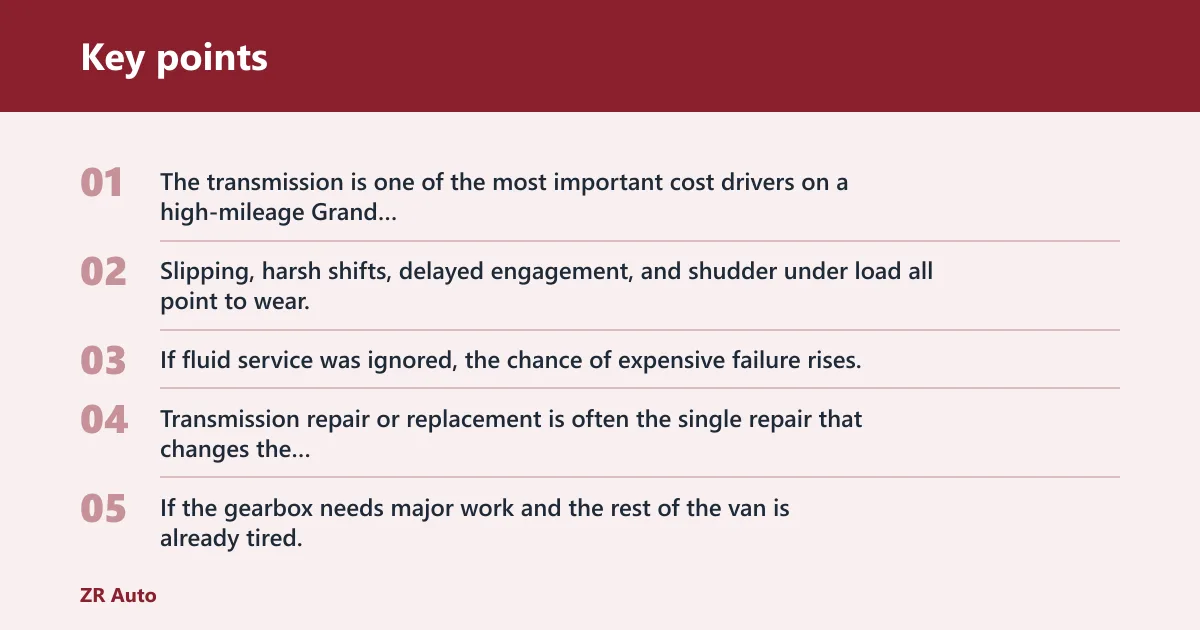
The transmission is one of the most important cost drivers on a high-mileage Grand Caravan. Slipping, harsh shifts, delayed engagement, and shudder under load all point to wear. If fluid service was ignored, the chance of expensive failure rises, and that can end the van’s useful life before the engine does.
Transmission repair or replacement is often the single repair that changes the keep-or-skip answer. If the gearbox needs major work and the rest of the van is already tired, the economics usually favor replacement.
Engine wear, oil use, and compression concerns
The engine can last a long time, but wear shows up in oil consumption, rough idle, leaks, and weak compression. The 3.6L Pentastar V6 is generally durable when serviced on time, yet any high-mileage engine should be checked for oil use and signs of neglected cooling maintenance. Older V6 variants need the same scrutiny, just with more age on the parts.
A common first-timer mistake is to judge the van by how smoothly it idles in a parking lot. A better check is whether it starts cleanly hot and cold, holds stable temperatures, and shows no oil smoke, coolant loss, or transmission flare on the road.
Rust, suspension, brakes, and cooling-system neglect
Rust is a hard limit on usable life, especially in salted regions. Check rocker panels, rear subframes, brake lines, spring seats, and suspension mounting points. If corrosion reaches structural areas, the van may still move but no longer make economic sense.
Cooling-system neglect also matters. Overheating can shorten engine life quickly, and failed radiators, water pumps, or thermostats are not rare on older vans. Suspension and brake neglect may not kill the van immediately, but they make it unsafe and costly to continue.
When is a high-mileage van still worth it?
A high-mileage Grand Caravan is still worth it when the next likely repairs are smaller than the cost of replacing the van. If the body is solid, the transmission shifts cleanly, and the engine has no major oil or compression issues, a 180,000-mile example can be a good buy. If several major systems are failing at once, walk away.
Repair cost versus resale value
Use the repair bill against the van’s market value, not against the original purchase price. A $2,500 transmission repair can make sense on a clean, rust-free van that still has years of life. That same repair on a rusted, tired example with a leaking cooling system usually does not.
Signs the van is near end of economic life
The van is nearing end-of-life when rust is structural, the transmission shows symptoms, the engine uses oil, and the suspension needs repeated work. Multiple failing systems matter more than any single issue. If each month brings a different repair, the vehicle is done as a sensible ownership choice.
Suppose a 200,000-mile van needs tires, rear brakes, a water pump, and has fresh transmission slip. Even if each repair is individually normal, the combined total can exceed what a similar replacement van would cost to buy and register. That is the point where replacement usually wins.
When replacement beats repair
Replacement beats repair when the next round of work exceeds the van’s remaining value and reliability. A simple rule of thumb is that once a major repair is close to or above the van’s market value, you should compare that cost with the price of a better example. For a family hauler, reliability often matters more than squeezing out one more year.
What maintenance helps it last longer?
Regular maintenance can push a Grand Caravan past 150,000 miles and sometimes beyond 200,000 miles. Oil changes, transmission fluid service, cooling-system care, and brake and suspension upkeep matter most. A documented service pattern is the best sign that the van has a realistic chance at longer life.
Oil change intervals and fluid care
Follow the oil interval listed in the owner’s manual or service plan for the engine and use the correct viscosity. Clean oil helps control wear and oil consumption, especially on higher-mileage engines. Also check coolant, power steering fluid where equipped, brake fluid condition, and differential-related service where applicable.
Transmission fluid service
Transmission fluid should not be ignored until it fails. On a used Grand Caravan, proof of regular transmission service is one of the strongest ownership clues you can get. If the fluid is dark, burnt, or unknown, budget for deeper inspection before you buy.
Shifts should feel smooth and predictable. Delayed engagement, flare between gears, or a shudder under light throttle are warning signs that can become expensive fast.
Cooling system and chassis upkeep
Cooling-system maintenance protects the engine from heat-related damage. Replace weak hoses, failing thermostats, and tired radiators before they trigger an overheat event. Chassis upkeep matters too: keep brakes, shocks or struts, control arms, and steering parts in good shape so the van remains stable and safe.
In salted regions, inspect the underbody every season if possible. Surface rust is manageable. Flaking metal around mounting points, brake lines, or subframes is not.
Frequently asked questions
How long does a Dodge Grand Caravan last?
A Dodge Grand Caravan commonly lasts 150,000 to 200,000 miles with proper maintenance, and some well-kept examples go farther. The real limit depends on transmission condition, cooling-system care, rust, and how much suspension and brake work the van needs before repairs stop making economic sense.
How many miles can a Dodge Grand Caravan last?
Many Grand Caravans can reach at least 150,000 miles, and a healthy one may pass 200,000 miles. The number alone does not decide durability. Service records, rust exposure, and whether the transmission has been maintained matter just as much as the odometer reading.
What mileage is too high for a Dodge Grand Caravan?
There is no single mileage that is automatically too high. At 200,000 miles and beyond, the van becomes a condition-based buy. If the transmission, engine, and body are sound, it may still be useful. If rust and major repairs pile up, the mileage is only part of the problem.
What shortens the lifespan of a Dodge Grand Caravan?
Missed oil changes, overdue transmission service, overheating, rust, and neglected brakes or suspension shorten life quickly. Short trips and salted roads can also accelerate wear. The van’s lifespan is usually reduced by ignored maintenance and repeated major repairs more than by mileage alone.
Which model years of the Dodge Grand Caravan tend to last the longest?
Later Grand Caravan years with the 3.6L Pentastar V6 and documented maintenance are usually the best longevity bets. Earlier generations can still last, but age, rust, and parts wear increase risk. The safest choice is the van with the best records and the least corrosion.
Can a Dodge Grand Caravan make it past 200,000 miles?
Yes. A Dodge Grand Caravan can make it past 200,000 miles if the transmission is healthy, the engine has no major oil or compression problems, and the body is not badly rusted. At that point, the question becomes whether the next repairs are still cheaper than replacing the van.
What maintenance helps a Dodge Grand Caravan last longer?
Frequent oil changes, transmission fluid service, cooling-system upkeep, and timely brake and suspension repairs help the most. A clean service history is the best sign that the van can keep going. For buyers, that history is often more important than trim level or advertised mileage.